True hourly wage: count every hour you work
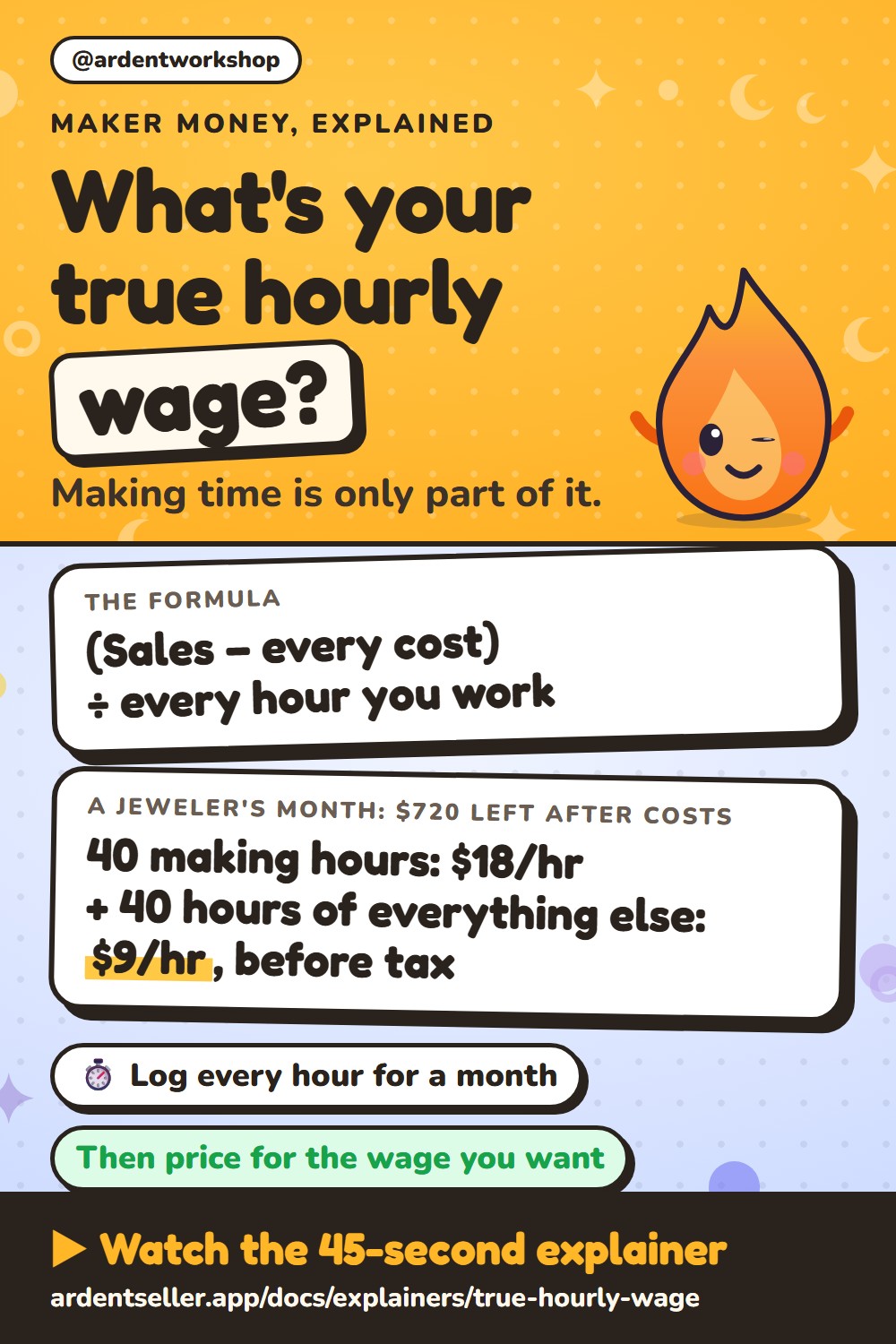
True hourly wage: what your business leaves you, divided by every hour it takes. An example jeweler keeps $720 a month: $18 an hour for 40 making hours, $9 before tax for all 80.
Your true hourly wage is what your business leaves you after materials, packaging, selling fees and overhead, divided by every hour the business takes, not only the hours spent making. This short works it through with an example jeweler’s month: say $720 is left after costs. That looks like $18 an hour over 40 hours of making, but adding 40 hours of photos, listings, messages, packing and shipping brings it to $9 an hour, before tax. That is close to the $7.25 federal minimum wage and below many state minimums. To find your own number, log every hour for a month, then price for the wage you want.
Watch on YouTube Shorts (opens in new tab)
The whole idea on one card
New explainers drop on our socials
Follow @ardentworkshop for more maker explainers.
Go further
- Glossary: True Hourly Wage
- Read: The True Hourly Wage of a Maker Business: What Your Hour Is Really Worth
- Read: 15 Numbers Every Maker Should Be Able to State From Memory
- Read: Knitting and Crochet Business Math: Pricing Handmade Garments When Yarn Costs $40 a Skein and Every Hat Takes Six Hours
- Read: Against the "Just Charge More" School of Pricing Advice
- For Jewelry Makers
- For Fiber Artists
- For Etsy Shop Owners
- Guide: Start a jewelry business
- Guide: Start a crochet business
- Guide: Start an Etsy shop
Transcript
Hook
What’s your true hourly wage? Making time is only part of it.
Definition
It’s what your business leaves you, divided by every hour it takes. Not just the making.
The math
Take sales, minus every cost, overhead too. Divide by all your hours: making, photos, messages, shipping.
Example
Say a jeweler’s necklaces leave $720 a month after costs. 40 hours of making: $18 an hour. Add 40 hours of everything else: $9, before tax.
Takeaway
That’s close to the federal minimum wage, below many state minimums. So log every hour for a month, then price for the wage you want.
Sources
- The federal minimum wage is $7.25 per hour: US Department of Labor, Wage and Hour Division, "Minimum Wage" (opens in new tab)
- As of November 2026, 30 states and DC set a minimum wage above $7.25; many are above $9: US Department of Labor, "State Minimum Wage Laws" (opens in new tab)
- Self-employed people generally owe self-employment tax (15.3% for Social Security and Medicare) on most net self-employment earnings, so profit per hour before tax overstates what is kept: IRS, "Self-employment tax (Social Security and Medicare taxes)" (opens in new tab)
- A maker’s true hourly wage starts from what is left of the selling price after materials, packaging, channel fees and overhead (the post divides that by hands-on hours per product and adjusts for self-employment tax; its FAQ adds that unpaid admin hours belong in the count too): Ardent Seller blog, "The True Hourly Wage of a Maker Business" (opens in new tab)
Minimum wage figures are US rates as of November 2026. General education, not tax advice.
Last updated .