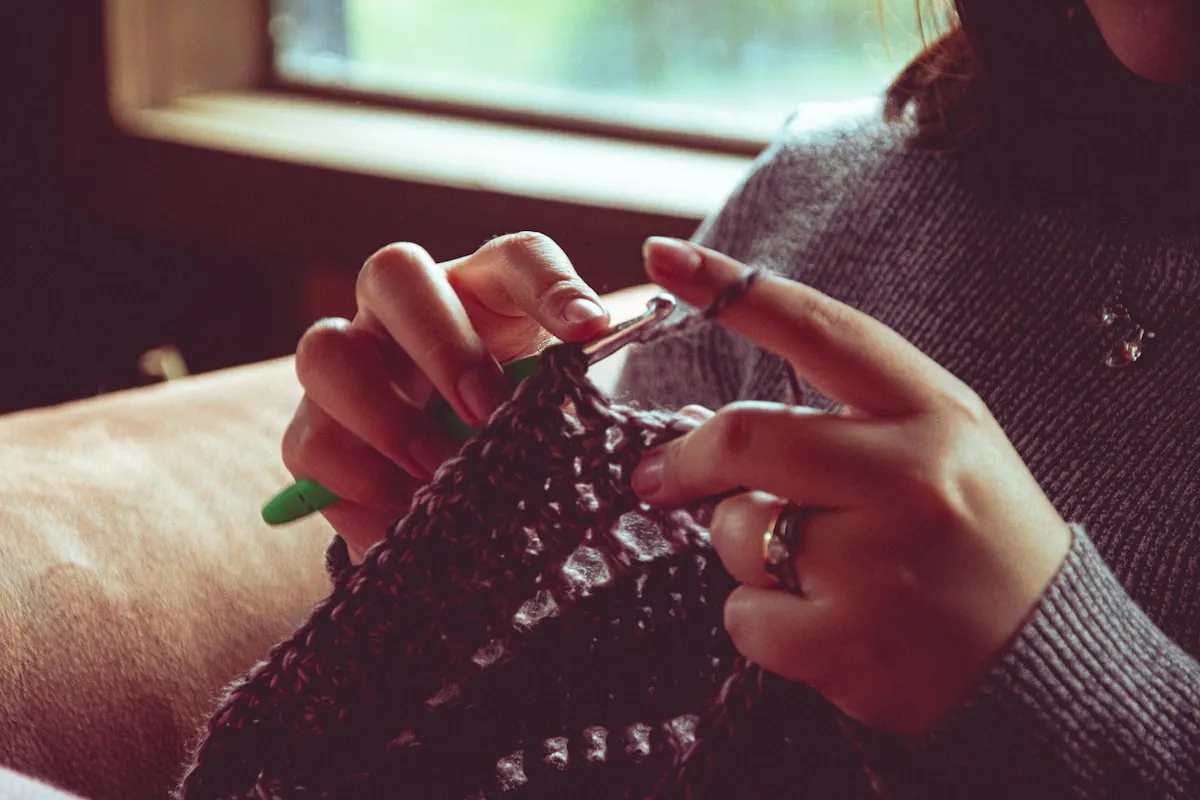
The yarn is the cheapest part of a hand-knit hat.
That is not a feel-good lecture about the value of your labor. It is the math. A $25 skein, six hours of work, an Etsy listing at $42 — the yarn is 60% of the listing price, the maker is paying themselves $2.83 an hour, and the platform fee, the shipping label, and the new pair of bamboo needles that snapped halfway through aren't even in the equation yet. Every hat sold loses money. The maker just doesn't see it because they only ever count the yarn.
This is the trap fiber arts businesses fall into more reliably than any other craft. Knitters and crocheters are, across every craft seller community, the category most likely to apologize for their prices. And the reason isn't that customers won't pay. The reason is that the entire pricing conversation in fiber arts has been built on six myths that quietly guarantee underpricing. Let's pull them apart.
The yarn cost trap
Before the myths, here's what's actually happening.
Most knitters and crocheters started pricing the way every craft seller does: by adding up the cost of materials and adding a markup. The problem is that fiber arts have an unusually skewed labor-to-materials ratio. A potter might spend two hours on a mug worth $4 in clay. A candle maker can pour forty candles in a long evening from $30 of wax. A knitter spends six to twelve hours per hat, twenty hours per shawl, eighty hours per adult sweater. The labor is the product. The yarn is the smallest line item that goes into making it.
When you price by "materials × 3" — the formula every well-meaning craft blog has been recycling since 2009 — you get a number that works fine for products where labor is fast. For knitting, it produces prices that don't even cover minimum wage for the time spent.
The honest framing: You are not selling yarn. You are selling 6 to 80 hours of skilled handwork that happens to be wrapped around yarn. Price the handwork, then add the yarn.
The myths below all stem from getting that framing backwards.
Myth 1: "Multiply yarn cost by 3 and you have your price"
Reality: Materials × 3 is a formula built for products where labor takes 30 minutes, not 6 hours.
A toy beanie in inexpensive acrylic — say, $4 of yarn — priced at $12 by the materials × 3 rule sounds reasonable until you realize the maker spent five hours on it. That's $2.40 an hour. The same hat priced at $48 (yarn × 12, or what amounts to $8 an hour for labor plus materials) is the actually-defensible number, and it is exactly the price most knitters refuse to set because "nobody will pay it."
The materials-multiplier formula assumes the labor scales with the materials. In knitting, it doesn't. A $40 skein of hand-dyed merino doesn't take three times as long to knit as a $13 skein of Cascade 220. The labor is a function of the pattern's complexity and the yarn's gauge, not its price.
The fix is to drop the multiplier entirely and use a labor-first formula:
Price = (Hours × Hourly rate) + Materials + Overhead + Profit margin
That's it. Pick an hourly rate you'd accept doing freelance work in any other field — for context, BLS reports a May 2024 median annual wage of $56,260 (~$27/hour) for craft and fine artists (BLS OOH: Craft and Fine Artists (opens in new tab)). Track the hours honestly (next myth). Add materials at cost. Add overhead — needles, replacement notions, pattern licenses, electricity, a percentage of your shop fees. Then add 15-25% on top as profit margin, because "covering costs" is not a business, it is a hobby with extra steps. (For the general framework that this formula sits inside, recipe costing 101 walks through how to build a per-unit cost properly.)
Myth 2: "Customers won't pay for my time"
Reality: Most customers pay for time every day of their lives. They just don't pay it to you because you didn't ask.
A customer who walks into a coffee shop pays $6 for a $0.40 cup of coffee. They pay it because someone made it for them, in a clean space, with skill, on demand. They are not paying for the beans. They are paying for the hands.
The customer who buys a hand-knit shawl is the same person. They are not searching for "shawl" with the cheapest price filter on. If they were, they would buy a fast-fashion acrylic shawl at H&M for $19 and be done. They are searching for a hand-knit shawl, on Etsy or at a craft fair, because they want a thing made by hands, by a specific person, for them or for someone they love. Price is not the filter. Story and quality are.
What customers genuinely won't pay for is a price that makes no sense. A $250 hand-knit shawl with a confident, specific story — 80 hours of work, hand-dyed merino from a small mill in Vermont, pattern original to me — sells. A $250 hand-knit shawl with a vague description and a generic photo doesn't, because the customer has nothing to anchor the price to.
Rule of thumb: Underpricing doesn't make your work more attractive. It makes it less attractive. A $40 hat suggests no real labor went in. A $90 hat suggests there's a maker behind it. Customers shopping for handmade are looking for the second signal, not the first.
Myth 3: "I knit while watching TV, so the time doesn't really count"
Reality: This is the single most expensive belief in fiber arts.
Every knitter and crocheter has said it. I would be on the couch anyway. The knitting isn't really work. The math nods sympathetically and then quietly bills you for it.
Two reasons it doesn't hold up. First, the customer doesn't care where the work happened. The hat took six hours of skilled handwork to make. Whether those six hours happened in a sunny studio or in front of a Netflix series doesn't change the labor that went in or the price the market will support. Calling the time "free" is a gift you're giving the customer, and it's a gift they didn't ask for and won't notice.
Second — and this is the part that matters more — your couch hours are not actually free. They are your rest hours, your hobby hours, your time-with-your-family hours. Once you start using them as production time for paid work, you're trading personal time for income. That trade has real terms. If those six couch hours are worth nothing to you, you wouldn't miss them when they're gone. But if you're now producing four hats a week from those hours, twenty-four weekly hours of your evenings have been quietly converted to unpaid labor. That is the textbook definition of burnout, and it is a pattern fiber artist communities talk about regularly.
The fix is mechanical. Pick an hourly rate. Apply it to every hour you spend producing for paid work, regardless of where that work happens. If you'd rather knit only for fun, don't list the items. The moment a project goes up for sale, the hours are billable.
Myth 4: "My patterns are simple, so I shouldn't charge as much"
Reality: Simple patterns take less time, which already lowers the price. Don't double-discount yourself.
The labor-first formula handles this automatically. A simple stockinette beanie takes maybe four hours. A cabled aran beanie takes ten. At the same hourly rate, the cabled one already costs roughly 2.5x more. You don't need to additionally discount the simple one for being "less impressive" — the time math has already accounted for it.
What knitters and crocheters tend to do instead is take the simple-pattern hat down even further out of guilt. It's so easy, I feel weird charging $48. The customer doesn't share that guilt. To them, a hand-knit beanie is a hand-knit beanie. Plain or cabled, it's still made by hand, still takes hours, still has a maker behind it. Discounting the simple one below its labor cost trains you to associate skill with money — which means you'll only ever feel right charging fairly for your most complex work, and you'll lose money on every quick project in between.
Quick projects are how fiber businesses pay their bills between major commissions. Don't undercut them.
Myth 5: "Custom orders should cost a little more than the same thing on the shelf"
Reality: Custom orders should cost meaningfully more than shelf items, because they cost meaningfully more to deliver.
Here's what most fiber artists charge for custom: the shelf price plus $10. Or maybe a 20% bump.
Here's what custom actually costs the maker:
| Cost factor | Shelf item | Custom order |
|---|---|---|
| Production hours | Same | Same |
| Communication time | None | 30-90 minutes (consultation, approvals, photos, revisions) |
| Materials risk | Low (use whatever's on hand) | High (must source specific yarn, color, weight) |
| Sizing risk | Standard sizes | Custom measurements; mistakes mean re-knit |
| Schedule risk | None (you make when you have time) | Hard deadline (wedding, birthday, holiday) |
| Cancellation risk | Low (just relist) | High (custom = unsellable to anyone else) |
Add it up honestly and a custom order takes 30-50% more time than the equivalent shelf item, with materially higher risk on every axis. A custom shawl shouldn't be priced at "shelf price + $20." It should be priced at 1.5x to 2x shelf price, and the maker should be willing to walk away if the customer balks.
Rule of thumb: A custom order at the same price as a shelf item is a tax you are paying for the privilege of being told what to make. Stop paying it.
Myth 6: "Wholesale is impossible because my products take too long"
Reality: Wholesale is hard for fiber artists, but the reason is rarely the production time. It is that wholesale was never priced into the retail.
Most makers calculate retail first, then realize wholesale (typically 50% of retail) doesn't cover their costs, then conclude wholesale doesn't work for handmade.
What's actually happening: the retail price was too low to begin with. If a knitter's true cost on a hat — labor, materials, overhead, profit — is $52, and they retail it at $48, then wholesale at $24 is a guaranteed loss. That doesn't mean wholesale is impossible. It means retail was wrong.
Set retail correctly — labor-first formula, real hourly rate, real overhead — and wholesale at 50% becomes the same exercise it is for any other maker: a discount you can support if the order quantity, the prepaid terms, and the relationship justify it. (The wholesale pricing for handmade products post covers the keystone math and minimums in detail.) Sometimes those conditions hold. Sometimes they don't. But the answer is now a business decision, not an admission that the math doesn't work.
For most fiber artists, the wholesale conversation has to wait until retail pricing is sustainable. Fix retail first.
The numbers most fiber artists never see
Here's the part that breaks most pricing systems: even with a clean labor-first formula, you can't actually price anything if you don't know your real numbers. How long does a beanie actually take you? Not in theory — in practice, including the false starts, the gauge swatches, the Sunday afternoon you spent ripping back four rows because you miscounted a cable.
Most knitters and crocheters track hours in their head, which is to say, they don't track them at all. The mental estimate is almost always meaningfully lower than reality, because your brain quietly skips the rip-backs, the troubleshooting, and the tea breaks.
A simple production log fixes this. Every project, write down: pattern, yarn, start date, finish date, total hours (rounded honestly), and any material waste. Three months of that data and you have a real average for every product type. Layer it under a real hourly rate and the formula stops being theoretical.
This is exactly the kind of tracking Ardent Seller was built for: per-product labor tracking, yarn skein costs by weight and lot, equipment depreciation on your sewing machine or swift, and a recipe and procedure system that lets you log "this hat takes 6.4 hours and 0.85 skeins of Cascade 220" once and have it cost itself out automatically every time you make another one. If the spreadsheet you've been using to track all this is starting to feel held together with formula tape and prayers, that's a sign you're ready for something built for it.
What sustainable looks like
Sustainable pricing in fiber arts looks unfamiliar at first, because we are so used to seeing handmade pieces priced at hobby rates that the real number feels wrong.
Based on what makers commonly charge on Etsy and in maker-community discussions — a sustainable beanie is $60-90 depending on yarn and complexity. A sustainable pair of fingerless mitts is $40-60. A sustainable shawl is $180-350. A sustainable adult-sized sweater, in real numbers honoring real time, is $400-800 — which is roughly what a comparable mass-produced cashmere sweater costs at any nice department store, except yours was made by hand, by a person, for a specific customer, and it will outlast three of theirs.
Customers who want that kind of garment exist. They are not the customers who haggle over $4. They are the customers who buy two pieces a year from makers they trust and wear them for a decade. Find them. Price for them. Stop pricing for the customer who was never going to buy anyway.
Your hourly rate is yours to set. The math is yours to do honestly. The hours are yours either way. The only question is whether you're getting paid for them.
Ready to track every project, every skein, and every hour without losing it all in a notebook? Try Ardent Seller free and set up your first product in about ten minutes — yarn cost per gram, hours per pattern, and a real per-item price you can defend.
Free resources
A few free downloads from the Ardent Workshop library that pair well with this post:
- Product Pricing Calculator (Excel) — Where the labor math in this post goes to live. Drop your hours × rate into the calculator with yarn, notions, packaging, and the Etsy fee %, and the suggested retail comes back with platform fees netted out. The hardest part of fiber pricing is not undercharging labor — this is the form that makes you put the number in.
- Should I Raise My Prices? Decision Tool — A live web tool that runs the +10% / +20% / +30% price-hike math on one product — including the volume drop that comes with each — and tells you which scenario clears the most monthly profit.
- Craft Seller Startup Checklist — Pricing math, inventory cataloging, and the legal essentials (entity, sales tax, business banking) for fiber artists ready to charge what their work is worth.
- Monthly Inventory Count Sheet — A printable count sheet for yarn, finished pieces, and notions — the first habit that turns a notebook of projects into an actual stock-on-hand number.
This article is provided for educational purposes only and does not constitute financial, tax, or business advice. Cost structures, pricing examples, and margin figures are illustrative and will vary by your specific circumstances. Consult a qualified accountant or small-business advisor before making financial decisions based on this content.