Reorder point: when to buy more supplies
Your reorder point is the stock level that says “order now.” Weekly use × lead time in weeks + safety stock, worked through on a jeweler’s silver chain.
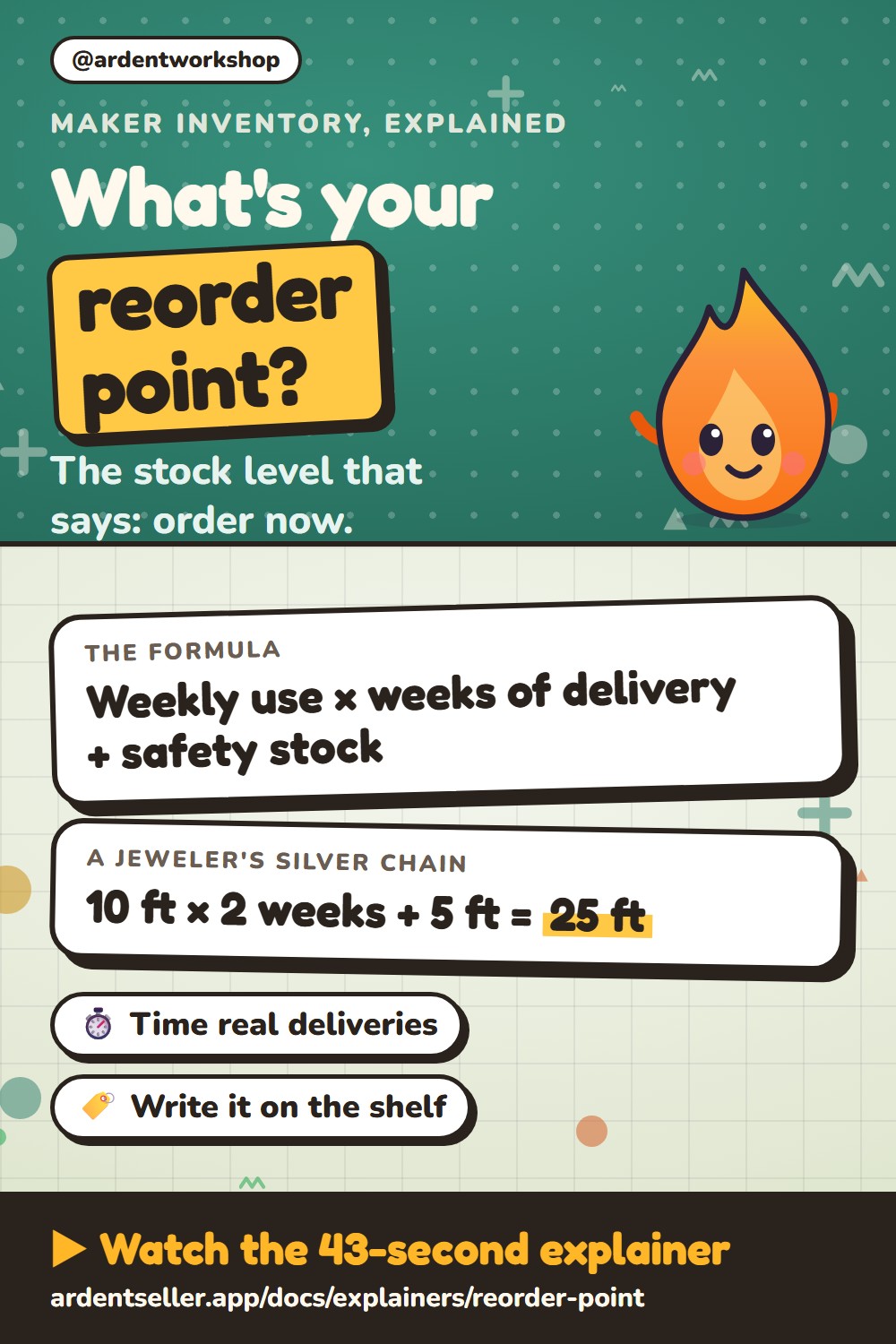
Your reorder point is how much is left on the shelf when it’s time to order more, set so new stock should arrive before the old runs out. To find it, multiply what you use in a week by your lead time: the weeks from placing an order to having it in hand, not just the shipping days. Then add safety stock, a cushion for late shipments and busy weeks. This short works through a jeweler who uses 10 feet of silver chain a week and waits 2 weeks for each order: 20 feet get used while the order is on its way, and a 5-foot cushion (half a week’s use) makes the reorder point 25 feet.
Watch on YouTube Shorts (opens in new tab)
The whole idea on one card
New explainers drop on our socials
Follow @ardentworkshop for more maker explainers.
Go further
- Glossary: Par Level (Reorder Point)
- Read: Reorder Points for Makers: How to Stop Running Out (and Stop Overbuying) With Simple Par Level Math
- Read: Inventory Management for Craft Sellers: Stop Guessing, Start Growing
- Read: Jewelry Making Math: Tracking Precious Metals, Gemstones, and Findings by the Gram
- Read: Holiday Production Calendar: A Month-by-Month Q4 Plan for Makers
- For Jewelry Makers
- For Polymer Clay Makers
- For Beekeepers
- Guide: Start a jewelry business
- Guide: Start a skincare business
Transcript
Hook
What’s your reorder point? Hint: it’s not when you run out.
Definition
Your reorder point is how much is left on the shelf when it’s time to order more. Order then, and new stock should land before the old runs out.
Formula
Take what you use in a week. Times the weeks delivery takes. Plus a cushion, called safety stock, for late boxes and busy weeks.
Example
Say a jeweler uses 10 feet of silver chain a week. Delivery takes 2 weeks, so that’s 20 feet gone while you wait. Add 5 feet of cushion. Reorder at 25 feet.
Takeaway
Time a few real deliveries, not the website’s promise. Then write the number on the shelf.
Sources
- The reorder point is average demand over the replenishment lead time plus safety stock (ROP = MX + SS); lead time runs from placing an order to receiving it: J. E. Tyworth, Basic Multi-period Inventory Systems, technical note (Penn State Smeal College of Business, SCM 810, February 2014), pp. 2 and 7, equation 2 (p. 3) (opens in new tab)
- Safety stock is a cushion to cover above-average demand and late deliveries; longer or more variable lead times call for more of it: J. E. Tyworth, Basic Multi-period Inventory Systems (Penn State Smeal, 2014), pp. 2–3, 7, 9 and 10; equations 10–11 (p. 15) (opens in new tab)
- Safety stock is extra inventory beyond what average demand during lead time needs; a reorder point lowers the chance of running out before the new order arrives but does not remove it: NC State University Supply Chain Resource Cooperative, Safety Stock Analysis (Inventory Management Models: A Tutorial) (opens in new tab)
Last updated .