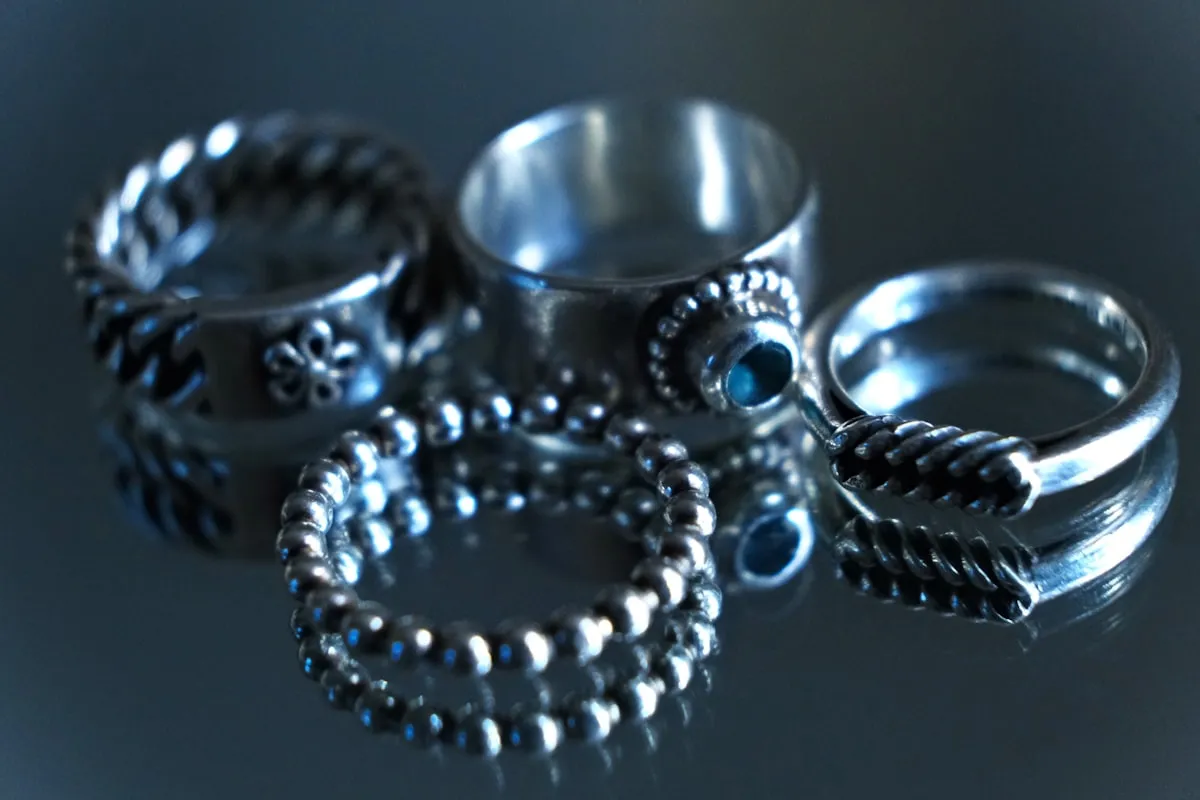
What is the most expensive material in your jewelry studio? If you said gold, you're probably wrong. It's the material you're not tracking accurately — the one where you estimate usage instead of measuring it, where you round down instead of weighing, where you assume a bag of 200 jump rings will last 200 pieces and then wonder why you're reordering at piece 140.
Jewelry making has a precision problem that no other craft shares. A baker measures flour in cups. A soap maker measures oils in ounces. You measure in grams, carats, and millimeters — units so small that rounding errors compound into real money faster than you'd expect. A 0.3-gram difference in silver wire per piece doesn't sound like much until you multiply it across 50 pieces a month for a year. At today's silver prices, that's $40-60 in untracked material. Do the same math with gold wire and it's $400-600.
This isn't about being cheap. It's about knowing your actual numbers so you can price with confidence instead of hope.
Precious Metals: Your Most Volatile Ingredient
Unlike every other craft material, precious metals are traded on global commodity markets. The silver you bought last month at $31 per troy ounce might cost $34 today. Gold swings even more — a $50 per gram shift in a single quarter isn't unusual. This means your material cost for the same ring design changes every time you buy wire or sheet.
Most jewelers handle this one of two ways, and both are wrong:
The "average it out" approach — you mentally estimate your metal costs based on some vague middle price. This works until gold drops 8% and you're still pricing pieces based on last quarter's highs, making you uncompetitive. Or it spikes 12% and you're selling at a loss without realizing it.
The "I'll just absorb it" approach — you set prices once and don't adjust them, treating metal price fluctuations as noise. This feels simpler, but you're gambling that the swings cancel out over time. They don't. Precious metal prices trend directionally for months or years. If you set your silver ring price during a dip, you might sell at a loss for an entire season before noticing.
The fix is straightforward: track your metal cost per purchase lot and calculate material cost per piece based on the actual lot you're pulling from.
Here's what that looks like in practice. You buy 100 grams of sterling silver wire at $1.05 per gram. That's a lot — call it "SS-Wire-0404." When you make a pair of earrings that uses 4.2 grams of wire from that lot, your wire cost for that pair is $4.41. When that lot runs out and you buy the next one at $1.12 per gram, the same earring design now costs $4.70 in wire. Your pricing should reflect that.
The Troy Ounce Trap
One detail that catches new jewelers: precious metals are sold by the troy ounce (31.1 grams), not the standard ounce (28.35 grams). If you're converting prices using regular ounces, every calculation is off by about 10%. That error flows into every piece you price.
Always convert your purchase price to cost per gram immediately:
| Metal | Per Troy Oz | Per Gram |
|---|---|---|
| Fine Silver | $31.00 | $1.00 |
| Sterling Silver | $32.50 | $1.05 |
| 14K Gold | $1,450.00 | $46.63 |
| 14K Gold Fill | $85.00 | $2.73 |
Work in grams from that point forward. Weigh your wire, sheet, and scrap in grams. Record usage in grams. Your entire cost model should be denominated in grams — it's the only unit small enough to be meaningful at the scale you're working.
Gemstones: Price Per Carat, Cost Per Setting
Gemstones introduce a different kind of tracking headache. You're dealing with three variables at once: weight (carats), quality grade, and cut/shape — and all three affect price. Two 6mm round blue topaz stones can cost $3 or $12 depending on clarity and origin. If you track gemstones as just "blue topaz — $7 average," your cost estimates will be wrong on every single piece.
Track gemstones individually or by purchase lot with these fields:
- Stone type and cut (e.g., 6mm round blue topaz, 8x6mm oval amethyst)
- Purchase price per stone (not per carat — per stone, since that's how you use them)
- Supplier and lot (because the next batch from a different supplier may look identical but cost 40% more)
- Quantity on hand (including a realistic breakage/loss allowance — more on this below)
The Quality Grade Problem
If you sell across price points — say, a "signature" line with higher-grade stones and an "everyday" line with commercial-grade — you need separate inventory entries even for the same stone type. A 6mm round garnet in AAA grade and the same stone in A grade have completely different costs, and mixing them in your records makes both product lines' margins unreliable.
This is where most spreadsheets break down. You end up with rows like "garnet (nice ones)" and "garnet (regular)" — and three months later you can't remember which pile on your bench matches which row.
Findings: The Death of a Thousand Jump Rings
Findings — jump rings, clasps, ear wires, headpins, chain, crimps, bead caps — are the materials jewelers track worst. The logic seems reasonable: they're cheap per unit, so who cares if you're off by a few?
You should care. Here's why.
A typical pair of earrings might use: 2 ear wires ($0.15), 2 headpins ($0.06), 4 jump rings ($0.12), and 2 bead caps ($0.20). That's $0.53 in findings. Doesn't sound like much. But you're making 15 different designs, each with a different combination of findings, and across 80 pieces a month, your total findings cost is $40-60. Over a year, that's $500-700 in materials that most jewelers either don't track at all or estimate as "a few cents per piece."
The bigger problem is loss rate. Findings are tiny. They fall on the floor, roll under your bench, get dropped in the wrong compartment, or get damaged during assembly. Expect a meaningful loss rate for small findings like jump rings and crimps — in practice, a bag of 200 often yields only 160–180 usable pieces once you account for drops, wrong compartments, and assembly damage. If you buy a bag of 200 expecting to use all 200, you'll run short and not understand why.
Build the loss rate into your cost per piece. If a bag of 200 jump rings costs $6 and you realistically get 170 usable rings, your cost per ring is $0.035, not $0.030. That 17% difference applies to every finding category.
Chain by the Inch
Chain sold by the foot or meter is its own tracking challenge. You buy 5 feet, use 7.5 inches for a necklace, 3 inches for a bracelet, lose half an inch to trimming, and the remaining piece is too short for anything but scrap. Track chain by length purchased, length used per piece, and length remaining — not by some abstract "percentage used" estimate.
Scrap and Waste: Money Sitting on Your Bench
Every jeweler generates scrap — wire offcuts, sheet metal trimmings, failed castings, filing dust. For base metals, this is just waste. For precious metals, it's money.
Silver scrap typically refines well below spot price; gold scrap returns more (refiner rates vary widely — always check before sending material). If you're sweeping your bench scraps into the trash, you're literally throwing away cash.
Track your scrap in a separate inventory bucket. Weigh it periodically. When it accumulates to a refiner's minimum (usually 1-5 troy ounces for silver, any quantity for gold), send it out. The return won't be huge — maybe $30-50 per quarter for a silver-focused jeweler — but it's a real offset against material costs.
More importantly, tracking scrap tells you something useful about your efficiency. If you're generating 15% scrap on wire work, your material cost per piece should include that 15%. Ignoring it means your price is based on 100% material utilization that you're never actually achieving.
Putting It Together: True Cost Per Piece
Here's what a real cost breakdown looks like for a pair of sterling silver earrings with amethyst drops:
| Component | Detail | Cost |
|---|---|---|
| Sterling wire | 4.2g @ $1.05/g (lot SS-0404) | $4.41 |
| Ear wires (sterling) | 2 @ $0.28 each | $0.56 |
| Headpins | 2 @ $0.03 each (incl. loss rate) | $0.06 |
| Jump rings | 4 @ $0.035 each (incl. loss rate) | $0.14 |
| Amethyst drops | 2x 8mm briolettes @ $4.50 each (lot AM-0312) | $9.00 |
| Material total | $14.17 | |
| Scrap allowance | 12% of metal cost | $0.60 |
| Packaging | Box + card + tissue | $1.85 |
| Total cost per pair | $16.62 |
If you were estimating this as "about $10 in materials," you'd be off by 66%. That gap is the difference between a healthy margin and a hobby you're accidentally subsidizing.
This is the kind of granularity that separates jewelers who grow from jewelers who burn out wondering why the math never works. And maintaining it by hand — across dozens of designs, fluctuating metal prices, and multiple gemstone lots — gets unmanageable fast. Ardent Seller lets you track inventory at the gram and carat level, tie materials to specific purchase lots, and automatically calculate true cost per piece as your input prices change. It's built for exactly this kind of precision.
The Price Update Trigger
Once you're tracking material costs at this level, you need a system for knowing when to update your retail prices. You can't reprice every piece every time silver moves a dollar. But you also can't ignore a 15% metal price increase for three months.
Set a threshold. A good starting point: reprice when your material cost for a design shifts more than 8-10% from the price it was last set at. Below that, margins absorb the noise. Above that, you're either leaving money on the table or selling at a loss.
With accurate cost-per-piece data in a tool like Ardent Seller, this check takes seconds instead of hours — pull up a piece, compare current material cost to the cost when you last set the price, and decide whether it's time to adjust.
Stop Guessing, Start Weighing
Jewelry making rewards precision everywhere — in your designs, your techniques, your finishing. Your costing should match. Weigh your metals. Track your gemstones by lot. Count your findings honestly, losses included. Treat scrap as inventory, not trash.
The jewelers who know their true cost per piece are the ones who can confidently say yes to a wholesale inquiry, adjust prices when metals spike without panicking, and build a business that actually pays them for their skill — not just their materials.
Your scale is already on your bench. Start using it for more than just weighing castings.
Related reading
- Recipe Costing 101 — The same materials-plus-labor-plus-overhead framework, generalized across maker categories.
- Margin vs Markup — Why the "200% markup" on a piece is not the same as a 200% margin — and the gap costs real money.
- Wholesale Pricing for Handmade Products — How to price for boutiques and galleries without giving away the metals margin.
Free resources
If you'd like to take this off-screen, these free downloads pair well with gram-level tracking:
- Jewelry Maker's Cost-Per-Piece Calculator — The Excel companion to this article: metals by the gram (with troy-ounce, pennyweight, and kilogram conversions baked in), gemstones by piece or carat, findings and chain by piece or inch, labor in minutes per piece, and packaging — per-piece fully-loaded cost out, with the daily metals-price volatility called out on every tab.
- Craft Seller Startup Checklist — Inventory cataloging, pricing math, and the legal essentials (entity, sales tax, business banking) for jewelers building a defensible operation around expensive raw materials.
- Monthly Inventory Count Sheet — A printable count sheet for raw materials, finished pieces, and findings — useful for catching the slow leak between the bench and the box.
- Vendor & Supplier Contact Organizer (Fillable PDF) — Refiners, casting houses, gemstone dealers, findings vendors — a jeweler with twelve suppliers is normal. A four-page fillable directory keeps account #s, terms, MOQs, and lead times on one sheet per vendor, with an alternate-supplier scoring sheet for the day spot prices spike and you need to reshop.
This article is provided for educational purposes only and does not constitute financial, tax, or business advice. Cost structures, pricing examples, and margin figures are illustrative and will vary by your specific circumstances. Consult a qualified accountant or small-business advisor before making financial decisions based on this content.