
Picture two versions of yourself this December.
The first one is up at 11 p.m. on the twelfth, hunched over the kitchen table, out of the one packaging size that actually fits the best-seller. This version is refreshing a supplier page that says "ships in 3–4 weeks," doing math on whether there's any way to promise a customer their order by Christmas. The second version has already shipped the bulk of the season, is working through a short, calm list of last-minute orders, and is starting to think about resting.
The difference between those two Decembers isn't talent or luck. It's what you do in July. The holiday season isn't won in the fourth quarter — it's won in the third, in the quiet weeks when nobody feels any urgency yet. So let's build the calendar now, while there's still time for it to matter.
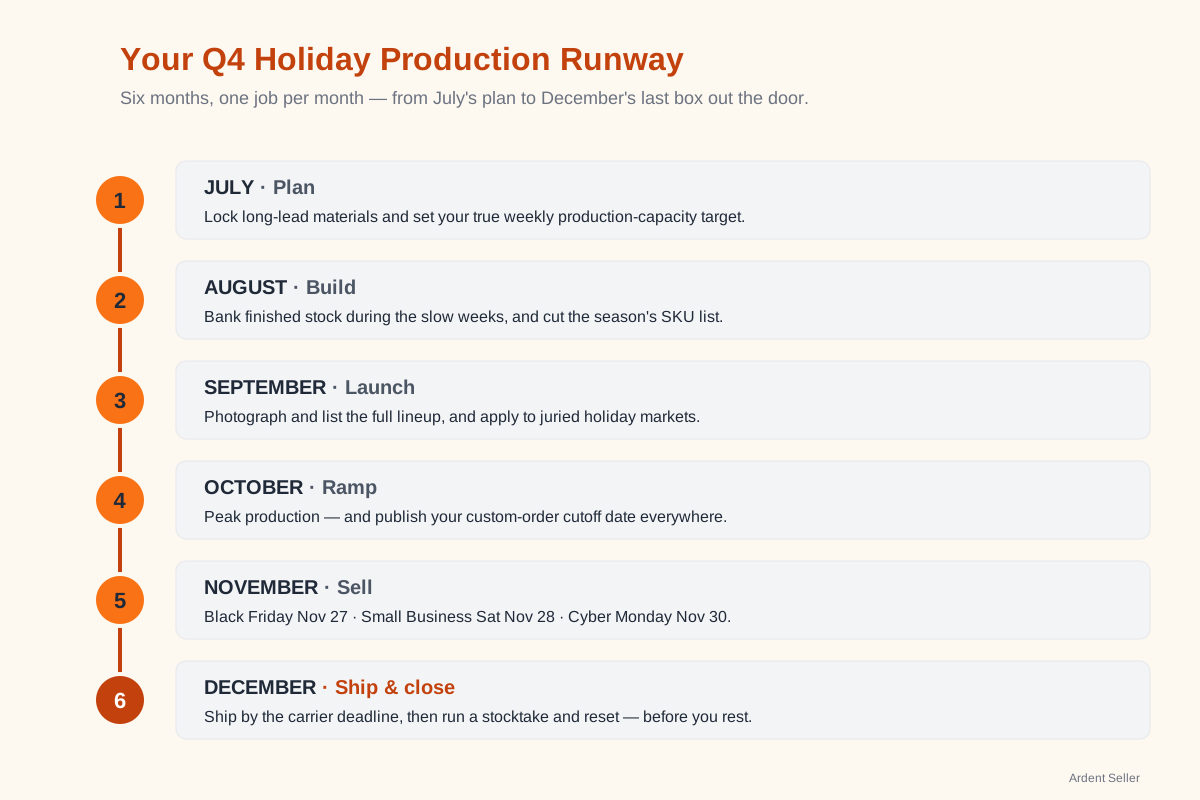
The short version: From July to December, your job shifts from planning to building to selling to shipping. The makers who clear the season without panic are the ones who front-load the boring parts — setting capacity and locking materials in summer, banking stock and opening the season in fall, then selling and shipping without the December scramble. Here's the month-by-month version:
| Month | If you only do one thing |
|---|---|
| July | Set your weekly capacity target, then lock long-lead materials |
| August | Bank finished stock, cut the season's SKU list |
| September | Photograph, list, and apply to holiday markets |
| October | Ramp production and publish your custom-order cutoff |
| November | Sell hard — but watch stock and hold your cutoff |
| December | Ship by the deadline, then stocktake and reset |
You have roughly twenty weekends between now and Black Friday. That's fewer than it sounds once you subtract the ones you'll spend at a wedding, on vacation, or simply too fried to work. Treat the number as real, and the plan below stops feeling early and starts feeling exactly on time.
July: set the target, lock the materials
Everything downstream depends on one honest number — your weekly production capacity. It's the first decision gate of the season: how much can you actually make between now and your cutoff? Not how much you'd like to sell — how much you can produce without hating your life.
To find it, work through last year's numbers:
- Write down what you sold in October, November, and December, by product.
- Add a modest growth assumption if this year is genuinely bigger.
- Divide the total units by the number of real working weeks you have left.
If that weekly number is higher than what you've ever actually produced in a week, your goal is a wish, not a plan — and it's better to find that out in July than in November.
Once you know the target, buy the long-lead materials now. This is the single highest-leverage move of the entire season. Suppliers often raise prices and run short as autumn demand from every other maker picks up, so the jars, findings, wax, cardstock, or fabric you order in July tends to cost less and actually arrive. The stuff with a three-week lead time in the summer can have a three-month lead time in October.
Rule of thumb: Anything you can't make yourself, order before Labor Day. Anything with a long lead time or a history of selling out, order this month.
If you only do one thing this month: calculate your true weekly production capacity and place your first materials order against it. Everything else can wait a few weeks. That can't.
August: bank stock and cut the lineup
August is your build-ahead month, and it's a gift — order volume is usually still light, which means you have hands free to make product for a rush that hasn't started. Any item that doesn't spoil or expire, you can start banking now. Every unit you finish in August is a unit you're not frantically making in November.
This is also the month to be ruthless about your lineup. You cannot make everything, so decide what earns a spot in the holiday season. Pull each product's numbers and ask three questions: does it sell, does it make money, and can I produce it fast enough to matter? A beautiful item that takes four hours and sells twice a year is a hobby, not a holiday SKU. Cut it for the season and put those hours toward your proven winners.
While you're trimming, design your gift sets. Bundles do quiet, powerful work in Q4: they raise your average order value, they use up odd-lot inventory, and they make the "I need a gift" shopper's decision easier. A three-candle sampler, a soap-and-lotion duo, a starter kit — the bundle often sells better than any single item in it.
If you only do one thing this month: start banking finished stock of your top three sellers. Momentum in August is worth double what it's worth in October.
September: photograph, list, and open the season
Here's the trap: makers spend October making product and then try to photograph and list it while orders are pouring in. Flip that. September is when the studio is productive but the storefront is still calm, so get every listing camera-ready now — clean photos, honest descriptions, correct variants, gift-ready framing.
September is also market-application season, and it's easy to miss. Many juried holiday craft fairs close their applications in late summer or early fall, months before the event. If in-person selling is part of your plan, find the shows you want, note their deadlines, and apply this month. Waiting until the vendor list looks full is how you end up watching the good markets from the outside.
Finally, decide your channel mix and put it on paper. Which products go online, which go to markets, which go to your wholesale accounts? A maker running an Etsy shop, two holiday fairs, and three boutique accounts is effectively running four businesses at once in December — and the only way that stays sane is if you decided in September which stock is promised to whom.
This is the point where a lot of makers feel the seams start to show. Stock is building in three places, listings are going live, market dates are landing on the calendar, and it gets genuinely hard to answer a simple question: how many of this do I actually have left, and where is it? This is exactly the problem Ardent Seller is built to solve — tracking finished stock across locations and sales channels so the number you see is the number that's real, whether the unit is on your studio shelf, in a booth bin, or held on consignment. When the season gets loud, one trustworthy inventory count is the difference between confidently taking an order and guessing.
If you only do one thing this month: photograph and list your entire holiday lineup before October starts. Your future self, elbow-deep in production, will thank you.
October: ramp up and draw the line
October is the heavy-production month. The plan you made in July becomes hours at the bench now, so batch your work — make like items together, prep components in bulk, and set up your packing station once so it's ready to run for eight straight weeks.
But the most important thing you do in October isn't production. It's drawing a line — and your custom-order cutoff is the second decision gate of the season, and the biggest: once it passes, you stop saying yes.
Custom and personalized orders are where good seasons quietly go wrong, because a "quick custom" in mid-December can eat the hours you needed for ten stock orders. So work backward:
- Start with the date an order has to ship to arrive in time for the holiday.
- Subtract the transit time.
- Subtract a buffer for revisions and the inevitable supply hiccup.
- Subtract your real production lead time.
The date you land on is your cutoff — often late October or the first week of November. Post it in your listings, your email, your social bios, and your order confirmations. A published deadline you hold is kindness, to your customers and to yourself.
Pro tip: Order your packaging and shipping supplies in bulk this month, not next. Running out of the right box size on December 15th is a completely avoidable emergency, and it happens to someone every single year.
If you only do one thing this month: pick your custom-order cutoff date and announce it today. Everything gets calmer once that line exists.
November: sell the season you built
This is what the last four months were for. The tentpoles land in a tight cluster this year — Black Friday on November 27, Small Business Saturday on November 28, and Cyber Monday on November 30 (2026 dates; they shift every year, so confirm before you build your promo calendar) — so decide your promotions in advance instead of inventing them at midnight. You don't have to discount; plenty of makers do better with a free-gift-with-purchase, a bundle deal, or simply being fully stocked and easy to buy from while competitors sell out.
The real work of November is watching your stock and honoring your limits. Keep an eye on what's moving and make restock decisions early, while there's still time to make more. When something sells out and you can't remake it before the cutoff, let it be sold out — a clean "sold out" protects your reputation better than a promise you can't keep.
And when your custom-order cutoff arrives, hold it. You published the date in October for exactly this moment. The order you turn down on November 8th is the reason the orders you accepted all ship on time.
If you only do one thing this month: check your real inventory numbers every few days and make restock calls early. In November, information beats effort.
December: ship on time, then close it out
December splits cleanly in two. The first three weeks are a shipping operation — the making is mostly done, and your job is to get boxes out the door accurately and on time. The carriers post their current-year holiday shipping deadlines in the fall; find them, and set your own order cutoff a few days earlier so you have breathing room to actually pack. Missing a customer's Christmas because you cut the deadline too close is the one Q4 mistake that turns a happy buyer into an angry review.
Then it eases. The last-minute rush becomes a short list, the storefront goes quiet, and you get to exhale.
Before you fully check out, do one unglamorous thing while the season is fresh: run a stocktake. Count what's left across every location — studio, booth bins, consignment shelves — and note which seasonal SKUs didn't sell so you can plan a January write-down or a sample-out instead of rediscovering them next October. That ending inventory number is also what your accountant needs at tax time, so capturing it now saves you a scramble later. It's the calm bookend to the target you set back in July.
If you only do one thing this month: ship against the real deadline, then count what's left before you rest. The reset you do tired in December is the head start you'll be grateful for in the new year.
The pattern underneath the calendar
Strip away the months and the whole plan is one idea: move the hard, boring work as early as it will go. Materials in July instead of October. Stock in August instead of November. Listings in September instead of mid-rush. A cutoff drawn in October instead of a crisis in December.
None of it requires you to work more — it requires you to work earlier, when the pressure is low and your decisions are good. That's the entire difference between the maker at the kitchen table at 11 p.m. and the one who's already resting. You have about twenty weekends. Start this one.
Ready to head into Q4 knowing exactly what you have and what you can promise? Start tracking your inventory and production with Ardent Seller — so the number you see in December is the number that's actually on the shelf.
Related reading
- 2026 Holiday Shipping Deadlines — This year's USPS and FedEx ship-by dates, the one that moved since 2025, and how to count back from the carrier cutoff to the last order date and the last batch on the calendar above.
- How to Price Gift Sets and Bundles — Before you assemble the season's gift sets, the line-by-line cost of the box and the assembly minutes, and the price that keeps a bundle from earning less than its parts sold alone.
- How to Take Preorders for Handmade Products — The obligations side of a holiday order book: which committed dates are legally binding promises, and the notice you owe the moment the calendar above stops holding.
- Cash Flow for Seasonal Sellers — The money side of the calendar above: how to fund a July materials buy from a slow-summer bank balance and carry the Q4 swing without a cash crunch.
- The Q4 Holiday Runway for Farmers Market Vendors — The produce-and-perishables version of this plan, with an earlier start and the spoilage math that fresh-goods vendors need on top of the general runway.
- How Much Inventory for Your First Craft Fair — If one of the juried holiday markets you apply to is your first ever, this is how to size its stock from a scouting count rather than last year's sales you do not have.
- Inventory Management for Craft Sellers — The foundation that makes the whole season trackable: how to set up counts, safety stock, and multi-channel visibility before the rush tests them.
Free resources
A few free downloads from the Ardent Workshop library that pair well with this post:
- Small-Batch Production Planning Playbook — A weekly production calendar template plus the capacity-and-bottleneck audit you need to turn July's target into a realistic build schedule. This is the tool that makes the "true weekly capacity" step actually happen.
- Craft Show Prep and Profit Tracker — Print one per holiday market: break-even math before you load the truck, an in-show tracking grid, and a post-show reconciliation of true per-event profit after booth fee and mileage.
- Etsy Inventory & Fee Survival Guide — If Etsy is part of your November channel mix, this walks through keeping stock counts straight and pricing in the platform fees before they quietly eat your holiday margin.
This article is provided for educational purposes only and does not constitute financial, tax, or business advice. Cost, pricing, and timeline figures are illustrative and will vary by your specific circumstances. Verify current-year holiday shipping deadlines directly with your carriers, and consult a qualified accountant or small-business advisor before making financial decisions based on this content.