Break-even point: sales to cover a booth fee
Your break-even point is the number of sales that covers your costs. Worked through on a $75 market booth and a $20 candle: 7 candles before the day pays you.
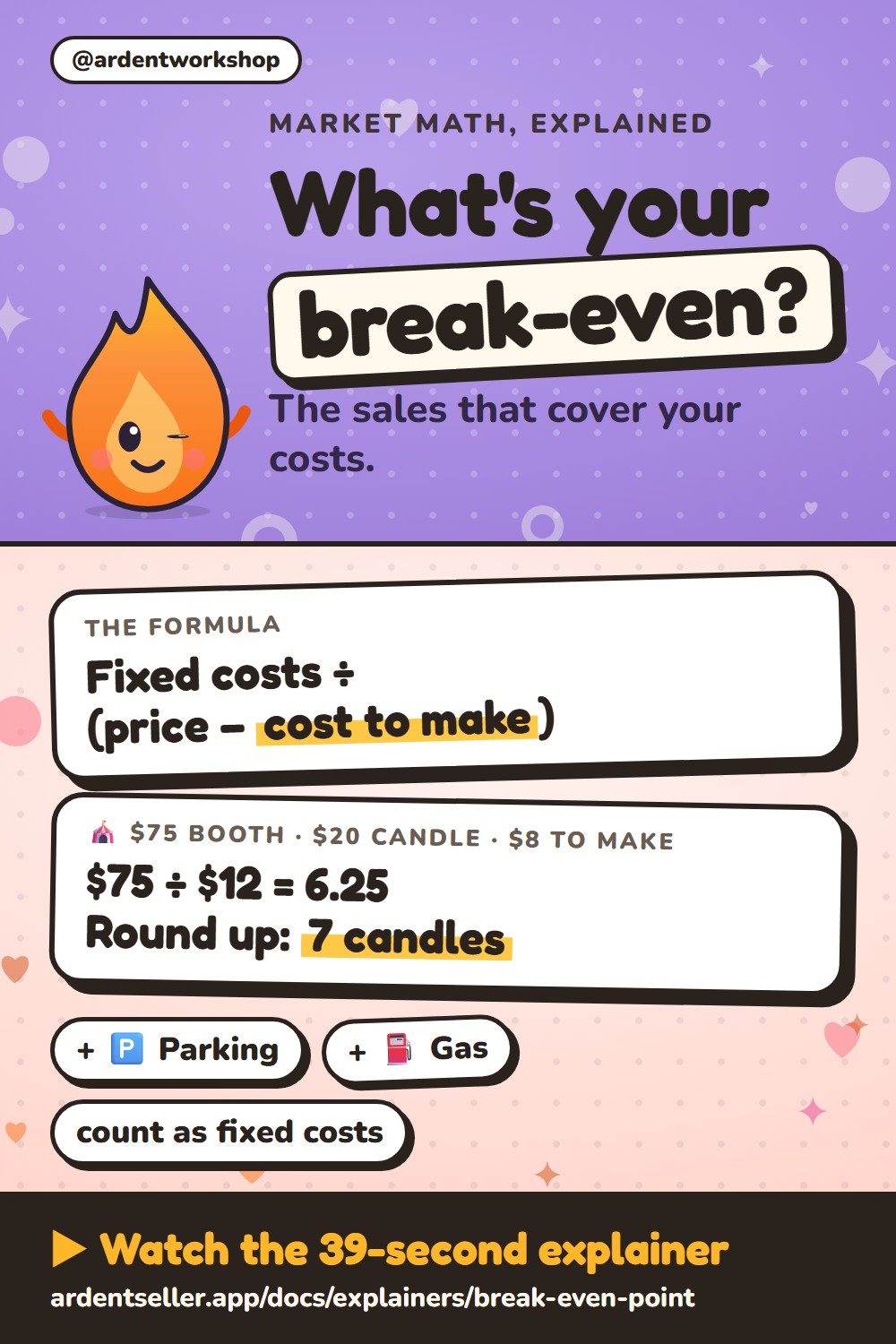
Your break-even point is the number of sales that covers your costs; every sale after it is profit. To find it, divide your fixed costs, like a market booth fee, by what each sale leaves after its own cost to make. This short works through one market day: a $75 booth fee and a $20 candle that costs $8 to make. Each candle leaves $12, so $75 ÷ $12 = 6.25, which rounds up to 7 candles.
Watch on YouTube Shorts (opens in new tab)
The whole idea on one card
New explainers drop on our socials
Follow @ardentworkshop for more maker explainers.
Go further
- Glossary: Break-Even Point
- Read: Why Your Craft Fair Booth Isn't Making Money: A Booth-Day Diagnostic
- Read: Selling at Juried Craft Shows: How to Apply, Price for the Booth Fee, and Actually Profit From a Weekend
- Read: How Much Inventory to Bring to Your First Craft Fair (When You Have No Sales History)
- Read: 15 Numbers Every Maker Should Be Able to State From Memory
- For Farmers Market Vendors
- For Candle Makers
- For At-Home Bakers
- For Jam & Preserve Makers
- Guide: Start a candle business
- Guide: Start a jam business
- Guide: Start a home bakery
Transcript
Hook
What’s your break-even point? Your $75 booth fee: how many candles to cover it?
Definition
Break-even is the number of sales that covers your costs. Every sale after it is profit.
Formula
Divide your fixed costs, like the booth fee, by what each sale leaves after its cost to make.
Example
A candle maker sells at $20. Each costs $8 to make, leaving $12. $75 divided by $12 is 6.25. Round up: 7 candles.
Takeaway
Add parking and gas to the fixed costs. If the number looks out of reach, raise the price or pick another market.
Sources
- The break-even point is where total cost and total revenue are equal; break-even units = fixed costs ÷ (sales price per unit − variable cost per unit); fixed costs, such as rent, don’t change with how much you make: U.S. Small Business Administration, Calculate your startup costs (opens in new tab)
Last updated .