How to start a jam business
A practical, step-by-step playbook for turning small-batch jam, jelly, and preserves into a side income or full business — from confirming your state's cottage food law to pricing each jar, with the food-safety and labeling details most beginner tutorials skip.
- Startup cost
- $100 – $800
- Time to first sale
- 2 – 6 weeks
- Note: Cottage food registration timeline varies widely by state (some same-day, some 4+ weeks); seasonal fruit availability can also gate when you start
- Difficulty
- Beginner-friendly
Last reviewed · Rates, fees, and regulatory thresholds in this guide can change — verify the linked sources before acting.
The short version
Jam, jelly, and preserves are among the easiest products to sell legally from a home kitchen: high sugar plus high acid makes them shelf-stable and low-risk, so nearly every U.S. state's cottage food law allows them (usually with no inspection). The chemistry is a four-part balance — fruit, pectin, acid, and sugar — and the craft is getting the gel to set and water-bath processing the jars so they're safely shelf-stable. Stick to tested recipes (the National Center for Home Food Preservation, USDA, and pectin-maker guides); the riskier territory is low-sugar/reduced-sugar formulas and savory or pepper products, which can change the acidity and, for genuinely low-acid items, push you into "acidified foods" rules that need a process authority. Startup runs $100–$800 (a water-bath canner, jars and lids, a scale, pectin, and fruit dominate the spend), and the pricing trap is the same as every food craft: the jar, lid, band, and label plus your labor are easy to under-count on an $8–$12 jar.
Good fit if…
- You already make jam or preserves that friends ask you to make again
- Your state's cottage food law allows jams and jellies (almost all do — verify in the Cottage Food Laws by State reference)
- You have $100–$800 of starter capital and a kitchen you can dedicate during a canning session
- You like the idea of farmers markets, local pickup, gift sets, and (where your state allows it) shipping
Probably not for you if…
- You want to ship nationwide from day one — most cottage food laws bar interstate sales, and wholesale to stores usually needs a commercial kitchen
- You're set on savory, low-sugar, or low-acid products that fall outside tested cottage-food recipes without extra steps
- You want to improvise recipes freely — safe canning depends on following tested formulas, not eyeballing acid and sugar
- You need year-round identical product regardless of season — fruit availability and price swing through the year
Tip: Jam is one of the most cottage-food-friendly products there is — high sugar and high acid make it shelf-stable and low-risk, so nearly every state allows it from a home kitchen. The craft is approachable with tested recipes; the work is getting the gel to set and following safe water-bath canning. Step 1 routes you through the law first.
End-to-end timeline to first sale
Jam moves faster than most food crafts — there's no long cure, and shelf-stable jars can be made ahead. The two variables that stretch the calendar are your state's cottage food registration and the fruit season.
- Confirm law + registerSame-day to 4+ weeks
Look up your state cottage food rules, register (a quick form in many states; an inspection in a few), and complete any required food-safety course.
- Source fruit + set up~1 week
Buy a water-bath canner, jars and lids, scale, thermometer, pectin, sugar, bottled acid, and seasonal fruit. Set up the kitchen for a canning session.
- Test + can a batch3–7 days
Make a tested recipe, dial in the gel/set, water-bath process, then verify seals after 12–24 hours. A couple of iterations to lock the recipe.
- Label + list~1 week
Shoot photos, print compliant labels (ingredients, allergens, net weight, home-kitchen disclaimer), and finalize listings, gift sets, and pricing.
2–6 weeks to first sale
The 8-step playbook
Run these in order. Skipping ahead is the most common reason new makers ship inconsistent product or under-price their work.
Step 1: Confirm your cottage food law allows jam — and pick your products
Jam is one of the most universally cottage-food-allowed products, but the law still varies by state on where you can sell and how much you can earn — and a few product types (low-sugar, savory, pepper) carry extra rules. Confirm the legal footprint before sourcing fruit.
Starter product types compared
Before committing to a product type, compare the cottage food and safety trade-offs below; the step that follows explains the state rules in detail. New makers tend to reach for clever low-sugar or savory products first, but the high-sugar classics are the easiest to make safely and to sell legally.
| Option | Shelf stability | Cottage food fit | Set difficulty | Main risk |
|---|---|---|---|---|
High-sugar fruit jam & jelly The classic — easiest and safest. | High (shelf-stable) | Allowed in nearly every state | Gentle with tested recipe | Under-pricing the jar |
Marmalade & fruit butter High-acid, high-sugar cousins. | High (shelf-stable) | Allowed in most states | Moderate (longer cook) | Scorching during long cook |
Low-/reduced-sugar jam Calcium-set (low-methoxyl) pectin. | High if processed right | Allowed in many states; verify | Steep (set is finicky) | Higher pH; softer set |
Pepper jelly & savory spreads Can be low-acid without acidification. | Depends on acidity | Varies; may need a process authority | Moderate | Low-acid/acidified-foods rules may apply |
Cottage food fit varies by state — verify against your jurisdiction in the reference linked above before committing. "Set difficulty" is a relative ranking among these product types, not an absolute; step 4 covers the gel chemistry and the test that tells you it's set.
Every U.S. state has a cottage food law that lets individuals sell certain home-made foods without a commercial kitchen, and high-sugar jams, jellies, and preserves are on the allowed list almost everywhere — they're shelf-stable, high-acid, and low-risk, which is exactly why they're a beginner-friendly product to sell legally. The rules still differ on three axes:
- What you can sell. Standard high-sugar fruit jams, jellies, marmalades, and fruit butters are allowed in virtually every state. The caveats live at the edges: reduced-sugar or "low-sugar" jams set with different pectin can have a higher pH and may fall outside some states' allowed lists; savory, pepper, or low-acid products (some pepper jellies, vegetable-heavy spreads, anything not reliably below pH 4.6) can cross into "acidified foods" territory — products made shelf-stable by adding acid to a low-acid base, regulated under 21 CFR Part 114 (opens in new tab) — that needs a tested, documented process. See the regulatory callout below.
- Where you can sell. Most cottage food laws allow direct-to-consumer sales (farmers markets, in-person pickup, direct delivery), and many now explicitly allow online ordering and intrastate shipping. Wholesale to grocery stores or restaurants is typically not permitted under cottage food — that crosses into commercial-kitchen territory. Interstate (across state lines) sales are almost never allowed under cottage food rules; shipping jars nationwide generally requires a commercial-kitchen license and FDA food-facility registration.
- Revenue cap. Most states impose an annual gross-revenue cap on cottage food operations — ranging from a few thousand dollars in some states to several hundred thousand in others, with a handful imposing no cap at all (the exact figure for your state is in the reference linked below). Above the cap, you typically move to a licensed commercial kitchen or an inspected "home processor" tier.
Do this before anything else: look up your jurisdiction in our Cottage Food Laws by State reference — interactive 51-state coverage of revenue cap, sales venues, registration rules, and label requirements. Then cross-reference your state's health department: agencies update cottage food rules periodically, and any third-party reference (including ours) is a starting point, not the authority. Only after you've confirmed your state allows the product you want to make does the rest of this guide apply.
For the safe-canning chemistry behind all of this, the National Center for Home Food Preservation (NCHFP) jam & jelly guide (opens in new tab) is the authoritative free reference — it hosts the USDA-backed tested recipes and the general principles every product below relies on.
Regulatory notice: Low-sugar, savory, and pepper products can change the rules
Standard high-sugar fruit jams and jellies are shelf-stable and allowed under nearly every cottage food law. But reduced-sugar formulas and savory or pepper products can have a higher pH, and a genuinely low-acid product (finished equilibrium pH above 4.6) sold shelf-stable is an "acidified food" under 21 CFR Part 114 that requires a documented scheduled process from a process authority — outside what cottage food permits. Stick to tested high-acid recipes, and verify any low-sugar or savory product against your state cottage food law and the FDA acidified-foods rules before selling it.
Step 2: Register under your cottage food law & set up the business basics
Cottage food registration is its own step beyond the standard business setup (LLC, EIN, sales-tax permit). For jams, most states are light-touch — often a simple registration with no inspection — but a few require a food-safety course or a kitchen check. Knowing which bucket your state is in sets your timeline.
The cottage food–specific steps (in addition to the general business setup below):
- State or local cottage food registration. Most states require a one-time registration or application before selling. For shelf-stable, high-acid products like jam, many states are at the lightest-touch tier — a free or low-fee online form with no inspection — because the food-safety risk is low. Some still require a fee or a basic food-safety course; a minority require an in-home kitchen inspection. Timelines range from same-day to several weeks. Look up your state in the Cottage Food Laws by State reference for the registration mechanics.
- Food handler card or food safety course. Some states require a food-handler certification or an equivalent state-recognized course before selling. Even where it isn't required, the ServSafe Food Handler course (opens in new tab) is a low-cost (check current pricing at the link), short online course covering safe food handling; StateFoodSafety food-handler certification (opens in new tab) is a recognized alternative in many states — check which your state accepts before paying.
- Required labels. Every cottage food state requires labels with specific elements. Common requirements: product name, business name and address, net weight, ingredients in descending order of predominance, allergen declaration, and a state-mandated disclaimer like "Made in a Home Kitchen" or "This product was produced in a home kitchen not subject to state inspection." Federal allergen labeling (FALCPA) applies to every cottage food product regardless of state. Our cottage food state pages list the exact disclaimer wording each state requires.
The general business setup (the same as any small business):
- A business structure. Most jam makers start as a sole proprietorship (no filing in most states) or form a single-member LLC for liability separation. LLC filing fees vary by state — check your Secretary of State. The SBA's guide to choosing a business structure (opens in new tab) is a good starting point.
- An EIN. Free from the IRS via the EIN application page (opens in new tab), ~10 minutes online. Useful if you form an LLC, sell wholesale (once you scale past cottage food), or want to keep your SSN off vendor forms.
- A state sales-tax permit. Required in every U.S. state with a state sales tax — only Alaska, Delaware, Montana, New Hampshire, and Oregon do not levy one (see the Tax Foundation's state and local sales-tax rates report (opens in new tab); note many states exempt food, but rules vary — verify your state's treatment of packaged jam). Etsy collects and remits as a marketplace facilitator in most states, but you typically still need a permit to operate as a business.
- Product liability insurance. Food products carry real liability (allergen mistakes, spoilage, a chipped jar). Maker- and food-focused programs are worth comparing — the Food Liability Insurance Program (FLIP) (opens in new tab) is built specifically for food sellers, and general craft-vendor insurers like ACT Insurance (opens in new tab) cover booth and general liability for craft sellers but are not food-specific — confirm a policy actually includes food product liability before relying on it, or stay with a food-focused program like FLIP. Quotes vary by coverage limits and state, and most farmers markets and any future wholesale buyer will require proof of coverage.
- Required federal labels. Beyond the state cottage-food disclaimer, the federal Fair Packaging and Labeling Act requires the manufacturer/distributor name and address and an accurate net-quantity statement on packaged consumer goods. For food specifically the FDA — not the FTC — administers these rules; see the FDA Food Labeling Guide (opens in new tab) for the food-product requirements.
Two things people over-do at this stage: forming an LLC before having any sales (start as a sole prop, upgrade later), and printing a big run of labels before the recipe lineup and jar sizes are locked (you'll redesign once you finalize flavors and net weights).
Regulatory notice: Allergen labeling (FALCPA) applies to every jar, in every state
Regardless of your state cottage food rules, federal law requires major food allergens to be declared on the label. Pectin is usually fine, but added nuts (some conserves), and any shared-equipment cross-contact, must be disclosed. Include a full ingredient list in descending order of predominance plus the state-required "made in a home kitchen" disclaimer, and check your state cottage food page for the exact wording.
Step 3: Buy starter equipment & supplies
Jam-making equipment is cheap and finite compared with most crafts — no lye, no kiln, no torch. The water-bath canner, jars, and a reliable scale are the core; the rest is fruit, sugar, pectin, and packaging.
A workable starter kit, sized to produce roughly 1–2 canner loads (about 7–16 half-pint jars per batch):
- Water-bath canner (a large pot with a rack, or a dedicated canner): $25–$60. The pot must be deep enough to cover the jars by 1–2 inches of water. A pressure canner is not needed for high-acid jams — water-bath is the correct method.
- Canning jars with two-piece lids (half-pint and/or 8 oz, by the case): $10–$18 per dozen. Lids (the flat sealing disc) are single-use; bands are reusable.
- Canning tools — jar lifter, canning funnel, bubble remover/headspace tool, lid magnet: $15–$30 as a set.
- A heavy-bottomed pot for cooking the jam (stainless or enameled, not aluminum for acidic fruit): $25–$70 if you don't already have one.
- Digital scale (0.1 g resolution for pectin/acid, plus a larger range for fruit and sugar): $20–$40. Canning recipes balance fruit, sugar, acid, and pectin by measure — weighing beats volume for consistency.
- Instant-read or candy thermometer (the gel point is ~220 °F / 8 °F above your local boiling point): $10–$25.
- Pectin (regular/high-methoxyl for standard jams, low-methoxyl/calcium-set for low-sugar): $3–$8 per batch-pack; cheaper in bulk.
- Sugar and acid (granulated sugar; bottled lemon juice or citric acid for reliable, consistent acidity — fresh lemon juice varies): $10–$25 to start.
- Fruit — seasonal, by the flat or pound from a farm, market, or u-pick: cost varies widely with fruit and season.
- Labels (waterproof, oil/moisture-resistant, sized for the lid and jar): $15–$30 for a starter sheet — see step 2 for the required label content (ingredients, allergens, net weight, home-kitchen disclaimer).
Total starter outlay: typically $100–$300 plus fruit.
Use bottled, standardized acid for consistency. A common reason a tested recipe goes wrong is variable acidity. Fresh lemon juice swings in acid content batch to batch; bottled lemon juice and food-grade citric acid are standardized, which is why tested recipes call for them specifically. Don't substitute "to taste" for the acid a tested recipe specifies — acid is a safety ingredient here, not just flavor.
Once you have a repeatable recipe and a channel, the next supply order should scale up — jars and sugar are much cheaper by the case and the bag, and a single fruit-season buy at the farm is far cheaper than grocery fruit. Compare your supplier's tiered pricing before locking a cost model, and only buy bulk fruit once the recipe and your sales channel are proven.
Step 4: Master a tested recipe and check the set
Jam is a four-part balance — fruit, pectin, acid, and sugar. Get the ratio right and it gels and keeps for a year; get it wrong and you ship runny syrup or an over-set rubber. Start from a tested recipe, then learn to read the set.
Start from tested recipes — this is a safety issue, not just quality. The acid and sugar levels in a tested jam recipe are what make it safely shelf-stable; improvising them can produce a product that molds, ferments, or (for genuinely low-acid products) is unsafe. The authoritative free sources:
- National Center for Home Food Preservation (NCHFP) (opens in new tab) — the USDA-backed gold standard, with tested recipes by fruit and the general principles of safe canning for jams, jellies, and marmalades (opens in new tab).
- Pectin-manufacturer recipe inserts (the printed guide inside every box of commercial pectin) — tested for that specific pectin. Use the recipe that matches the pectin you bought; high-methoxyl and low-methoxyl pectins are not interchangeable.
The four-part balance. For a jam to set, you need the right combination of fruit (flavor and natural pectin/acid), pectin (the gelling agent), acid (pectin needs acid to gel, and acid keeps the product safely shelf-stable), and sugar (sets the gel, preserves, and carries flavor). High-pectin fruits (apples, citrus, currants) can gel with little or no added pectin; low-pectin fruits (strawberries, peaches) usually need added pectin or a longer cook. Low-sugar jams use a different (low-methoxyl, calcium-set) pectin and behave differently — treat them as a separate recipe, not a tweak.
What to test, for every recipe
- The gel/set. Use the cold-plate test: put a saucer in the freezer, drop a spoonful of boiling jam on it, wait a minute, and push it with a finger — it should wrinkle and hold, not run. The gel point is also around 220 °F (about 8 °F above the boiling point of water at your altitude).
- Headspace and processing. Fill jars to the recipe's specified headspace (usually 1/4 inch for jams), wipe rims, apply lids, and water-bath process for the recipe's time — adjusted for your altitude (processing time increases at higher elevations; NCHFP publishes the adjustment table). Don't skip the water-bath process and rely on the "inversion" or "open-kettle" method — those are not considered safe by current guidance.
- The seal. After 12–24 hours, check that each lid has sealed (the center is concave and doesn't flex). Unsealed jars go in the fridge for personal use, never to a customer.
- Yield. Record how many jars a given quantity of fruit actually produces — yield drives your per-jar cost (step 5) and swings with the fruit, the cook-down, and the day.
- Flavor and texture over time. Taste at fill, at one week, and at one month — some flavors deepen, some fade, and texture can firm up after the jar cools and rests.
Keep a batch log: fruit and weight, sugar, pectin type and amount, acid added, cook time, gel-test result, jars filled, processing time and altitude, and seal check. This is your recipe library and the traceability record (lot codes and best-by dates) you'll need if a batch ever has to be pulled — covered in step 7.
Safety warning: Follow tested recipes and water-bath process every jar
Safe, shelf-stable jam depends on the tested balance of acid and sugar and on proper water-bath processing — do not reduce the sugar or acid in a high-sugar recipe, do not substitute fresh for bottled lemon juice where a recipe specifies bottled, and adjust processing time for your altitude. Skip the unsafe shortcuts (open-kettle filling, jar inversion to seal). Check every lid has sealed before selling; refrigerate and use any unsealed jar yourself.
Step 5: Price your jars to actually make money
A jar of jam sells for $8–$12 at market or direct retail, which makes it easy to under-price: the jar, lid, band, and label plus your labor each get under-counted unless you run the math explicitly. This step makes it explicit.
The pricing framework we recommend for cottage-food jam sellers — a widely used maker rule of thumb — sets wholesale at 2× cost and direct retail at 2× wholesale. The arithmetic below derives the same 2×/4× logic from first principles, so you can see why it holds rather than take it on faith:
Wholesale price = (materials + labor + overhead) × 2
Direct retail price = wholesale × 2 (≈ 4× cost)
That puts your market/Etsy retail price at roughly four times true cost — otherwise a future wholesale buyer (a farm store, a gift shop) can't mark you up to match what you charge direct. If you only ever sell direct, you can land closer to 3× cost; the 4× math applies once wholesale enters the picture.
What "materials" actually includes for a single 8 oz jar. The numbers below are illustrative mid-range estimates as of mid-2026 — your actual figures vary substantially by fruit, season, and supplier. The big swing is fruit cost and yield (how many jars a flat of fruit makes), so plug your own batch numbers into the calculator below.
- Fruit (per jar, allocated from batch yield): ~$0.90 (varies enormously by fruit and season)
- Sugar: ~$0.35
- Pectin: ~$0.30
- Acid (bottled lemon/citric): ~$0.05
- Jar + two-piece lid (sealing disc and screw band): ~$0.90
- Label: ~$0.25
- Energy (long cook + canner): ~$0.10
- True material cost (illustrative): ~$2.85
What "labor" includes: sourcing and prepping fruit (washing, hulling, chopping), cooking and testing the set, filling and processing jars, cooling and seal-checking, labeling, and cleanup. As an editorial estimate for a straightforward recipe, a batch yielding ~12 jars tends to run 90–150 minutes of active labor including fruit prep — allow more for complex fruit prep or while you're still learning the process. A reasonable starting reference for the hourly rate is roughly $20–$25/hr: the BLS Occupational Employment and Wage Statistics (opens in new tab) table for "Craft Artists" (SOC 27-1012) is a reasonable reference point for a maker labor rate — check the current figure at the link, since BLS updates the page in place each release, and note the median for this broad classification can run lower and excludes self-employed makers. That occupation is a broad proxy, not jam-makers specifically — use it as a floor so your pricing doesn't assume you work for free, then adjust with the Hourly Rate Pricing Calculator below. At roughly $20–$25/hr over a 12-jar batch, labor adds about $3–$5 per jar — often the largest single cost, and the one most beginners forget.
Overhead (your fixed costs that aren't tied to a single jar): electricity beyond the per-jar energy line, kitchen and storage, insurance, market or platform fees, and packaging not in the per-unit cost. A workable starting heuristic is roughly 10–20% of materials + labor until you have real expense data.
That puts the true cost of a typical 8 oz jar around $6–$8 once labor is honestly counted — which is why a $5 "farmers-market jam" price is usually a loss. Apply the framework above: if you only ever sell direct, ~3× materials-plus-labor lands a retail price near the bottom of the $8–$12 range; once you want headroom for a future wholesale buyer, the full 4× math pushes you toward the top of it. Gift sets (three jars in a box) are the most reliable way to lift the average order value above a single jar. Any price that doesn't clear your true cost is losing money, even when it looks competitive next to mass-produced grocery jam (which has none of your labor cost).
The pricing calculators below run this math for you — plug in your own fruit cost, batch yield, and labor time.
Step 6: Choose where to sell
Jam is a farmers-market native — buyers love to taste before they buy, and gift sets sell themselves around the holidays. Your channels are shaped by cottage food law, which limits where and how far you can sell.
The most common starting channels for jam makers, shaped by what cottage food allows:
- Farmers markets & craft fairs — jam's home turf. You keep all the margin (minus the booth fee), buyers can taste samples (check your market's sampling rules and any required permits), and gift sets move well. Booth fees vary widely by market and region — as a rough guide, small community markets are often low-cost per day while juried holiday shows command a premium, so check your specific market's published fee and model break-even against your per-jar margin from step 5.
- Direct local sales & pickup — allowed in essentially every cottage food state: local delivery, farm stands, on-farm sales, and word-of-mouth orders. The lowest-friction channel and the highest margin.
- Online ordering & intrastate shipping — many states now allow cottage food producers to take online orders and ship within the state. Etsy and your own store both work where your state permits it — but confirm your state allows shipping before listing, and remember interstate shipping is almost never permitted under cottage food. If you sell on Etsy, model the stacked fees (listing + transaction + payment processing, plus optional offsite ads — see Etsy's Fees and Payments Policy (opens in new tab)); they bite harder on a single $8 jar than on a multi-jar set, so lead with gift sets online. The full worked fee breakdown is in our Etsy fees FAQ.
- Wholesale & grocery — the commercial-kitchen line. Selling wholesale to stores, restaurants, or across state lines almost always requires moving out of cottage food into a licensed commercial or commissary kitchen and registering as an FDA food facility. This is the natural "graduation" once you hit your state's revenue cap — plan for it, but it's typically phase two, not your starting channel.
A common opening combination is farmers markets plus local pickup, adding intrastate online orders once you know which flavors sell. Pick one channel, run it for a few weeks, then layer the next.
Whichever channels you choose, you'll need to track inventory, batch lot codes, and best-by dates across all of them — both to manage the seasonal stock and to pull a recall list if a batch ever has to come off the shelf. That's the operational problem step 7 solves.
Step 7: Track inventory, batches, lots, and taxes from day one
Once you have a tested recipe and a place to sell, the operational reality kicks in — what fruit and jars are left, how many jars of each flavor are in stock, which lot is which, what's approaching best-by, where you stand against your state's revenue cap, and what you owe in taxes.
For the first several batches a notebook or spreadsheet is genuinely fine. The volume is low and you remember everything.
Past that point the math gets brittle. Common breakdowns:
- You buy fruit by the flat and sugar by the bag but recipes are by the jar — manual unit conversions drift.
- Fruit prices swing through the season and your jar price doesn't move because nobody recalculated.
- A market sells out of one flavor and you can't quickly see what's left in stock across your other channels.
- A customer (or, if you scale to wholesale, an inspector) asks which lot a jar came from and you can't trace it to its batch.
- You're approaching your state's cottage food revenue cap and don't realize it until you've blown past it.
- Tax time arrives and you can't tell the IRS what you paid for the fruit and jars that went into the jam you sold.
This is an editorial observation, not a hard threshold — your breaking point depends on your tracking habits — but spreadsheet workflows tend to get brittle once you're juggling several flavors, seasonal fruit buys, lot codes, and a revenue cap to watch. That's typically when a dedicated tool starts to pay for itself: lot-and-expiry tracking for traceability, true cost-per-jar that updates when fruit prices move, and a running view of sales against your cap. The Tools to consider section below covers what works at each stage.
Step 8: Market without burning out
Jam sells on taste and story — a sample spoon at a market does more than any ad. You don't need a content treadmill; you need a few good photos, a tasting habit, and a way for happy customers to reorder.
Strong photography still matters, especially if you sell online where your state allows it. Etsy is visual-first — search results show photos before titles — and Etsy's own Etsy Seller Handbook photography section (opens in new tab) has a deep library. Treat lead-photo quality as a competitive lever, not a polish item.
What works for jam photography:
- Natural light from a window, never overhead kitchen lighting
- A neutral surface (linen, wood, stone) that lets the jam color glow
- The jar open with a spoonful or a piece of toast, so buyers see the texture and set
- A scale prop and the fruit it's made from, to signal "real fruit, small batch"
- A gift-set shot (three jars in a box or tied with twine), since sets lift the order value
Beyond photos, the two highest-leverage activities are:
- Sampling at markets. Tasting is the single best sales tool jam has — a spoonful converts far better than a label. Follow your market's sampling rules (some require a permit or specific serving setup), and pair samples with a "what should I make next?" question to learn which flavors to scale.
- Email list and repeat customers. Jam is a consumable and a giftable — buyers come back and they buy in threes for presents. Capture emails at every market with a "10% off your next order" card, and send a short note when a seasonal flavor returns. The downside risk is near zero even if uplift is modest.
Treat paid ads cautiously in the first six months — the single-jar price point makes ad ROI tight until your photography and bestseller mix are working, and gift sets are where online spend pays off first. Start with sampling and the email habit; both compound and cost almost nothing.
The next sections cover tools at every stage (Tools to consider), the patterns that trip up new makers (Common mistakes to avoid), and the questions beginners ask most (Frequently asked questions).
The tools section
Tools to consider
A short, honest list — Ardent Seller alongside the other tools most jam business owners end up using.
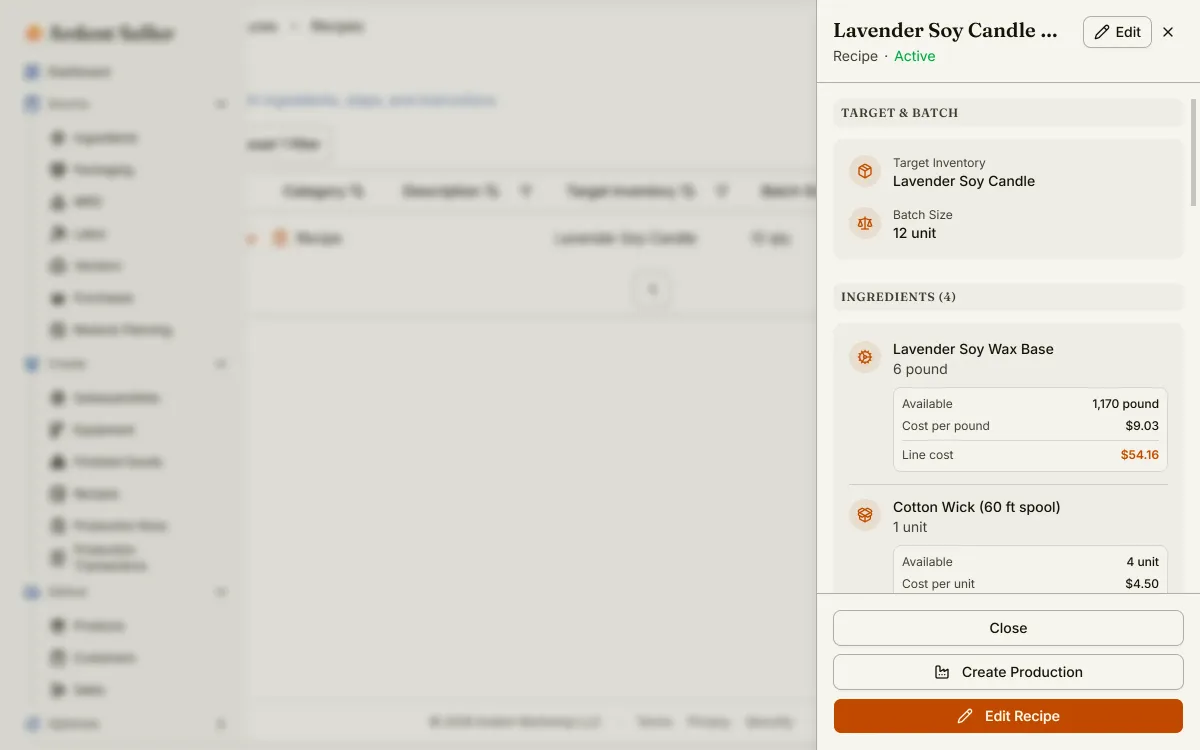
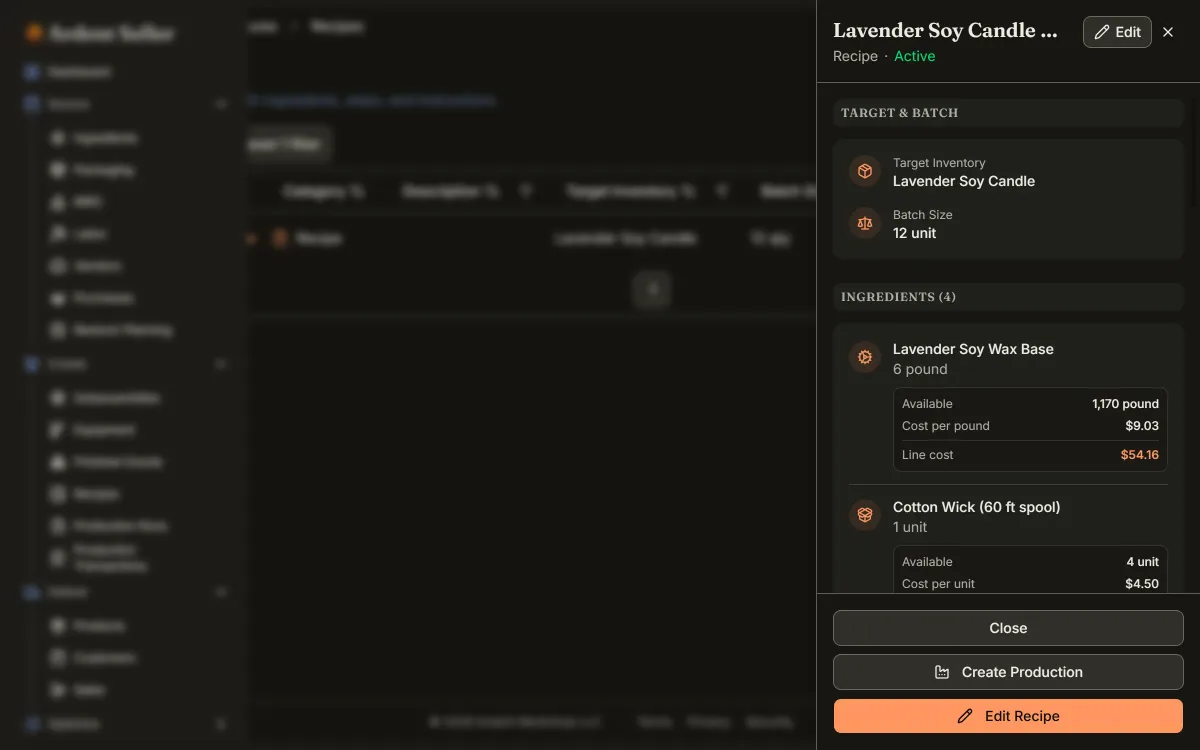
Track fruit, sugar, pectin, jars, lids, and labels as inventory; store each recipe as a scalable procedure so a test batch becomes a market run in one click; assign lot codes and best-by dates for traceability; see true cost per jar including the jar, lid, band, and label; and watch sales against your state's cottage food revenue cap. The Free plan covers a small line and includes one connected Etsy shop; paid plans raise the limits and add more shops and advanced reporting.
The USDA-backed gold standard for safe, tested jam, jelly, and preserve recipes and canning guidance. Free, authoritative, and the source most pectin makers and extension offices defer to.
Standard for tracking income and expenses for tax purposes. Categorizes purchases automatically and exports a Schedule C summary at year-end. Pricing changes — see Intuit's pricing page for current rates.
Free design tool for jar labels, lid toppers, and listing graphics. Templates map cleanly to the required cottage-food label elements (ingredients, allergens, net weight, home-kitchen disclaimer).
Free POS app for in-person sales at markets. Handles card payments, basic inventory, and email-receipt capture for building your list.
A marketplace option where your state allows cottage food shipping — strong for gift sets. Be aware of the stacked fee load (listing + transaction + payment processing, plus optional offsite ads) which bites harder on a single jar — review Etsy's current fees before listing — and confirm your state permits intrastate shipping first.
Common mistakes to avoid
The patterns that show up over and over in the first year.
Assuming cottage food lets you ship anywhere
Most cottage food laws allow direct local sales and, in many states now, intrastate shipping — but interstate (across state lines) sales and wholesale to stores are almost never permitted. Shipping jars nationwide or selling to a grocery generally requires a commercial kitchen and FDA food-facility registration. Confirm your state's venue rules before promising shipping.
Reducing the sugar or acid in a tested recipe
Sugar and acid aren't just flavor — they're what makes high-sugar jam safely shelf-stable and what lets pectin gel. Cutting them, or swapping fresh lemon juice for the bottled juice a recipe specifies, can produce a product that won't set, molds, or (for low-acid results) isn't safe. Use tested recipes as written, and treat low-sugar jam as a separate calcium-set recipe, not a tweak.
Skipping the water-bath process
Open-kettle filling and "inverting the jar to seal" are old shortcuts that current guidance considers unsafe — they don't reliably produce a vacuum seal or destroy surface molds and yeasts. Water-bath process every jar for the recipe's time, adjusted for your altitude, and check that each lid sealed before selling.
Pricing a jar like the grocery store does
Mass-produced grocery jam has near-zero labor cost; yours doesn't. A $5 farmers-market jar usually loses money once the jar, lid, band, and label plus your time are counted. Price at 3–4× your true cost (often $8–$12 for an 8 oz jar) and lean on gift sets to lift the average order above a single jar.
Ignoring yield when costing
A flat of fruit yields a different number of jars depending on the recipe, the cook-down, and the day. If you cost against the fruit you bought rather than the jars you actually filled, every jar is mis-costed. Record yield per batch and allocate fruit cost against jars produced.
No lot codes or best-by dates
Without a lot code on every jar and a record of which batch it came from, you can't pull a targeted recall if a batch has a problem, and you can't practice first-in-first-out selling. Assign a lot code and best-by date to every batch from jar one — it's trivial early and impossible to reconstruct later.
Frequently asked questions
The questions new makers ask most often.
Do I need a license to sell homemade jam?
In most U.S. states you don't need a full food-business license to sell high-sugar jams and jellies — they're shelf-stable and allowed under your state's cottage food law, often with just a simple registration and no inspection. You will typically need a general business registration, a sales-tax permit if your state taxes packaged food, and compliant labels including a state-mandated "made in a home kitchen" disclaimer. A few states require a food-handler course or a kitchen check. Look up your state in the Cottage Food Laws by State reference, then confirm with your state health department, since agencies update rules periodically.
How much does it cost to start a jam business?
A realistic starter outlay is $100–$800. The minimum to produce a batch or two is around $100–$300 for a water-bath canner, jars and lids, a scale, a thermometer, canning tools, pectin, sugar, bottled acid, and labels — plus seasonal fruit, which varies widely. Add any state registration or food-safety-course fee (often small for shelf-stable products), a product-liability insurance quote (varies by carrier and state), and $50–$150 for initial labels and packaging. Many makers start lean at $150–$400 and reinvest revenue into fruit and jars.
How long does it take to start selling jam?
Plan on 2–6 weeks, with two variables that can stretch it. First, your state's cottage food registration timeline — some states are same-day online forms, a few require a kitchen inspection that takes weeks. Second, fruit season — you make the best (and cheapest) jam when the fruit is in season. The making itself is fast: there's no long cure, so a batch is cooked, canned, sealed, and ready to label within a day or two. Most of the calendar is registration plus a short recipe-testing window plus photos and listings.
Is homemade jam safe to sell, and do I need to worry about botulism?
High-sugar fruit jams and jellies made from tested recipes and water-bath processed are among the safest home-canned foods — botulism is a risk of low-acid canning, and proper jams are high-acid (pH well below 4.6), which the bacteria can't grow in. The keys to safety are using tested recipes (from the National Center for Home Food Preservation, USDA, or your pectin maker), not reducing the sugar or acid those recipes specify, water-bath processing every jar for the right time and altitude, and confirming each lid sealed. The risk territory is low-sugar, savory, or pepper products that can have a higher pH — a genuinely low-acid product sold shelf-stable becomes an "acidified food" under FDA acidified-foods rules (21 CFR Part 114, linked in the step 1 regulatory note) that needs a documented process from a process authority.
Can I sell my jam online or ship it across state lines?
It depends entirely on your state's cottage food law. Many states now allow cottage food producers to take online orders and ship within the state (intrastate); some still limit you to in-person direct sales. Interstate shipping — across state lines — is almost never permitted under cottage food rules; doing it legally generally requires producing in a licensed commercial kitchen and registering as an FDA food facility. Before you list jam for shipping anywhere, confirm exactly what your state allows in the Cottage Food Laws by State reference and with your state health department.
Why didn't my jam set (or why did it set too hard)?
Set problems come from the four-part balance of fruit, pectin, acid, and sugar being off. Runny jam usually means too little pectin or acid, not reaching the gel point (about 220 °F, or 8 °F above your local boiling point), or using a low-pectin fruit without added pectin. Over-set, rubbery jam usually means too much pectin or over-cooking. Use the cold-plate test to check the set before filling jars, match your recipe to the specific pectin you bought (high-methoxyl and low-methoxyl pectins are not interchangeable, and low-sugar jam needs the calcium-set kind), and follow a tested recipe rather than improvising the ratios.
How should I price homemade jam?
Start from true cost: materials (fruit allocated by batch yield, plus sugar, pectin, acid, the jar, lid, band, and label — often around $2.85 for an 8 oz jar) plus labor (fruit prep, cooking, canning, labeling — frequently the largest cost, several dollars per jar at a real hourly rate) plus overhead (energy, insurance, fees). That lands true cost around $6–$8 a jar once labor is honestly counted, which is why a $5 jar usually loses money. The standard framework is wholesale at 2× cost and direct retail at 2× wholesale (≈4× cost), putting a typical 8 oz jar around $8–$12 retail. Gift sets are the most reliable way to lift the average order above a single jar. The pricing calculators on Ardent Seller run this for your own fruit cost, yield, and labor time.
Where should I sell my jam first — farmers markets or online?
For most new jam makers, farmers markets are the best first channel because jam sells on taste — a sample spoon converts far better than a photo, and you keep all the margin minus the booth fee. Local pickup and direct sales are allowed in essentially every cottage food state and carry the highest margin. Online selling works where your state permits cottage food shipping (most that do limit it to within the state), and it's strongest for gift sets, which absorb platform fees better than a single jar. A common start is markets plus local pickup, adding intrastate online orders once you know which flavors sell.
Free resources
Hand-picked calculators, checklists, and templates that map directly to the steps above.
A working Excel recipe scaler — enter a base recipe, set a target yield, and every ingredient auto-scales with unit conversions (oz/g/lb/ml/cups). Plus a batch-cost tab and a unit-conversion reference.
A working Excel pricing calculator — materials, labor, packaging, and platform fees in, a defensible retail price out. Plus a batch tab that shows what 50 vs. 10 actually costs.
Pick your state, enter year-to-date gross sales, and see in real time how close you are to the cap that turns a cottage food operation into a regulated food business. Covers all 50 states + DC.
A printable six-page playbook for handmade-goods producers — five planning principles, the demand-driven batch-sizing formula, and four worksheets for sizing, run logging, weekly WIP, and post-run audit.
Three sections, one page. Print, count, and reconcile raw materials, finished goods, and packaging — with expected, actual, and variance columns.
Pick a target hourly rate, enter your materials, hands-on minutes per unit, and platform fees — the calculator returns the minimum price that actually pays you that rate after fees and costs. Maker-business specific, not a "freelance day rate" tool.
36 things to set up before — and after — your first sale. Inventory, pricing, and the legal essentials in one place.
A working Excel inventory tracker for makers — raw materials, finished goods, packaging, and a purchase log. Reorder thresholds and a status column do the math; conditional formatting flashes red when you are below the line.
A free, scoped-for-small-sellers economic-nexus checker. Enter your trailing 12-month sales and transactions per state, and the tool flags every state where you have probably crossed the post-Wayfair economic-nexus threshold — without pushing you into a filing product.
Live web version of our Excel pricing calculator. Materials + labor + packaging + platform fees → defensible retail at your target margin, with batch-pricing tiers.
Read next
Deeper dives on the topics that come up in the guide.
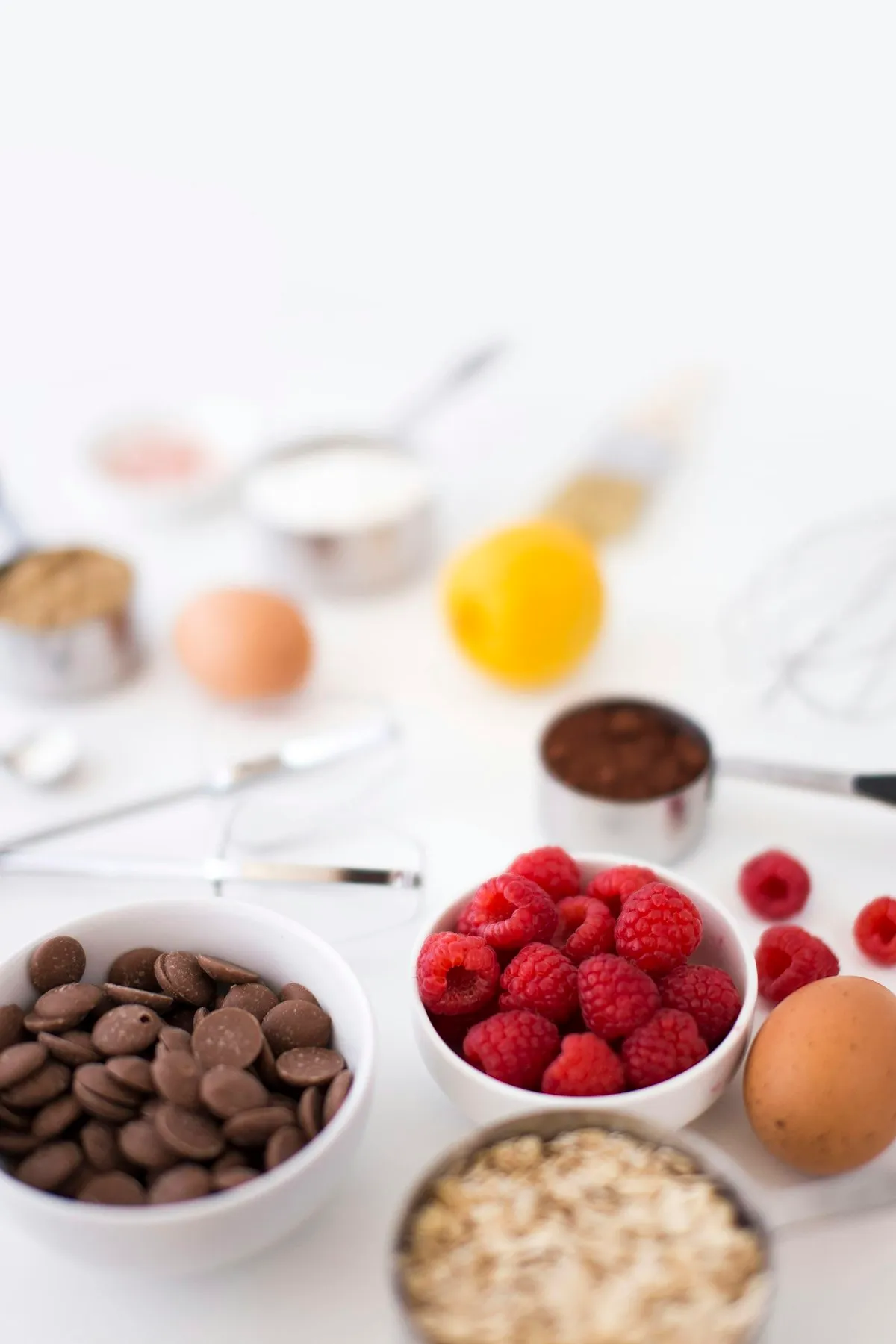
Learn how to calculate the real cost of every product you make — from raw ingredients to labor and overhead — so you can price with confidence and protect your profit margins.
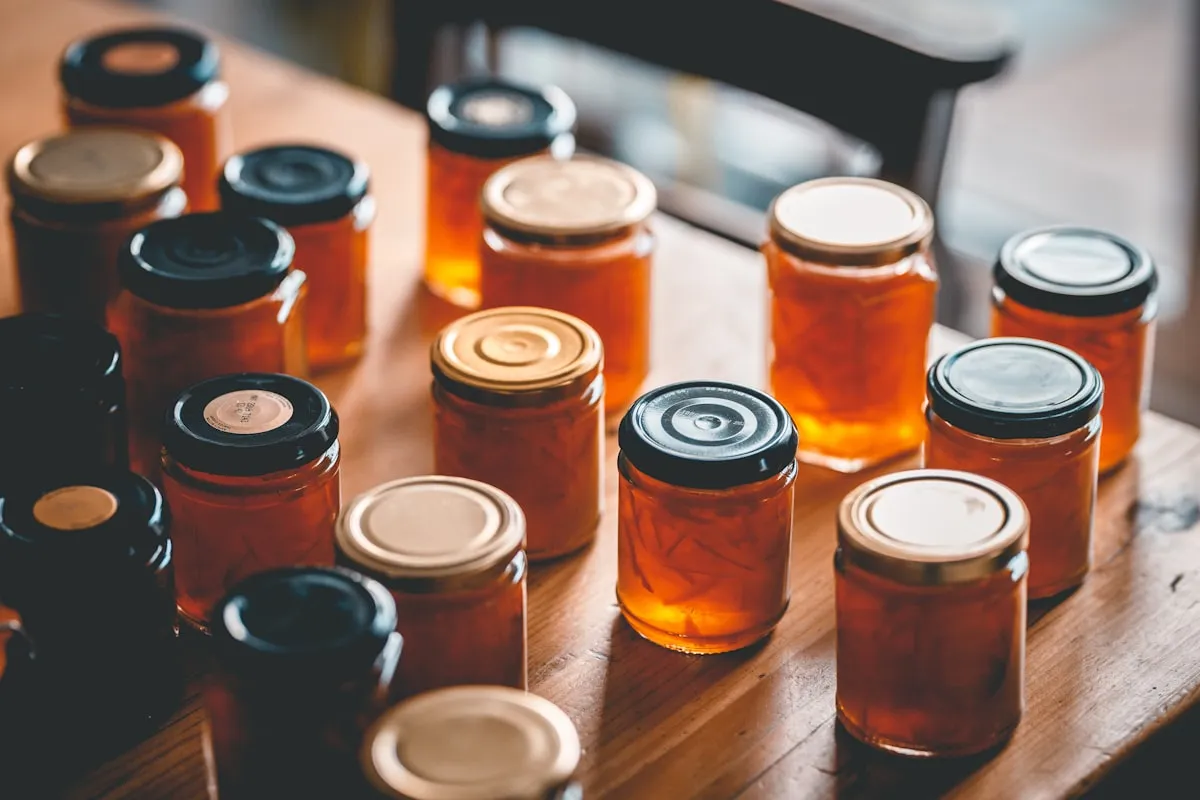
Batch tracking protects your food business from recall disasters, builds customer trust, and keeps you ahead of tightening regulations. Learn how to set up a simple lot tracking system that works.
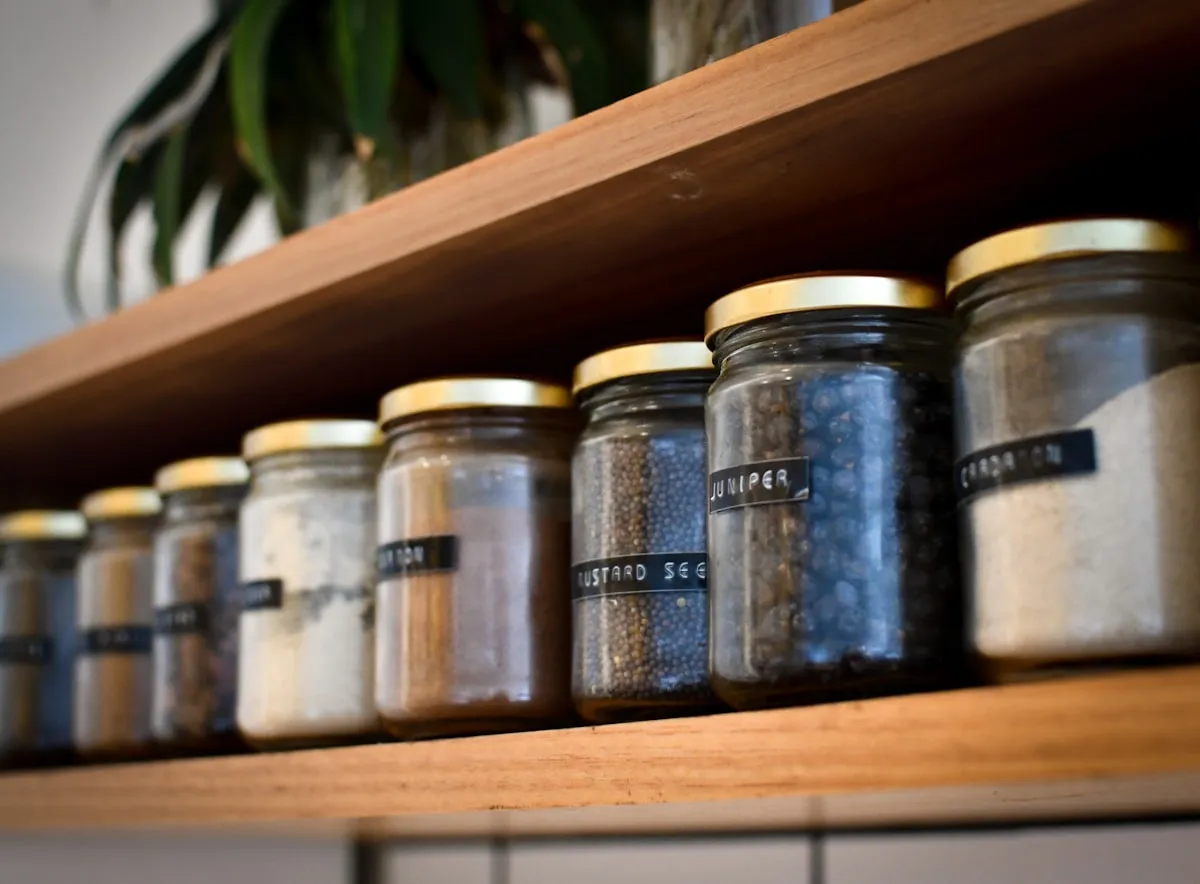
You bought it. You made it. But it never sold. Spoilage, expiration, and shrinkage silently eat your margins — here is how to track every ounce of inventory that disappears before it reaches a customer.
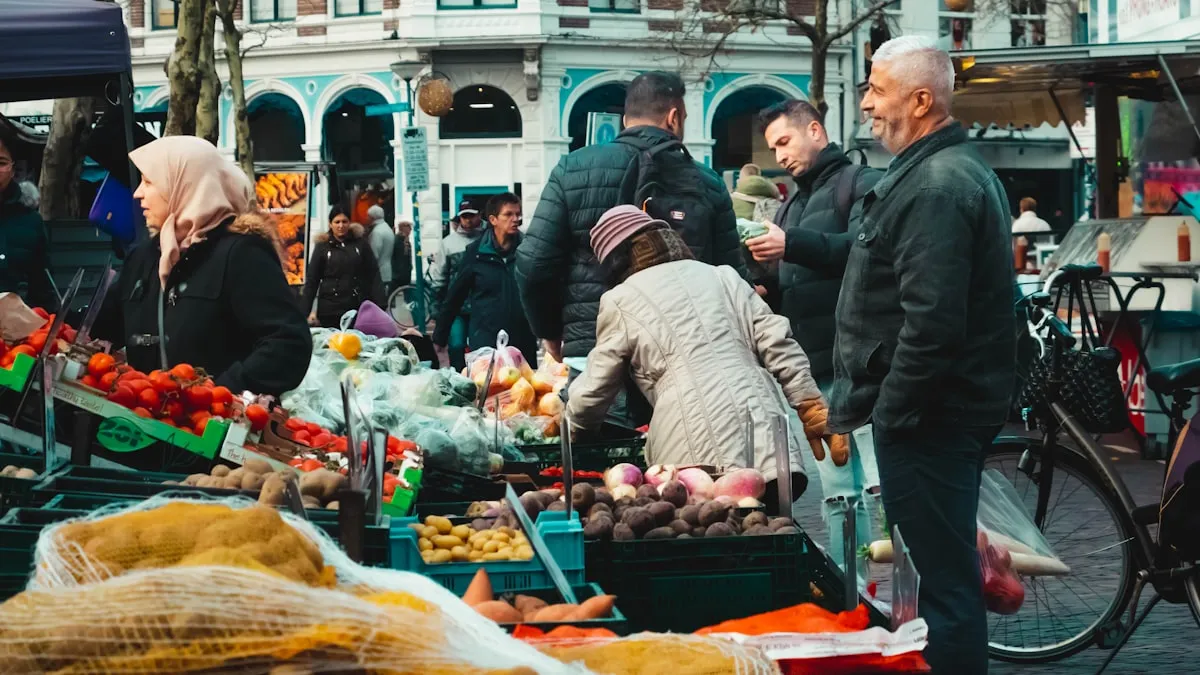
Farmers markets feel profitable — until you count the real numbers. Here are 10 common mistakes market vendors make that silently drain profits, and how to fix each one.
COGS is the single number that quietly decides whether your maker business is profitable, what your taxes look like, and which products are worth keeping in the catalog. Here is what it actually means, what goes in (and what stays out), and how to start tracking it this week — without an accounting degree.
Once you're selling, you'll need to track it
Tracking inventory, costs, and taxes across every batch and every channel is the operational reality once sales start. Ardent Seller is purpose-built for this.
Small-batch jams, jellies, preserves & canning
Ready to start?
Track every batch, recipe, and sale from day one of your jam business. Free plan, no credit card.