The tent smells like hot vinyl by ten in the morning. There is kettle corn somewhere upwind, a folk duo tuning two rows over, and the particular crackle of a canopy leg being dragged across asphalt. Someone picks up a candle, turns it over, reads the label, sets it down two inches from where it was, and moves on. The card reader is warm in your apron pocket. By three o'clock you will have taken $840, packed the truck in the heat, and driven home genuinely pleased.
The unease usually arrives on Tuesday, when the bank balance does not look like $840 felt.
The short version: a craft show day is easy to measure wrong, because the money arrives in one visible lump and leaves in a dozen invisible ones. To find out what a booth really pays, you need two numbers instead of one — the show margin (what the day contributed after every cost the show created) and the show wage (that margin divided by every hour the show consumed, not just the six you spent standing behind the table). Get both, get them for three appearances at the same show, and the rebook decision makes itself.
Here is one Saturday, walked back hour by hour. The maker is Wren, who is not a real person but is assembled from the way small candle businesses tend to run: soy candles and wax melts, a mid-size suburban craft fair, a folding canopy, and a hatchback with the back seats permanently down. Her numbers are illustrative, not a benchmark. The method is the point, and it transfers to whatever you make.
Thursday night: the show starts three days early
Wren spends the evening before last making stock. That is not a show cost, and this is the first place most booth math goes wrong.
The hours you spend pouring, curing, trimming, and labeling are a cost of the product, not of the show. You would have paid them selling online, wholesale, or out of your front room. Charge them to the show and you will conclude that every in-person event on earth loses money, which is both untrue and unhelpful.
What is a show cost is the prep that exists only because Saturday exists. For Wren that is an hour and forty-five minutes: writing new price cards because last time three people asked the same question, packing testers, checking the float, printing a QR code for the email list, and pulling 130 units into bins in the order they will come out of the car.
Nobody bills this hour. Everybody spends it.
Saturday, 5:15 a.m.: the hours nobody bills
Loading takes forty-five minutes because the canopy weights go in first and the fragile things go in last. The drive is thirty-one miles each way, about thirty-five minutes in Saturday morning traffic.
That drive has a price, and it is not just gas. Vehicle wear, tires, insurance, and depreciation are all being consumed by the trip. The simplest defensible way to put a number on it is the IRS standard mileage rate, which is 76 cents per mile for travel from July 1, 2026 onward, up from 72.5 cents for the first half of the year (IRS standard mileage rates (opens in new tab); the mid-year increase was announced in Internal Revenue Bulletin 2026-29 (opens in new tab)). Sixty-two round-trip miles comes to $47.12.
You are allowed to feel a small amount of grief about that number. It is roughly a candle and a half, and you spent it before you sold anything.
7:00 a.m.: setup, and the costs bolted to your tent
Setup runs an hour and fifteen minutes. Canopy up, weights on, two tables, the cloth that has to be steamed because it lives folded, risers, lighting, signage, the tray of testers.
That kit cost money once and is quietly costing money still. Wren's canopy, weights, tables, cloths, lights, and crates came to about $640 and will realistically survive twenty shows before something needs replacing. That is $32 a show, and it belongs in the day's math the same way a kiln belongs in the price of a mug. Equipment does not become free just because you already paid for it.
If you have never assigned your booth kit a per-show cost, do it once and then stop thinking about it. Divide what the kit cost by the number of shows you honestly expect to get out of it. The number is small, it is stable, and leaving it out is how a show looks profitable for two years and then hands you a $400 replacement canopy in one lump.
9:00 to 3:00: what came out of the $840
Six hours behind the table. Forty-eight units at $17.50, tax included. Thirty-one card transactions, plus a handful of cash sales.
$840.00. It is a real number and it is not a bad day. It is also the last honest thing that happens to it, because several people have a claim on that money before Wren does.
The state has a claim. Wren prices tax-inclusive, the way most market vendors do, because nobody wants to make change for $18.55. At a 6% rate, $47.55 of that $840 was never hers; it was collected on behalf of the state and is owed at filing time. Net revenue is $792.45. If you add tax at checkout instead, the split is cleaner but the principle is identical: sales tax is not revenue, and counting it as such quietly inflates every show you have ever run. Rates and rules vary by state and sometimes by event, so check yours.
The processor has a claim. Thirty-one card transactions carrying $588 of the day, at an in-person rate of 2.6% plus 10 cents a transaction: $18.39. That rate is Wren's, not a law of nature — in-person rates and per-swipe fees differ by processor and by plan, so use the one on your own statement. Small either way, but it is real and it scales with your good days.
The product has a claim. Materials in what sold — wax, fragrance, wick, jar, label — at $6.05 a unit across 48 units: $290.40. Bags, tissue, and thank-you cards at 55 cents a unit: $26.40.
The booth has a claim. Two testers burned down and given away, one jar dropped on the asphalt at 11:40: call it $22.00. Parking and the kettle corn that was not optional: $12.00. The booth fee itself: $110.00.
And the 82 units that came home did not cost Wren anything on Saturday. They are cash tied up in a bin — $496.10 of materials sitting in the garage waiting for a customer — but candles do not spoil, and charging them against this show would be double-counting them the moment they sell in December. Unsold stock is a cash-flow event, not a loss.
Perishables are the exception. The bakery across the aisle has the opposite problem: five dozen unsold scones are gone by Sunday. Cut flowers, prepared food, and anything else that cannot survive to the next sale is a genuine cost of that specific show, and it does belong in the day's math. If that is what you sell, this is the one line where your booth accounting differs from Wren's.
3:00 p.m.: teardown, and the second drive
Forty-five minutes to break down, thirty-five minutes home, twenty-four minutes to unload because everything has to come inside and the fragile things go last again.
This is the part of the day that never appears in anyone's mental arithmetic, and it is nearly two hours of physical work performed at the exact moment you have the least appetite for it.
Sunday: the invisible hour
One hour, roughly, the next morning: reconciling cash against card against what is actually left in the bins, logging which scents moved and which did not, adding six email signups to the list, and noting that the $22 melt trio outsold the $34 large jar three to one.
Skip this hour and Saturday becomes a feeling instead of a number. It is also the only hour of the whole weekend that makes the next show better, which is a poor argument for skipping it.
One booth day, honestly costed
| Line | Amount |
|---|---|
| Collected at the booth (48 units at $17.50, tax included) | $840.00 |
| Less sales tax collected for the state (6%) | −$47.55 |
| Net revenue | $792.45 |
| Materials in units sold (48 × $6.05) | −$290.40 |
| Booth fee | −$110.00 |
| Mileage (62 miles × $0.76) | −$47.12 |
| Card processing (2.6% + $0.10 × 31) | −$18.39 |
| Packaging (48 × $0.55) | −$26.40 |
| Testers given away and one broken jar | −$22.00 |
| Booth kit, per-show share ($640 ÷ 20 shows) | −$32.00 |
| Parking and market-day incidentals | −$12.00 |
| Show margin | $234.14 |
Two hundred and thirty-four dollars. For a day that felt like eight hundred and forty.
Nothing has gone wrong here. No one was careless. Every line on that list is ordinary, and most of them are unavoidable. The problem was never the spending — it was that only one of those numbers was visible while it was happening.
Two numbers, not one
Now count the hours the show consumed. Prep 1.75, loading 0.75, drive out 0.6, setup 1.25, selling 6.0, teardown 0.75, drive home 0.6, unloading 0.4, Sunday reconciliation 1.0. 13.1 hours.
$234.14 ÷ 13.1 = $17.87 an hour. That is Wren's show wage: what the booth paid her for the time the booth demanded.
Those two are the pair you compare across shows. There is also a third, harder figure worth computing once, and it is not a show number at all. Those 48 candles took about nine minutes each to make, which is 7.2 hours of production the margin has not paid for either, because materials were the only product cost in the table. Across all 20.3 hours, the day returned $11.53 an hour — call it the all-in figure.
The show wage tells you whether this event is worth your Saturday, which is why it travels with the show margin from event to event. The all-in figure is a diagnostic you run on yourself: it tells you whether your pricing survives contact with a booth. If the all-in figure is uncomfortable and the show wage is fine, the show is not your problem and no amount of switching venues will fix it — that is a pricing conversation, and it follows you to every channel you sell in.
If you only do one thing this week: run the show margin and the show wage on your most recent show. Not a season, not an average. One day, honestly costed. You cannot make a decision about a show you have never measured, and the first one takes about twenty minutes.
The decision: rebook, fix, or retire the show
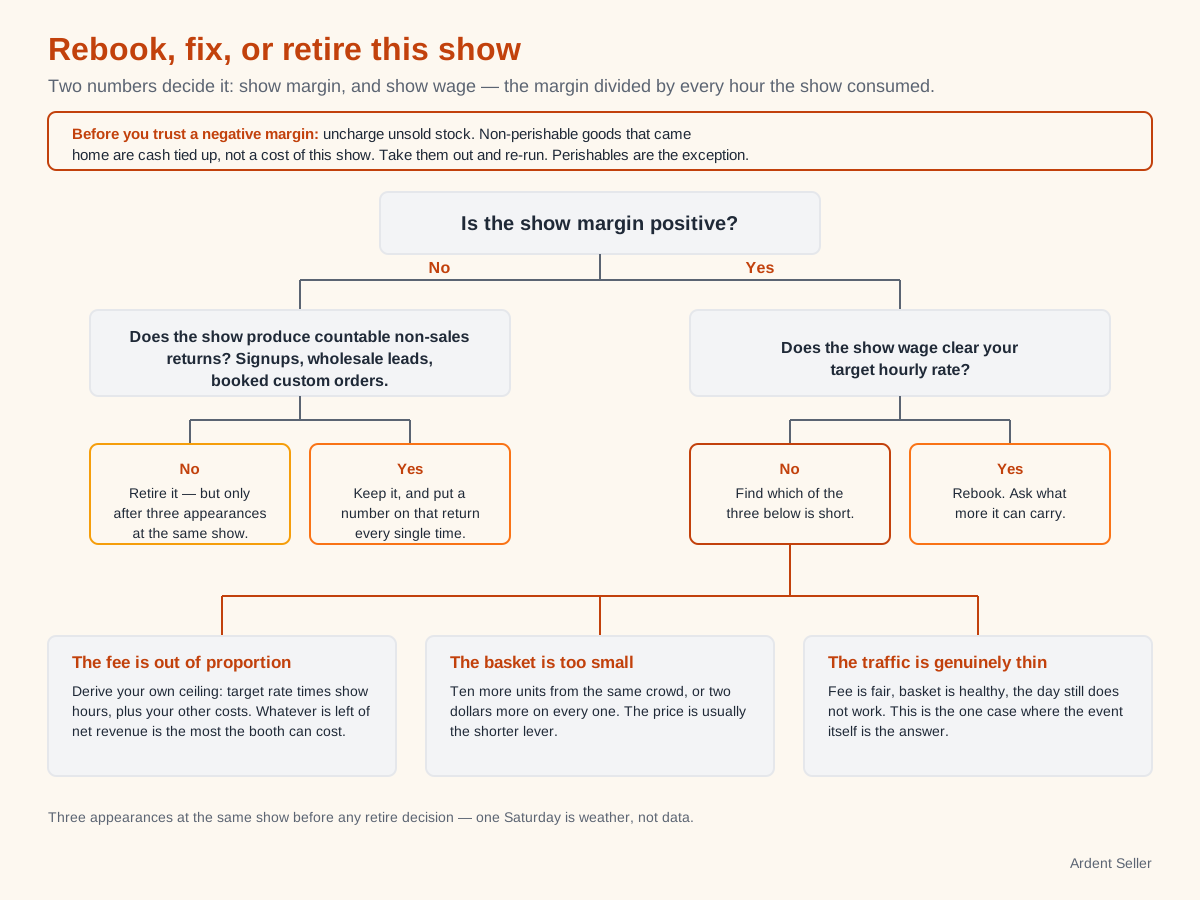
Once you have a show margin and a show wage, the rebook decision stops being a mood and becomes a branch. One thing to settle before you start: every branch below turns on your target hourly rate, so if you have never set one, the hourly-rate calculator will get you a number in a few minutes. Then work through the branches in order.
If the show wage clears your target hourly rate, rebook without agonizing, and change the question. It is no longer "is this worth doing" but "can this carry more" — a second table, a deeper stock of your best three sellers, a helper for setup and teardown so you spend fewer hours on the parts that pay nothing.
If the show margin is positive but the show wage is below your target, find out which of three things is short before you touch anything.
- Is the fee out of proportion? Derive your own ceiling rather than borrowing one. Take your target rate, multiply by the hours the show consumes, add your other show costs and materials, and see what is left over for the booth. Say Wren has settled on $25 an hour as her target. Across 13.1 hours she needs $327.50, and the money available before the booth fee is $344.14 (the $234.14 margin plus the $110 fee she actually paid). That leaves about $16 of room for a booth fee. No realistic fee works at that sales level, which is the useful finding: the fee was never the problem.
- Is the basket too small? The basket is what each customer buys in one visit, and it is the lever most people reach for last. Wren needs roughly $93 more contribution to hit her $25 an hour. That is about ten more units from the same crowd, or $2 more on every candle — and the $2 is worth doing slowly, because $2 across 48 units is $96 at the till but only about $89 in her pocket once the tax-inclusive price and the card fee take their share. That still covers roughly 95% of the gap, and it needs nothing at all from the crowd. When the price is the shorter lever, pull the price. A small, deliberate price change is a faster experiment than a better Saturday.
- Is the traffic genuinely thin? If the fee is reasonable and the basket is healthy and the day still does not work, the event is under-attended for what you sell. That is the one case where the show itself is the answer — but see the next section before you act on a single Saturday.
If the show margin is negative, do not act on it yet. First check whether you charged unsold stock to the day. If you came home with full bins of something that does not spoil and those units are sitting in the margin as a cost, take them out and run the number again — that is the most common arithmetic error in booth accounting, and it makes healthy shows look fatal. If the margin turns positive, go back and work the two branches above instead. Only a margin that is still negative after that is a real result.
If the margin is genuinely negative, the show is only worth keeping if it pays you in something other than sales, and you must be able to name and count it. Email signups at whatever rate your list converts. A wholesale buyer who took a line sheet. Three custom orders booked for the fall. Write those down at the booth, in the moment, or they will not exist on Tuesday. A show that has produced none of them across three appearances is paying you in sales alone, and the sales math has already answered.
Before you decide anything, get three shows
One Saturday is a weather report, not a verdict. A road closure, a competing festival, a heat advisory, a booth spot behind a support pillar, or a rainy forecast that never delivered can each swing a day by half. Good days lie in the same direction.
Three appearances at the same event, ideally in the same season, is enough to separate the show from the day. Keep the format identical every time so the numbers compare: same cost lines, same hour categories, same reconciliation the next morning.
This is also the point where most makers discover their record-keeping is not up to the question, because the answer lives in four places — the card reader's report, a note in a phone, a shoebox of receipts, and memory. Tracking each show as its own sales location solves it structurally: count stock into the booth and back out again, tag the day's sales, fees, and mileage to that event, and the per-event profit is a report rather than an evening's work. That is one of the things Ardent Seller is built to do, and it turns "I think that show went well" into a number you can compare against the same show last year.
What to change before the next one
- Write the two numbers on the same page as the show's name and date. Show margin and show wage. Nothing else compares cleanly across events.
- Log hours as they happen, in a phone note, not from memory on Monday. Memory reliably deletes loading, unloading, and the drive.
- Decide your booth-kit per-show cost once and reuse it all season.
- Capture the non-sales returns at the booth — signups, inquiries, buyer cards — because those are the only defensible reason to keep a thin show.
- Bring a price ladder, not a price. Wren's $22 melt trio outselling the $34 jar three to one is not a failure of the jar; it is information about who walks that particular market, and it should change what she packs next time.
None of this makes the tent lighter or the asphalt cooler. What it does is give you permission — to rebook the show that is quietly working, to raise the price on the show that is nearly working, and to let go of the one that has been costing you Saturdays for two years while you assumed everyone else knew something you did not. They mostly do not. Most vendors have never run this math either.
Run it once on your last show. Then run it after your next one, while the receipts are still in the apron pocket, and start tracking each event's true profit alongside your inventory so the third appearance is already waiting for you.
Related reading
- Farmers Market Mistakes Costing You Money — ten profit leaks specific to recurring market stalls, including the per-event tracking habit this diagnostic depends on.
- Craft Fair Booth Theft Prevention — if the shortfall survives the costing, the other explanation is shrinkage: the four ways product and cash actually leave a booth, and the count that separates a theft from a miscount.
- The Best Card Reader for Craft Fairs and Farmers Markets — if the day's shortfall traces to sales you could not take, this is the device comparison: which readers keep working when the fairground signal dies.
- Best Canopy Tent for Craft Fairs — booth gear shows up as a cost line in this diagnostic; here is how to size that line once, and why a tent that fails the show's fire or weight rule turns a booth fee into a zero-revenue day.
- Selling at Juried Craft Shows — the break-even math to run before you mail the application, plus jury fees and booth setup costs for higher-tier shows.
- How to Run a Pop-Up Shop for a Handmade Business — the venue one step past a booth: you rent the space rather than a pitch, and the same per-event arithmetic has to survive a stock remainder that comes home with you.
- The True Hourly Wage of a Handmade Business — if your all-in figure looked worse than your show wage, the problem is your price rather than your venue; this is the calculation that fixes it.
- Q4 Holiday Runway for Farmers Market Vendors — month-by-month planning for the season when booth fees, stock levels, and show counts all rise at once.
Free resources
Free companion downloads if you want to put any of this into practice:
- Craft Show Prep and Profit Tracker — one printable page per event with the pre-show break-even math, an in-show tracking grid, and the post-show reconciliation that produces the two numbers above.
- Maker Hourly-Rate Pricing Calculator — set the target hourly rate this diagnostic measures you against, and find the price that actually pays it after materials and fees.
- End-of-Month Closeout Checklist — folds show reconciliations into a monthly routine so a season's events are already totalled when you need them.
This article is provided for educational purposes only and does not constitute financial, tax, or business advice. Cost structures, pricing examples, sales tax treatment, and margin figures are illustrative and will vary by your specific circumstances and jurisdiction. Consult a qualified accountant or small-business advisor before making financial decisions based on this content.