How to start a candle business
A practical, step-by-step playbook for turning candle making into a side income or full business — from your first test batch to your first sale.
- Startup cost
- $200 – $1,500
- Time to first sale
- 3 – 8 weeks
- Note: The range is mostly sourcing, dialing in burn and scent throw, and marketplace ramp-up; a focused maker with a wax-and-wick baseline already dialed in can be ready closer to the 3-week end of the range.
- Difficulty
- Beginner-friendly
Last reviewed · Rates, fees, and regulatory thresholds in this guide can change — verify the linked sources before acting.


The short version
Startup cost is low: a few hundred dollars in wax, wicks, fragrance, and vessels gets a first product line into testing within a week. Time to first sale is 3–8 weeks once you factor in a two-week test phase and 1–2 weeks of cure time. The hard parts come after the first pour — fragrance-load and wick sizing so candles burn cleanly, pricing that actually leaves a profit (true cost of an 8 oz soy candle lands around $12–$14 at moderate bulk wax pricing — see step 5 for the full breakdown — so direct retail sits at roughly $24–$28 for a $10–$16 margin), and choosing the right channel. This guide walks through each step in order, with rough cost ranges and links to tools and calculators that handle the math.
Good fit if…
- You enjoy small-batch, repeatable work and care about consistency
- You have $300–$1,000 of starter capital and a ventilated workspace
- You're willing to spend the first month testing instead of selling
- You like the idea of selling on Etsy, at markets, or wholesale to gift shops
Probably not for you if…
- You need income within 30 days — candle businesses ramp slowly
- You can't test in a well-ventilated space (fragrance oils are strong)
- You expect every batch to be perfect from the start
- You're looking for a passive-income product line
Tip: No license is required to make candles at home in most U.S. states — the legal and regulatory bar is low compared to food or skincare.
End-to-end timeline for a soy candle line
A first candle can be poured in a day, but a structured test phase before any first sale is what separates a clean-burning product from a returns problem. The midpoint of the band below is roughly five weeks.
- Source + set up~1 week
Order wax, wicks, fragrance, vessels, scale, and thermometer. Set up a ventilated workspace.
- Test batches1–2 weeks
Iterate on wick + fragrance combinations against your chosen wax and vessel.
- Cure1–2 weeks
Soy and coconut-soy waxes need 1–2 weeks of cure to reach peak scent throw.
- Photograph + list1–2 weeks
Shoot product + lifestyle photos, write listings, finalize labels and pricing.
3–8 weeks to first sale
The 8-step playbook
Run these in order. Skipping ahead is the most common reason new makers ship inconsistent product or under-price their work.
Step 1: Learn the craft — wax, wicks, and fragrance
Before spending money on inventory, build a working mental model of how the three core variables interact. A wrong combination wastes wax and produces candles that tunnel, smoke, or never throw scent.
Wax options compared
Most new makers pick soy or a coconut-soy blend — they have the gentlest learning curve and CandleScience's beginner content leads with a soy candle tutorial. The trade-offs across the four common waxes:
| Option | Cost per lb (small order) | Scent throw | Burn profile | Buyer perception |
|---|---|---|---|---|
Soy The default starter wax. | $3–$5 | Good at 6–10% load | Clean, low soot | Natural / clean |
Coconut-soy blend Step-up for a premium line. | $4–$6 | Strong at 6–10% load | Smooth finish | Premium natural |
Paraffin Strongest throw, lowest cost. | $2–$4 | Strongest | Strong, can soot | Mixed (petroleum-derived) |
Beeswax Premium unscented or lightly-scented. | $10–$15 | Mild — competes with FO | Slow, golden, light honey scent | Premium natural |
Cost ranges are small-order retail at 10–25 lb — typical first-purchase quantity per step 3. Major suppliers (CandleScience, Lone Star, The Flaming Candle) publish tiered pricing in which case-level bulk (45–50 lb) generally runs 20–30% lower per pound, with steeper drops only at pallet quantities — compare your supplier's tiered schedule before locking in a cost model.
The three core ingredients of any candle are wax, wick, and fragrance oil. Every other ingredient — color dye, additives, glitter — is optional. Get these three right and the rest is finishing.
Wax options for beginners
- Soy wax (most common starter wax) — clean-burning, made from soybean oil, easy to source, melts at ~120–125 °F. Holds fragrance well at 6–10% load.
- Coconut-soy blends — smoother finish than pure soy, better scent throw, slightly more expensive. Popular for premium lines.
- Paraffin — strongest hot throw, lowest cost, but petroleum-derived. Some buyers avoid it for that reason; many candle brands still use it.
- Beeswax — premium, naturally golden, faint honey scent. Burns very slowly. Better for unscented or lightly-scented candles because it competes with strong fragrance oils.
Soy and coconut-soy blends are the most commonly recommended starter waxes — the learning curve is gentler than for paraffin or beeswax. CandleScience's learning library (opens in new tab) leads with a soy candle beginner tutorial alongside soy-wax selection and troubleshooting guides; Lone Star Candle Supply's Candle Making University (opens in new tab) and The Flaming Candle's Resource Hub (opens in new tab) cover wax types alongside fragrance-load calculators, wick guides, and step-by-step articles.
Wicks are sized by the diameter of the candle and the wax type. A wick that's too small tunnels (burns straight down the middle leaving wax on the walls); one that's too big smokes, mushrooms, or burns dangerously hot. Wick sizing isn't intuitive — every wax and vessel combination needs testing.
Fragrance load is the percentage of fragrance oil to wax by weight. Soy and coconut-soy blends typically max out around 8–10% (see the supplier technical sheets linked below for the specific wax you're using — CandleScience, Lone Star, and Flaming Candle all publish per-wax max-load specs). Above that, the wax can't hold the oil and it weeps out the top, refuses to harden, or creates "wet spots" against the vessel. Below 4%, the candle has almost no scent throw. Each fragrance oil also has a manufacturer-specified maximum load — go above it and the candle becomes a fire hazard, not just a bad product.
Spend a week reading the supplier learning libraries linked above — CandleScience, The Flaming Candle, and Lone Star Candle Supply all publish per-product technical content alongside tutorials — before buying anything. Supplier guidance tied to the specific product you're using is more reliable than informal video tutorials when you need an exact wax-and-wick spec to start from; always cross-check specs against the sheet for the product on hand.
Step 2: Set up the legal & business basics
Candles don't require a license or permit in most jurisdictions, but the basic business setup still matters — for taxes, liability, and being able to sell on platforms like Etsy and at wholesale shows.
Compared to food or skincare, candle businesses face a relatively light regulatory load in the United States. A food handler's permit, cottage food registration, and FDA approval are generally not required. What you do need:
- A business structure. Most candle makers start as a sole proprietorship (no filing required in most states) or form a single-member LLC for liability separation. LLC filing fees vary by state (often a low-hundreds one-time fee — check your Secretary of State for the exact number). The SBA's guide to choosing a business structure (opens in new tab) is a useful starting point for the structure decision itself, and an LLC is the right choice once sales become regular.
- An EIN (Employer Identification Number). Free from the IRS via the EIN application page (opens in new tab), completed online in a few minutes. Required if you form an LLC, sell wholesale, or want to keep your SSN off W-9s.
- A state sales-tax permit. Required in every U.S. state that has a state sales tax — that's most of them; only Alaska, Delaware, Montana, New Hampshire, and Oregon do not levy a state-level sales tax (see the Tax Foundation's state and local sales-tax rates report (opens in new tab) — current edition as of the "last reviewed" date above; Alaska localities can still impose local sales tax) — if you sell directly to consumers locally, even at a single farmers market. Etsy acts as a marketplace facilitator and collects and remits sales tax in most marketplace-facilitator states; a state permit is still typically required to operate as a business — verify your own state's marketplace-facilitator rules.
- Product liability insurance. Candles cause fires, get spilled, and occasionally crack vessels. ACT Insurance (opens in new tab) and Indie Business Network (opens in new tab) are two maker-focused programs to compare — confirm candle-making is an accepted class with the carrier before relying on a quote, since fire-risk products are sometimes excluded. Quotes vary widely by coverage limits, state, and carrier, so get an actual quote before budgeting. Required to sell at most craft fairs and to most wholesale buyers.
- Required labels. Federal law (the Fair Packaging and Labeling Act (opens in new tab), administered by the FTC) requires two things on the package: the net weight of the wax, and the manufacturer or distributor name and address. The standard "Warning: To prevent fire and serious injury…" three-bullet fire-safety warning is not mandated by the FPLA — it is codified in the industry's voluntary ASTM F2058-07(2021) candle fire-safety labeling standard (opens in new tab) (paid standard, ~$72) and recommended by the National Candle Association (NCA) (opens in new tab), which publishes downloadable safety pictograms (the three-icon "Burn within sight," "Keep away from combustibles," and "Keep away from children" set). It is voluntary, but in practice most retailers, craft fairs, and wholesale buyers expect to see the warning, so plan to include it.
Two things people often over-do at this stage: forming an LLC before having any sales (start as a sole prop, upgrade later), and buying complex software (a notebook works for the first 20 batches).
Regulatory notice: Federal labeling is required on every candle
The Fair Packaging and Labeling Act requires net weight and the manufacturer/distributor name and address on every candle sold in the U.S. The standard three-bullet fire-safety warning is not an FPLA mandate — it is the industry voluntary ASTM F2058-07(2021) standard (wording codified there, recommended by the National Candle Association). It is voluntary, but in practice most retailers, craft fairs, and wholesale buyers expect to see it, so plan to include it. California sellers should also check Prop 65 for fragrance ingredients above the safe-harbor threshold — see the OEHHA warnings site at p65warnings.ca.gov.
Step 3: Buy starter equipment & supplies
Resist the urge to buy in bulk before you've tested. The right list is small, cheap, and lets you produce real candles you can hold in your hand within a week.
A workable starter kit for a soy or coconut-soy candle line, sized to produce ~50 candles for testing and gifting:
- Wax (10–25 lb / 4.5–11 kg): $30–$75. Buy one wax to start — don't mix experiments.
- Wicks (assortment pack of 3–5 sizes): $15–$25. You will burn through these testing; buy the variety pack, not a single size.
- Fragrance oils (3–4 scents, 1 oz / 28 g each): $20–$40. Pick scents that don't compete for the same buyer — one fresh, one warm, one floral, one seasonal.
- Vessels (24–36 of one size): $50–$120. Match the vessel diameter to wick sizing data from your supplier. Heat-tolerant glass jars, tins, or ceramic.
- Pouring pitcher / pot: $15–$30. Aluminum with a spout.
- Digital scale (0.1 g resolution, >5 kg capacity): $20–$40. The single most important tool — fragrance load is by weight, not volume.
- Thermometer (instant-read, 50–250 °F): $10–$25.
- Wick stickers + wick centering tool: $10. Holds wicks straight while wax cools.
- Labels (waterproof, oil-resistant): $15–$30 for a starter sheet.
Total starter outlay: typically $185–$395, plus whatever you spend on labels and packaging.
Set up a dedicated workspace with good ventilation. Fragrance oils are strong; a closed kitchen will quickly become unbearable. Cover any surfaces — spilled wax on countertops, sealed wood floors, or fabric is a multi-hour cleanup.
Once you've tested and have a repeatable product, the next supply order should jump in size — at most major candle-wax suppliers, case-level bulk pricing (45–50 lb) runs roughly 20–30% lower per pound than 10–25 lb starter orders — but only buy in bulk once you're confident the wax works for your line.
Step 4: Test, document, and refine
This is the step new makers skip and regret. Two to four weeks of structured testing — before any sales — is the difference between a clean-burning, scent-throwing candle and an inconsistent product that customers complain about.
Burn-testing isn't optional. A candle that looks fine in the pour might tunnel after the first burn, develop wet spots after 48 hours, or burn too hot and become a fire-safety risk once it's in a buyer's home.
What to test, for every wax + vessel + wick combination
- Full melt pool — within 2–4 hours, the wax should melt to the edges of the vessel. Tunneling means the wick is too small for the diameter.
- Cold throw — the scent of the unlit candle. Strong, recognizable, not chemical.
- Hot throw — the scent when burning. This is what the customer actually buys. Test in a normal room, not a closet.
- Flame stability — no smoking, mushrooming, or jumping flame.
- Cure time — soy candles need 1–2 weeks of cure (just sitting) before they reach their best scent throw. Test at 1 day, 1 week, and 2 weeks for the same recipe.
- Adhesion — wax should stay tight against the vessel walls without wet spots or pulling away.
Keep a paper or digital log. For every test batch record: wax type and amount, fragrance oil and percentage, wick used, pour temperature, ambient temperature, cure time, and a rating for each of the six criteria above. This becomes your recipe library — and the proof you'll need if a customer ever complains.
Fragrance-load safety. Above the manufacturer's stated maximum, fragrance oil weeps from the wax and the candle becomes a fire-safety risk, not just a bad product. Suppliers' max-load specs are typically derived from the IFRA Standards library (opens in new tab), which publishes searchable per-ingredient limits (each ingredient links to a PDF spec). Always work to the supplier sheet for the oil you're using.
Expect multiple rounds of testing before a recipe is sale-ready — burn-testing is iterative, and the first attempt is almost never the right combination. Bake it into your timeline rather than treating it as a one-shot exercise.
Once a test batch passes all six checks, the Recipe Scaling and Batch Calculator below sizes the recipe up to larger pour counts without recomputing the fragrance load by hand each time.
Safety warning: Fragrance load above max is a fire-safety risk
Above the fragrance oil manufacturer's stated max usage rate (derived from IFRA Standards), the wax can't hold the oil — it weeps, the candle becomes structurally unstable, and the flame can burn dangerously hot. Always work to the supplier sheet for the specific oil you're using, not a generic "10% max" rule.
Step 5: Price your candles to actually make money
CandleScience's candle-pricing guide (linked below) warns explicitly against under-pricing for new candle makers. The worked example below shows why — once labor and overhead are honest, a $12–$14 true cost can't be recovered at retail prices below roughly $24.
CandleScience's candle-pricing guide (opens in new tab) documents two frameworks — a multiplier method (roughly 2× cost for wholesale and 3–4× cost for direct sales) and a margin method (a 25–50% margin is a starting point for a new candle business). The multiplier framework is easier to model layer-by-layer:
Wholesale price = (materials + labor + overhead) × 2
Direct retail price = wholesale × 2 (≈ 4× cost)
That puts the retail price you charge at a market or on Etsy at roughly four times your true cost — otherwise wholesale buyers won't be able to mark you up to a price that matches what you charge direct. (If you only ever sell direct and never wholesale, you can land closer to 3× cost; the 4× math applies once wholesale buyers enter the picture.)
What "materials" actually includes for a single 8 oz soy candle
- Wax: ~$0.95 per candle once your recipe is locked in and you're buying at 50 lb case pricing (roughly 7 oz / 200 g of soy at ~$2.15/lb); plan on $1.30–$2.20 per candle while you're still on small-order 10–25 lb starter quantities
- Fragrance oil: ~$3.80 (≈ 0.42 oz / 12 g at 6% of wax weight, illustrative $9/oz oil — fragrance oils run roughly $3–$15/oz depending on supplier, order size, and scent complexity, so substitute your own per-oz cost here)
- Wick + sticker: ~$0.25
- Vessel: ~$2.50
- Label: ~$0.40
- Box / packaging: ~$1.00
- True material cost (illustrative): ~$8.90
The numbers above are illustrative mid-range estimates for a soy or coconut-soy line at a moderate 6% fragrance load and assume you've reached bulk-supplier wax pricing. Your actuals will shift with the wax type, the load percentage you settle on (step 1 calls out 6–10% as the working range for soy and coconut-soy, with scent throw dropping off below about 4%), the fragrance oil's per-oz price, the vessel choice, and — most relevant in month one — whether you're still buying wax in 10–25 lb starter quantities (which would push the materials cost ~$0.85–$1.75 higher per candle, taking the materials line to roughly $9.75–$10.65 and the true cost into the mid-teens until volume catches up).
What "labor" includes: the time to weigh wax, melt, add fragrance, pour, wick, label, package, and clean up. For a 12-candle batch, a workable starting estimate is 60–120 minutes — track your own pace across the first few batches to dial in the real figure. At an illustrative $22–$26/hr labor rate, that adds roughly $2–$4.50 per candle. That band is anchored above the published wage benchmark: the BLS Occupational Employment and Wage Statistics (opens in new tab) table for the "Craft Artists" wage-worker occupation (SOC 27-1012) reports a median hourly wage of roughly $22/hr in the most recent OES release (verify against the current release at the link); that survey excludes self-employed makers, so a self-employed rate that accounts for self-employment taxes and the absence of employer benefits should typically run somewhat higher than the BLS median — which is why the example sits a little above it rather than at it. Use the Hourly Rate Pricing Calculator below to model your own.
Overhead: electricity, workspace, insurance, Etsy fees, packaging materials not in the per-unit cost. A workable starting estimate is 15% of materials + labor when you don't yet have actual overhead figures — refine the number once you have a few months of real expense data.
That puts the true cost of a hand-poured 8 oz soy candle around $12–$14 for a typical batch pace — the upper end of the $22–$26 labor range paired with slower 120-minute batches can push it into the mid-$14s, so treat $14 as a soft ceiling rather than a hard one. A defensible direct-sale-only retail price lands around $24–$28 (≈ 2× true cost — viable if you only ever sell direct to consumers). If you ever plan to wholesale, your direct retail price floor rises to roughly $48–$56 (4× cost) so that a wholesale buyer purchasing at 2× cost (≈ $24–$28 per candle) can still mark up to match your direct price. Note that $48–$56 is what you charge the end consumer — not what you charge the shop; the shop pays the ~$24–$28 wholesale figure. Any direct retail price below ~$24 at the illustrated $12–$14 true cost loses money once labor and overhead are honest — before setting your own price, run an Etsy search for "handmade soy candle 8oz" and compare what you see to the math you just ran.
That leaves a per-candle direct-sale margin of roughly $10–$16 — the gap between the $24–$28 retail price and the $12–$14 true cost. This is the figure step 6's booth-fee break-even math leans on; in months you're still on small-order wax pricing, the margin band narrows by roughly $1–$2.
The pricing calculators linked below run this math for you — pick the one that matches how you want to think about it.
Step 6: Choose where to sell
There is no single "best" channel. Each comes with trade-offs in fees, foot traffic, customer expectations, and how much hand-holding the buyer needs.
The four most common starting channels for candle makers:
- Etsy — large built-in audience, but several fee layers stack against your sale. Per Etsy's Fees and Payments Policy (opens in new tab) (verify current rates before relying on these numbers): a $0.20 listing fee per item, a 6.5% transaction fee on the sale + shipping, plus US payment-processing of ~3% + $0.25 per order, plus an Offsite Ads fee that applies only to sales Etsy attributes to its own off-site ad placements (shops with over $10K USD in sales in the past 365 days are enrolled mandatorily and pay 12% on those Offsite Ads conversions; smaller shops are enrolled by default at 15% on those Offsite Ads conversions but can opt out of the program entirely). For a worked example: on a $24 item with $6 shipping (a $30 order total), a non-Offsite-Ads sale runs roughly $0.20 listing + 6.5% × $30 = $1.95 transaction + ~3% × $30 + $0.25 ≈ $1.15 processing = ~$3.30 — about 11% of the $30 order, or ~14% of the $24 item price; if Offsite-Ads applies, add 12–15% of the $30 order total (Offsite-Ads is charged on the full order, shipping included) on top. The full worked breakdown — including the Offsite-Ads case — lives in our Etsy fees FAQ. Etsy is a visual-first marketplace; product photography quality is a key competitive lever for new shops (step 8 covers this in detail). A good starting point if you want built-in marketplace traffic without building a storefront from scratch — though the stacked fee load above needs to be modeled against your margins.
- Farmers markets & craft fairs — high margin (no platform cut), face-to-face feedback, and the buyer can smell the product. Booth fees vary widely — small local markets often run under $100/day while juried holiday or regional shows can run several hundred — confirm with the organizer and model break-even against your own booth cost. For illustration only: at a $24–$28 retail price, you cover the gross of a $200 booth in roughly 7–9 candles sold (booth ÷ sale price) — but gross revenue isn't profit. To actually walk away with money you also need to cover per-candle COGS, so the real target is higher: plan on roughly 13 candles (at the $16 high-margin end) to 20 candles (at the $10 low-margin end) — that is the $200 booth divided by your step-5 $10–$16 per-candle margin. Smaller markets break even much sooner.
- Wholesale to local gift shops — predictable repeat orders, lower per-unit revenue (you make wholesale price, the shop makes retail). Build a wholesale line sheet with photos, retail prices, MOQ (minimum order quantity), and lead time. Established wholesale relationships often run on Net-30 payment terms; for a first order, many indie makers ask for payment up front or a deposit until trust is built.
- Your own Shopify / Squarespace store — no platform cut, full design control, but you have to drive every visitor yourself. Typically a "phase 2" channel after Etsy or markets have built up a base of repeat customers and an email list large enough to drive recurring traffic on its own — there's no magic threshold; a common signal is needing to manually re-invite the same buyers at each launch, at which point a dedicated store becomes more practical.
A common opening combination is Etsy plus local farmers markets — Etsy brings built-in traffic while markets give direct feedback and full-margin sales. Pick one to start, ship for 4–8 weeks, then layer the second.
Whichever channels you choose, you'll need to track inventory across all of them so you don't oversell a scent that just ran out. That's the operational problem step 7 solves.
Step 7: Track inventory, costs, and taxes from day one
Once you have a working product and a place to sell it, the operational reality kicks in — what wax is left, which scents are profitable, what you owe in quarterly taxes, and which orders haven't shipped.
For the first 20–30 batches a notebook or spreadsheet is genuinely fine. The volume is low and you remember everything.
Past that point the math becomes brittle. Common breakdowns:
- You buy fragrance oil in 4 oz bottles but recipes call for grams — manual unit conversion errors creep in.
- Wax goes up at your supplier and your prices don't move because nobody recalculated.
- An Etsy order ships, but you forget to deduct the wax, wick, and vessel from inventory — and oversell next week.
- Tax time arrives and you can't tell the IRS what you paid for the wax that went into the candles you sold.
- A wholesale buyer asks for batch traceability and you can't produce it.
A rough heuristic: once you're tracking 20–30 batches across several scents, spreadsheet workflows tend to become error-prone — that's typically when a dedicated tool starts to pay for itself. The Spreadsheet vs. Inventory Software Decision Guide below helps you judge when to make the switch, and the Tools section further down compares Ardent Seller alongside the point-of-sale and bookkeeping tools most makers end up using.
Step 8: Market without burning out
You don't need a TikTok strategy to sell candles. You need photos that show scale, a story that means something, and a way for happy customers to come back.
Strong photography is one of the easiest levers a new candle maker can pull on. Etsy is a visual-first marketplace, and Etsy's own Seller Handbook photography category (opens in new tab) maintains an entire library of guides on it for a reason — the lead photo is what stops the scroll on a search results page.
What works for candle photography:
- Natural light from a window, never overhead kitchen lighting
- A neutral surface (linen, wood, raw concrete) — not the kitchen counter
- A scale prop (a hand, a coffee cup) so buyers understand the candle's actual size
- One lifestyle shot showing the candle in context (a bedside table, a bathroom shelf)
- A close-up of the flame burning — proves the candle works
Beyond photos, the two highest-leverage marketing activities are:
- Email list. Capture emails at every farmers market with a simple "10% off your next order" card. Even at a modest conversion rate, a few hundred subscribers produces repeat orders with no additional ad spend — actual conversion varies heavily by list quality, offer, and scent line, so model your own from the first few sends rather than working off a generic benchmark.
- Repeat customer focus. The cheapest sale to make is the second one to someone who already bought. A hand-written thank-you note with the first order, paired with a simple "what scent next?" question, is a low-cost habit that's hard to mess up — the downside risk is near zero even if uplift turns out to be modest.
Three activities are typically a poor investment in the first six months: paid Etsy ads (at sub-$30 retail prices, CPC and conversion math can easily compress or eliminate per-candle margin — model your actual cost-per-conversion before committing ad spend), TikTok content (the production-time investment is large for an unproven audience), and influencer outreach (small candle brands rarely have the margin to support paid placements). These can all become useful later — they're just expensive ways to learn marketing in month one.
The tools section
Tools to consider
A short, honest list — Ardent Seller alongside the other tools most candle business owners end up using.
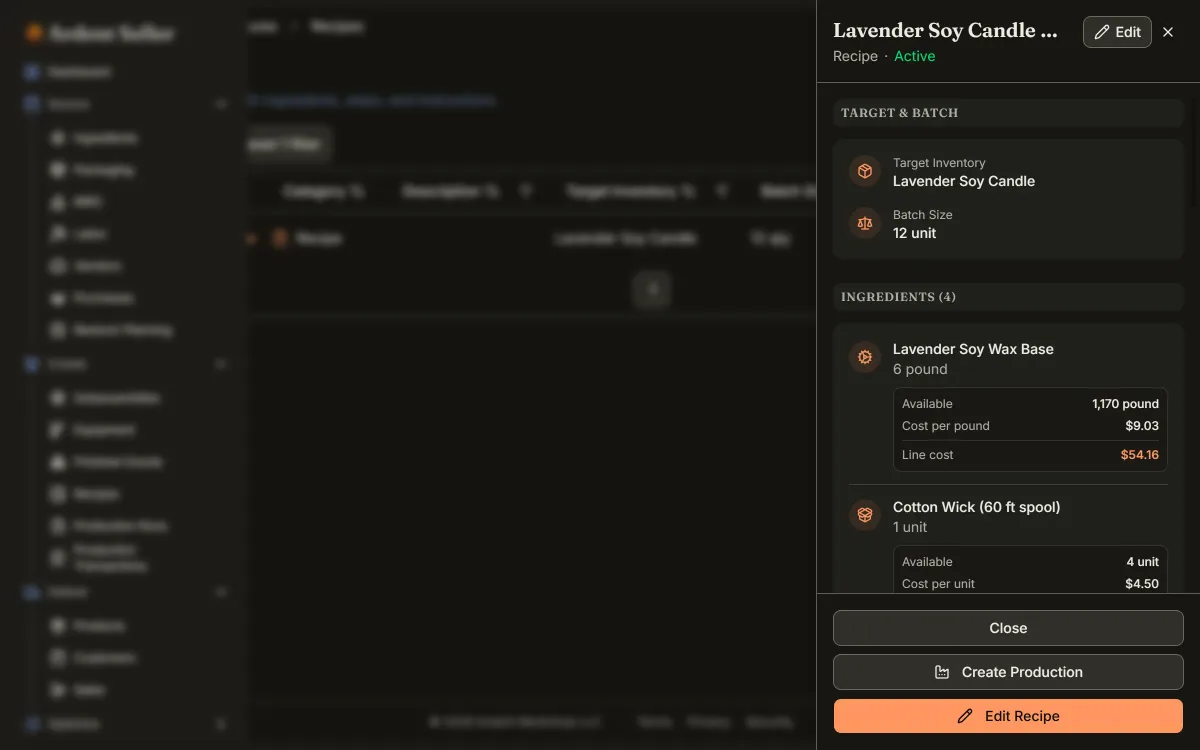
Track every wax, wick, fragrance oil, and vessel as inventory; build candle recipes as reusable subassemblies; auto-generate SKUs across scent/size/vessel; see true per-candle cost including labor. Etsy sync is included on every plan — even the Free plan — so a one-shop Etsy seller can sync listings, orders, and inventory at no cost; paid plans add more connected shops, higher limits, and deeper reporting.
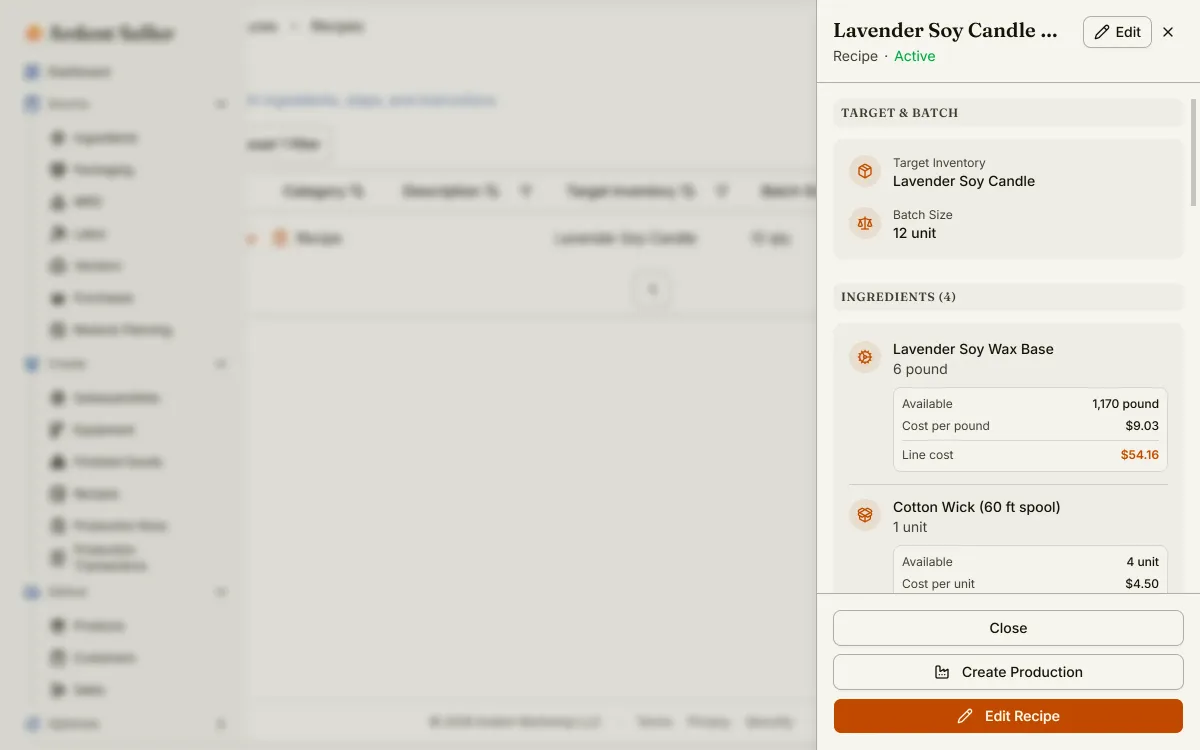
Standard for tracking income and expenses for tax purposes. Categorizes purchases automatically and exports a Schedule C summary at year-end. Pricing changes — see Intuit's pricing page for current rates.
Free design tool for labels, packaging, and Etsy listing graphics. Has candle-label templates to start from — add the FPLA-required elements (net weight, manufacturer name/address, NCA safety warnings) yourself using the NCA downloadable pictograms referenced in step 2.
Free POS app for in-person sales at markets. Handles card payments, basic inventory, and email-receipt capture for building your list.
A common first channel for candle makers — built-in marketplace traffic means less work to surface a new shop to its first few dozen buyers. Be aware of the stacked fee load (listing + transaction + payment processing, plus optional offsite-ads — see Etsy's Fees and Payments Policy) and the offsite-ads opt-out rules.
Common mistakes to avoid
The patterns that show up over and over in the first year.
Skipping cure time
Soy and coconut-soy waxes need 1–2 weeks of cure before they hit peak scent throw. Selling a 2-day-old candle means the buyer experiences your weakest product. Bake cure time into the production schedule, not an afterthought.
Buying wax in 50 lb bags before testing
A 10 lb test bag costs $30; a 50 lb bag costs $110. The per-pound difference looks great until the wax doesn't work with your vessels and you have 40 lb of unusable wax. Lock in a recipe first, then scale the purchase.
Pricing based on what competitors charge on Etsy
Anchoring your price to what other Etsy candle listings show is risky — the supplier pricing guides linked in step 5 (CandleScience in particular) are explicit that the prevailing low-end handmade-candle prices often don't cover labor, fees, and true overhead. Run the numbers on your own materials, labor, and overhead first (step 5 has the formula), then check if the market will bear that price.
Treating fragrance load as optional
Going above the manufacturer's max usage rate is a fire-safety issue, not a flavor issue (see step 4 for the IFRA Standards library that suppliers reference). Use the supplier sheet for the oil you're working with rather than guessing, and run the fragrance-load calculator linked above to size the pour.
Mixing personal and business money
Open a separate checking account on day one — even before you form an LLC. At tax time the difference between five minutes and five hours of bookkeeping is whether the candle purchases sit in their own account.
Frequently asked questions
The questions new makers ask most often.
Do I need a license to sell candles?
In most U.S. states, no specific candle-making license is required. You will typically need a general business license or registration with your state or city, a sales-tax permit if your state has sales tax, and product liability insurance to sell at most craft fairs or to wholesale buyers. Candles are not regulated by the FDA because they are not consumed.
How much does it cost to start a candle business?
A realistic starter outlay is $200–$1,500. The minimum to produce ~50 testing candles is around $185–$395 in wax, wicks, fragrance, vessels, and basic tools. Add a first-year insurance quote (varies by carrier, coverage limits, and state — typically a few hundred dollars for a small line), an LLC filing fee if you form one (varies by state — often a low-hundreds one-time fee, sometimes higher in states like California and Massachusetts), and $50–$200 for initial labels and packaging. Many makers start lean at $300–$500 and reinvest revenue into inventory expansion.
How long does it take to start selling candles?
Following the steps in this guide, plan on 3–8 weeks from start to first sale: roughly one to two weeks of test batches, one to two weeks of cure time on the recipe you settle on, and one to two weeks to photograph, label, list, and price. The test phase is the step new makers most often try to compress — and it is the single most reliable predictor of whether your first saleable batches are consistent or need rework.
What's the most profitable candle to make?
A common starting configuration is an 8–12 oz candle in a quality vessel (ceramic, frosted glass, amber jar). Step 5's worked example puts the illustrative true cost of an 8 oz candle around $12–$14 (your actuals will shift with the wax type, fragrance load, fragrance-oil price per oz, and vessel — see step 5 above for the full breakdown). A 10–12 oz candle uses more wax, more fragrance, and a larger vessel, so its true cost runs meaningfully higher than the 8 oz baseline — model each size on its own before pricing it. Applying the 2–3× direct-sale multiplier most candle makers land on to each size's own cost yields roughly $24–$42 retail (8 oz at $24–$28, larger 10–12 oz sizes climbing into the $32–$42 band as both cost and size grow). Below $20, the math is hard to make work after fees and labor; above $45, buyers typically expect premium presentation that adds packaging cost. Many new makers find the easiest unit economics in a 9 oz vessel across 4–6 signature scents — model your own numbers before committing.
Can I make candles in my kitchen?
Yes — most home candle businesses start in a kitchen. The two requirements are good ventilation (fragrance oils are strong and accumulate quickly) and a workspace you don't mind getting wax on. As you scale past 20 candles per pour, a dedicated work area becomes more practical than dragging equipment in and out of the kitchen.
Do I need product liability insurance for candles?
Strongly recommended. Candles cause house fires, get knocked over, and occasionally crack vessels. Most craft fairs and wholesale buyers require proof of liability insurance, often with a per-occurrence minimum specified on the vendor application — check each show's packet for the exact figure. ACT Insurance and Indie Business Network are two maker-focused programs to compare; pricing varies widely by coverage limits, carrier, and state, so get an actual quote before budgeting. Operating without insurance is a meaningful personal-finance risk.
What labels do I have to put on a candle?
U.S. federal law (the Fair Packaging and Labeling Act, administered by the FTC) requires two things on every candle sold: net weight (e.g. "Net Wt 8 oz / 226 g") and the manufacturer or distributor name and address. The standard three-bullet fire-safety warning (starting with "WARNING: To prevent fire and serious injury…") is not an FPLA requirement — it is the industry voluntary ASTM F2058-07(2021) standard, with wording recommended by the National Candle Association. It is voluntary, but in practice most retailers, craft fairs, and wholesale buyers expect to see it, so plan to include it. California sellers should also check California's Proposition 65 via the OEHHA Prop 65 warnings site (p65warnings.ca.gov) — a warning may be required if a fragrance ingredient appears on the OEHHA chemical list above the safe-harbor threshold. The NCA publishes downloadable safety pictograms (see the link in step 2 above).
Where should I sell my candles first — Etsy or local markets?
For most new candle makers, Etsy and local markets are both viable starting points and many makers run them in parallel. Etsy provides built-in traffic but stacks a listing fee, transaction fee, payment processing, and an Offsite Ads fee that applies only to sales Etsy attributes to its own off-site ad placements (mandatory at 12% on those Offsite Ads conversions for shops over $10K in sales over the past 365 days; smaller shops are enrolled at 15% on those Offsite Ads conversions by default but can opt out of the program entirely). On a $24 item with $6 shipping (a $30 order) the non-Offsite-Ads fees work out to roughly $3.30 — about 11% of the $30 order, or ~14% of the $24 item price. Step 6 above has the full worked breakdown, including the Offsite-Ads case — and verify current rates against Etsy's Fees and Payments Policy. Etsy also demands strong photography; local markets keep all the margin but require booth fees and weekend availability. If your photography is weak, markets are easier to start. If your weekends are committed, Etsy is the better fit.
Free resources
Hand-picked calculators, checklists, and templates that map directly to the steps above.
Pick a wax or soap base, enter your batch size, and get the exact fragrance oil weight — plus the typical and max load for that medium and the cost per unit.
Pick container diameter, wax family, and fragrance load — get starting wick recommendations across the CD, ECO, HTP, LX, CDN, RRD, and Zinc series with construction notes.
Pick a target hourly rate, enter your materials, hands-on minutes per unit, and platform fees — the calculator returns the minimum price that actually pays you that rate after fees and costs. Maker-business specific, not a "freelance day rate" tool.
36 things to set up before — and after — your first sale. Inventory, pricing, and the legal essentials in one place.
A working Excel inventory tracker for makers — raw materials, finished goods, packaging, and a purchase log. Reorder thresholds and a status column do the math; conditional formatting flashes red when you are below the line.
A free, scoped-for-small-sellers economic-nexus checker. Enter your trailing 12-month sales and transactions per state, and the tool flags every state where you have probably crossed the post-Wayfair economic-nexus threshold — without pushing you into a filing product.
Live web version of our Excel pricing calculator. Materials + labor + packaging + platform fees → defensible retail at your target margin, with batch-pricing tiers.
A working Excel recipe scaler — enter a base recipe, set a target yield, and every ingredient auto-scales with unit conversions (oz/g/lb/ml/cups). Plus a batch-cost tab and a unit-conversion reference.
When a spreadsheet is enough, when it stops working, and how to tell the difference before it costs you.
Walk through the nine factors of Treasury Regulation §1.183-2(b) and find out whether your side activity qualifies as a for-profit business or a hobby for federal tax purposes — and where to focus to strengthen the business case.
Read next
Deeper dives on the topics that come up in the guide.
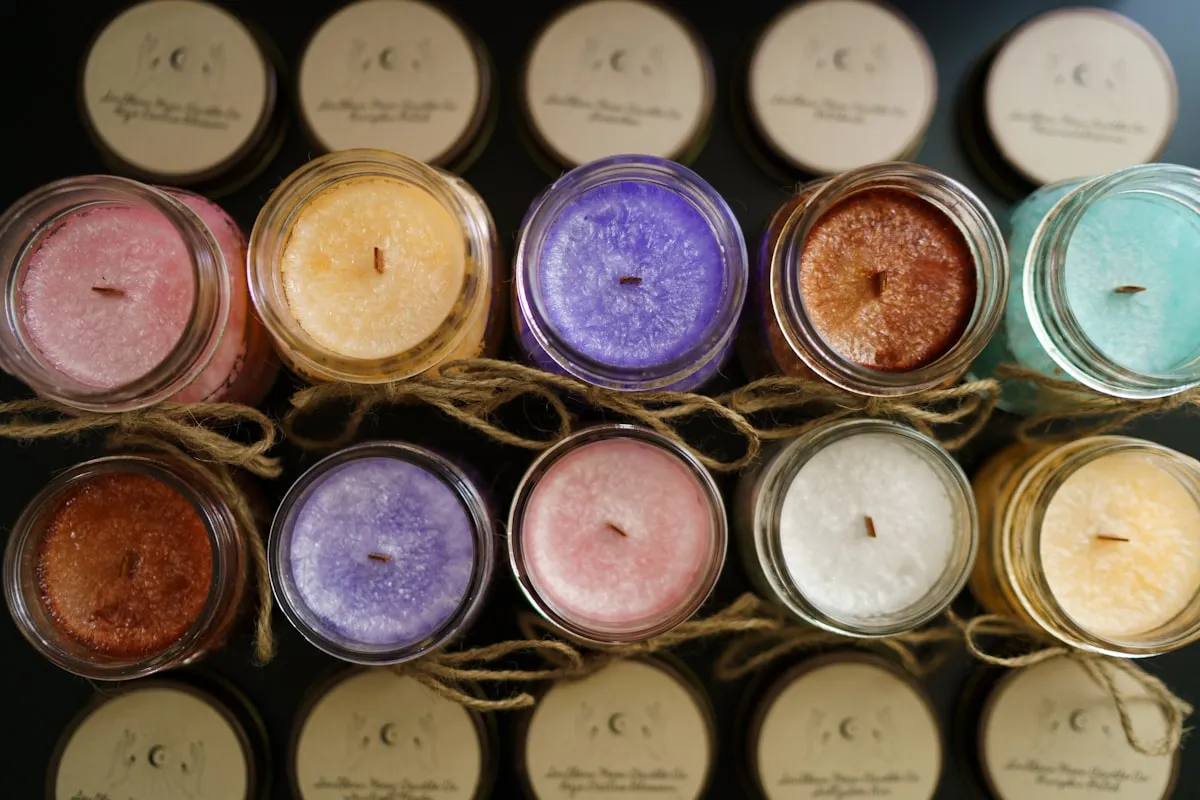
Most candle makers price their jars by glancing at what the booth next door charges and rounding up. Meanwhile the math underneath — wax yield, fragrance load percentages, wick and vessel cost, the wholesale fragrance oil that spoiled because nobody tracked its shelf life — is quietly setting a floor that most sellers are charging below. Here is how to cost a candle from the wax up, walk through three real pricing scenarios, and land on a per-candle number you can defend.
Soap making has unique inventory challenges — lye ratios, cure times, fragrance costs by weight, and batch-level oil tracking. This guide covers exactly how to manage ingredients, track batches, and calculate the real cost of every bar you make.
Once you're selling, you'll need to track it
Tracking inventory, costs, and taxes across every batch and every channel is the operational reality once sales start. Ardent Seller is purpose-built for this.
Candlemakers, chandlers & wax artisans
Ready to start?
Track every batch, recipe, and sale from day one of your candle business. Free plan, no credit card.