Wholesale pricing: is it half of retail?
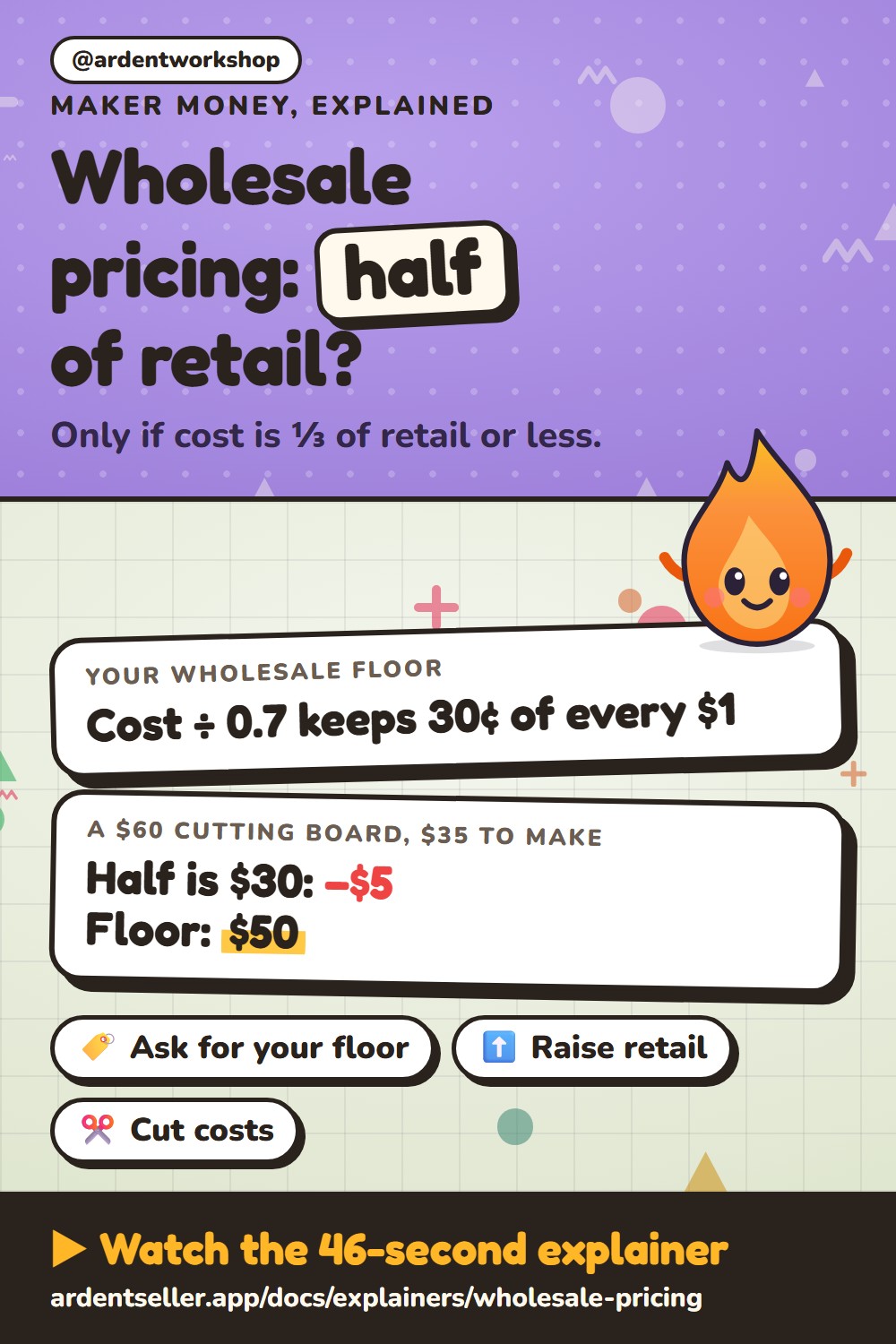
Most shops expect to pay about half your retail price. That works only if your cost is about a third of retail or less. Your wholesale floor: cost ÷ 0.7 keeps 30¢ of every dollar.
Wholesale means a shop buys your products at a discount and resells them at full price. The usual benchmark, keystone pricing, sets the wholesale price at half of retail, and the shop doubles it. Keystone sets the shop’s margin; it says nothing about yours. Start from your full cost instead (materials, packaging, your time and a share of overhead) and divide it by 1 minus the margin you want to keep: for 30 cents of every dollar, that’s your cost ÷ 0.7. At that margin, half of retail covers you only when your cost is 35% of retail or less, about a third. The video works it through for a woodworker’s $60 cutting board that costs $35 to make: half of retail is $30, a $5 loss on every board, while the floor is $50. If your floor is a little above half your retail price, quote at or a little above your floor: keystone is a benchmark, not a rule, and some product categories support other ratios. If your floor is far above half, as the board’s is (83% of retail), raise your retail price (at $100 retail, half is the $50 floor) or bring your costs down before you say yes.
Watch on YouTube Shorts (opens in new tab)
The whole idea on one card
New explainers drop on our socials
Follow @ardentworkshop for more maker explainers.
Go further
- Glossary: Wholesale
- Read: Wholesale Pricing for Handmade Products: How to Set Minimums, Protect Margins, and Not Undersell Yourself
- Read: Should You Take On Your First Wholesale Account? A Decision Tree
- Read: Free Wholesale Line Sheet Template for Handmade Sellers (with the Pricing Math Built In)
- Read: Case Study: How a Soap Maker Cut Wholesale Order Losses 32% in One Quarter
- Read: Woodshop Math: Tracking Lumber by the Board Foot, Managing Offcuts, and Pricing Custom Builds
- For Wholesale & Consignment
- For Woodworkers & Furniture Makers
- Guide: Start a woodworking business
- Guide: Start a jewelry business
Transcript
Hook
Wholesale pricing is half of retail, right? That rule can cost you money.
Definition
Wholesale means a shop buys at a discount, then resells at full price. Most shops expect about half your retail price.
Formula
So start from your cost instead. To keep, say, 30 cents of every dollar, divide your cost by 0.7. That’s your floor.
Example
A woodworker’s cutting board sells for $60 and costs $35 to make, time included. Half of $60 is $30: a $5 loss per board. The floor is $50.
Takeaway
If your floor is above half your retail price, ask for your floor, raise retail, or cut costs before you say yes.
Sources
- Keystone pricing (wholesale price = retail price ÷ 2) is the most common benchmark retailers expect; the retailer doubles it for resale; some product categories support different ratios: Faire, “Wholesale basics for brands, makers and artists” (opens in new tab)
- Margin = (price − cost) ÷ price (the gross-margin formula, applied here to full cost including time and overhead), so the price that gives a 30% margin is cost ÷ (1 − 0.30) = cost ÷ 0.7 ($35 ÷ 0.7 = $50; ($50 − $35) ÷ $50 = 30%): Investopedia, “Gross Profit Margin” (opens in new tab)
- A wholesale price must cover the full cost (materials, packaging, labor at a real rate, a share of overhead); a straight 50% discount can sell below cost when the retail margin is thin: Ardent Seller blog, “Wholesale pricing for handmade products” (opens in new tab)
Last updated .