TCS food: cookies, not cheesecake, from home
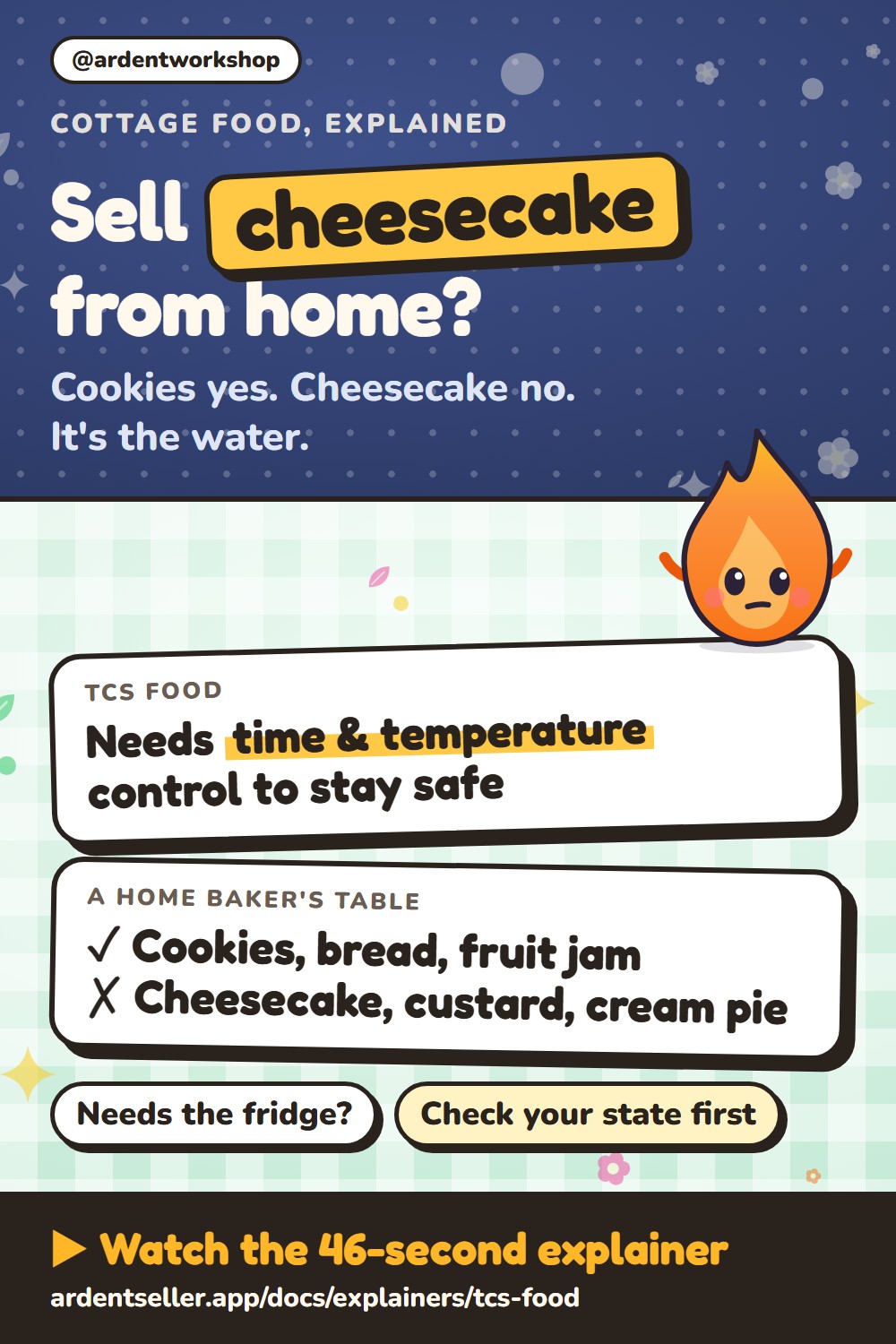
Cheesecake is a TCS (time/temperature control for safety) food: it needs the fridge to stay safe, and most cottage food laws cover only shelf-stable foods like cookies.
Most cottage food laws only cover foods that stay safe on a shelf. This short explains why: germs need available water to grow, so a moist food like cheesecake is a TCS (time/temperature control for safety) food that needs the fridge. Baked goods like cookies and bread, and classic fruit jams (sugary and acidic), keep on a shelf. The video sorts a home baker’s market table, then gives the one question to ask before adding a recipe: does it need the fridge to stay safe? If yes, check your state’s rules first. A few states, including Arizona, Texas and Tennessee, now allow some fridge foods under extra rules.
Watch on YouTube Shorts (opens in new tab)
The whole idea on one card
New explainers drop on our socials
Follow @ardentworkshop for more maker explainers.
Go further
- Glossary: TCS Food (Time/Temperature Control for Safety)
- Read: Cottage Baker's Glossary: 32 Terms Every Home-Bakery Seller Needs to Know
- Read: California Cottage Food Operations: Class A vs. Class B, the 2026 Sales Caps, and the Compliance Map
- Read: Texas Cottage Food Law: What You Can Sell, Where, and How to Stay Under the $150,000 Cap
- Read: Tennessee Food Freedom Act: A Cottage Food Maker's Guide to America's Most Permissive Home Kitchen Law
- For At-Home Bakers
- For Cake Decorators
- For Jam & Preserve Makers
- For Farmers Market Vendors
- Guide: Start a home bakery
- Guide: Start a jam business
- Guide: Start a meal prep business
Transcript
Hook
Why can you sell cookies from home, but not cheesecake?
Definition
Cheesecake is a TCS food. That means it needs time and temperature control to stay safe.
Why
Germs need water to grow. In moist cheesecake, they can multiply at room temperature. A food dry or acidic enough keeps them from growing.
Example
A home baker’s table: cookies, bread and most jams keep on the shelf, so they’re in. Cheesecake, custard and cream pies need the fridge, so under most cottage food laws, they’re out.
Takeaway
Before adding a recipe, ask: does it need the fridge? If yes, check your state’s rules first. Some states allow it, with extra rules.
Sources
- A TCS (time/temperature control for safety) food needs time/temperature control to limit pathogen growth or toxin formation; foods whose water activity and pH keep pathogens from growing (for example, water activity below 0.88) are not TCS foods: FDA Food Code 2022, §1-201.10(B), Time/Temperature Control for Safety Food (Tables A and B) (opens in new tab)
- TCS food is held at 41°F (5°C) or below, or 135°F (57°C) or above, unless time is used as the control: FDA Food Code 2022, §3-501.16 and §3-501.19 (opens in new tab)
- Most US cottage food laws (as of 2018) limit home production to non-TCS foods, called “potentially hazardous foods” in earlier Food Codes; low-sugar jams can be TCS foods: Harvard Law School Food Law and Policy Clinic, Cottage Food Laws in the United States (August 2018), pp. 3, 9 (opens in new tab)
- California’s cottage foods exclude baked goods with cream, custard or meat fillings, and allow only jams that meet 21 CFR Part 150: California Department of Public Health, Approved Cottage Foods List (opens in new tab)
- Arizona’s cottage food program includes TCS foods (2024): Arizona Laws 2024, Ch. 18 (HB 2042), A.R.S. §§36-931, 36-932 (opens in new tab)
- Texas cottage food operations may sell TCS foods with registration (effective September 1, 2025): Texas SB 541 (89th Legislature), enrolled (opens in new tab)
- Tennessee homemade food includes TCS foods sold in person by the producer or an agent (effective July 1, 2025): Tennessee Public Chapter 431 (SB 484 / HB 130, 2025), text as rewritten by Senate Amendment 1 (SA0263) (opens in new tab)
- Tennessee’s agriculture department confirms that, since July 1, 2025, the Tennessee Food Freedom Act allows the production and sale of certain time/temperature controlled foods: Tennessee Department of Agriculture, Tennessee Food Freedom Act (opens in new tab)
- Wyoming’s Food Freedom Act covers potentially hazardous homemade food sold by the producer: Wyoming Statutes §11-49-103 (opens in new tab)
- Utah exempts homemade food (food made in a private home kitchen, except raw dairy and most meat; poultry only under the 1,000-bird exemption) sold within the state to an informed final consumer from licensing: Utah Code Title 4, Chapter 5a (sections 4-5a-102, 4-5a-104 and 4-5a-105) (opens in new tab)
General education, not legal or food-safety advice. Cottage food rules differ by state and change often; check your state agency before you sell.
Last updated .