How to start a meal prep business
A meal prep business sells prepared, ready-to-eat meals on a weekly schedule — and unlike a jam or cookie business, you almost certainly can't run it from your home kitchen. Prepared, perishable meals are time/temperature-control-for-safety (TCS) foods, which fall outside cottage food law in nearly every state, so the law requires a licensed commercial or commissary kitchen and a health-department permit. That regulatory reality — not the cooking — is what makes or breaks a new meal prep business, and it's where this guide starts. Realistic startup runs $2,000–$10,000 and 1–3 months to first sale, mostly licensing lead time.
- Startup cost
- $2,000 – $10,000
- Time to first sale
- 1 – 3 months
- Note: Driven by licensing, not cooking — health-department permit lead time, inspection scheduling, and food-manager certification gate when you can legally sell, and they vary widely by county
- Difficulty
- Advanced
Last reviewed · Rates, fees, and regulatory thresholds in this guide can change — verify the linked sources before acting.

The short version
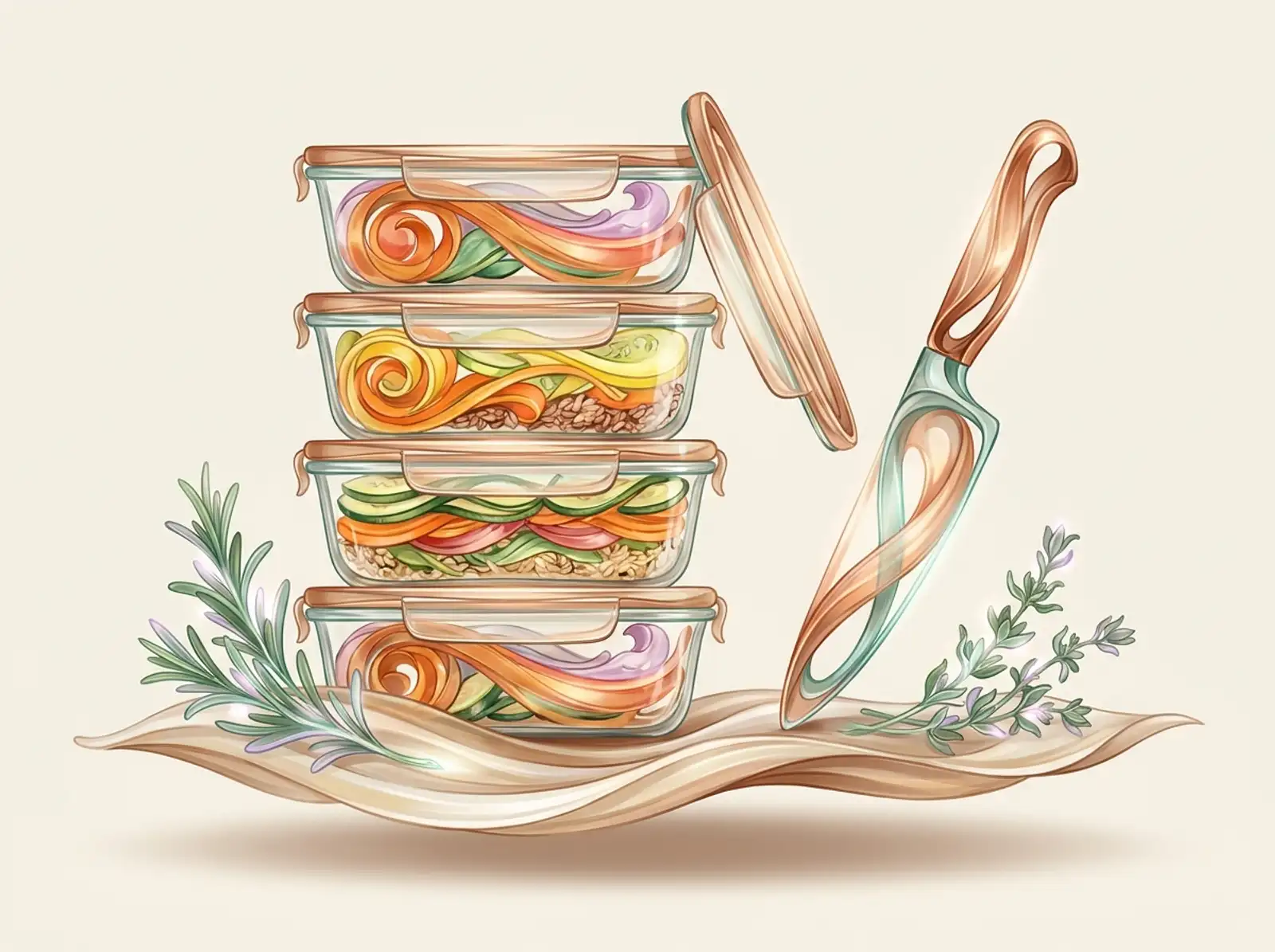
The single most important fact about starting a meal prep business: prepared, perishable meals are time/temperature-control-for-safety (TCS) foods under the FDA Food Code, and cottage food laws cover only shelf-stable, non-TCS foods (baked goods, jams, candy, dry mixes). That means a meal prep business generally cannot operate from a home kitchen under cottage food law — it requires a licensed commercial or commissary kitchen and a retail food establishment permit from your local health department in nearly every state. The rare exception is a permitted home-kitchen program like California's MEHKO (Microenterprise Home Kitchen Operation), which exists only in the counties that opted in; a small number of other states have created similar permitted home-kitchen programs. The practical path for almost everyone is to rent a licensed commissary or shared kitchen by the hour, get a food-protection manager certification (commonly ServSafe), carry general and product liability insurance, and build a cold-chain and allergen-labeling system that meets the Food Code. Startup runs $2,000–$10,000 (commissary deposit, permits, insurance, packaging, smallwares) and 1–3 months to first sale, gated mostly by permit and inspection timelines. Margins are tight — food cost plus kitchen rent, packaging, labor, and delivery means a meal that costs ~$9 fully loaded needs to sell around $15 — so pricing discipline is everything. This guide walks the law, the kitchen, the permits, food safety, pricing, and where to sell, in order.
Good fit if…
- You're willing to operate as a licensed foodservice business — a permitted kitchen, health inspections, and a food-manager certification — not a home-kitchen side hustle
- You can access a commercial or commissary kitchen (rent by the hour, a shared/incubator kitchen, or in a participating county, a permitted home kitchen)
- You can cook consistent, portion-controlled meals at batch scale and hold tight food-safety standards (cold chain, cooling, labeling)
- You understand the margins are thin and you'll price with discipline rather than competing on the lowest per-meal price
- You have $2,000–$10,000 of startup capital and can wait 1–3 months for permits and inspections before legally selling
Probably not for you if…
- You expected to cook prepared meals from your home kitchen under cottage food law — in nearly every state that's not permitted for TCS/perishable foods
- You're not prepared for health-department permits, inspections, and a food-manager certification
- You want the lowest-overhead food business — meal prep carries kitchen rent, packaging, labor, and delivery costs a shelf-stable cottage-food maker never has
- You can't reliably maintain the cold chain from prep through storage and delivery — TCS food handled wrong is a genuine public-health risk
- You need a fast, same-week launch — licensing lead time alone is usually weeks to months
Tip: The cooking is the easy part. A meal prep business is regulated much like a small restaurant: prepared meals require a licensed kitchen, a health-department permit and inspections, and usually a certified food-protection manager — plus the margins are tighter than any cottage-food craft once kitchen rent, packaging, labor, and delivery are loaded in. Treat it as a regulated foodservice business, not a home-kitchen side hustle.
End-to-end timeline for a new meal prep business
Unlike a cottage-food craft you can launch in a week, a meal prep business is gated by licensing. The permit and inspection timeline — not the cooking — sets the calendar, and it varies widely by county.
- Confirm the law + secure a kitchen1–3 weeks
Confirm the legal path with your local health department, then line up a commissary or shared kitchen and sign the agreement you'll need to apply for your permit.
- Permits, certification, insurance3–8+ weeks
Apply for the retail food establishment permit, complete plan review and inspection, earn a food-protection manager certification, and bind general and product liability insurance. This is the gating stage.
- Build menu + food-safety systems1–2 weeks (overlaps permitting)
Finalize the menu, cost each meal, write the cold-chain and cooling process, and design compliant allergen and date labels — done in parallel while permits process.
- Launch + first orders1–2 weeks
Open ordering, run a first batch at small scale, and deliver or hand off the first week of meals once the permit is in hand.
1–3 months to first legal sale, gated mostly by health-department permit and inspection timelines
The 7-step playbook
Run these in order. Skipping ahead is the most common reason new makers ship inconsistent product or under-price their work.
Step 1: Understand the law: prepared meals are not cottage food
Before anything else, internalize the rule that governs the whole business: prepared, perishable meals are TCS foods, and cottage food laws don't cover them. That single fact means a home kitchen almost never works — you need a licensed commercial kitchen. Confirm this for your state before you spend a dollar.
Cottage food vs. commercial kitchen for meal prep
The difference between a cottage-food craft (jam, baked goods) and a meal prep business is the kind of food you sell — and it changes everything about how you can legally operate. This is the decision that shapes your whole startup.
| Option | Food type | Kitchen allowed | Health permit | Manager certification | Viable for meal prep? |
|---|---|---|---|---|---|
Cottage food (jam, baked goods) Shelf-stable, non-TCS foods. | Non-TCS / shelf-stable | Home kitchen allowed | Light registration or none | Often not required | No — prepared meals are excluded |
Commercial / commissary kitchen The required path for meal prep. | TCS / perishable meals OK | Licensed commercial or commissary kitchen | Retail food establishment permit + inspections | Usually required (e.g. ServSafe) | Yes — this is the standard path |
Permitted home kitchen (e.g. CA MEHKO) Rare, county-by-county opt-in. | Limited TCS allowed under the program | Private residence, where the program exists | Program-specific permit + inspection | Required under the program | Only in participating counties, tightly capped |
Requirements vary by state and county — confirm with your local health department before committing. The bottom line for almost everyone: prepared meals need a licensed commercial or commissary kitchen, not a home kitchen.
The TCS rule. The FDA Food Code (opens in new tab) defines a "time/temperature control for safety" (TCS) food as one that needs temperature control to limit the growth of pathogens or the formation of toxins. Cooked meats, poultry, cooked rice and pasta, dairy, cut leafy greens, and most assembled meals are TCS — they have to stay out of the temperature danger zone (roughly 41 to 135 °F) through prep, storage, and delivery. A weekly meal-prep plate is essentially all TCS food.
Why that rules out cottage food. Cottage food laws — the state programs that let people sell home-made food without a commercial kitchen — cover only non-TCS, shelf-stable foods: baked goods without cream filling, jams and jellies, candy, dry mixes, honey, and high-acid canned goods. Prepared meals, refrigerated foods, and anything requiring temperature control are excluded almost everywhere. So unlike a jam business or a home bakery, a meal prep business generally cannot legally operate from a home kitchen under cottage food law. The path the law expects is a licensed commercial or commissary kitchen plus a health-department permit (steps 2 and 3).
The one narrow exception — a permitted home kitchen. A handful of states have created a permitted home-kitchen tier that can include some TCS food. The most established is California's MEHKO (Microenterprise Home Kitchen Operation, created by AB 626), which lets an individual run a small meal operation from a private residence — but only in the counties whose Board of Supervisors has affirmatively opted in, and under strict caps (a limited number of meals per day and week and an annual sales cap). See the California Department of Public Health MEHKO page (opens in new tab) for the official rules. Treat MEHKO as the exception that proves the rule: it's California-only, not available in every county even there, and tightly capped. Outside a participating MEHKO county, plan on a commercial kitchen.
Do this before anything else: contact your local (county or city) health department and ask two questions — (1) does my state or county permit any home-kitchen operation for prepared meals, and (2) what permit do I need to sell prepared food. Their answer determines your entire setup. Any third-party reference (including ours) is a starting point, not the authority — the health department is.
Regulatory notice: You generally cannot run a meal prep business from your home kitchen
Prepared, perishable meals are TCS foods, and cottage food laws cover only shelf-stable, non-TCS foods — so home-kitchen production of meal-prep plates is not permitted in nearly every state. The exception is a permitted home-kitchen program like California's MEHKO, which exists only in counties that opted in and is tightly capped. Before you cook anything to sell, confirm the legal path with your local health department. Selling prepared food without the required permit is operating an unlicensed food establishment, with real legal and public-health consequences.
Step 2: Secure a licensed commercial or commissary kitchen
With cottage food off the table, your first concrete task is access to a licensed kitchen. The most common path for a new meal prep business is renting a commissary or shared/incubator kitchen by the hour, rather than building your own — it's the difference between a few hundred dollars a month and tens of thousands upfront.
What a commissary kitchen is. A commissary (or shared, or incubator) kitchen is a licensed commercial facility you rent — by the hour, by the shift, or monthly — alongside other food businesses. It already holds the health-department license for the space, and your commissary agreement often serves as your business's permitted "kitchen of record" when you apply for your own permit (step 3). For a new meal prep business this is almost always the right starting point: you get a fully equipped, inspected kitchen without the capital cost of building one.
The options, cheapest to most expensive:
- Hourly shared/commissary kitchen. Pay for the hours you cook. Rates vary widely by region — a rough national range is on the order of $15–$50 per hour — plus a deposit, possible membership or onboarding fee, and often separate cold and dry storage (a monthly add-on). This is the lowest-commitment way to start. Marketplaces like The Kitchen Door (opens in new tab) (the kitchen-search side of The Food Corridor's platform) list shared kitchens you can rent by area.
- Monthly shared-kitchen membership. A fixed monthly fee for a block of access, often cheaper per hour if you cook a lot. Common in incubator kitchens aimed at growing food businesses.
- Private commercial kitchen lease. Your own dedicated licensed space — far more expensive (a multi-thousand-dollar monthly lease plus build-out and equipment) and rarely worth it until volume justifies it. Most meal prep businesses don't start here.
What to confirm before signing a commissary agreement:
- The facility is licensed and in good standing with the health department, and the agreement can be used as your permitted address when you apply for your own permit.
- Storage — refrigerated, frozen, and dry storage you can actually rely on for your ingredients and finished meals, and whether it's included or a separate monthly cost.
- Insurance requirements — most commissaries require you to carry general liability (often around $1–2M per occurrence — confirm the exact requirement with the facility) and to name the facility as additional insured (covered in step 3).
- Access hours and scheduling — whether you can get the prep windows you need, especially for a weekly meal-prep cadence that clusters cooking into a day or two.
Costs vary significantly by metro — sometimes by a factor of two or more — so price several local options before committing. The kitchen rent you negotiate flows straight into your per-meal cost in step 5 — it's one of the overhead lines that makes meal-prep margins tighter than a cottage-food craft's.
Step 3: Get your permits, food-manager certification, and business basics
With a kitchen secured, you register the business and clear the food-specific hurdles: a retail food establishment permit, a food-protection manager certification, and insurance. These are gated by your local health department and are the main reason time-to-first-sale is measured in months, not weeks.
The food-specific requirements (these are what set meal prep apart from a cottage-food craft):
- Retail food establishment permit / food business license. Issued by your local (county or city) health department, this is the permit that lets you legally prepare and sell food. It typically requires your commissary agreement, a plan review of your menu and processes, and an inspection. Names, fees, and lead times vary by jurisdiction — this is the step most likely to take weeks. The FDA Retail Food Protection (opens in new tab) hub explains the framework, but your local health department is the authority and the place to apply.
- Food-protection manager certification. Most jurisdictions require the person in charge to hold a manager-level food-safety certification from an ANSI-accredited program — ServSafe Manager (opens in new tab) is the most widely recognized. (A food-handler card is the lower, employee-level credential; the manager certification is the one usually required of the operator.) Budget exam time into your launch timeline.
- Product and general liability insurance. Effectively mandatory: commissaries require general liability, and prepared food carries real foodborne-illness exposure, so product liability matters too. Food-focused programs like the Food Liability Insurance Program (FLIP) (opens in new tab) are built for this; confirm any policy actually covers prepared-food product liability, not just booth/general liability, before relying on it.
The general business setup (the same as any small business):
- A business structure. Many food entrepreneurs form a single-member LLC rather than operate as a sole proprietorship, because food is a higher-liability business and the LLC separates personal assets from business liabilities. You can start as a sole prop and convert later. The SBA's guide to choosing a business structure (opens in new tab) compares the options.
- An EIN. Free from the IRS via the EIN application page (opens in new tab), in minutes online. Never pay a third party for one.
- A state sales-tax permit. Prepared food is frequently taxable even where grocery food is exempt — but the rules vary by state, so register for a seller's permit with your state department of revenue and confirm how your state treats prepared meals. (Only a few states levy no state sales tax at all.)
- 1099-K awareness. Payment platforms and marketplaces issue Form 1099-K above the federal threshold, but that threshold has changed more than once in just the past few tax years — so confirm the amount in effect for the current tax year on the IRS 1099-K overview (opens in new tab) rather than relying on a figure from memory. Income is reportable whether or not you receive the form.
Because the permit and inspection timeline is the gating item, apply early and use the wait productively — secure the kitchen, build your food-safety systems (step 4), and finalize your menu and pricing (step 5) while the application is in process.
Regulatory notice: Permits and requirements vary by state and county — your health department is the authority
Permit names, fees, plan-review requirements, inspection schedules, and which food-safety certification is accepted all vary by state and county. There is no single national rule and no single fee. Contact your local health department early, follow their specific application process, and don't rely on a figure or requirement from another jurisdiction (or from a general guide like this one) — confirm everything with the agency that will actually issue your permit.
Step 4: Build a food-safety system: cold chain, cooling, and labeling
Meal prep lives or dies on food safety. Because every meal is TCS food, you need disciplined temperature control from prep through delivery, safe cooling of cooked food, and accurate allergen and date labeling. This isn't paperwork — it's the difference between a safe business and a foodborne-illness incident.
Temperature control and the cold chain. TCS food must stay out of the danger zone (roughly 41 to 135 °F). In practice that means cooking to safe internal temperatures, holding hot or cold as required, and — critically for meal prep — moving cooked food into refrigeration promptly and keeping it cold through storage, packaging, and delivery. A calibrated probe thermometer is a core tool, not an optional one. Insulated bags and cold packs maintain the chain during pickup and local delivery.
Safe cooling is where meal prep most often goes wrong. Improper cooling of large batches of cooked food is a leading cause of foodborne illness. The Food Code two-stage cooling rule is the standard to follow: cool cooked food from 135 °F to 70 °F within 2 hours, and from 70 °F down to 41 °F within an additional 4 hours (a 6-hour total window) — using shallow pans, ice baths, or a blast chiller, not a deep pot left on the counter. Confirm the exact parameters in the current FDA Food Code (opens in new tab) and any stricter local rule.
Allergen labeling — the nine major allergens. Federal law requires the major food allergens to be declared. Under FALCPA there were eight (milk, eggs, fish, crustacean shellfish, tree nuts, peanuts, wheat, and soybeans); the FASTER Act added sesame as the ninth, effective January 1, 2023. Declare allergens either within the ingredient list or in a separate "Contains" statement. The FDA's FASTER Act page (opens in new tab) covers the sesame requirement. Allergen accuracy is one of the highest-liability parts of selling prepared food — a missed declaration can cause a serious reaction.
Date marking and meal labels. Refrigerated, ready-to-eat TCS meals need date marking, and your meal labels should clearly carry the meal name, an ingredient list, the allergen declaration, a use-by/keep-refrigerated instruction, and your business name. Reheating instructions reduce both customer confusion and food-safety risk. Check your local rules for any additional required label elements.
Write your process down. Health departments increasingly expect a documented food-safety plan, and a written process (cook temps, cooling method and timing, storage, labeling, cleaning) is also how you stay consistent as volume grows and how you'd trace a problem batch if one ever had to be pulled. The batch-tracking and production tools below help formalize it.
Safety warning: TCS food handled wrong is a genuine public-health risk
Every meal you sell is time/temperature-control-for-safety food. Maintain the cold chain from prep through delivery, follow the Food Code two-stage cooling rule for cooked batches (135 °F to 70 °F within 2 hours, then to 41 °F within 4 more), declare all nine major allergens accurately, and date-mark refrigerated ready-to-eat meals. A calibrated probe thermometer and a written food-safety process are non-negotiable. When in doubt about a parameter, follow the current FDA Food Code and your local health department's stricter rule.
Step 5: Plan your menu and price for tight margins
Meal prep margins are thinner than any cottage-food craft because you carry kitchen rent, packaging, labor, and delivery on top of food cost. The standard foodservice food-cost rule gives you a starting menu price, but you have to load every overhead line in to see whether a meal actually makes money.
Foodservice pricing starts from a food-cost percentage: the ingredient cost of a dish should be roughly 28–35% of its menu price (a widely used foodservice rule of thumb). The complement most operators watch even more closely is prime cost — food plus labor — which typically needs to land around 55–65% of revenue to leave room for everything else. For a direct-to-consumer meal brand carrying kitchen rent and packaging, those benchmarks imply a gross margin around 45–55%, which means a meal fully loaded at about $8–$9 should sell near $15.
What a single meal actually costs. The numbers below are illustrative mid-range estimates — your real figures vary by menu, ingredient tier, kitchen rate, and volume. The point is that food cost is only the first of five lines.
- Ingredients (food cost): ~$4.00
- Packaging (container, lid, label): ~$0.75
- Commissary kitchen rent, allocated per meal: ~$1.00
- Labor (prep, cook, portion, pack), allocated per meal: ~$2.75 (e.g., ~16 meals from a 2-hour prep session at ~$22/hr)
- Delivery / overhead, allocated per meal: ~$0.50
- Fully loaded cost ≈ $9.00 per meal
What that means for price. On the food-cost rule alone, $4.00 of ingredients at a 30% target implies a menu price around $13. But the fully loaded cost is ~$9, so at a $13 price you keep about $4 per meal (≈31% margin), and at $15 you keep about $6 (≈40% margin) — while food cost stays a healthy ~27% of the $15 price. Drop the price to $11 "to compete," and you're keeping $2 a meal before a single mistake, refund, or slow week. That's why meal prep rewards pricing discipline: the low-price end of the market is frequently unprofitable once the real overhead is counted.
Use roughly $20–$25/hr as a labor floor when you allocate labor per meal — deliberately above the national BLS median wage for restaurant cooks (opens in new tab) (a useful reference point; check the current figure at the link), because pricing your own skilled labor at the bottom of the market undervalues it and leaves no room to absorb a hired cook later. Counting your own labor at zero is the most common way meal-prep pricing hides a loss. The bigger your batch, the lower the per-meal labor and kitchen-rent allocation — which is why menu simplicity and batch size are themselves pricing levers.
The pricing and batch calculators below run this math; plug in your own ingredient cost, batch size, kitchen rate, and labor time to see the real per-meal margin before you publish a menu.
Step 6: Choose your model and where to sell
Meal prep has a few proven business models, and the one you pick shapes your cash flow, your production rhythm, and your marketing. Most new operators sell locally — pickup or short-radius delivery — because shipping perishable prepared food adds cost and food-safety complexity.
The common models:
- Weekly subscription meal plans. Customers order a recurring number of meals per week (e.g., 5, 10, or 15). This is the most predictable revenue model — it lets you forecast ingredient buys and batch sizes, which is exactly what keeps per-meal cost down. The trade-off is the work of managing a rotating menu and recurring billing.
- À la carte / weekly menu. Customers order individual meals from a menu that changes weekly. More flexible for buyers, harder to forecast — you carry more risk of over- or under-producing until you have demand history.
- Bulk / family meals. Larger portions sold by the tray or family pack. Higher order value, simpler production, fewer SKUs — often a good complement to individual meals.
- Niche meal plans. Targeting a specific need — high-protein/fitness, diabetic-friendly, postpartum, senior, or a specific cuisine — lets you charge more and market more precisely than a generic "healthy meals" service.
Pickup vs. delivery. Local pickup (from the commissary, a fixed location, or a farmers market) is the simplest and cheapest fulfillment. Short-radius local delivery widens your market but adds cost and cold-chain responsibility — insulated transport and a tight delivery window keep meals out of the danger zone. Shipping prepared meals nationally is a different, far more complex operation (insulated packaging, frozen logistics, and broader regulatory exposure); most new businesses stay local first.
Where customers find you:
- A simple ordering site — a Square, Shopify, or dedicated meal-prep ordering platform handles menus, recurring subscriptions, and payment. Start simple; you can add subscription billing as demand proves out.
- Local and community channels — gyms, CrossFit boxes, offices, and neighborhood groups are natural fits for a fitness- or convenience-oriented meal service, and they skip marketplace fees.
- Farmers markets and local pickup points — a recurring market stall builds a local subscriber base face-to-face.
- Social proof — real photos of your meals, clear nutrition and portion info, and customer reviews do more for a local food brand than paid ads early on.
Whatever the channel, your stated turnaround and delivery windows have to match what you can safely produce in your kitchen hours — overpromising on volume is a fast way to miss a cold-chain or quality standard.
Step 7: Track ingredients, per-meal cost, batches, and taxes
Meal prep runs on fast-moving perishable inventory and thin per-meal margins, so the operational discipline that keeps you profitable is tracking — what you bought, what each meal truly costs, what you produced in each batch, and whether the math still works as ingredient prices move.
For the first few weeks a spreadsheet is fine. As you scale a rotating menu across weekly batches, three things make the math brittle:
- Perishable turnover. Ingredients spoil on a weekly cycle, so over-buying is a direct loss and under-buying stalls a production run. Tracking inventory turnover — what you have, what it cost, and what each batch consumes — is how you buy to actual demand instead of guessing.
- True per-meal cost moves. Ingredient prices swing, and a menu that was profitable last month can quietly slip underwater when produce or protein costs jump. Recalculating per-meal cost from a live bill of materials — ingredients plus packaging plus allocated labor and kitchen rent — keeps your pricing honest as costs move.
- Batch traceability. If a batch ever has to be pulled, you need to know which ingredients and lots went into which meals on which day. A batch record is both a food-safety requirement and the data behind your costing.
Scale recipes cleanly. A weekly menu means cooking the same recipes at different batch sizes depending on orders. Scaling by hand is error-prone; a recipe that auto-scales ingredient quantities to the week's order count keeps both your shopping list and your per-meal cost accurate. The recipe-costing fundamentals post and the Recipe Scaling and Batch Calculator below cover the method.
Keep cost-of-goods separate from overhead for taxes. Meal prep income goes on Schedule C (sole prop) or the equivalent, and quarterly estimated taxes are generally required if you expect to owe $1,000+ for the year. Keep ingredient and packaging costs (cost of goods) separate from kitchen rent, insurance, and platform fees (operating expenses) so the breakdown takes minutes at tax time. Open a separate business checking account on day one. The production and costing tools below are built for exactly this kind of food-business tracking.
The tools section
Tools to consider
A short, honest list — Ardent Seller alongside the other tools most meal prep business owners end up using.
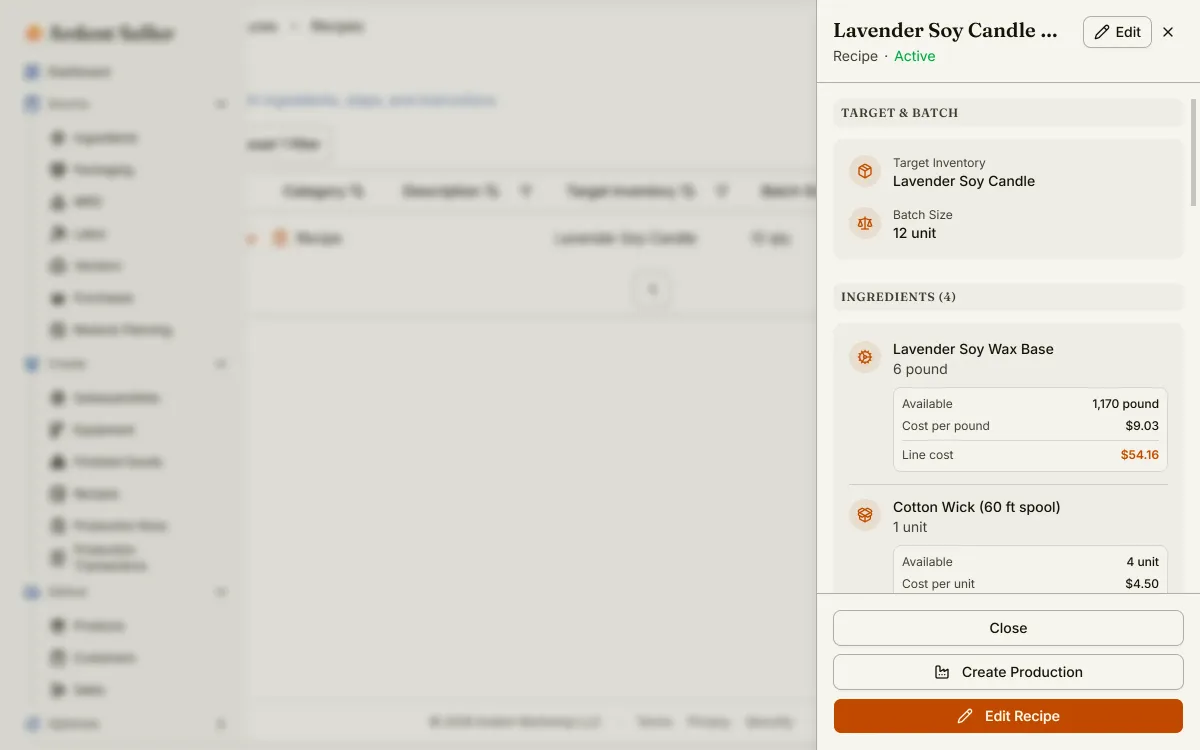
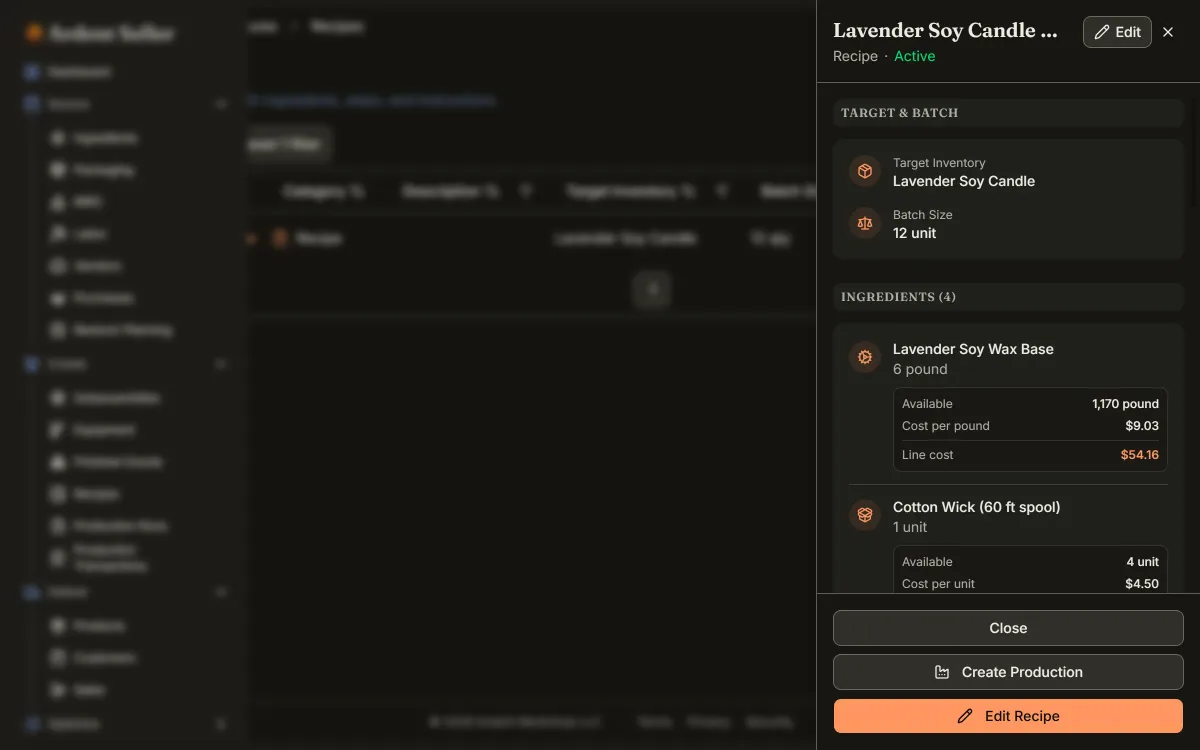
Built for the perishable-inventory and tight-margin reality of meal prep. Track ingredients and packaging as inventory with weekly turnover, scale recipes to the week's order count, and build each meal from a bill of materials so true per-meal cost — ingredients, packaging, allocated labor and kitchen rent — stays accurate as prices move. Batch records give you the traceability the Food Code expects, and per-channel reporting keeps counts right across subscription, à la carte, and market sales. Free plan, no credit card.
The most widely recognized ANSI-accredited food-protection manager certification (from the National Restaurant Association). Most health departments require the person in charge of a food business to hold a manager-level certification — ServSafe Manager is the common choice. Check current exam pricing and the format at the link.
A marketplace for finding and booking shared and commissary kitchens across the US — the kitchen-search side of The Food Corridor's platform, useful for finding a licensed kitchen to rent by the hour or month when you're starting out. Listings and rates vary by area; confirm licensing and your specific needs with each facility.
A food-focused insurance program offering general and product liability coverage built for food businesses. Commissaries typically require proof of general liability; confirm any policy covers prepared-food product liability specifically before relying on it. Quotes vary by coverage and state.
Point-of-sale and online-ordering platform that handles menus, payments, and (with its subscription tools) recurring meal-plan billing. A simple way to take orders and payment for pickup or local delivery without building a custom site. Pricing is per-transaction plus optional subscriptions — see Square's pricing page.
Standard for tracking income and expenses for tax purposes. Keeps ingredient and packaging cost of goods separate from kitchen rent, insurance, and platform operating expenses, and exports a Schedule C summary at year-end. Pricing changes — see Intuit's pricing page for current rates.
Common mistakes to avoid
The patterns that show up over and over in the first year.
Assuming you can cook from your home kitchen
This is the costliest misunderstanding in meal prep. Prepared, perishable meals are TCS foods and fall outside cottage food law in nearly every state, so a home kitchen is not a legal production space for them (the rare exception is a permitted home-kitchen program like California's MEHKO, in participating counties only). Confirm the legal path with your local health department before you cook anything to sell — operating without the required permit is running an unlicensed food establishment.
Pricing on food cost alone
A meal with $4 of ingredients looks like it should sell for $13 on the food-cost rule — until you load in packaging, allocated kitchen rent, labor, and delivery and the true cost is closer to $9. Pricing on ingredients alone hides the overhead that makes meal-prep margins thin. Price the fully loaded cost times a margin, and use roughly $20–$25/hr for your own labor rather than counting it at zero.
Cutting corners on the cold chain and cooling
Improper cooling of large cooked batches is a leading cause of foodborne illness. Cooling a deep pot of food slowly on the counter, or letting meals sit out during packing and delivery, pushes TCS food through the danger zone. Follow the Food Code two-stage cooling rule (135 °F to 70 °F within 2 hours, then to 41 °F within 4 more), use shallow pans or an ice bath, and keep the chain cold through delivery with insulated transport.
Allergen and labeling mistakes
Allergen accuracy is one of the highest-liability parts of selling prepared food. Declare all nine major allergens (the eight under FALCPA plus sesame, required since 2023) in the ingredient list or a "Contains" statement, and date-mark refrigerated ready-to-eat meals. A missed declaration can cause a serious reaction — this is not a corner to cut to simplify a label.
Forgetting kitchen rent and insurance in the model
Commissary rent, storage fees, and required liability insurance are real recurring costs that a cottage-food maker never carries. New operators often model only food and packaging, then discover the business doesn't clear once the kitchen invoice and insurance premium land. Build every overhead line into your per-meal cost from the start (step 5) so the price you publish actually covers the cost of producing it.
Launching before the permit is in hand
Selling prepared food before your retail food establishment permit is issued is operating an unlicensed food business, with real legal and public-health consequences. The permit and inspection timeline is the gating item in your launch — apply early, and use the wait to secure the kitchen, finalize pricing, and build your food-safety systems rather than starting to sell before you're legally cleared.
Too much menu variety too soon
A sprawling weekly menu multiplies your ingredient list, your spoilage risk, and your per-meal labor — all of which erode thin margins. Start with a small, tight menu you can batch efficiently and forecast accurately, prove demand, and expand variety once your inventory turnover and per-meal costs are under control.
Frequently asked questions
The questions new makers ask most often.
Can I run a meal prep business from my home kitchen?
In nearly every state, no. Prepared, perishable meals are time/temperature-control-for-safety (TCS) foods, and cottage food laws — the programs that let people sell home-made food without a commercial kitchen — cover only shelf-stable, non-TCS foods like baked goods, jams, and candy. So a meal prep business generally requires a licensed commercial or commissary kitchen and a health-department permit, not a home kitchen. The one exception is a permitted home-kitchen program such as California's MEHKO (Microenterprise Home Kitchen Operation), which exists only in the counties that opted in and is tightly capped. Confirm the legal path with your local health department before you cook anything to sell.
Do I need a commercial kitchen for meal prep?
Almost always, yes. Because prepared meals are TCS foods excluded from cottage food law, you need a licensed kitchen — and for a new business that usually means renting a commissary or shared/incubator kitchen by the hour or month rather than building your own. The commissary already holds the health-department license for the space, and your rental agreement often serves as your permitted "kitchen of record" when you apply for your own food establishment permit. Building or leasing a private commercial kitchen is far more expensive and rarely necessary at the start.
How much does it cost to start a meal prep business?
A realistic range is $2,000–$10,000, well above a cottage-food craft because of the licensed-kitchen requirement. The main line items are a commissary deposit and first month of kitchen rent (a few hundred to a couple thousand dollars), permits and a food-manager certification (roughly $100–$1,000+, varying by jurisdiction), general and product liability insurance, packaging (an ongoing per-meal cost), and any smallwares not provided by the kitchen. Renting an hourly commissary keeps the entry cost at the low end; a fuller setup with more storage, insurance, and equipment pushes it higher. Get exact figures from your local health department and the kitchens you're considering.
What licenses and permits do I need?
Typically a retail food establishment permit (or food business license) from your local health department, which usually requires your commissary agreement, a plan review, and an inspection; a food-protection manager certification from an ANSI-accredited program such as ServSafe Manager; a business registration (sole proprietorship or LLC); a state sales-tax permit (prepared food is often taxable); and general and product liability insurance, which commissaries usually require. Exact requirements, names, and fees vary by state and county, so your local health department is the authority — contact them early, because the permit and inspection timeline is the main reason launching takes one to three months.
Is a meal prep business profitable?
It can be, but the margins are tighter than any cottage-food craft because you carry kitchen rent, packaging, labor, and delivery on top of food cost. The foodservice rule of thumb keeps ingredient cost around 28–35% of the menu price, but once every overhead line is loaded in, a meal that costs about $9 fully loaded needs to sell near $15 to keep a healthy margin. The businesses that profit price with discipline (not at the lowest per-meal price), keep the menu tight enough to batch efficiently, forecast demand with subscriptions, and watch per-meal cost as ingredient prices move. Competing on the lowest price is frequently unprofitable once real overhead is counted.
How do I price my meals?
Start from the foodservice food-cost rule — ingredient cost should be roughly 28–35% of the menu price — then load in every other cost line before you commit. A worked example: $4.00 ingredients + $0.75 packaging + $1.00 allocated kitchen rent + $2.75 allocated labor + $0.50 delivery/overhead is about $9.00 fully loaded; at a $15 menu price that keeps roughly $6 per meal (about a 40% margin) while ingredients stay around 27% of the price. Use roughly $20–$25/hr for your own labor rather than counting it free, and remember that larger batches lower the per-meal labor and kitchen-rent allocation — so menu simplicity and batch size are themselves pricing levers.
Do I need a ServSafe certification?
Most jurisdictions require the person in charge of a food business to hold a manager-level food-protection certification from an ANSI-accredited program, and ServSafe Manager is the most widely recognized one. (A food-handler card is the lower, employee-level credential; the manager certification is the one usually required of the operator.) Requirements vary by state and county, so confirm exactly which certification your local health department accepts — but plan on earning a manager-level certification, and budget the exam time into your launch timeline.
How long does it take to start a meal prep business?
Plan on one to three months, gated mostly by licensing rather than cooking. Confirming the legal path and securing a commissary kitchen takes one to three weeks; the retail food establishment permit, plan review, inspection, and food-manager certification are the slow stage and can take several weeks or more depending on your county; and building the menu, pricing, and food-safety systems can run in parallel while permits process. First legal sale comes once the permit is in hand. The timeline varies widely by jurisdiction, so ask your local health department about current permit and inspection lead times early.
What is the difference between a cottage food business and meal prep?
The difference is the type of food, and it changes everything. Cottage food businesses sell shelf-stable, non-TCS foods (jams, baked goods, candy, dry mixes) that most states allow you to make in your home kitchen with light or no permitting. A meal prep business sells prepared, perishable TCS meals, which fall outside cottage food law and require a licensed commercial or commissary kitchen, a health-department permit and inspections, and usually a food-manager certification — closer to running a small restaurant than a home-kitchen craft. That's why meal prep has higher startup costs, a longer licensing timeline, and tighter margins than a cottage-food business like a home jam or bakery operation.
Free resources
Hand-picked calculators, checklists, and templates that map directly to the steps above.
A working Excel recipe scaler — enter a base recipe, set a target yield, and every ingredient auto-scales with unit conversions (oz/g/lb/ml/cups). Plus a batch-cost tab and a unit-conversion reference.
A working Excel pricing calculator — materials, labor, packaging, and platform fees in, a defensible retail price out. Plus a batch tab that shows what 50 vs. 10 actually costs.
Pick a target hourly rate, enter your materials, hands-on minutes per unit, and platform fees — the calculator returns the minimum price that actually pays you that rate after fees and costs. Maker-business specific, not a "freelance day rate" tool.
A printable six-page playbook for handmade-goods producers — five planning principles, the demand-driven batch-sizing formula, and four worksheets for sizing, run logging, weekly WIP, and post-run audit.
Live web version of our Excel pricing calculator. Materials + labor + packaging + platform fees → defensible retail at your target margin, with batch-pricing tiers.
A live web tool that runs the +10% / +20% / +30% price-hike math for one product — including the volume drop that comes with each — and tells you which scenario clears the most monthly profit.
Pick your state, enter year-to-date gross sales, and see in real time how close you are to the cap that turns a cottage food operation into a regulated food business. Covers all 50 states + DC.
A working Excel inventory tracker for makers — raw materials, finished goods, packaging, and a purchase log. Reorder thresholds and a status column do the math; conditional formatting flashes red when you are below the line.
36 things to set up before — and after — your first sale. Inventory, pricing, and the legal essentials in one place.
A free, scoped-for-small-sellers economic-nexus checker. Enter your trailing 12-month sales and transactions per state, and the tool flags every state where you have probably crossed the post-Wayfair economic-nexus threshold — without pushing you into a filing product.
Walk through the nine factors of Treasury Regulation §1.183-2(b) and find out whether your side activity qualifies as a for-profit business or a hobby for federal tax purposes — and where to focus to strengthen the business case.
Read next
Deeper dives on the topics that come up in the guide.
The questions home-based meal-prep sellers ask in year one: kitchen licensing, cottage food limits, true cost per meal, pricing, and the perishable waste that erases the profit.
You bought it. You made it. But it never sold. Spoilage, expiration, and shrinkage silently eat your margins — here is how to track every ounce of inventory that disappears before it reaches a customer.
Batch tracking protects your food business from recall disasters, builds customer trust, and keeps you ahead of tightening regulations. Learn how to set up a simple lot tracking system that works.

California runs the cottage food program through two classes, 58 county environmental health offices, and a separate MEHKO track for hot food. Here is what the rules actually permit in 2026, the difference between Class A and Class B, the foods that quietly disqualify you, the labels that pass an inspection, and the Microenterprise Home Kitchen path you should know exists before you stretch the cottage food rule too far.

Learn how to calculate the real cost of every product you make — from raw ingredients to labor and overhead — so you can price with confidence and protect your profit margins.
Once you're selling, you'll need to track it
Tracking inventory, costs, and taxes across every batch and every channel is the operational reality once sales start. Ardent Seller is purpose-built for this.
Home-based meal prep services & cottage food delivery
Ready to start?
Track every batch, recipe, and sale from day one of your meal prep business. Free plan, no credit card.