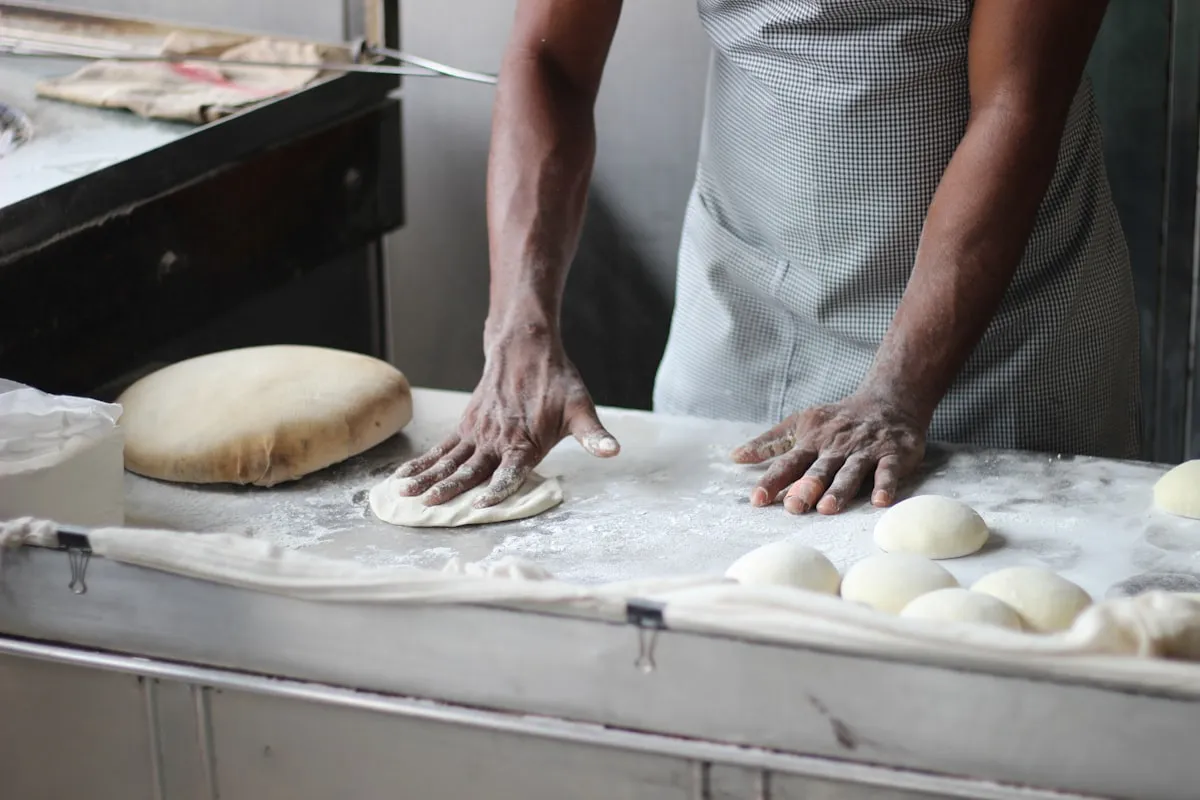
Becoming a cottage baker is a bit like moving to a country where you already speak the language but where every other sign is in a dialect you do not. You know flour and butter, oven and proof, taste and texture. Then on day one of selling — sometimes day one of thinking about selling — a stranger says "what's your water activity," "are you under your state's gross cap," "what's your COGS," and "is that loaf an acidified food or a low-acid one." And suddenly you are reading menus you cannot translate.
This is the dictionary nobody hands you. Thirty-two terms, drawn from the four worlds a cottage baker is now living in at the same time: the kitchen, the regulator, the books, and the storefront. Each entry is the definition first, then the version that matters to a person who is mixing dough on a Tuesday.
Read it straight through if you are brand-new. Skim it later when a term ambushes you.
How this glossary is organized
The terms are grouped into four sections by the world they come from:
- Kitchen and food science — the technical vocabulary of what you are actually baking
- Cottage food law and labeling — the regulatory language that decides what you can sell and how
- Books, taxes, and money — the accounting words that show up the day you start charging for what you bake
- Inventory, sales, and platform terms — the operational language of running a small product business
Most cottage bakers learn these in fragments, in the order the universe ambushes them with each one. The order below is friendlier.
Section 1: Kitchen and food science
These are the words that describe what is actually happening in your dough, in your jars, and on your shelves. Some of them you may already know in a hobby sense; the legal and commercial sense is sometimes narrower than the kitchen one.
Water activity (aₓ)
The amount of unbound water available in a food, expressed as a number between 0 and 1. It is not the same as moisture content. A jar of honey is over 17% moisture but has a water activity around 0.6 — too low for most spoilage organisms to grow. A loaf of fresh sourdough is around 30% moisture but has a water activity near 0.97 — wide open to mold within days.
Why a baker cares: in many states, what you are legally allowed to sell from a home kitchen is decided by water activity. Anything at or below 0.85 is generally considered "non-potentially-hazardous" and falls inside cottage food (FDA Food Code (opens in new tab)). Anything above sits in a regulated category that needs commercial licensing. If you sell shelf-stable goods like cookies, breads, and dry mixes, you are almost always under the line. The moment you add cream cheese frosting, you are over it.
pH
The acidity scale. Zero is battery acid; fourteen is drain cleaner; pure water is seven. Lower means more acidic. Lemon juice sits around 2.4, vinegar near 2.5, sourdough crumb around 4.2, butter around 6.5.
Why a baker cares: acidity is one of the two main reasons low-water-activity foods stay safe. If you sell anything jarred, fermented, or canned — sourdough starter, fruit butter, infused syrups, pickled trim from your produce side hustle — pH joins water activity as the number that decides whether you can sell it under cottage food law. A jam with a pH of 3.8 is allowed almost everywhere. The same jam at 4.7, made with low-acid pears, is a different legal category.
Potentially hazardous food (PHF) / Time-Temperature Control for Safety (TCS)
Food that supports rapid pathogen growth and therefore needs refrigeration, hot holding, or other control. Custards, cream pies, meat fillings, garlic-in-oil, and most cheesecakes fall in this bucket. Cookies, breads, and dry mixes do not.
Why a baker cares: cottage food laws almost universally exclude PHF/TCS items. A batch of chocolate chip cookies sold at the farmers market is fine. A box of the same cookies with a layer of cream cheese frosting is now a TCS product, and selling it from your home kitchen probably is not legal in your state. The line surprises people every year.
Allergen
One of nine substances the FDA requires be disclosed on packaged food labels in the US: milk, eggs, fish, shellfish, tree nuts, peanuts, wheat, soybeans, and sesame (added in 2023) (FDA major food allergens (opens in new tab)).
Why a baker cares: every label you put on a product sold to the public must disclose every one of the nine allergens that touched the recipe. "Contains: wheat, milk, eggs" is the standard format. The fact that you know your blueberry scones have wheat in them does not satisfy the rule — the label has to say so explicitly. Cross-contact warnings ("may contain peanuts due to shared equipment") are separate and not federally mandated, but most states recommend or require them when the kitchen is shared with the products that contain those allergens.
Cross-contamination vs. cross-contact
Two terms used interchangeably and incorrectly. Cross-contamination is the transfer of pathogens — E. coli from raw chicken to a cutting board to a salad. Cross-contact is the transfer of an allergen — peanut residue from a bowl to a batch of cookies that contained no peanuts.
Why a baker cares: food safety rules speak the cross-contamination language; allergen rules speak the cross-contact language. Inspectors and customers will use both. Knowing which one you are addressing changes what you say on a label and how you clean between batches.
Mise en place
French for "everything in its place." The professional kitchen habit of weighing, prepping, and arranging every ingredient before any heat or mixing begins.
Why a baker cares: at hobby scale, mise en place is a quality habit. At cottage scale, it is also an inventory habit. Every gram you weigh into the bowl is a gram you can deduct from your raw-material count, attribute to a batch, and use to calculate cost per loaf. A maker without mise en place is a maker without numbers — and numbers are the part you are about to start charging for.
Yield
The amount of finished product a recipe produces, in units, weight, or volume. Distinct from "batch size," which describes how much input a recipe takes.
Why a baker cares: yield is the conversion factor between cost and price. A sourdough recipe that uses $4.20 of flour, water, and salt and yields two boules has a per-loaf material cost of $2.10. If your yield is unstable — sometimes two loaves, sometimes three — your costing is unstable. The first habit of a profitable cottage baker is pinning yield to a number and not improvising it.
Hydration
In bread baking, the percentage of water relative to flour by weight. A 70% hydration dough has 70 grams of water for every 100 grams of flour.
Why a baker cares: beyond the obvious effect on crumb and crust, hydration changes both yield and labor time. A 65% hydration loaf is faster to shape than an 85% hydration ciabatta — the difference can be five minutes per loaf, which on a 30-loaf production day is two and a half hours of paid time. If you price by labor, hydration is in your pricing math whether you wrote it down or not.
Pro tip: Write down your hydration on every recipe card. It will save you the conversation that starts with "this dough feels different today" and ends two hours later with the realization you used a different flour bag.
Lot / batch
A specific production run, made with the same ingredients on the same day under the same conditions. Two loaves baked from the same dough are the same lot. Two loaves baked from doughs mixed on different days are different lots, even if the recipe is identical.
Why a baker cares: if a single jar of preserves goes bad, the only way to know which other jars share its risk is to know which lot it came from. Several states (Texas is the most prominent) now require lot codes on cottage food labels for traceability. Even where it is not required, it is the cheapest insurance a small kitchen can buy. A scrawled LOT-2026-04-28-01 on the label tells you which day, which batch, which production run — in three seconds, six months later.
Section 2: Cottage food law and labeling
Cottage food law in the United States is a state-by-state patchwork. The federal government does not regulate it. Every state writes its own rules — what you can sell, where you can sell it, how much you can sell, what the label has to say, and whether you need an inspection or a registration. The terms below show up in nearly every state's version of the rule.
Cottage food law
The state-level statute that allows individuals to produce certain non-potentially-hazardous foods in their home kitchens and sell them to the public, usually with restrictions on revenue, venue, and labeling. Sometimes called "homemade food law," "home processor exemption," or "cottage food operation law."
Why a baker cares: this is the legal foundation of your business. Without it, selling food from your home kitchen is almost always illegal. With it, you have a defined sandbox: certain foods, certain venues, certain dollar limits, certain labels. Your first homework is finding your state's version and reading the actual statute, not a forum summary of it.
Revenue cap
The maximum gross sales — usually per calendar year — a cottage food operator is allowed before being required to move into a commercial kitchen, get a food processor's license, or stop selling. Caps range from no cap at all (most "food freedom" states) to $5,000 (a few of the strictest states), with most states clustering between $25,000 and $80,000.
Why a baker cares: the cap is gross, not net. A baker who sells $50,000 worth of cookies and spends $30,000 on ingredients, packaging, and fees is at $50,000 of gross revenue, not $20,000. Crossing the line — even by a dollar — typically means an immediate licensing requirement and, in some states, retroactive enforcement. Track gross monthly. Set an alert at 80% of your state's cap.
Direct-to-consumer (DTC) vs. third-party / retail
DTC means selling directly to the person who eats it: farmers markets, your own table, a customer at your door. Third-party means selling through a store, a coffee shop, or a restaurant that resells your product. Many state cottage food laws allow DTC and prohibit third-party sales. Some allow both. A few allow neither online nor by mail.
Why a baker cares: the wholesale opportunity that looks like easy revenue ("our coffee shop will take a dozen muffins a week!") is illegal in roughly half of US states under cottage food law. Crossing that line is the most common compliance failure a cottage baker can make. Read your state's allowed-venue list before saying yes.
Cottage food disclaimer
A standardized warning label most states require on cottage food products, declaring that the food was made in a home kitchen not subject to state inspection. The exact wording varies. A typical Texas example reads: "This food is made in a home kitchen and is not inspected by the Department of State Health Services or a local health department."
Why a baker cares: the disclaimer must usually appear in a specific font size, on the principal display panel, in legible contrast. Skipping it, shrinking it, or burying it is one of the most common reasons cottage food sellers receive a warning letter from a state inspector. Treat it as you would the nutritional facts panel on a commercial product: required, prescribed, non-negotiable.
Net weight
The weight of the product alone, excluding the package. Required on most cottage food labels. Expressed in both metric (grams) and US customary (ounces or pounds).
Why a baker cares: the customer thinks of your product in pieces ("two scones, please"); the regulator thinks of it in net weight. A scone label that says "2 scones" instead of "Net Wt. 4.2 oz (119 g)" is non-compliant in most states. Buy a scale that reads to 0.1 g and weigh a representative sample of every product you sell.
Acidified food
A food that has had its pH adjusted, usually by adding vinegar, citric acid, or lemon juice, to bring it below 4.6 — the threshold under which Clostridium botulinum cannot grow (FDA 21 CFR Part 114 (opens in new tab)). Pickles, hot sauces, and many fruit preserves fall here.
Why a baker cares: acidified foods sit in a separate, often stricter regulatory category than baked goods. Most cottage food laws either exclude acidified foods entirely or require additional documentation: a pH-tested recipe, a process letter from a Better Process Control School-certified processor, or registration with the FDA as an acidified-food manufacturer. If your "baking" includes a sourdough starter you sell, a flavored vinegar drizzle, or a jam, you have crossed into territory that needs separate research.
Inspection vs. registration
Two different regulatory checkpoints. Registration typically means filing a one-time form with the state and paying a small fee — no one comes to your kitchen. Inspection means a state or county official visits and physically reviews your operation. States vary widely: some require neither, some require registration only, some require inspection.
Why a baker cares: which one applies to you decides the operational shape of year one. A registration-only state means you can probably be selling within two weeks. An inspection state may mean a four-to-eight-week wait for the appointment, plus modifications to your home kitchen if anything fails. Knowing which one applies to your state — and which version applies to your product line — should be on your week-one to-do list.
Section 3: Books, taxes, and money
The day you accept money for a loaf of bread is the day you become a small business in the eyes of the IRS, your state revenue department, and (eventually) your accountant. The vocabulary below comes from accounting, not baking. None of it is hard. All of it shows up at tax time.
Schedule C
The IRS form a sole proprietor uses to report business income and expenses. Filed with your personal Form 1040. Has line items for revenue, cost of goods sold, advertising, supplies, vehicle, home office, and so on.
Why a baker cares: if you sell a single loaf of bread for money, you are filing Schedule C — even if your "business" is a side hustle that makes $400 a year. The form decides what counts as a business expense and what does not, and it is the place where every receipt, every fee, and every bag of flour you bought for resale lands at year-end. The earlier you start tracking your numbers in Schedule C categories, the easier April becomes.
Cost of goods sold (COGS)
The direct cost of producing the goods you sold during the period. For a cottage baker, that means flour, butter, eggs, sugar, salt, yeast, and packaging that left the kitchen as part of a sold product. It also includes a beginning and ending inventory adjustment so the IRS gets the timing right.
Why a baker cares: COGS is the single most-mis-recorded number on a cottage baker's tax return. The maker who counts every flour bag bought during the year as "COGS" is overstating it — flour still in the pantry on December 31 is inventory, not cost. The fix is keeping a beginning-of-year and end-of-year inventory count. Two evenings a year. The difference between a defensible Schedule C and a sketchy one.
Gross revenue vs. net profit
Gross revenue is the total dollars you took in. Net profit is what is left after every cost — COGS, fees, supplies, packaging, vehicle, home office, taxes — comes out.
Why a baker cares: every regulatory cap (cottage food revenue cap, sales tax thresholds, business-license thresholds) is measured in gross. Every personal financial decision (can I afford this, is this worth my time) is measured in net. Confusing the two is how cottage bakers convince themselves they had a great year and then watch the tax bill drain it.
Sales tax permit / seller's permit
A state-issued license that authorizes you to collect sales tax from customers and remit it to the state. Required in nearly every state where sales tax exists, even for small home-based sellers. Sometimes called a "resale permit" because it also lets you buy ingredients tax-free for resale.
Why a baker cares: the requirement is unrelated to your cottage food permit, your business license, or your federal tax filing. Sales tax is a separate animal in a separate department. Most states issue the permit free or for a token fee, and most have a low or zero threshold for when it kicks in. The exemptions for unprepared food vary by state — bread sold uncut may be exempt; the same bread sliced may be taxable.
Sales tax nexus
The legal connection between your business and a state strong enough that the state can require you to collect sales tax on sales delivered there. Triggered by physical presence (a home kitchen, a farmers market booth) or by economic thresholds (typically $100,000 or 200 transactions in a year, post-Wayfair (South Dakota v. Wayfair, 2018 (opens in new tab))).
Why a baker cares: if you sell only locally and at markets in your home state, nexus is simple — you have it where you live. The moment you ship interstate, list on platforms that span states, or sell at a fair across the state line, the rules expand. A cottage baker shipping shortbread to 30 states almost certainly does not have nexus in 29 of them; she does have it in her home state. See sales tax nexus for handmade sellers for the full walkthrough.
Operating expenses (OpEx)
Costs of running the business that are not directly tied to a unit of product. Insurance, internet, phone, accounting software, advertising, the website domain, the photography props. Distinct from COGS, which is direct material cost.
Why a baker cares: OpEx and COGS land on different parts of Schedule C and behave differently for tax purposes. A bag of flour you used in a batch you sold is COGS. A subscription to a recipe-management tool you use for the whole catalog is OpEx. Putting the wrong cost in the wrong bucket can either inflate your gross margin (and your tax bill) or trigger a query from a careful CPA. The rule is simple: did this cost go into the actual product, in a way you can attribute to a specific unit? COGS. Otherwise, OpEx.
Hobby vs. business (IRS test)
The distinction the IRS draws between a money-making hobby and a real business. If your activity makes a profit in three of the last five years, the IRS presumes you are a business (IRS hobby vs. business guidance (opens in new tab)). If not, it may classify you as a hobby — which means your expenses are no longer deductible against the income.
Why a baker cares: hobby classification is the worst of both worlds: you owe tax on every dollar you took in, but you cannot deduct the costs that produced it. The fix is acting like a business from day one — separate bank account, written records, intentional pricing, demonstrable effort to be profitable. See hobby vs. business taxes and record-keeping if this is the term that ambushed you.
Section 4: Inventory, sales, and platform terms
Once your operation has a shelf, a customer list, and a product page, a fourth vocabulary shows up — borrowed from retail, ecommerce, and operations. These are the words that describe how the business runs, not what is in the oven.
SKU (Stock Keeping Unit)
A unique internal code assigned to every distinct, sellable version of a product. A sourdough loaf and a sourdough boule of the same recipe are two SKUs if customers can buy them separately.
Why a baker cares: the moment you have more than fifteen products, "the lavender shortbread" stops being a useful identifier. SKUs let you track inventory, attribute sales, and reconcile counts without typing a description. See SKU design for small sellers if this is the rabbit hole you are about to fall into.
Par level / reorder point
The minimum quantity of an ingredient or finished product at which you place a new order. Set it correctly and you order exactly early enough to arrive before you run out, without sitting on months of stock.
Why a baker cares: running out of butter at 9 p.m. on a Friday with a Saturday market load to bake is the most expensive mistake in your kitchen — it is a wasted weekend, a Plan B trip to a boutique grocery at 30% markup, or a missed market. Par levels turn that scramble into a calm reorder placed on Tuesday. Twenty minutes per ingredient. Lasts a year. See reorder points and par levels for makers when you are ready to set them up.
Lead time
The interval between placing a supplier order and the goods arriving at your kitchen. For a major bulk-flour delivery, this might be five business days. For your favorite specialty malt order from a regional miller, it might be three weeks.
Why a baker cares: par levels are a function of usage rate times lead time. A baker who uses 6 lb of flour a week and orders from a five-day-shipping supplier needs less safety stock than a baker who uses 6 lb a week and orders from a supplier with a three-week ship cycle. The same ingredient at two different suppliers is, for inventory purposes, two different items.
Margin (gross margin)
The percentage of revenue left after the direct cost of producing the product. A loaf that sells for $9 and costs $3 to make has $6 of margin, or 67%.
Why a baker cares: margin is the lever every other business decision turns on. A 60% margin business can afford to be inefficient; a 25% margin business cannot. Know your gross margin per product. Know your wholesale margin separately from your retail margin. The day you do not know the margin on a flagship product is the day you start subsidizing it without knowing.
Markup vs. margin
Two different percentages built from the same three numbers. Markup is profit divided by cost; margin is profit divided by price. A $3 cookie sold for $9 is a 200% markup or a 67% margin — the same dollar described two different ways. Mixing them is one of the most expensive math mistakes in retail. See margin vs. markup: the pricing math mistake because the confusion is that common.
Why a baker cares: if you ever say "I run a 50% markup" and mean "I keep half of every sale," you are off by 17 percentage points and quietly underpricing your work.
Wholesale vs. retail price
Retail is the price you charge a final consumer. Wholesale is the price you charge a coffee shop, a farmers market reseller, or a gift basket aggregator who is going to sell it to their customer.
Why a baker cares: a wholesale price needs to leave enough margin for the buyer to mark it up to retail and still profit, while leaving you a defensible margin too. The standard rule is wholesale = retail / 2 — a $9 retail loaf wholesales for $4.50 — but only if your COGS supports it. Many cottage bakers sign their first wholesale order at a price that loses them money on every loaf. Run the math first. (Full breakdown in wholesale pricing for handmade products.)
Audit trail
The chronological record of every change to a piece of business data — every inventory adjustment, every price update, every batch produced, every sale processed. Distinct from a "log" because an audit trail is meant to be defensible: timestamped, attributed to a person, and immutable.
Why a baker cares: a real audit trail is what turns a cash-box business into a defensible one. Inspectors, tax preparers, and your future-self all benefit. If a customer reports illness from a batch sold three months ago, an audit trail tells you in seconds which lot, which day, which ingredients. A spreadsheet of cell edits cannot do this.
A short closing list of words this post did not include
Cottage baking has more vocabulary than thirty-two terms can hold. Words you will meet next, alphabetized, in case any of them ambush you before our next post:
- 3PL (third-party logistics — a company that warehouses and ships your product for you)
- DBA (doing business as — the trade name your business uses if it is different from your legal name)
- EIN (employer identification number — the IRS-issued business tax ID)
- FIFO / LIFO (first-in-first-out vs. last-in-first-out inventory accounting methods)
- MOQ (minimum order quantity — the smallest order a wholesale buyer is willing to place)
- R&D batch (a recipe development batch run before commercial release — costed differently)
- Shrinkage (inventory loss between count and reality, from waste, theft, or miscount)
- UPC / GTIN (commercial barcode standards, generally only needed for big-box retail)
Each of these will get its own paragraph in your life eventually. None of them is urgent in week one.
Where this stops being a vocabulary problem
A glossary helps you read the room. It does not help you keep the numbers it describes. Once a cottage baker is fluent in COGS, par level, lot code, gross margin, and audit trail, the obvious next question is: where do I keep all of this?
A spreadsheet works for a while. The shelf life of that spreadsheet is roughly the same as a loaf of fresh sourdough — about a week before it starts going stale, and a few months before it is genuinely past its prime. Ardent Seller is built for the cottage baker who has outgrown the sheet: ingredients with par levels, recipes that auto-cost when prices change, batch and lot tracking baked in, Schedule C-mapped expense categories, and an audit trail every inspector and tax preparer wants to see. The vocabulary in this post is the vocabulary the software speaks.
You do not need every term in this glossary on day one. You will need them all eventually. The bakers who skim this once and then keep it bookmarked tend to have a calmer year three than the ones who learn each word the hard way at the moment it ambushes them.
Start a free Ardent Seller account and the next time one of these terms shows up in your inbox, the answer is already a tab away.
Free resources
A few free downloads from the Ardent Workshop library that pair well with this post:
- Cottage Food Laws by State (live reference) — the interactive 51-state hub for every term in this glossary that depends on jurisdiction: revenue cap, sales venues, permit / registration regime, label requirements, and acidified-foods rules. Filter by feature (no cap, no permit, wholesale OK, interstate shipping, acidified OK) or click into your own state for the full breakdown.
- Cottage Food Laws by State: The 50-State + DC Quick Reference (PDF) — printable take-it-with-you version of the same dataset for the binder behind the mixer.
- Home Baker's Order & Delivery Tracker (Excel) — the order book, dietary log, and production calendar in one workbook. The terms above (deposit, balance, lot code, allergen, lead time) all live here as columns you fill in once per order.
- Craft Seller Startup Checklist — the inventory, pricing, and legal-essentials checklist for the first time every term in Section 2 and Section 3 stops being a definition and turns into a to-do.
- Small Business Tax Deduction Cheat Sheet — Schedule C line by line, including the COGS-vs-OpEx split that several entries above hinge on.
This article is provided for educational purposes only and does not constitute legal, regulatory, food-safety, tax, or financial advice. Cottage food laws, labeling rules, water-activity and pH thresholds, sales-tax obligations, and Schedule C rules vary by jurisdiction and product, and change frequently. Consult your state agriculture or health department, a qualified compliance consultant, or a CPA before making compliance, safety, or tax decisions.