How much does a 20% off sale cost? Discount math
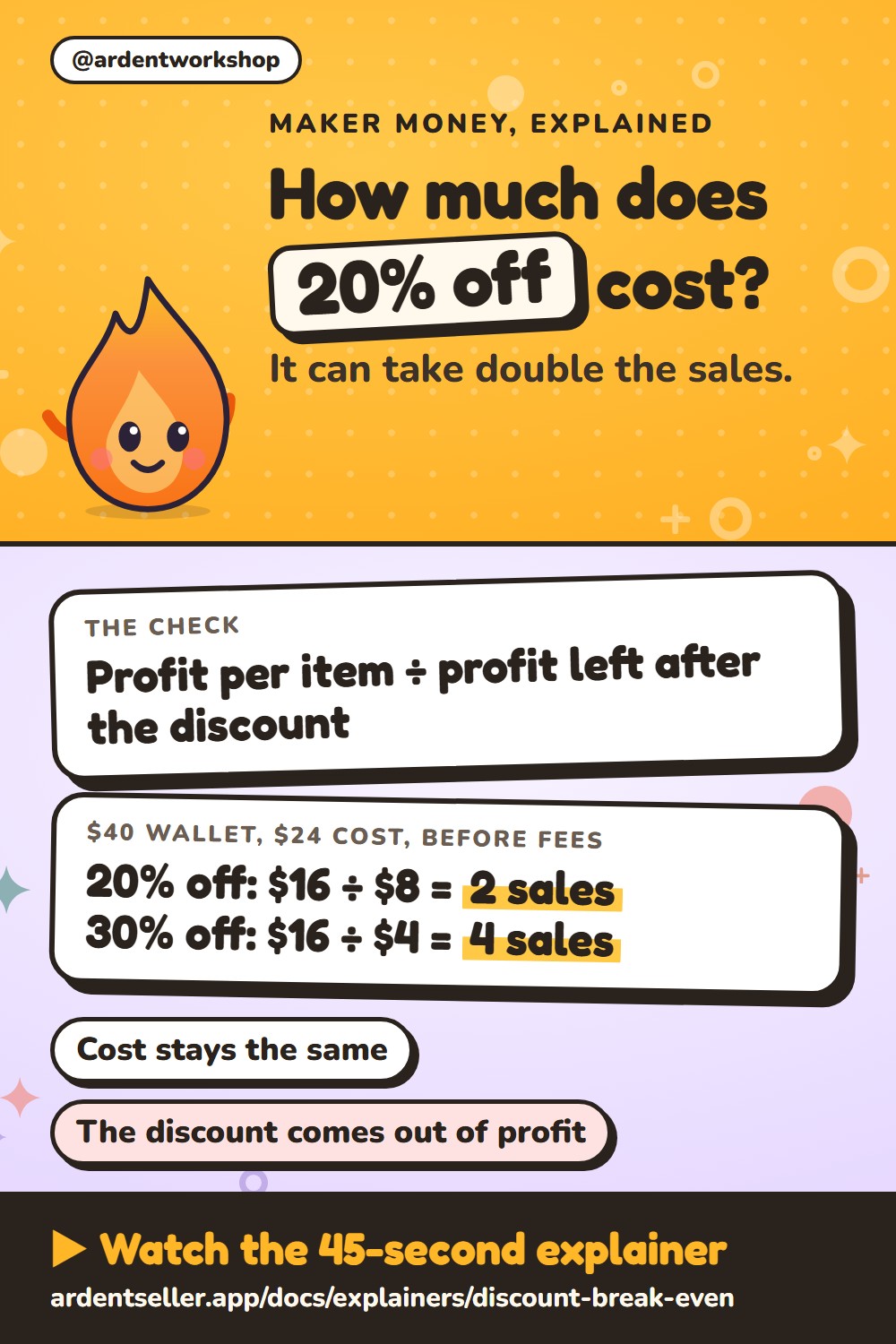
A discount comes off the price but out of your profit. Say a $40 wallet has $16 of profit before fees: it takes 2 sales at 20% off to match 1 at full price, and 4 at 30% off.
A percent-off sale takes money off the price, but the item costs the same to make, so the discount comes out of your profit. Say a leatherworker’s $40 wallet costs $24 to make and pack, leaving $16 before selling fees. 20% off is $8, so it sells for $32, leaving $8 of profit: it takes two to earn that $16. 30% off is $12, so it sells for $28, leaving $4: it takes four. Before a sale, divide your profit per item by the profit left after the discount. That’s your discount break-even: how many you must sell to match one full-price sale. Count materials, packaging and time as costs. Fees raise the real number, so use what you keep after fees at each price. If the discount uses up your whole profit, no number of sales matches it; any bigger, and each sale pays less than your costs.
Watch on YouTube Shorts (opens in new tab)
The whole idea on one card
New explainers drop on our socials
Follow @ardentworkshop for more maker explainers.
Go further
- Glossary: Discount Break-Even
- Read: What a "Quick Sale" Really Costs: The Discount Break-Even Math Makers Skip
- Read: Should Handmade Sellers Do Black Friday Sales? Mostly No, and Here Is What to Run Instead
- Read: Margin vs Markup: The Pricing Math Mistake That's Quietly Ruining Your Profit
- Read: The Hide Tax: 7 Leather-Goods Pricing Mistakes That Quietly Eat Your Margin
- For Leather Workers
- For Etsy Shop Owners
- For Farmers Market Vendors
- Guide: Start an Etsy shop
Transcript
Hook
How much does a 20% off sale cost? It can take double the sales.
Definition
A discount comes off your price, but making the item costs the same. So the discount comes out of your profit.
The math
Say a leatherworker’s $40 wallet costs $24 to make and pack, leaving $16 before fees. 20% off is $8. Half the profit, gone.
Example
To earn that same $16, you have to sell 2 wallets. At 30% off, only $4 is left, so you need 4.
Takeaway
Before a sale, divide profit per item by the profit left after the discount. That’s how many you must sell to match one full-price sale.
Sources
- Contribution margin is the amount by which a product’s selling price exceeds its variable cost per unit; contribution margin ratio = contribution margin per unit ÷ sales price per unit (applied to the illustrative wallet, before selling fees and treating its full $24 as per-unit cost: $40 − $24 = $16; $16 ÷ $40 = 40%): OpenStax, Principles of Accounting, Volume 2: Managerial Accounting, section 3.1 (opens in new tab)
- A price cut has to be repaid in added unit sales to make the same profit, calculated from the size of the cut and the contribution margin (for example, a 20% cut at a 60% contribution margin needs 50% more units): Impact Pricing, “Break Even Volume Calculator” (opens in new tab)
- Extra units needed = discount % ÷ (margin % − discount %). At a 40% margin: 20 ÷ (40 − 20) = +100%; 30 ÷ (40 − 30) = +300%. The video’s $40 wallet is an illustrative application: $16 ÷ $8 = 2 and $16 ÷ $4 = 4: Ardent Seller blog, “What a Quick Sale Really Costs: The Discount Break-Even Math Makers Skip” (opens in new tab)
Last updated .