
You ran a 20%-off weekend. Sales were up — maybe 30% more units out the door than a normal Saturday. You felt like you'd cracked something.
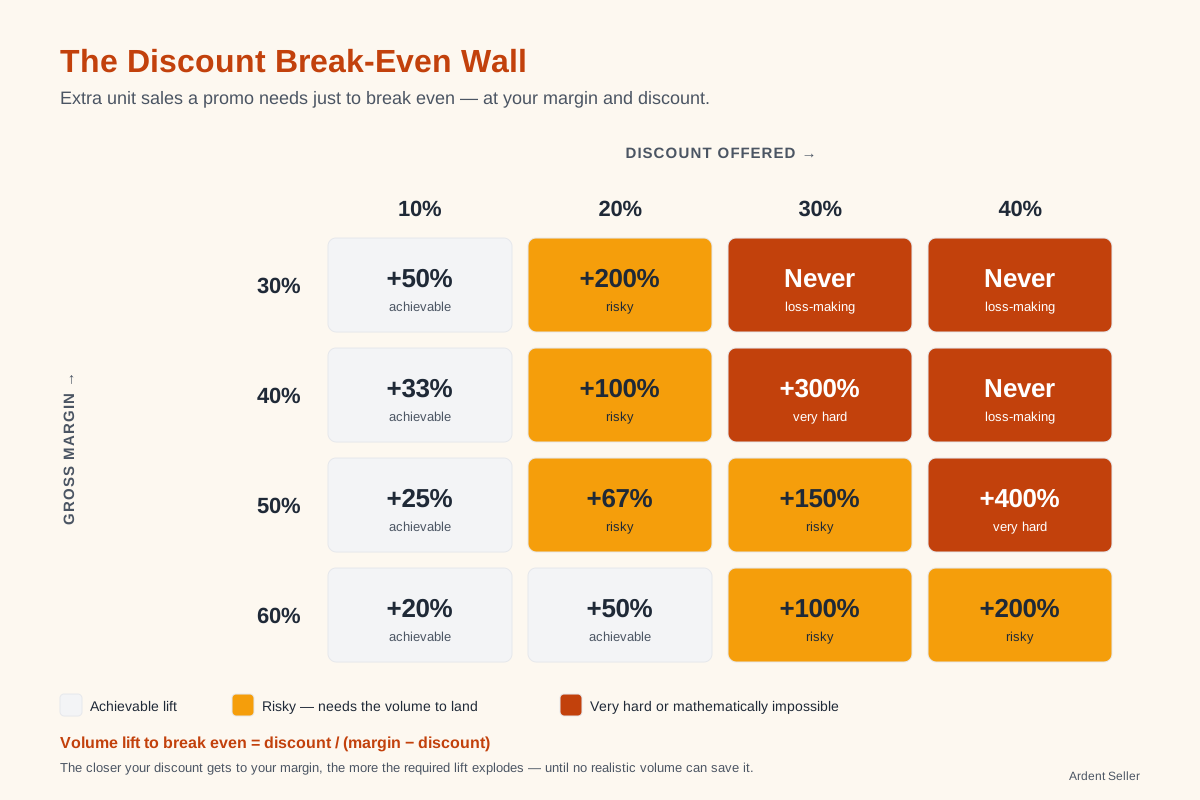
Here's the part nobody puts on the promo graphic: at a 40% margin, a 20% discount needs you to sell twice as many units — a 100% increase — just to make the same profit you'd have made at full price. You sold 30% more. You didn't win the weekend. You paid customers to take your inventory and went home with less money than a quiet Saturday would have left you.
That's not a reason to never run a sale. It's a reason to run the one number that tells you whether a sale is a promotion or a donation. That number is a one-line formula, and it's coming a couple of sections down — but it only makes sense once you see the idea underneath it: the discount comes off the price tag, but it doesn't come out of the price. It comes straight out of your margin, and your margin is a much smaller number than your price.
The discount doesn't come off the price. It comes out of profit.
This is the mental flip the whole thing hinges on, so it's worth slowing down for.
When you knock 20% off a $28 candle, the customer sees $5.60 saved. You see $5.60 gone — but gone from what? Not from the $28. From the slice of the $28 you actually keep after wax, wick, jar, fragrance, label, packaging, and the platform and processing fees that come off every order.
For example: a $28 candle might keep about $12.60. If your true cost to make and sell it is $15.40, your contribution margin is $12.60 — 45% of the price. (Your own numbers will differ; the point is the gap between price and margin, not these exact figures.) That $12.60 is the entire pool the discount gets subtracted from.
Take $5.60 out of a $28 price and it looks like a rounding error. Take $5.60 out of a $12.60 profit and you've just handed back 44% of everything the sale was going to earn you. Same $5.60. Completely different story, depending on which number you measure it against. Sellers measure it against the price. The math measures it against the margin. The math is right.
"More sales" is not the same as "the promo worked."
The trap is that a discount almost always does lift unit volume. People buy more when things are cheaper — that part is real. The question is never "did I sell more?" It's "did I sell enough more to cover what I gave away?" And there's a single formula for that — the one number this whole post is built around:
The break-even formula Volume lift needed = discount % ÷ (margin % − discount %) (Use whole numbers: a 20% discount on a 40% margin is 20 ÷ (40 − 20) = 1, or +100%.)
That's the unit-sales increase a promo needs just to match the profit you'd have made without it. Not to win. To break even. Run a few of your own numbers through the Discount Strategy Simulator if you want to see it move in real time, but the pattern is brutal and consistent:
At a 40% margin, a 20% discount needs +100% units to break even. You have to double your sales to stand still.
At a 40% margin, a 30% discount needs +300% units. A ten-point bigger discount doesn't cost a little more — it triples the volume you need. The math goes vertical as the discount climbs toward your margin.
Notice what's happening: the gap between your margin and your discount is the denominator, and as the discount creeps toward the margin, that gap collapses toward zero and the required lift explodes. A 30% discount on a 40% margin leaves only ten points of room, so the formula demands a 300% increase. Push the discount to 38% and you'd need to sell nineteen times as many units. There is a point, well before "50% off," where no realistic volume can save the promo.
BOGO is a 50% discount wearing a nicer outfit
Buy-one-get-one-free reads as the friendliest promo in the book. It's also the one most likely to be mathematically impossible.
Here's why: if every customer who buys one takes the free one — which is the whole point — BOGO is really a 50% discount, just dressed up as generosity. Two items go out the door for one payment. So plug 50% into the formula and watch it break:
At a 50% margin, BOGO requires infinite volume. The discount (50%) equals the margin (50%), the denominator hits zero, and there is no number of extra units that breaks even. Every redeemed pair is sold at exactly your cost or below.
Even at a healthier 60% margin, BOGO demands a 500% volume lift — six times your normal sales — to come out even. For most handmade products, where materials, packaging, and platform fees already eat a large chunk of the sticker price before any profit is left, BOGO on your core product isn't a promotion. It's a clearance event you didn't mean to hold. (It can work on a low-cost add-on with a fat margin, or to move genuinely dead stock — see "When a sale actually earns its keep" below — but never reach for it as a default "big sale.")
Free shipping is cheap — until the order is small.
Free shipping gets a pass because it feels like the gentle promo. Sometimes it is. The thing to understand is that free shipping is a fixed-dollar discount, not a percentage one, so its damage depends entirely on the size of the order it's attached to.
Say shipping costs you $5 to absorb. Watch what that same $5 does across two orders at the same 45% margin:
On an $80 order, free shipping is a ~6% discount — it needs about a 16% volume lift to break even. Survivable, especially if it nudges the average order size up.
On a $14 order, that same $5 is a 36% discount — and it needs a roughly 385% volume lift to break even. You are shipping at a loss and calling it marketing.
This is why free-shipping promos should almost always carry a minimum-order threshold set above your average order value. Free shipping over $50 protects you. "Free shipping, period" on a shop full of $12 items is one of the quietest ways small sellers bleed margin all year.
"Everyone runs Black Friday sales" is not a reason. It's a reflex.
The last problem isn't math, it's pressure. November rolls around, every inbox screams 30% off, and not discounting feels like sitting out the only game in town.
But a discount doesn't just cost you the margin on the extra sales it drives. It costs you margin on every sale that would have happened anyway. The loyal customer who was going to buy your soap on December 1st at full price now buys it November 29th at 25% off. You didn't gain a sale. You gave a discount to someone already reaching for their wallet. Multiply that across your regulars and a chunk of your "promo" is pure giveaway to demand you already had.
The inverse is the part that should keep you up at night. Pricing research has long shown that a 1% improvement in price, holding volume flat, lifts operating profit far more than chasing the same gain through volume does. The foundational analysis of large public companies is Marn and Rosiello's Harvard Business Review study (Managing Price, Gaining Profit (opens in new tab)); the underlying discount-elasticity math is laid out in Nagle and Holden, The Strategy and Tactics of Pricing (3rd ed., 2002). The exact figures come from big companies, but the direction holds for a one-person shop: price is the most sensitive lever you have. A discount yanks that lever in the wrong direction and then asks volume — a far blunter tool — to make up the difference. That trade rarely clears.
When a sale actually earns its keep
None of this means discounting is a sin. It means a discount needs a reason that the break-even math can't capture — because on the per-order math alone, most promos lose. The good reasons:
- Clearing genuinely dead stock. A product taking up shelf space and tying up cash is already costing you. Recovering some money beats writing it to zero. Here the "loss" is the comparison point, not full margin.
- Customer acquisition you can value. If a first-time discount reliably turns into repeat orders, you're not buying one sale — you're buying a customer. Just make sure you actually know your repeat rate before you assume the lifetime value is there.
- Real excess capacity. A slow Tuesday at the market, perishable inventory with a clock on it, a production slot that's already paid for. Marginal sales at a slim margin still beat empty hours.
- List-building and momentum. A launch discount that grows your email list or seeds reviews can pay off later — as long as "later" is a number you track, not a hope.
What these share is that the payoff lives outside the single transaction. If you can't name where the return comes from beyond "more sales this weekend," the formula has already told you the answer.
Know your real margin before you know your discount
Every number in this post depends on one input most sellers guess at: the true, fully-loaded cost of the thing you're discounting. If you think your candle costs $9 to make but it actually costs $15.40 once you count fragrance shrinkage, the label, the dust cap, and the 9% in platform and processing fees, then every break-even calculation you run is fiction — and it's fiction that flatters the discount.
This is where having your costs and sales in one connected system stops being bookkeeping and starts being a pricing decision. Ardent Seller resolves each product's real cost from its recipe — materials, labor, and packaging — so the margin you're discounting against is the live number, not last year's estimate. And when you do run a promo, it logs the sale as a discount event against the orders it actually moved, so you can look back after the holiday and see the real lift each campaign produced instead of guessing. The next "should I run BOGO or 20% off?" decision gets made on your data, not on whatever everyone else's inbox is shouting.
Before your next sale, run the one number. Take your discount, divide it by your margin-minus-the-discount, and look at the volume lift it demands. If you can realistically clear that bar — or if the sale is buying you something the single order doesn't show — run it with confidence. If you can't, you just saved yourself a weekend of selling your best work at a loss and calling it a win.
Start your free Ardent Seller account and track your real margins →
Related reading
- Margin vs. Markup: The Pricing Math Mistake That Costs Makers Money — Before you discount a margin, make sure you're calculating it the right way; this is the conversion mistake that quietly breaks the whole equation.
- How to Price Gift Sets and Bundles — The break-even math above assumes the discount is the only cost; a gift set adds a box, filler and assembly minutes on top, and this is how to price one so the "save 10%" sticker still pays.
- Why Are My Margins Shrinking? — A six-symptom diagnostic for the slow leaks — including discount habituation — that erode profit a few points at a time.
- Against "Just Charge More" — The other side of the pricing-pressure coin: when raising prices is the right move, and the three things to check before you do.
Free resources
Free companion downloads if you want to put any of this into practice:
- Discount Strategy Simulator (Margin-Aware) — Plug your price, true cost, and fees into this free calculator and watch all four promo types run against your actual margin, each with a green/amber/red verdict and the exact volume lift it needs to break even.
- Should I Raise My Prices? — The flip side of this post, as a free calculator: instead of giving margin away, see what a small price increase does to your profit and how much volume you could afford to lose and still come out ahead.
This article is provided for educational purposes only and does not constitute financial, tax, or business advice. Cost structures, pricing examples, and margin figures are illustrative and will vary by your specific circumstances. Consult a qualified accountant or small-business advisor before making financial decisions based on this content.