Superfat: why soap uses less lye on purpose
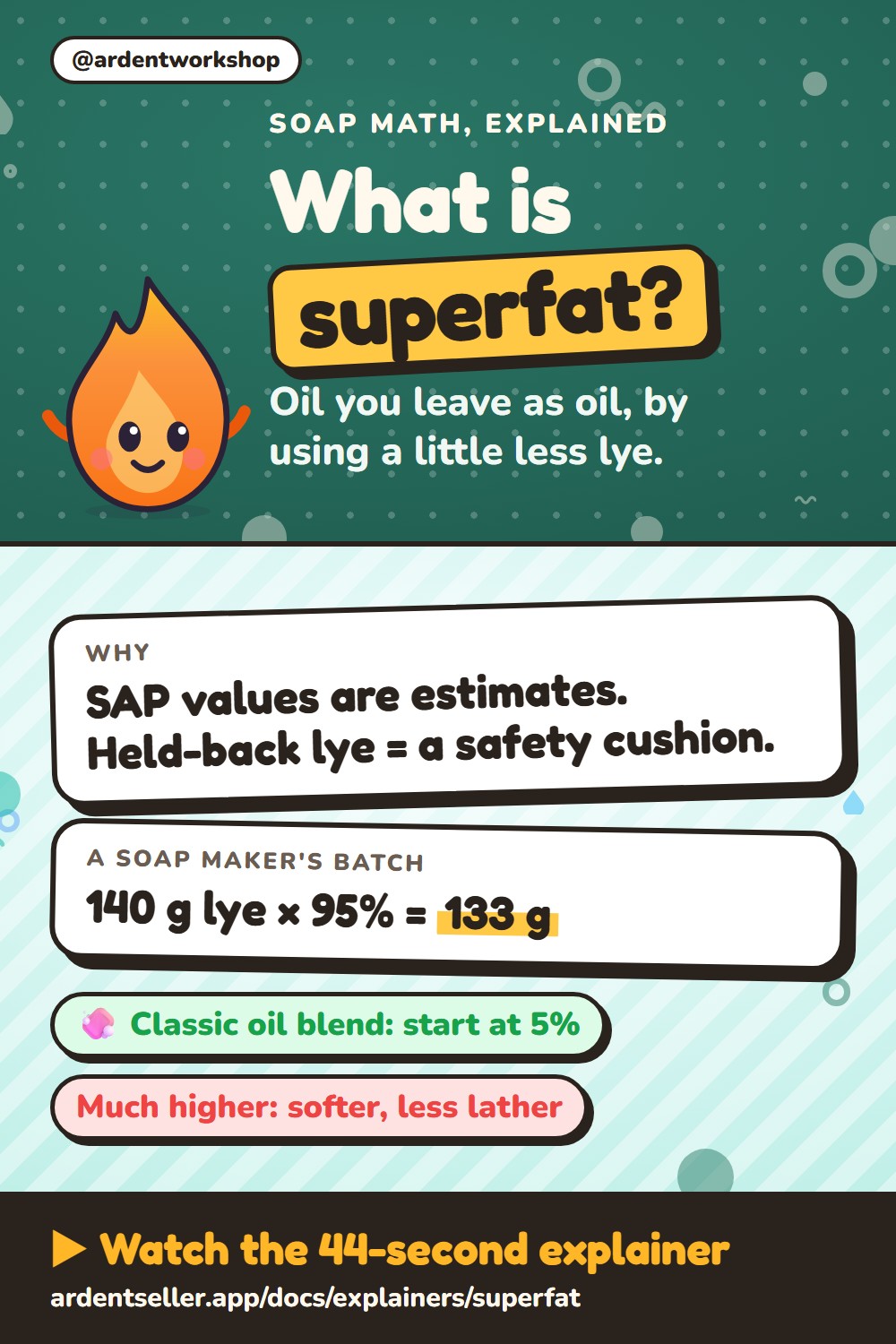
Superfat is oil you leave as oil, by using a little less lye than your oils could turn into soap. Worked through: oils needing 140 g of lye get 133 g at 5%.
Lye calculators ask for a superfat (some call it a lye discount). This short explains what it is: the share of your oils you leave as oil, by adding a little less lye than they could turn into soap. Each oil’s saponification (SAP) value is an estimate, and real oils and lye vary. Holding some lye back is a safety cushion that makes sure the lye gets used up. The video works it through on a batch whose oils need 140 g of lye: at a 5% superfat, 95% of it, 133 g. For a classic oil blend, 5% is a good place to start; much higher and the bar gets softer and lathers less.
Watch on YouTube Shorts (opens in new tab)
The whole idea on one card
New explainers drop on our socials
Follow @ardentworkshop for more maker explainers.
Go further
Transcript
Hook
What is superfat? Less lye than the math says. On purpose.
Definition
Superfat is oil you leave as oil, by adding a little less lye than your oils could use up.
Why
Each oil needs its own amount of lye: its SAP value. Those are estimates, and oils vary. Holding lye back is a safety cushion: the lye gets used up.
Example
Say a soap maker’s oils need 140 grams of lye. At 5% superfat, they use 95%: 133 grams. The spare oil stays in the bar.
Takeaway
For a classic oil blend, start at 5%. Much higher, and the bar gets softer and lathers less.
Sources
- Superfat is fat that remains in a soap after saponification; a soap must include enough fat to make sure all of the lye is used up: Classic Bells (Kathy Miller), Superfat (opens in new tab)
- Recipes are based on estimates of the saponification values and alkali purity, so soapmakers add a little extra fat to make sure the alkali is used up: Classic Bells (Kathy Miller), Superfat (opens in new tab)
- A saponification value is the amount of alkali needed to saponify one gram of a fat; published values are ranges (coconut oil 248–265 mg KOH/g), and bar soap uses sodium hydroxide: Wikipedia, Saponification value (opens in new tab)
- SAP values used by lye calculators are averages drawn from published ranges: The Sage, About the Lye Calculator (opens in new tab)
- 5% superfat is a good place to start with a classic blend of fats; a too-high superfat reduces lather and makes a bar softer: Classic Bells (Kathy Miller), Superfat (opens in new tab)
- Lye calculators apply superfat as a lye discount: 140 g × (1 − 0.05) = 133 g: Arithmetic; Ardent Seller Lye & Saponification Calculator (superfat / lye discount field) (opens in new tab)
- Raising superfat even 2–3% can noticeably soften the bar and reduce lather: Classic Bells (Kathy Miller), What do the Soapcalc numbers really mean? (opens in new tab)
General education, not formulation or safety advice. Lye is caustic: wear gloves and sealed goggles, and run every recipe through a lye calculator.
Last updated .