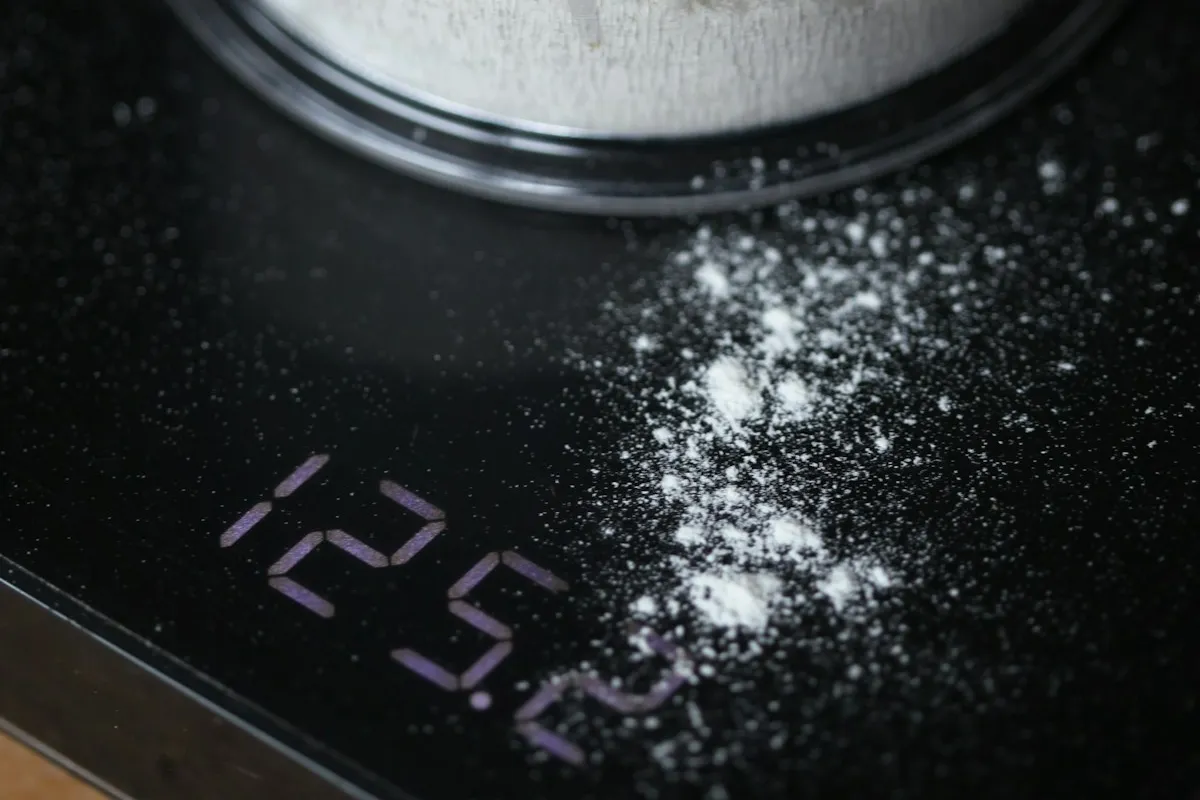
A common instinct in soapmaking is to buy the most precise scale you can afford. For the lye in a full-sized batch, that instinct buys you very little. A plain 1-gram kitchen scale moves the superfat of a 1,000 g batch by less than one percentage point, which sits comfortably inside the safety margin the superfat exists to provide.
Where the same scale fails badly is in the lotion you make with the leftover afternoon. At a 0.1% preservative level in a 200 g batch, the dose is 0.2 g, and a 1 g scale will display it as zero.
So "which scale is best" has a different answer depending on the lightest thing you put on the platform. Batch size, capacity and brand come after that. This guide works out the rule, checks it against five real scales, and ends with what to buy for three kinds of maker.
What 1 gram actually does to a soap batch
Take the batch from the lye calculation walkthrough: 1,000 g of oils (60% olive, 25% coconut, 15% shea butter), which needs 144.55 g of sodium hydroxide to saponify completely. At a 5% superfat you weigh out 137.32 g.
A scale that reads in whole grams cannot show 137.32. You pour until it reads 137, and the real mass on the platform is somewhere between about 136.5 and 137.5 g. Work the superfat back out from each end of that range and you get the table below.
| Batch and scale | Lye target | Real lye range | Real superfat range |
|---|---|---|---|
| 1,000 g oils, 1 g scale | 137.32 g | 136.5 – 137.5 g | 4.9% – 5.6% |
| 300 g oils, 1 g scale | 41.20 g | 40.5 – 41.5 g | 4.3% – 6.6% |
| 300 g oils, 0.1 g scale | 41.20 g | 41.15 – 41.25 g | 4.9% – 5.1% |
The full batch is fine on a 1 g scale. The rounding is small next to the 7 g of lye you are already choosing to leave out.
The 300 g test batch is where the 1 g scale starts to matter. It will not make a dangerous bar, but a 2.3-point spread in superfat is enough that a recipe you tested at 300 g may not behave the same way when you scale it up to 1,000 g. A test batch is only a test if you can repeat it, and a 0.1 g scale brings that spread back down to a fifth of a point.
Fragrance follows the same logic. At 3% of oils it is 30 g in the big batch, which a 1 g scale handles easily, and 9 g in the test batch, which it does not.
Rule of thumb: divide the lightest ingredient you weigh by 20. The answer is the largest display step you should buy. 30 g of fragrance allows a 1 g scale. 9 g allows 0.1 g. 1 g of preservative calls for 0.01 g.
The quickest way to find your lightest weighing is to run the recipe through the free Lye & Saponification Calculator and look at the smallest number it gives you, before you ever open a scale listing.
The rule comes from the people who inspect scales
That divide-by-20 rule is not a forum rule of thumb. It comes from NIST Handbook 44 (opens in new tab), the national standard that state weights-and-measures officials use when they inspect commercial scales. Its user requirement UR.3.1 sets a recommended minimum load "since the use of a device to weigh light loads is likely to result in relatively large errors" (2026 edition, section 2.20, Table 8 (opens in new tab), page 2-54).
The table expresses that minimum in scale divisions, which Handbook 44 defines as the difference between two consecutive displayed values, in other words the step the display moves in (Appendix D (opens in new tab)).
| Display step | Class III minimum (20 steps) | What that covers in practice |
|---|---|---|
| 1 g | 20 g | Oils, lye and fragrance in a full soap batch |
| 0.1 g | 2 g | Test batches, colorants and clays in full batches |
| 0.01 g | 0.2 g | Preservatives and actives in small cosmetic batches |
One honest caveat: none of the consumer scales below is certified to a Handbook 44 accuracy class, and the table is written for scales used in trade. It is borrowed here as the best published guide to how light a load a scale handles before its error takes over. If you sell soap priced by weight, certification becomes a legal question in its own right, which the shipping scale guide covers under "NOT LEGAL FOR TRADE."
What 1 gram does to a lotion batch
Liquid Germall Plus is a common preservative in small-batch lotions and creams. Its manufacturer, Ashland, gives recommended use levels of 0.1% to 0.5% (Ashland Liquid Germall Plus product page (opens in new tab)). In a 200 g batch that is between 0.2 g and 1.0 g, and every figure in that range is below the 20 g minimum of a 1 g scale.
| Target dose and scale | What the display shows | Real dose range | Real share of the batch |
|---|---|---|---|
| 0.2 g (0.1%), 1 g scale | 0 | Not measurable | Unknown |
| 1.0 g (0.5%), 1 g scale | 1 | 0.5 – 1.5 g | 0.25% – 0.75% |
| 1.0 g (0.5%), 0.1 g scale | 1.0 | 0.95 – 1.05 g | 0.48% – 0.53% |
| 1.0 g (0.5%), 0.01 g scale | 1.00 | 0.995 – 1.005 g | 0.50% |
The second row is the dangerous one. The top of that band is half again above the manufacturer's maximum, and nothing on the display warns you. The 0.1 g scale fixes the rounding, but its 2 g minimum load says the reading is still shakier than it looks. A 0.01 g scale is the first one where a 1 g preservative dose sits comfortably above the minimum.
This is also the point in the process where you should write down what the scale actually said rather than what the recipe asked for. If you keep your formulas in Ardent Seller, its soap and cosmetics recipe costing takes each ingredient in grams against what you paid for it by the pound or kilogram, and does the unit conversion for you. The cost per bar or per jar then comes from the weights you really use, not the round numbers you meant to use.
Readability is not accuracy, and most boxes only print one of them
Every scale lists its readability, the step the display moves in. Very few list how close that reading is to the truth.
My Weigh's own product page for the KD-8000 shows "8000 g 1 g" under a column headed Resolution, then shows the same "8000g 1 g" again under a heading of Accuracy (KD-8000 product page (opens in new tab)). The iBalance i2600 page does the same with 0.1 g (i2600 product page (opens in new tab)). That second heading is doing a lot of unearned work. It restates the display step and calls it accuracy.
The lab-balance makers show what a real specification looks like. OHAUS publishes, for the Scout STX2201, a readability of 0.1 g, a linearity of ±0.1 g and a typical repeatability of 0.1 g (OHAUS (opens in new tab)). Put plainly, even a laboratory scale can be off by one full display step. At the 0.01 g step, the manual for the American Weigh Scales AC-100, another pocket scale from the same maker as the AC-150 compared below, lists an acceptable tolerance of ±0.02 g on a 0.01 g display, two full steps (AC Series manual (opens in new tab)).
So assume any scale can be wrong by one or two of its own steps. That is exactly why the divide-by-20 rule exists: at 20 steps, a two-step error is 10% of the weighing, and at 200 steps it is 1%.
There is one more cost to fine readability, and Escali's support team states it well: "If your scale shows very precise increments (e.g. 0.01 or 0.1 grams), it will always look less stable" (Escali support (opens in new tab)). A 0.01 g scale on a counter near an open window or an air vent will wander, and chasing the last digit as it drifts is its own way to pour badly.
Five scales, side by side
These were chosen to cover the three steps that matter, 1 g, 0.1 g and 0.01 g, with one consumer model and one lab-grade model at the middle step. Every figure comes from the manufacturer's own page or manual, checked on September 23, 2026.
| Scale | Capacity × readability | Published accuracy | Calibration mass (not included) | Price on maker's site |
|---|---|---|---|---|
| My Weigh KD-8000 (opens in new tab) | 8,000 g × 1 g | Not published ("Accuracy" = display step) | 5 kg | Not listed |
| Escali Primo P115 (opens in new tab) | 5,000 g × 1 g | Not published | 5 kg | $49.95 |
| My Weigh iBalance i2600 (opens in new tab) | 2,600 g × 0.1 g | Not published ("Accuracy" = display step) | 2,000 g | Not listed |
| OHAUS Scout STX2201 (opens in new tab) | 2,200 g × 0.1 g | Linearity ±0.1 g, repeatability 0.1 g | 2 kg | Quote only |
| American Weigh Scales AC-150 (opens in new tab) | 150 g × 0.01 g | Not published | 100 g | $21.99 MSRP |
A few details from the manuals that the table cannot hold:
- The KD-8000 has a percentage mode. Its manual describes a "baker's percentage" feature: set the first ingredient to 100% and the display shows everything after it as a percentage. For a soaper working in oil percentages, that is a genuinely useful check. The manual also lets you set auto-off to about 2 minutes, about 5 minutes, or disable it entirely (KD-8000 manual (opens in new tab)), which matters when a slow lye pour takes longer than the timer.
- The Escali Primo turns off after 4 minutes of non-use and reads in 1 g or 0.1 oz steps (Primo manual (opens in new tab)). It is the simplest scale here, and one of only two in the table with a price on the maker's own site.
- The iBalance i2600 manual says "For optimum accuracy, recalibrate before each use" and calls for a 2,000 g weight to do it (i2600 manual (opens in new tab)). That is a candid instruction, and it also means the scale is only as good as the calibration weight you buy for it.
- The STX2201 adds percent weighing and a calibration lock, and it is the only scale in the group whose maker publishes linearity and repeatability for the exact model. OHAUS sells it by quote rather than list price.
- The AC-150 is a second scale, not a batching scale. Its product page publishes no tolerance figure; the ±0.02 g quoted earlier comes from the same maker's AC-100 manual, not from the AC-150's own documentation. Its 100 g calibration weight is sold separately, and its lid doubles as a weighing tray. At 150 g of capacity, it is there for additives only.
Which one to buy
Work from the lightest thing you weigh, using the divide-by-20 rule.
You make cold-process soap in batches of roughly 1,000 g of oils or more, and nothing else. A 1 g bench scale covers every ingredient. The KD-8000's percentage mode and adjustable auto-off make it the better fit for soap specifically. The Escali Primo is the simpler, cheaper choice with a published price. Neither publishes a true accuracy figure, so buy a calibration weight and check it.
You also make small test batches or weigh colorants and clays. Move to a 0.1 g scale with enough capacity to hold a mixing container plus the oils. The iBalance i2600 covers 2,600 g, which fits a test batch comfortably. The OHAUS Scout STX2201 costs more but is the only scale here with a published linearity figure. If your full batches exceed about 2 kg in the pot, keep a 1 g bench scale for those and use the 0.1 g scale for everything smaller.
You make lotions, balms or anything with a preservative. You need two scales. Use a bench scale (1 g or 0.1 g) for the water phase and oils, and a 0.01 g pocket scale such as the AC-150 for the preservative, the actives and anything else under about 2 g. One scale cannot do both jobs. A 0.01 g scale that could hold a full lotion batch is a laboratory balance at laboratory prices, and a bench scale cannot see a 1 g preservative dose.
Whichever you choose, keep the platform covered or wiped when you weigh lye. Sodium hydroxide beads on a scale are a hazard for the next person who touches it, and some of the scales above are also the ones people use for flour.
Keep it honest after you buy it
A scale that was accurate out of the box drifts. Batteries sag, the platform takes a knock, and a bench that is not quite level puts a small permanent lean into every reading. The manufacturers above assume you will check. That is why each one names a calibration mass and none of them includes it.
Three habits cover most of it:
- Buy the calibration weight the manual names, and weigh it at the start of any batch day. If the reading is off by more than a step or two, recalibrate following the manual before you weigh anything.
- Check the low end too. A scale can read 2,000 g perfectly and still read 1.0 g poorly. Weigh a small known mass near your lightest ingredient.
- Weigh away from drafts and vibration. The finer the readability, the more a nearby fan or a running stand mixer shows up in the last digit.
Then record what the scale said. A batch sheet that reads "preservative 1.02 g" tells you something next month. One that reads "preservative, 0.5%" only tells you what you meant to do.
Start with the lightest ingredient in your most delicate recipe, divide by 20, and let that number choose the scale. Once the weights are real, you can cost every batch from them. Build the recipe in Ardent Seller free and see what each bar or jar costs at the grams you actually poured.
Related reading
- How to Calculate Lye for Soap Making — The six-step lye arithmetic behind the 1,000 g batch used above, including why the superfat is your margin for error.
- Best Shipping Scale for Makers — The other scale on a maker's bench, judged on postage boundaries instead of formulation, plus what NOT LEGAL FOR TRADE means.
- Soap Making Inventory Guide — What to do with the weights once you have written them down.
- Pricing Handmade Skincare — Costing the small-dose ingredients a 0.01 g scale exists to weigh.
Free resources
Free companion tools for the numbers this post depends on:
- Lye & Saponification Calculator — Produces the lye target your scale then has to hit, so you can apply the divide-by-20 check before you pour.
- Soap Batch & Cure Log — A place to record the weights the scale actually displayed, batch by batch.
This article is provided for educational purposes only and does not constitute regulatory, safety, or professional formulation advice. Sodium hydroxide is caustic and can cause severe burns and permanent eye injury, so wear gloves and sealed eye protection and follow your supplier's safety data sheet. Preservative use levels, cosmetic labeling rules, and requirements for products sold by weight vary by jurisdiction and product and change over time. Confirm your formulation with a qualified cosmetic chemist and your requirements with your state or national regulator before selling.