Hobby or business? What the IRS test means
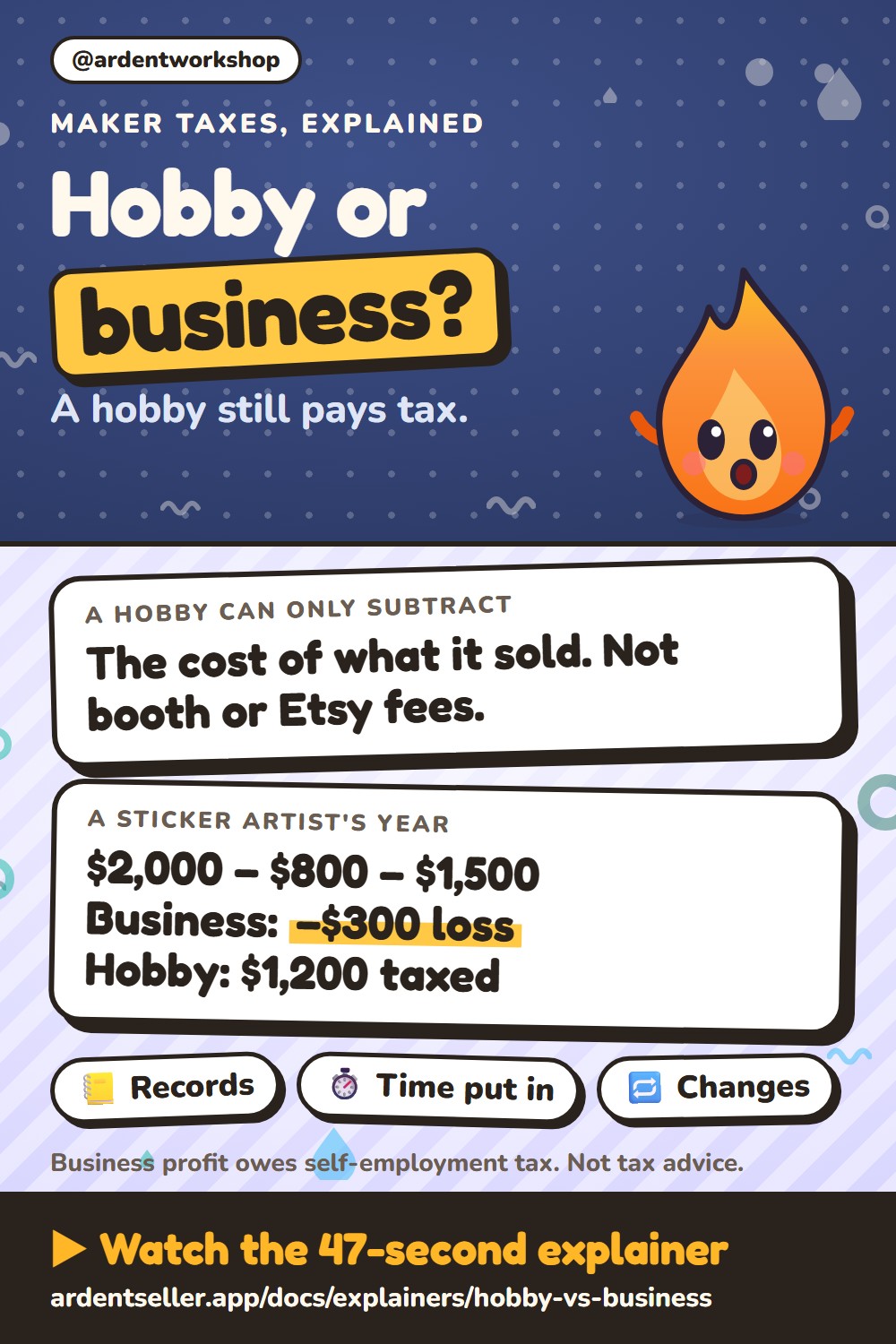
The IRS test: are you really trying to make a profit? A hobby still pays tax on its sales and can subtract only the cost of what it sold, not booth or Etsy fees.
If you sell what you make, federal tax law (the hobby loss rule) treats the activity as either a business or a hobby, and “it’s just a hobby” doesn’t mean no tax. Hobby sales are still income. A hobby can subtract the cost of the goods it sold, but not its other expenses, such as booth fees and Etsy fees. Those have been disallowed since the 2018 tax year, and a 2025 law made that permanent. A hobby loss also can’t offset your other income. What decides it is whether you’re really trying to make a profit: the IRS weighs signs such as businesslike records, the time you put in and whether you change course when you lose money, and no one sign decides it alone. If the activity made a profit in at least three of the last five years, counting this one, it’s presumed to be a business unless the IRS shows otherwise. The video works an example sticker artist’s money-losing year both ways: $2,000 of sales, $800 cost of the stickers sold and $1,500 of fees is a $300 business loss, or $1,200 of taxed hobby income. Being a business has a cost too: a business with net earnings of $400 or more owes self-employment tax on them. If it’s a real business, run it like one: keep a separate bank account and every receipt.
Watch on YouTube Shorts (opens in new tab)
The whole idea on one card
New explainers drop on our socials
Follow @ardentworkshop for more maker explainers.
Go further
- Glossary: Hobby Loss Rule
- Read: When Your Hobby Becomes a Business: The Tax and Record-Keeping Tipping Point
- Read: Do You Need an LLC for Your Handmade Business? Probably Not Yet
- Read: How Long to Keep Business Receipts: The IRS Clock, Not the 7-Year Myth
- Read: 42 Questions Etsy Sellers Ask About Fees, Inventory, and Bookkeeping
- For Etsy Shop Owners
- For Sticker Makers
- For Farmers Market Vendors
- Guide: Start an Etsy shop
- Guide: Start a sticker business
Transcript
Hook
Hobby or business? Either way, a hobby still pays tax.
Myth vs fact
Hobby sales are taxed too. And a hobby can only subtract the cost of what it sold. Booth and Etsy fees? Not deductible.
The test
What decides it is a real profit motive. The IRS weighs signs like business records, real time put in, changes when you lose money.
Example
A sticker artist sells $2,000. Stickers cost $800, fees $1,500. As a business, that’s a $300 loss. As a hobby, $1,200 gets taxed.
Takeaway
If it’s a real business, run it like one: a separate account, every receipt. A profit in 3 of 5 years helps too.
Sources
- Income from an activity not engaged in for profit (such as a hobby) must be reported, on Schedule 1 (Form 1040), line 8j (its sentence on deducting hobby expenses predates the §67 suspension): IRS Publication 525, Other Income: Activity not for profit (opens in new tab)
- A hobby’s gross income may be figured as gross receipts minus cost of goods sold: Treas. Reg. §1.183-1(e) (opens in new tab)
- Other hobby expenses are miscellaneous itemized deductions, disallowed for tax years beginning after 2017; Pub. L. 119-21 (2025) removed the 2025 end date, so the disallowance has no sunset: 26 U.S.C. §67(h) (formerly (g)) and amendment notes (opens in new tab)
- Hobby expenses are miscellaneous itemized deductions and can no longer be deducted: IRS Publication 529, Miscellaneous Deductions (opens in new tab)
- Selling and distribution costs (such as booth and marketplace fees) are not inventory costs, so they don’t go into cost of goods sold: Treas. Reg. §1.471-11(c)(2)(ii) (opens in new tab)
- Whether an activity is engaged in for profit is judged on all the facts, including the manner it is carried on (books and records, changes of operating methods to improve profitability) and the time and effort put in; no one factor is determinative: Treas. Reg. §1.183-2(b) (opens in new tab)
- An activity with a profit in 3 or more of 5 consecutive years is presumed to be engaged in for profit unless the IRS establishes otherwise: 26 U.S.C. §183(d) (opens in new tab)
- A not-for-profit activity’s loss can’t offset other income; factors the IRS considers: IRS Fact Sheet FS-2022-38, “Know the difference between a hobby and a business” (Oct 2022) (opens in new tab)
- Self-employment tax applies to net earnings of $400 or more from a trade or business; hobby income is not from a trade or business: 26 U.S.C. §1402(a)-(b) (opens in new tab)
US federal tax rules as of October 2026. General education, not tax advice. Check your own situation with a tax professional.
Last updated .