What is COGS? Cost of goods sold, explained
COGS, or cost of goods sold, is what the things you sold cost to make. At its simplest: start-of-year inventory, plus materials bought, minus what’s left at year end.
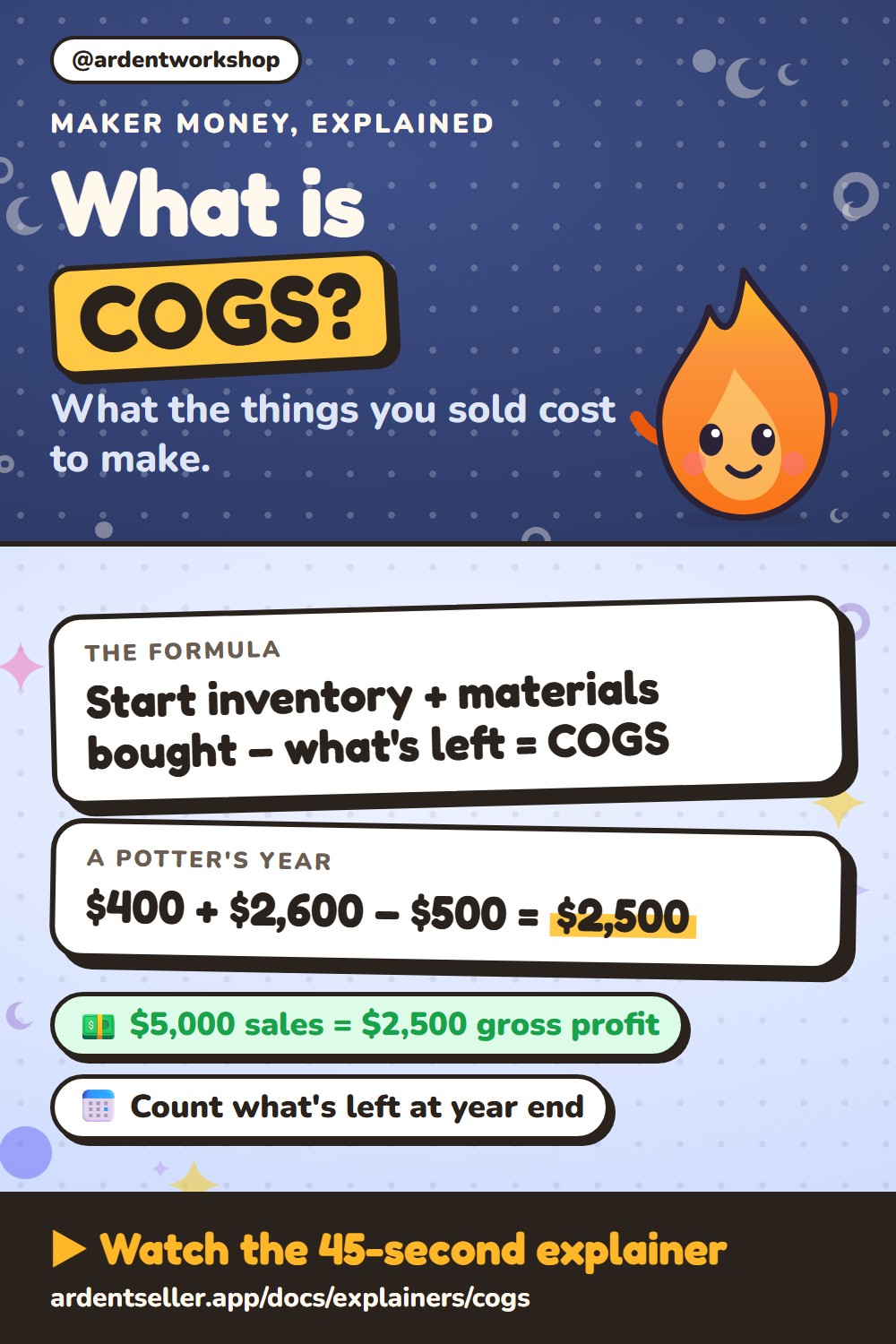
Cost of goods sold (COGS) is what the products you sold cost you to make, starting with the materials in them. It sits between your sales and your profit: sales (after returns) minus COGS is your gross profit, before your other expenses such as selling fees. At its simplest, the formula is inventory at the start of the year, plus the materials you bought, minus what’s left at year end. The video works it through for a potter who starts the year with $400 of clay, glaze and unsold mugs, buys $2,600 more and ends the year with $500 of clay, glaze and mugs left: COGS is $2,500, so $5,000 of mug sales is $2,500 of gross profit. Without that year-end count, your COGS and your profit are a guess, so count what’s left at year end.
Watch on YouTube Shorts (opens in new tab)
The whole idea on one card
New explainers drop on our socials
Follow @ardentworkshop for more maker explainers.
Go further
- Glossary: COGS (Cost of Goods Sold)
- Read: What Is Cost of Goods Sold? A Plain-English COGS Primer for Maker Businesses
- Read: Year-End Inventory Count for Taxes: A December Plan for the Number Schedule C Asks For
- Read: Stocktake Guide: A Step-by-Step Walkthrough for Counting What You Actually Have
- Read: Pottery Seller's Glossary: 36 Terms You'll Hear from Suppliers, Galleries, and the Tax Office
- For Pottery & Ceramics
- For Etsy Shop Owners
- Guide: Start a pottery business
- Guide: Start an Etsy shop
Transcript
Hook
What is COGS? It’s why your sales aren’t your profit.
Definition
Cost of goods sold is what the things you sold cost to make, like the clay and glaze. Selling fees don’t count.
Formula
Start with the inventory you began the year with. Add the materials you bought. Subtract what’s left. That’s your COGS.
Example
A potter starts with $400 of clay, glaze and unsold mugs, buys $2,600 more, and ends with $500. COGS: $2,500.
Payoff
So $5,000 of mug sales is $2,500 in gross profit.
Takeaway
So count what’s left at year end. Skip it, and your COGS and your profit are a guess.
Sources
- Cost of goods sold: inventory at beginning of year + purchases + cost of labor (not amounts paid to yourself) + materials and supplies + other costs − inventory at end of year (Schedule C lines 35–42): IRS Publication 334 (2025), Tax Guide for Small Business, How To Figure Cost of Goods Sold (opens in new tab)
- If you make, buy or sell goods, you must take inventories into account at the beginning and end of your tax year (with an elective exception for small business taxpayers): IRS Instructions for Schedule C (Form 1040) (2025), Part III (opens in new tab)
- Inventory includes raw materials, work in process, finished products, and supplies that physically become part of the item intended for sale: IRS Publication 334 (2025), Items included in inventory (opens in new tab)
- Gross profit is net receipts (gross receipts minus returns and allowances) minus cost of goods sold: IRS Publication 334 (2025), Figuring Gross Profit (opens in new tab)
- Commissions and fees are deducted as expenses in Part II of Schedule C (line 10), not in cost of goods sold: IRS Instructions for Schedule C (Form 1040) (2025), Part II, line 10 (opens in new tab)
- You must value your inventory at the beginning and end of each tax year: IRS Publication 334 (2025), Inventories (opens in new tab)
- Book inventories should be verified by physical inventories at reasonable intervals: 26 CFR 1.471-2(d), Valuation of inventories (opens in new tab)
- $400 + $2,600 − $500 = $2,500 COGS; $5,000 − $2,500 = $2,500 gross profit: Arithmetic on the example’s numbers (opens in new tab)
General education, not tax advice. The full Schedule C formula also counts labor you pay others (not your own time), supplies used in making the goods, and other production costs. Small businesses also have other inventory options, so check with a tax professional.
Last updated .