Markup vs margin: 50% markup ≠ 50% margin
Markup divides your profit by your cost; margin divides it by your price. Why a 50% markup leaves only a 33% margin, and the one conversion worth remembering.
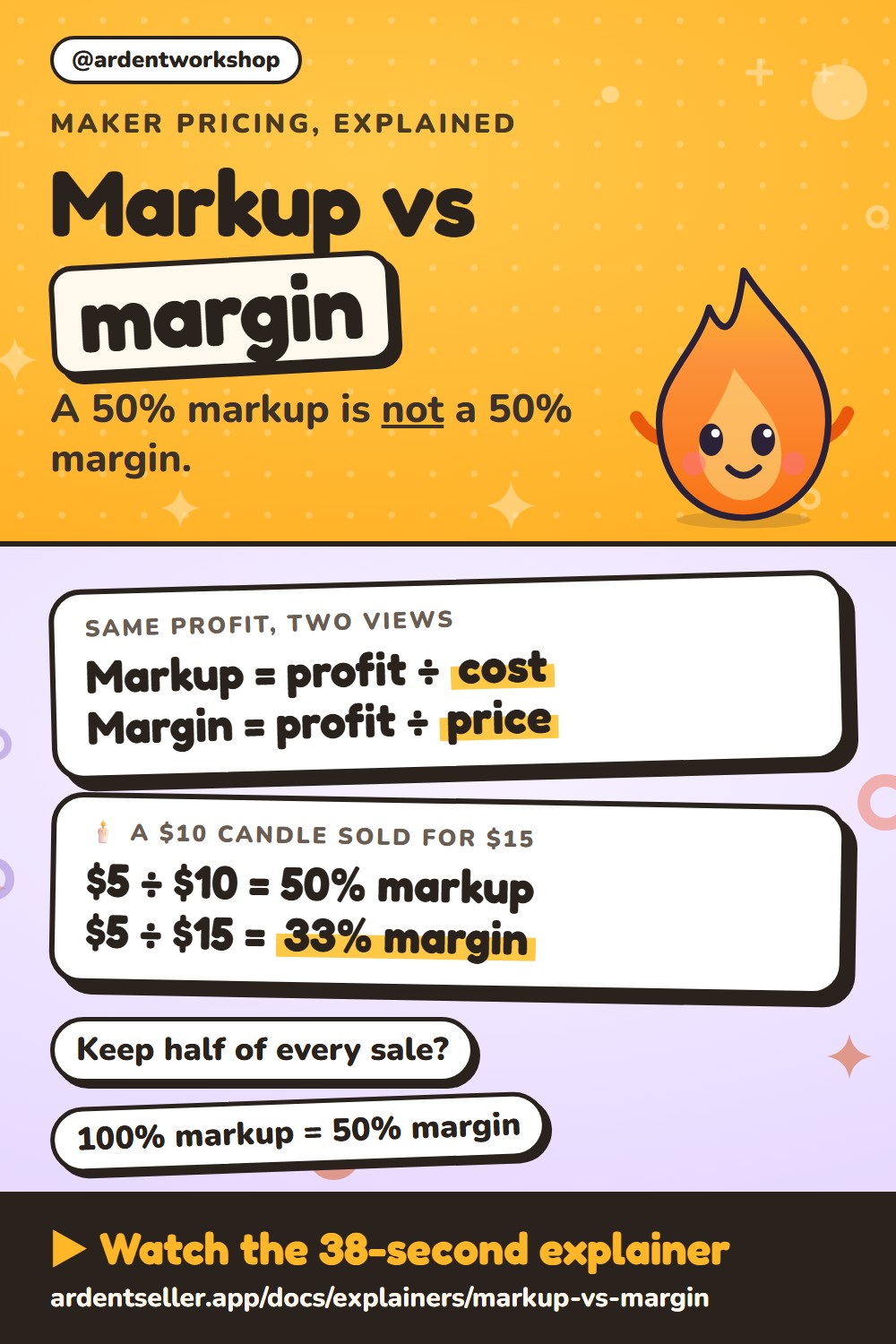
Markup and margin start from the same profit but divide it by different numbers: markup by your cost, margin by your price. This short works through one candle that costs $10 to make and sells for $15, a 50% markup but only a 33% margin, then shows the conversion most makers need: a 100% markup (doubling your cost) is a 50% margin.
Watch on YouTube Shorts (opens in new tab)
The whole idea on one card
New explainers drop on our socials
Follow @ardentworkshop for more maker explainers.
Go further
- Glossary: Markup
- Read: Margin vs Markup: The Pricing Math Mistake That's Quietly Ruining Your Profit
- Read: Wholesale Pricing for Handmade Products: How to Set Minimums, Protect Margins, and Not Undersell Yourself
- Read: Against the "Just Charge More" School of Pricing Advice
- For Wholesale & Consignment
- For Candle Makers
- For Etsy Shop Owners
- Guide: Start a candle business
- Guide: Start an Etsy shop
Transcript
Hook
Markup vs margin: a 50% markup is not a 50% margin.
Definition
Both start from the same profit. Markup divides that profit by your cost. Margin divides it by your price.
Example
Say a candle costs you $10 to make. You add 50% and sell it for $15. That’s $5 of profit.
The gap
$5 over $10 is a 50% markup. But $5 over $15 is only a 33% margin.
Takeaway
Want to keep half of every sale? Double your cost. A 100% markup is a 50% margin.
Sources
- Markup is figured on cost and margin on selling price; a 50% markup on cost is only a 33⅓% margin on selling price, and a 100% markup equals a 50% margin: University of Maine Cooperative Extension, Bulletin #3000: Basic Pricing Strategies for Small Businesses (text and Table 2) (opens in new tab)
- Adding a percentage to cost gives a smaller margin than that percentage (Penn State’s example: adding 20% to cost gave a 16% gross margin, not 20%): Penn State Extension, Retail Farm Market: Pricing (opens in new tab)
Last updated .