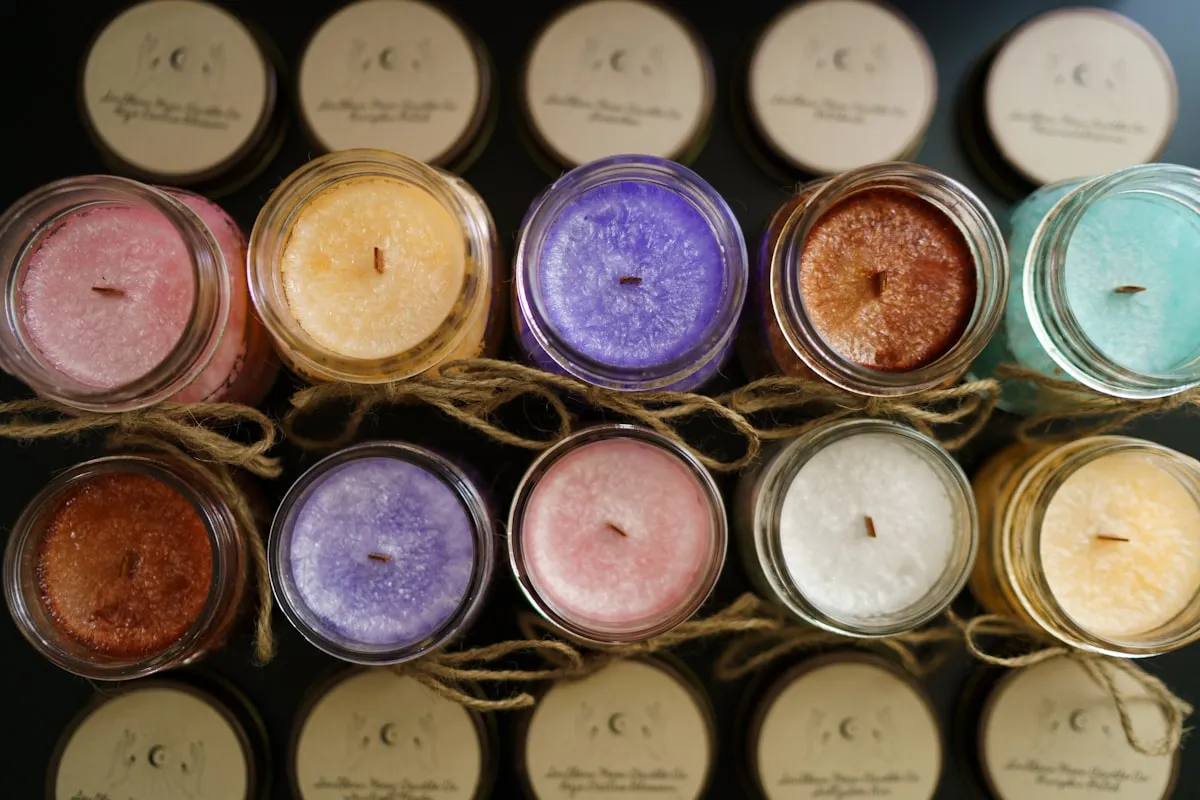
Rosa pours her last candle of the night at 11:47 p.m. There are forty-two cooling on the table, each in a 9-ounce amber jar, each scented with a blend she spent $68 on a month ago. Tomorrow is the spring market. She has priced these at $18 each — same as last year, same as the booth across the aisle, same as the nice round number her sister told her felt right.
If she sells all forty-two, she will make $756 in revenue, eat a $41 booth fee, hand the payment processor $24 in fees, and drive home with what feels like a profitable Saturday.
Candle pricing requires three numbers: wax weight per vessel, fragrance load percentage, and fragrance cost per ounce. Most candle makers know none of them. The price the booth across the aisle charges is not one of them. Here is how to find yours.
She is losing money on every candle. She does not know it yet. Nobody has ever shown her the math.
Rosa — and Marcus and Dev, who appear later in this post — are composite illustrations assembled from patterns common to small candle businesses. They are not real people, and not Ardent Seller customers. The arithmetic is what matters; the names are just a way to keep three cost structures apart.
The three questions every candle needs to answer
Before we talk dollars, there are three questions a candle has to answer in numbers, not vibes. Most sellers can answer one of them. Some can answer two. Almost none can answer all three.
Rule of thumb: If you cannot tell me, off the top of your head, (1) how many ounces of wax go into one of your candles, (2) what fragrance load percentage you pour at, and (3) what you paid for that specific bottle of fragrance oil, you are not pricing — you are guessing in a nice font.
Question 1: How much wax is actually in this candle?
Not the jar size. The wax weight. A 9-ounce jar does not hold 9 ounces of wax — it holds the wax plus the fragrance plus headspace, and the headspace matters because it is why your yield per pound of wax is never what the bag says.
Question 2: What is your fragrance load?
Fragrance load is the weight of fragrance oil as a percentage of your wax weight. Soy wax can generally carry 6–10%, paraffin handles 10–12%, coconut-soy blends sit around 8–10%, beeswax tops out lower at 3–6% — check your specific wax supplier's technical data sheet for exact recommended maximums. A candle poured at 10% load is not twice as scented as one at 5% — but it costs twice as much in fragrance, and fragrance is usually your second-biggest ingredient expense.
Question 3: What did the fragrance oil actually cost you per ounce?
Not per 16-ounce bottle. Per ounce, including shipping, spread across the batches you actually poured before the bottle went off. Fragrance oils have a shelf life, and the back-of-the-shelf bottle nobody remembered is not free — it is scrap cost.
These three questions are where we start. Everything else stacks on top.
Question 1: Wax yield, honestly
Here is the calculation most candle makers were handed by a YouTube video in 2019 and have been quietly using wrong ever since.
They weigh the empty jar. They weigh the filled, finished candle. They subtract. That number, they call "the wax." Then they divide the price per pound of wax by that weight and call it cost per candle.
The problem: that number includes the fragrance oil, which is not wax. So the per-candle "wax cost" is artificially high, the per-candle fragrance cost is zero, and the books do not match reality.
The right way: Decide the wax weight you are pouring first, based on how full you want the jar and how much headspace you need. Then calculate fragrance weight from that wax weight. Then weigh both into the pour pitcher separately.
For Rosa's 9-ounce amber jar:
- She pours 6.5 oz of soy wax
- At 8% fragrance load: 6.5 × 0.08 = 0.52 oz of fragrance oil
- Total pour weight: 7.02 oz (which leaves healthy headspace in a 9-oz vessel)
Now her yield-per-pound math is clean. A 16 oz (1 lb) bag of soy wax yields 16 / 6.5 = 2.46 candles. Not "about two and a half." Not "roughly two." Exactly 2.46, repeatably, every pour, until she changes her fill line.
Rule of thumb: Pick your wax weight per vessel once, write it down somewhere that is not a Post-it, and never let yourself improvise again. Every improvised pour is a candle you cannot cost.
Question 2: Fragrance load is where the margin goes to die
Fragrance oil is the ingredient that sneaks up on candle makers. A 16-ounce bottle at $42 feels like a reasonable expense until you do the per-ounce math: $2.63 per ounce, which means at 8% load in a 6.5-ounce wax pour, each candle is carrying 52 cents of fragrance. Forty-two candles in a batch is $21.84 in fragrance alone.
That is fine. What is not fine is not knowing it.
Here is what changes the math faster than any other variable:
A 2-percentage-point increase in load doubles the fragrance impact you notice — and adds 25% to your fragrance cost per candle. Going from 6% to 8% on that same jar takes the fragrance portion from 0.39 oz to 0.52 oz. Multiply across a 100-candle production run and you have added $34 in material you may or may not be passing to the customer.
Rosa had been pouring at 10% because a Facebook group told her "max your load for maximum throw." Her actual cost per candle on fragrance: 65 cents. She thought it was closer to 30. She had been underpricing by about a dollar per candle for eight months. At roughly 400 candles sold, that is $400 of margin she deposited into her fragrance supplier's bank account instead of her own.
Question 3: The fragrance oil that went rancid
This is the cost nobody counts and everybody pays.
Fragrance oils have shelf lives. Citrus notes degrade fastest — sometimes inside six months once opened. Vanillins can discolor. Essential oils oxidize. If you bought a 16-ounce bottle of pine-cedar at the holiday-season prep sale and have 4 ounces left in April that now smell sharp and off, that bottle did not cost you $42. It cost you $42 minus whatever the 12 ounces you poured generated in revenue — and the remaining $10.50 of oil is waste you owe to the books.
How to count it: At the end of every quarter, walk the shelf. Anything that has turned, discolored, or is past 12 months opened goes in a scrap column. Total that column. Divide it into the candles you sold that quarter. That is your fragrance waste cost per candle. (The shelf-life and shrinkage post walks through the same exercise across other inventory categories — same math, different ingredients.)
Many candle makers who do this exercise for the first time find 3–8% of fragrance spend is walking out the door as scrap. Build that into your load cost and your prices. Or keep eating it silently.
Rule of thumb: If you are opening a new bottle of seasonal fragrance, date it with a Sharpie on the cap. If you would not pour it for a customer at the one-year mark, you are holding scrap and calling it inventory.
The full candle cost stack
We have talked about wax and fragrance. Those are the biggest two ingredient lines, but a candle is not two ingredients in a jar. It is at least eight.
Here is what actually goes into one 9-ounce jar candle, with the ranges most small makers land in:
- Wax — $0.55–$1.20 per jar depending on wax type (soy cheap, coconut-apricot blends expensive, pure beeswax very expensive)
- Fragrance oil — $0.30–$0.90 per jar at 6–10% load with mid-range oils
- Wick — $0.08–$0.25 per jar, more if you use wooden wicks
- Wick sticker or glue dot — $0.02–$0.05
- Vessel (the jar itself) — $1.10–$3.50 depending on weight, shape, and whether you source from a jar wholesaler or Michael's
- Lid — $0.40–$1.20 (and yes, lidded candles sell for more, because buyers perceive gift-readiness)
- Label — $0.10–$0.40 depending on paper, print method, and whether you printed 10 or 1,000
- Dye, wick tabs, warning stickers, dust cover stickers, tissue, any finish detail — $0.05–$0.30 combined
Rosa's 9-ounce soy amber jar, mid-range fragrance at 8% load, kraft label, no lid:
- Wax: $0.72
- Fragrance: $0.52
- Wick + sticker: $0.14
- Jar: $1.85
- Label + warning sticker: $0.22
- Misc: $0.08
Ingredient cost per candle: $3.53.
Rosa was assuming her per-candle cost was "about two dollars." It is 76% higher than that, and she has not priced a single candle with the real number in mind.
But that is not your cost either
Ingredient cost is where amateur pricing stops and where professional pricing begins.
The candles on Rosa's table cost her $3.53 in materials each. They also cost her:
- Her labor. Two hours of pouring, labeling, and cleanup to produce 42 candles. At a self-paid rate of $25 an hour, that is $1.19 per candle in labor.
- Her fixed overhead. Rent on the corner of the garage she cannot use for anything else, the power bill for the melter, the subscription to the design software for her labels, the insurance premium the cottage industry policy charges her for liability. Spread across about 1,400 candles a year, that is roughly $1.80 per candle.
- Her variable selling costs. The 6 × 6 × 6 shipping box for online orders. The booth fee divided across market-day sales. The payment processor fee. For her market sales specifically, those run about $1.40 per candle.
Total cost per market candle, all-in: $3.53 + $1.19 + $1.80 + $1.40 = $7.92.
She has been selling them for $18.
And this is where a lot of sellers stop reading, relieved. "$18 minus $7.92 is $10 — I am profitable!" Hold that thought. We are not done.
Three makers, three floors, three different prices
Rosa is one candle maker. Let us look at two more, because the right price for a candle depends entirely on what kind of candle it is and who is buying it. The same math, different answers.
Scenario 1: Rosa — market and direct-to-consumer soy jars
Cost per candle (all-in, market sales): $7.92
If Rosa wants a 60% gross margin on ingredient cost alone (a common starting heuristic, and probably too low), she needs to price at $3.53 / 0.4 = $8.83.
If she wants a 60% gross margin on total cost (materials + labor + overhead + selling), she needs to price at $7.92 / 0.4 = $19.80.
At $18, Rosa is running a 56% margin on total cost. That is below her stated target. She is also undercharging for the market channel specifically, where her selling costs are highest.
Rosa's right price: $20 at the market, $22 direct-to-consumer with free shipping absorbed into the price, $24 on her Etsy shop to cover Etsy's 6.5% transaction fee (Etsy fees & payment policies (opens in new tab)) and the ad budget she runs on listings. Not one price. Three prices, for three different channels with three different cost structures.
Scenario 2: Marcus — wedding favor specialist
Marcus pours 4-ounce mini-tins for wedding favors. He makes them in batches of 100–250 per order. His math looks nothing like Rosa's because his economics are fundamentally different.
- Wax weight: 3.0 oz per tin (coconut-soy blend, higher cost than pure soy)
- Fragrance: 0.24 oz at 8% load, but he only offers three scent profiles, so he buys fragrance in gallons
- Tin: $0.85 at volume
- Custom printed label: $0.18 at the bulk order quantities weddings require
His ingredient cost per candle is $1.92 — lower than Rosa's, because he buys in volume and uses smaller vessels.
But here is the catch. Weddings come with:
- Custom label design time: 2–4 hours of his time per order, amortized across 100–250 units
- Personalization risk: one typo on the bride's name and that batch is scrap
- Payment terms: a 50% deposit up front, the rest after delivery, sometimes with 60-day lag
Marcus cannot price on ingredient cost. He prices on project economics. A 150-unit wedding order costs him roughly $288 in materials, $200 in labor (pouring + design + coordination), $180 in amortized overhead, and a 2% scrap reserve. His floor is about $4.45 per candle.
He charges $6.50 per candle as a standard rate, $8 for rush orders inside three weeks. At $6.50 × 150 units, he grosses $975 on an order that cost him $668 — a $307 profit for roughly 9 hours of work, or $34 an hour.
Marcus's right price: It is not really a candle price. It is a project price disguised as a per-unit number, and it has a minimum order of 75 units because below that he cannot absorb the design time profitably.
Scenario 3: Dev — boutique beeswax specialist
Dev makes pillar candles out of 100% locally sourced beeswax. His per-candle ingredient cost is $14.80 — higher than some sellers' retail prices. His fragrance cost is $0, because beeswax candles are sold unscented (beeswax has its own honey-hay aroma that is the whole point of the product).
Dev sells his pillars for $48 each at a single high-end boutique in a tourist town. He makes 300 a year. His economics:
- Ingredient: $14.80
- Labor: $4.20 (beeswax is fussier to work with)
- Overhead: $3.90
- Wholesale margin (boutique takes 50%): the boutique buys from him at $24, sells at $48
- Dev's cost to deliver at wholesale: $22.90. His wholesale price: $24. His profit per candle: $1.10.
If Dev looks at this and panics, he should. He is running a 4.6% margin on wholesale and has no direct-to-consumer channel. The pillar candles are a boutique product that is not paying him.
Dev has three options:
- Raise wholesale to $32 (boutique retail would go to $64, test elasticity)
- Open a direct channel at $48 retail and keep the full margin on those sales
- Recognize that beeswax pillars are a premium loss leader and price something else in his line to subsidize them
Dev's right price: probably $36 wholesale / $72 retail direct. Anything less is philanthropy with extra steps.
The patterns across all three
Three different candle makers. Three different cost structures. Three different right prices. But the patterns are the same:
- Ingredient cost is the floor, never the ceiling. Every maker had to layer labor, overhead, and channel cost on top to find a real number.
- Channel changes price. Market, Etsy, wholesale, direct — each channel has its own cost structure and should have its own price. One price across all channels means you are undercharging on at least one of them.
- Volume changes everything. Marcus's math works because he buys in gallons and pours in batches of 100. Rosa's math would break if she tried to price like Marcus.
- The wax is the cheap part. Across all three, wax was never the biggest line item. Fragrance, vessel, and labor each beat it. Sellers who obsess over a 15% wax price change and ignore a 40% vessel price change are fighting the wrong battle.
What a candle maker's books actually need to track
You cannot price what you cannot measure. Here is the minimum record-keeping that makes candle costing possible, in roughly the order most makers adopt it:
- Wax weight per vessel, written down. Not estimated. Not remembered. Documented per SKU.
- Fragrance load percentage per SKU. And the oil supplier, the bottle date, and the per-ounce cost including shipping.
- Batch log. Which pour produced which candles, what went into it, when it was made, how many came out usable. Useful for pricing, essential for scent consistency, critical if a batch fails and you need to figure out why.
- Open fragrance shelf inventory. Bottles, open dates, remaining volume. Quarterly scrap-out of anything past shelf life. (Pair this with reorder points and par levels so you stop discovering you are out of bergamot at 11 p.m. the night before a market.)
- Per-channel cost breakdowns. Market selling costs. Shipping costs. Wholesale buyer terms. Each channel gets its own cost card.
- A per-SKU cost card that pulls from all of the above and spits out a current cost-to-produce number that updates every time an ingredient cost changes.
If that list sounds like it is too much for a kitchen-table business, it is — which is the whole problem. A spreadsheet with 14 tabs is where candle makers start; it is also where they stop, because reconciling a spreadsheet is the worst kind of Saturday. (Where a candle spreadsheet actually breaks works through the three specific failures — variant multiplication, wax that never reaches a candle, and the component that quietly caps what you can pour.) A tool like Ardent Seller was built for this specifically: recipe-based costing that tracks ingredients at the gram, batches that link directly to the production runs that used them, and per-SKU cost cards that update the moment your fragrance supplier raises prices. You stop guessing what a candle costs. You stop pricing on feelings. You start pricing on numbers.
The questions Rosa should have been asking in November
It is April now and Rosa is pouring tomorrow's market stock. But she lit a candle on her own counter last November and burned through the whole bottle of cold-pressed vanilla by New Year's without writing down what it cost, what it yielded, or what the 42 candles she sold that month earned her after everything came out of the till.
The right time to set up costing was November. The second-right time is tonight, before she drives to the market in the morning. Pulling the new prices out at the booth would be a bad idea. Pricing the next batch at the real number is not.
Every candle on her table tomorrow will sell for $18. That is fine. That batch is cost-of-education, and the education she buys with it is: do not pour another batch without knowing the number.
What to do this week
Pick one SKU — your bestseller. Open a blank page. Answer:
- What is the wax weight in this candle? Weigh a pour if you are not sure.
- What is the fragrance load percentage? If you do not know, you are probably at 10% because that is where the YouTube videos told you to land.
- What did the fragrance oil cost per ounce, delivered?
- What does the vessel cost, delivered?
- What are every other ingredient and its per-unit cost?
- What is your labor rate, and how many minutes does this candle take from a cold melter to a finished, labeled jar?
- What is your monthly overhead, and how many candles do you make a month? Divide.
- What channel are you pricing for?
Add it up. Compare to what you charge. If you are below the real number — and most of you are — the next batch gets priced on math, not vibes.
Then do the same thing for your second bestseller. Then your third. By the time you have five SKUs costed honestly, you will have a pricing model that other candle makers will ask you for.
If you are still pre-launch — or know someone who is — the same math is the foundation of how to start a candle business, our step-by-step guide covering equipment, legal setup, and where to sell.
Ready to stop pricing on feelings? Start a free Ardent Seller account and cost your first SKU in under ten minutes. No credit card, no pressure — just the math your candles have been trying to tell you for months.
Free resources
A few free downloads from the Ardent Workshop library that pair well with this post:
- Fragrance Load Calculator — A live web tool that turns the percentage-of-wax math in this post into exact ounces and grams, with typical and max safe loads for 11 candle waxes (and seven soap and bath bases) plus per-candle fragrance cost when you add your FO price.
- Recipe Scaling & Batch Calculator (Excel) — A working scaler with melted soy wax (0.88 g/ml) and beeswax (0.96) densities baked in. Set a target candle count, the workbook rewrites every wax, FO, jar, and wick quantity with unit conversions handled for you. The Batch Cost & Yield tab compares per-candle cost across 5 / 10 / 25 / 50 / 100 / 250 unit pours — the math behind "is the second pour day worth it?"
- Product Pricing Calculator (Excel) — Plug your wax, fragrance, jar, wick, and labor numbers into the calculator with the Etsy or Shopify fee % you actually pay. The suggested retail comes back with the platform fee netted out — so a 40% target margin actually means 40% in your pocket, not 30% after Etsy's cut.
- Should I Raise My Prices? Decision Tool — A live web tool that runs the +10% / +20% / +30% price-hike math on one product — including the volume drop that comes with each — and tells you which scenario clears the most monthly profit.
- Craft Seller Startup Checklist — Pricing math, inventory setup, and the legal pieces (insurance, sales tax, business banking) that candle makers running on a folding table tend to defer until something forces the issue.
- Monthly Inventory Count Sheet — A printable count sheet for the wax, fragrance oils, jars, and wicks behind every SKU — useful for catching the slow leak between bulk fragrance purchases and finished candles on the table.
This article is provided for educational purposes only and does not constitute financial, tax, or business advice. Cost structures, pricing examples, and margin figures are illustrative and will vary by your specific materials, channels, and circumstances. Consult a qualified accountant or small-business advisor before making financial decisions based on this content.