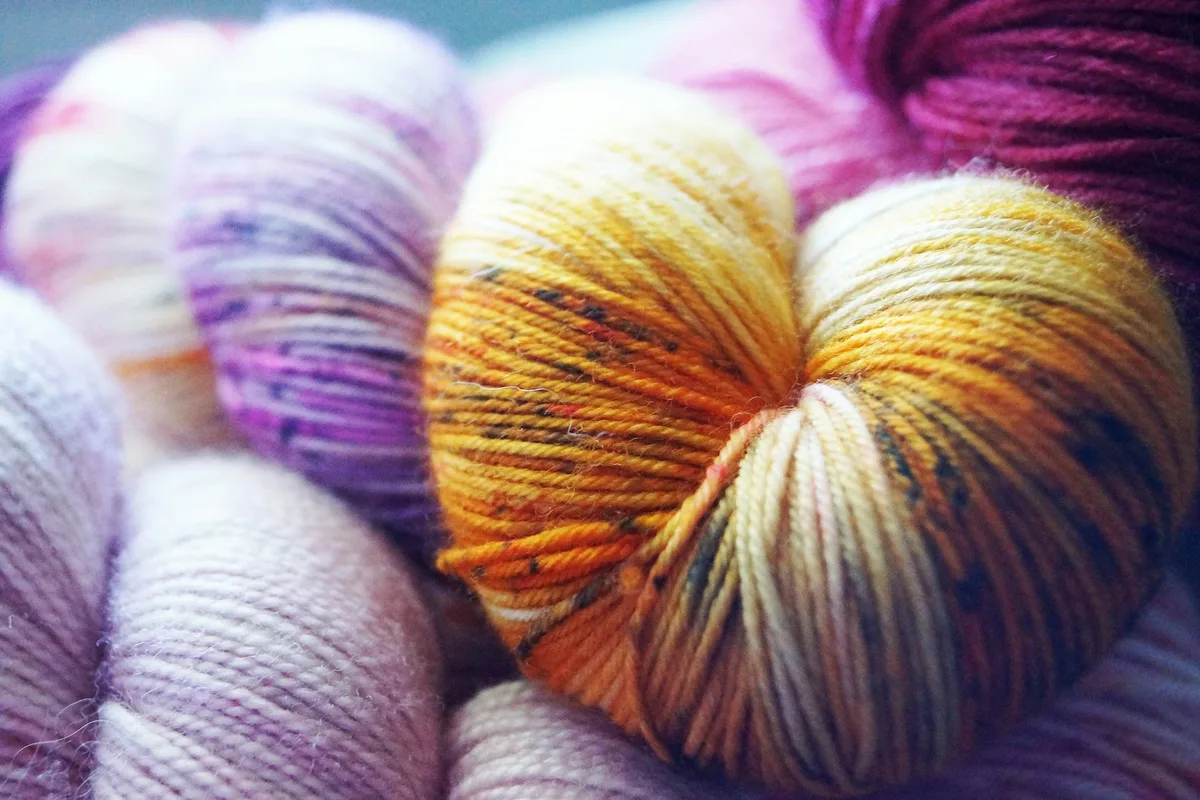
The kitchen smells like warm wet wool and vinegar. Three stockpots tick on the burners, and the window over the sink has fogged so thoroughly that the street outside is just a gray blur. Along the drying rack, eight skeins of a colorway called Wharf Smoke drip into a towel: blue-gray at the crown of each loop, a little deeper where the yarn sat lowest in the pot.
On the phone propped against the flour tin, a message has just arrived:
"Love the Wharf Smoke. I need three more skeins to finish my sweater. Same dye lot as my last order, please!"
Picture Wren, the indie dyer standing at that stove (she and her buyers are composites, not real people). Whether she can answer that message in thirty seconds or thirty minutes depends on one small number she either wrote down three months ago or did not.
A dye lot is every skein that came out of the same dye pot at the same time. Skeins in one lot share a lot number, which goes on the label so a knitter can buy skeins that match. Two lots of the same colorway, dyed from the same recipe, can still come out a visibly different shade. That is why knitters ask for the number, and why a dyer who sells by colorway also has to keep track of lots.
The rest of this primer covers why lots differ, how to number them, where the number sits on a legally complete label, and how to keep track of which lot went to which customer.
Why dye lots of the same colorway differ
Yarn is dyed in batches, and every batch gets its own number. Even the biggest yarn companies work this way. Lion Brand's guide to dye lots (opens in new tab) explains that each batch carries its own dye lot number on the label, and that skeins from different batches can show noticeable color variation even when the same dyes were used.
For an indie dyer, more of what drifts between batches is in plain view. One pot holds a handful of skeins instead of a vat's worth. The water came from a different tap run. The pot simmered a few minutes longer while the phone rang. The base yarn came from a new shipment, and the wool took up the color slightly differently. None of that is a mistake. It is what makes hand-dyed yarn look hand-dyed. But it means "Wharf Smoke" is a recipe, not a guarantee.
Commercial labels sometimes say "no dye lot" instead, meaning the skeins carry no batch number to match. Lion Brand explains (opens in new tab) that no-dye-lot yarns are dyed in much bigger batches, and still advises caution: a no-dye-lot yarn does not necessarily mean every skein will be exactly the same color, because once a big batch sells out, the next one is a different lot. Indie hand-dyed yarn is usually dyed in skeins, one pot at a time, so "no dye lot" is rarely a label an indie dyer can honestly print.
Speckled and variegated colorways add one more layer. Their skeins can vary noticeably within a single lot, because dye placement is part of the look. Telling buyers that up front, and suggesting they alternate skeins as they knit, prevents more unhappy messages than any numbering scheme.
Why knitters ask for the lot number
From the knitter's side, the dye lot decides whether a finished sweater has a stripe across the middle where one skein ran out and the next began. Lion Brand's guide (opens in new tab) tells crafters to buy enough of a single dye lot to finish a project. It also suggests buying one extra skein when in doubt. When they cannot get enough of one lot, it suggests alternating rows of the old and new lot so the change blends in instead of landing as a hard line.
That buying habit shapes three moments in an indie dyer's week:
- The sweater-quantity order. A buyer wants six skeins for a cardigan. They want all six from one lot, and they will notice if they are not.
- The "same lot as last time" message. A buyer is short a skein and gives you a lot number from their label. You need to know whether any of that lot is still on the shelf.
- The repeat colorway. You dye Wharf Smoke again next month. The new skeins need a new number so nobody mistakes them for the old batch.
Each of those is a two-minute job when lots are written down and a guessing game when they are not. The stash-costing guide for knitters covers the same problem from the buyer's side, including the spare safety skein that guards against running short of a lot.
How to number a dye lot
A dye lot number only has two jobs: it must be unique to one pot, and you must be able to read it back months later. Fancy schemes tend to fail the second job. A plain one works:
- Date plus pot letter.
261028-Bis the second pot dyed on October 28, 2026. It sorts in date order and needs no lookup table. - One pot, one number. If a wholesale order of twenty skeins takes two pots, that is two lots, even with the same colorway and the same recipe card. Label them separately and tell the buyer.
- Write it before the skeins leave the rack. Tag each skein while the batch is still together. A skein that dries unlabeled and lands in a bin with the next batch has lost its lot for good.
- Keep the batch record with the number. Note the base yarn and its shipment, the dye amounts, and the skein count. When a buyer asks why lot B looks warmer than lot A, that record is the only real answer.
A lot number is not a SKU. The SKU names the product (the Wharf Smoke fingering-weight skein), and stays the same every time you dye it. The lot number names one batch of that product. The SKU design guide covers the product-code side of that split.
What a yarn label needs besides the dye lot
The dye lot number is optional. Some other information on a yarn label is not.
The FTC's guide to the Textile and Wool Acts (opens in new tab) lists "all fibers, yarns and fabrics" among covered textile products, and names yarn among the wool products covered by the Wool Act. The guide does not list an exemption for small or handmade sellers. It sets out three required disclosures:
| Disclosure | What it means on a hand-dyed skein |
|---|---|
| Fiber content | Generic fiber names and percentages by weight, in descending order (for example, 75% wool and 25% nylon). Wool must be named even under 5%. |
| Country of origin | Where the yarn was made. The guide uses a yarn maker as its example of a business that must identify imported fiber. |
| Identity of the business | Your business name, or an RN number issued by the FTC in its place. |
| Dye lot (optional) | Allowed alongside the required disclosures. The guide permits non-required information, such as care instructions, as long as it does not minimize, detract from or conflict with them. |
The guide to labeling handmade products covers how these rules reach finished hand-knits, too. Most indie labels already carry the colorway name, the yardage, the weight and a care line. The lot number fits beside those. Put it where a knitter will find it later; the label may be the only record they keep of which lot they bought.
Tracking dye lots once the skeins sell
Numbering lots is the easy half. The hard half is answering Wren's message: how many skeins of lot 260722-A are left, and who already bought some?
On paper, that means a dye log with one row per pot and a sales log that records the lot on every order line. It works until the shop runs a dozen colorways across three weights and a holiday rush. Then the two logs drift apart, and "do you have any more of my lot?" turns into a search through the drying rack.
This is the part that Ardent Seller for fiber artists handles. Each dye pot is recorded as a production run with its own lot number. The run uses up the undyed base yarn and dye from inventory and adds the finished skeins, so the cost per skein comes from what that pot actually used. When a skein sells, the order line carries its lot. Because lot numbers link purchases to production to sales, you can see how many skeins of a lot remain and which customers received it. It is included on the free plan.
So Wren's answer takes thirty seconds: two skeins of 260722-A are left, and a third would have to come from a new pot. She can say so honestly before the buyer finds out mid-sleeve.
The short version
A dye lot is one pot's worth of yarn. Give every pot its own number, write it on every skein before the batch splits up, put it on the label next to the fiber content, origin and business name the FTC requires, and record which lot each order shipped. Every "same lot as last time?" message then has a fast, honest answer.
If you are ready to stop keeping lots in a notebook, start tracking your dye pots in Ardent Seller. Each pot becomes a lot, and each lot follows its skeins to the customers who bought them.
Related reading
- Costing a Knit Project From Your Yarn Stash — The buyer's side of dye lots: logging lots in a stash, the safety skein, and costing a project by the gram.
- How to Label Handmade Products — The FTC textile rules from the finished-goods side, if you also sell knitted pieces made from your own yarn.
- SKU Design for Small Sellers — How to build product codes that stay stable across every dye pot, so the SKU and the lot number each do one job.
- Fiber Arts Pricing Math: Labor-First Formula — Once each skein's cost comes from its own pot, this is how to price for your time as well as the fiber.
Free resources
Two free downloads that go with this post:
- Yarn Stash Log & Project Cost Worksheet — Its colorway and dye-lot columns work as a starter dye log for your undyed base yarn and finished skeins.
- Care Cards & Packaging Inserts Starter — A card in each parcel is a good second place to print the lot number, for buyers who throw the label away.
This article is for general educational purposes only and does not constitute legal or regulatory advice. Textile and wool labeling rules are enforced by the Federal Trade Commission and can change; state and international rules may add requirements. Check the FTC's current guidance, or consult a qualified professional, before finalizing your labels.