Labeling rules read like building codes for a house where the plumber, the electrician, and the fire marshal each brought their own book. None of them has read the others'. All of them can fail your inspection. And the frustrating part is that they are each internally sensible — it is only when you are one person making four kinds of things at a kitchen table that the absence of a single, unified rulebook starts to feel personal.
Here is the good news, and it is genuinely good: the rules are finite. There are not a thousand of them. For nearly everything a small maker sells, the answer comes down to identifying which of a handful of regimes governs your product, then filling in a short, knowable list of required elements. This guide walks that path in the order the questions actually arrive.
This guide is educational, not legal advice. Labeling requirements change and vary by product and jurisdiction, and the full disclaimer at the end of this article applies to every table and checklist in it. Who to ask about your specific case depends on which regime you land in — see that disclaimer for the options.
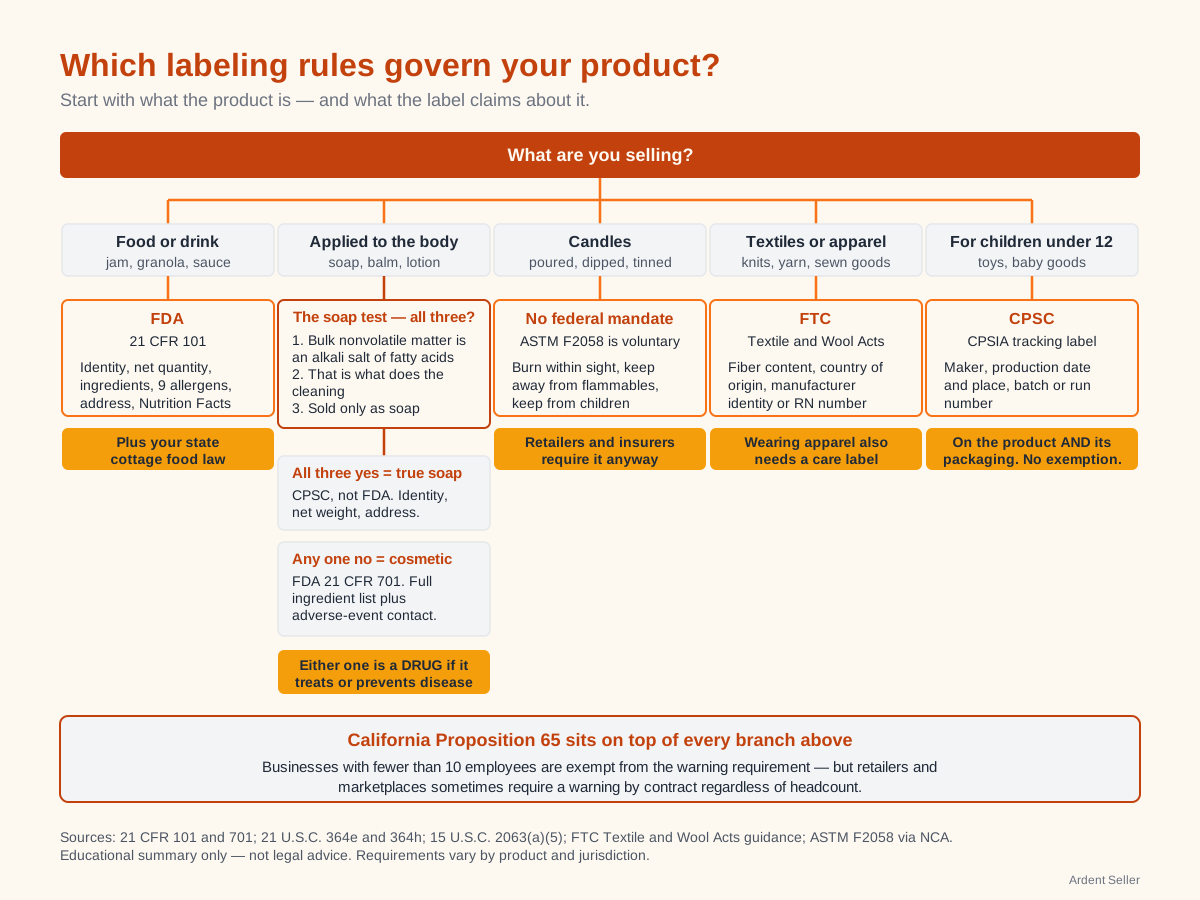
Which agency governs your label?
Everything downstream depends on this answer, so it is worth getting right before you buy label stock. In US federal law, a product's label is governed by whichever statute matches what the product is and what your label claims about it — not by what category you filed under on your business registration.
Find your row. Every row links straight to the section that covers you, except "Everything else" — that one is explained immediately below the table.
| What you make | Governing law | Agency | Core label elements |
|---|---|---|---|
| Food, drink, jam, spice blends, baked goods | FD&C Act + Fair Packaging and Labeling Act; 21 CFR 101 (opens in new tab) | FDA (plus state cottage food law) | Identity, net quantity, ingredients, allergens, name and address, Nutrition Facts |
| True soap making no other claim | Consumer Product Safety Act / FHSA | CPSC | Identity, net weight, name and address |
| Lotion, balm, scrub, perfume, cosmetics | FD&C Act + FPLA + MoCRA; 21 CFR 701 (opens in new tab) | FDA | Identity, net quantity, ingredients, name and address, adverse-event contact |
| Candles | ASTM F2058 (voluntary) | None mandatory | Fire-safety warning, plus retailer requirements |
| Clothing, blankets, yarn, most sewn goods | Textile and Wool Acts; Care Labeling Rule | FTC | Fiber content, country of origin, manufacturer identity, care instructions |
| Anything designed for children under 12 | CPSIA; 15 U.S.C. 2063 (opens in new tab) | CPSC | Tracking label with batch and production data |
| Everything else — jewelry, pottery, wood, resin, paper goods, decor | No product-specific federal labeling regime | None | None mandated — see the three overlays below |
| Any of the above sold into California | Proposition 65 | CA OEHHA | Chemical exposure warning, if applicable |
That "everything else" row covers a lot of makers, so it is worth saying plainly what it means: if you throw pots, set stones, turn bowls, pour resin, or print cards, no federal rule dictates what goes on your label. You are free to design it. The reason is structural. The Fair Packaging and Labeling Act applies to "consumer commodities," and 15 U.S.C. 1459(a) (opens in new tab) defines that term to cover food, drugs, devices, and cosmetics by name, plus any other retail article that "usually is consumed or expended in the course of" ordinary use. It is that consumed-or-expended qualifier which leaves a ceramic mug out: a mug is used, not used up.
But three things still reach you, and they are covered below:
- Origin claims. The moment you print "Handcrafted in America," the FTC's Made in USA rule applies to you exactly as it applies to a candle maker.
- Anything for children under 12. A wooden toy or a beaded bracelet marketed to kids needs a CPSIA tracking label, regardless of how small your shop is.
- California. Proposition 65 reaches durable goods too. Jewelry sellers have a second, stricter exposure worth knowing: California's Metal-Containing Jewelry Law (Health & Safety Code §§ 25214.1–25214.4.2 (opens in new tab)) caps lead content directly by restricting what materials jewelry may be made from — and unlike Prop 65, it carries no small-business exemption.
Two rows deserve an early flag, because they are where makers most often discover they were in the wrong column.
The soap row is a fork, not a category — a bar of soap can land in any of three regimes depending on a single sentence of marketing copy. And the California row is the one people forget: those requirements sit on top of the federal ones rather than replacing them, and a marketplace listing that ships nationwide is a listing that ships to California. Most one- and two-person shops turn out to be exempt from the Prop 65 warning duty, for a reason covered in the FAQ — but "exempt" is a conclusion you should reach deliberately, not assume.
What has to be on a food label?
Five elements, and the list has been stable for decades. If you sell jam, granola, spice blends, hot sauce, or baked goods in packaged form, this is the checklist.
| Element | Where it goes | Regulation |
|---|---|---|
| Statement of identity — what the thing is | Principal display panel | 21 CFR 101.3 (opens in new tab) |
| Net quantity of contents | Principal display panel | 21 CFR 101.7 (opens in new tab) |
| Ingredient list, descending by weight | Principal display or information panel | 21 CFR 101.4 (opens in new tab) |
| Name and place of business | Information panel | 21 CFR 101.5 (opens in new tab) |
| Nutrition Facts, unless exempt | Information panel | 21 CFR 101.9 (opens in new tab) |
Net quantity has a rule people trip on: 21 CFR 101.7 (opens in new tab) requires weight for solid, semisolid, or viscous foods and fluid measure for liquids, in avoirdupois pounds and ounces or US fluid ounces respectively. Honey is the classic trap. It is viscous, so it is declared by weight — a "16 fl oz" honey label is wrong even though the jar holds sixteen fluid ounces.
The 2% rule, and why it is not the 1% rule
Ingredients go in descending order of predominance by weight. But 21 CFR 101.4(a)(2) (opens in new tab) lets you set aside ingredients present at 2% or less and list them at the end, out of order, behind a quantifying statement such as "Contains 2 percent or less of." That is a real convenience when you are reformulating a spice blend and do not want to redesign a label every time the paprika and the cumin swap places.
Hold on to that number, because the cosmetic rule is different — and if you make both food and body products, this is the single likeliest place to get it wrong. Food is 2%. Cosmetics are 1% (21 CFR 701.3(f) (opens in new tab)). Same-shaped rule, different threshold, different chapter of the regulations.
Allergens
Nine major allergens must be declared: milk, eggs, fish, crustacean shellfish, tree nuts, peanuts, wheat, and soybeans from the 2004 FALCPA list, plus sesame, which the FASTER Act added effective January 1, 2023 (opens in new tab). The source has to appear at least once — either parenthetically after the ingredient ("lecithin (soy)") or in a "Contains" statement adjacent to the ingredient list.
Sesame is worth a second look if your label predates 2023. It shows up in tahini, in za'atar, in hamburger buns, in some spice blends, and in a lot of recipes where nobody thinks of it as an allergen ingredient.
The Nutrition Facts exemption most small makers qualify for
This is the one place where being small genuinely gets you out of something. FDA runs two separate exemptions, described on its Small Business Nutrition Labeling Exemption (opens in new tab) page:
- The low-volume exemption. Available if you employ fewer than an average of 100 full-time equivalent employees and fewer than 100,000 units of that product are sold in the US in a 12-month period. It requires filing a notice with FDA annually, and it is forfeited if the product bears a nutrition claim.
- The small-retailer exemption. Available to retailers with annual gross sales of not more than $500,000, or annual gross sales of food to consumers of not more than $50,000. No notice needs to be filed.
Two cautions worth internalizing. First, "low fat," "high protein," and "sugar free" are nutrition claims — making one costs you the exemption on that product. Second, and FDA says this plainly, these exemptions cover nutrition labeling only. Statement of identity, net quantity, ingredient statement, and name and address are all still required.
If you sell food made at home, remember that your state's cottage food law sits on top of all of this and frequently adds a required disclosure — most commonly a statement that the product was made in a home kitchen not subject to state inspection. The federal list above is the floor, not the ceiling, so check your own state's wording — or pull up the Cottage Food Laws by State reference and find your row before you finalize the artwork.
Is your soap a soap, a cosmetic, or a drug?
This is the fork that catches more handmade sellers than any other rule in this article, and it turns on wording rather than chemistry.
21 CFR 701.20 (opens in new tab) sets out FDA's interpretation in two paragraphs, which FDA's own FAQ on Soap (opens in new tab) summarizes as three conditions that must all be met:
- The bulk of the nonvolatile matter in the product consists of an alkali salt of fatty acids — the result of combining fats or oils with an alkali such as lye.
- The detergent properties of the article are due to those alkali-fatty acid compounds.
- The product is labeled, sold, and represented only as soap.
Clear all three and your bar is not a cosmetic. The FD&C Act's definition of cosmetic specifically excludes soap, so the product falls to the Consumer Product Safety Commission instead — and CPSC does not require an ingredient declaration.
Fail any one of them and you are making a cosmetic, with all of the labeling in the next section attached. The regulation is blunt about the consequence: products intended for cleansing the human body that are not soap under paragraph (a) "are 'cosmetics,' and accordingly they are subject to the requirements of the act and the regulations thereunder."
What one word changes
Here is what that looks like in practice, because condition three is usually the one that breaks:
| What the label says | Regulatory result |
|---|---|
| "Oatmeal Soap" | True soap, if the chemistry holds — CPSC |
| "Moisturizing Oatmeal Soap" | Cosmetic — moisturizing is a beautifying claim |
| "Deodorant Soap" | Cosmetic |
| "Antibacterial Soap" | Drug, and a cosmetic if it also beautifies |
| "Soap for eczema relief" | Drug |
Notice that the bar in the mold never changed. Only the copy did. Adding one adjective to a label moves the product into a regime that requires a full INCI-style ingredient declaration, an adverse-event contact, and — for a drug claim — a body of law well beyond the scope of a labeling article.
If you do not want to be in the cosmetic regime, the discipline is straightforward: keep the claim to cleansing, and put the lovely descriptive language about how it makes skin feel into your listing copy rather than onto the label. That distinction is finer than it sounds, and it is worth a conversation with a compliance consultant if the product line matters to your revenue.
What has to be on a cosmetic label?
Balms, lotions, scrubs, perfumes, lip products, and any soap that failed the test above land here. FDA's Summary of Cosmetics Labeling Requirements (opens in new tab) is the readable overview; the requirements themselves live in 21 CFR 701 and 740.
| Element | Requirement | Regulation |
|---|---|---|
| Identity of the product | Name plus descriptive name or illustration of its nature or use, on the principal display panel | 21 CFR 701.10 (opens in new tab) |
| Net quantity of contents | Principal display panel, placed in the bottom area, parallel to the base the package rests on, type size scaled to container size | 21 CFR 701.10 (opens in new tab) |
| Name and place of business | Information panel: street address, city, state, ZIP | 21 CFR 701.12 (opens in new tab) |
| Ingredient declaration | Information panel, descending order of predominance, letters at least 1/16 inch | 21 CFR 701.3 (opens in new tab) |
| Warnings, where the product could be hazardous if misused | Prominent and conspicuous | 21 CFR 740 (opens in new tab) |
| Adverse-event contact information | Domestic address, domestic phone number, or electronic contact | 21 U.S.C. 364e(a) (opens in new tab) |
Four details in that table repay close reading.
The 1% rule. Color additives and ingredients present at one percent or less may be declared without regard for predominance, per 21 CFR 701.3(f) (opens in new tab). Ingredients FDA has accepted as exempt from public disclosure may be stated as "and other ingredients." That is the trade-secret provision, and it requires FDA's prior acceptance — it is not a self-serve option for a proprietary blend.
Type size scales down, but only so far. Ingredient letters must be at least 1/16 inch tall. If the total package surface available for labeling is under 12 square inches, the minimum drops to 1/32 inch. For lip balm tubes and sample jars, 21 CFR 701.3(i) (opens in new tab) also permits off-package ingredient labeling when the product sits in tightly compartmented trays or racks and is not in a folding carton.
A PO box will not do. FDA answers this directly in its Small Businesses & Homemade Cosmetics fact sheet (opens in new tab): "A post office box or website address is not adequate for this labeling requirement." You need a street address, city, state, and ZIP — though you may omit the street address if your firm is listed in a current city or telephone directory. Makers working from home who do not want a home address on retail packaging generally solve this with a commercial mail-receiving address that is a real street address, or by using a contract manufacturer's address with "Manufactured for" wording.
MoCRA added a line to every cosmetic label. Since the Modernization of Cosmetics Regulation Act of 2022, 21 U.S.C. 364e(a) (opens in new tab) requires every cosmetic product to bear "a domestic address, domestic phone number, or electronic contact information, which may include a website, through which the responsible person can receive adverse event reports." The statute's own effective-date note sets that at two years after enactment — December 29, 2024.
The small-business exemption that does not exempt you from labeling
This is the point most worth carrying away from this section. MoCRA does contain a small-business provision, and it is genuinely useful: 21 U.S.C. 364h (opens in new tab) treats responsible persons whose average gross annual US cosmetic sales for the previous three-year period are under $1,000,000, adjusted for inflation, as small businesses.
But read what it exempts them from. The statute names two sections — good manufacturing practice requirements, and facility registration plus product listing. Labeling is a different section entirely. It is not on the list.
The exemption also does not apply at all — at any revenue level — if you make a product that:
- Comes into contact with the mucus membrane of the eye under customary use
- Is injected
- Is intended for internal use
- Is intended to alter appearance for more than 24 hours, where removal by the consumer is not part of customary use
Eyeliner and lash tint are the categories small makers most often assume are covered and are not.
Still pending: MoCRA also directs FDA to identify fragrance allergens by regulation and require them on labels, under 21 U.S.C. 364e(b) (opens in new tab). The statute set an 18-month deadline for a proposed rule. On FDA's MoCRA page (opens in new tab), fragrance allergen labeling is still listed among the regulations FDA is required to establish rather than among requirements in force — check that page's own "Content current as of" date when you read this. If you sell scented products, this is the change to watch, and EU allergen lists are the best available preview of where it may land.
Do candles need a warning label?
Federally, no. There is no regulation requiring a warning on a candle.
What exists instead is ASTM F2058, Standard Specification for Candle Fire Safety Labeling, developed by the National Candle Association with ASTM International and CPSC. NCA describes it (opens in new tab) as setting "specifications for the warning label that cautions consumers to always burn a candle within sight; to keep candles away from things that can catch fire; and to keep candles out of the reach of children." Those three cautions are the substance of a compliant candle warning, and NCA publishes example labels and official pictograms.
Compliance is voluntary as a matter of law. It is generally not voluntary as a matter of business — wholesale accounts and product-liability insurers commonly ask for F2058 conformance, so check the terms of whoever you sell through rather than assuming. And a candle that burns a house down without a warning label is a different conversation with a lawyer than one that had a warning label.
The related standards are worth knowing by name even though they are design rather than labeling requirements: ASTM F2417 covers fire safety for candles, including maximum flame height and end-of-useful-life specifications; ASTM F2179 covers annealing of glass candle containers; ASTM F2601 covers candle accessories.
What about textiles, knitwear, and sewn goods?
Two separate FTC rules apply, and they require different things.
Fiber content, origin, and identity. FTC guidance in Threading Your Way Through the Labeling Requirements Under the Textile and Wool Acts (opens in new tab) states that federal requirements "require that most of these products have a label listing the fiber content, country of origin and identity of the manufacturer or another business responsible for marketing or handling the item."
Generic fiber names, with percentages by weight, in descending order of predominance. Fibers under 5% of the fiber weight are disclosed as "other fiber" rather than by name — so a scarf that is 92% merino and 8% nylon reads "92% Wool, 8% Other Fiber," not "92% Wool, 8% Nylon." Decorative yarn that creates a visible pattern is exempt from disclosure when it does not exceed 5% of fiber weight, disclosed with the phrase "Exclusive of Ornamentation."
You can use a Registered Identification Number (RN) from FTC in place of your business name, which is the usual answer for makers who would rather not print a legal name on every garment.
Care instructions. The Care Labeling Rule (opens in new tab) requires care instructions on wearing apparel, and requires you to have a reasonable basis for each instruction — reliable evidence supporting it. FTC's guidance is direct: "you can't say 'Dryclean Only' unless you have proof that washing will harm the garment." For a multi-component garment you need evidence that the whole thing survives the recommended care, not just the parts. If a maker dyes with something known to bleed, or sets beads that drycleaning would damage, testing is the reasonable basis. FTC treats each mislabeled garment as a separate violation.
The exclusions worth knowing
The exclusion lists in the FTC guidance are genuinely useful for makers, because several popular handmade categories sit outside the Textile Rules:
- Headwear — hats, caps, and anything worn exclusively on the head — is outside the Textile Rules. Wool hats are covered by the Wool Rules instead.
- Pet clothing and pet furniture are not covered.
- Holiday decorations and ornaments are not covered.
But this is a conditional exclusion with a trap in it. Several excluded categories fall back under the rules the moment you make a fiber content claim. As FTC puts it, "If you make any representation about fiber, all the requirements for fiber content disclosure apply." Advertising a hat as "100% alpaca" is a fiber representation — and it pulls the product back into full disclosure, percentages and all.
When can you put "Made in the USA" on the label?
The FTC's Made in USA Labeling Rule at 16 CFR 323 (opens in new tab) sets the bar, and it is higher than most makers assume. An unqualified US-origin claim is permitted only where "the final assembly or processing of the product occurs in the United States, all significant processing that goes into the product occurs in the United States, and all or virtually all ingredients or components of the product are made and sourced in the United States."
The definition of a covered claim is where handmade sellers get caught. The rule reaches any unqualified representation that a product is "made," "manufactured," "built," "produced," "created," or "crafted" in the United States or in America. "Handcrafted in America" is not a softer, artisanal version of the claim — it is the claim.
So a candle poured in Ohio from wax imported from Malaysia and a wick from China does not qualify for an unqualified claim, however genuinely the pouring happened in Ohio. The honest and fully compliant alternative is a qualified claim that describes what actually happened domestically: "Poured in Ohio from imported wax." Nobody has ever been disappointed by that sentence, and it is accurate.
Textiles carry an additional layer. FTC guidance under the Textile and Wool Acts (opens in new tab) requires that products made in the US from imported materials indicate as much — "Made in U.S.A. of imported fabric" — as a single unbroken statement, and for flat goods such as scarves, napkins, and towels, Customs requires identifying where the fabric was made. That produces labels like "Made in U.S.A. of fabric made in Peru."
Do you need a batch or lot number?
For children's products, yes, and there is no small-manufacturer relief.
15 U.S.C. 2063(a)(5) (opens in new tab) requires a manufacturer of a children's product to "place permanent, distinguishing marks on the product and its packaging, to the extent practicable," enabling the manufacturer to identify the location and date of production plus "cohort information (including the batch, run number, or other identifying characteristic)," and enabling the ultimate purchaser to identify the manufacturer or private labeler, the location and date of production, and that same cohort information. Note the two audiences and the two surfaces: the product and the packaging.
For everything else, a lot code is not federally required — with the exception of state cottage food statutes, several of which require a date or batch marking of their own.
That said, the case for putting one on anyway is not a compliance case, it is a survival case. A lot code is the difference between "we are recalling lot 2604-B, roughly forty units, sold at three markets in April" and "we do not know which jars came from the batch with the bad honey." One of those conversations ends. The other one does not.
This is the part where inventory tracking stops being paperwork and starts being insurance. If you already run production batches through a system that assigns a lot number and records which raw materials went into it — which is what batch and lot tracking in Ardent Seller is for — then generating the code for the label is a lookup rather than an act of memory, and the traceability exists before you need it rather than after.
How do you keep labels accurate when the recipe changes?
Here is the failure that produces most real-world labeling problems, and it has nothing to do with misreading a regulation.
You reformulate. The supplier discontinues a fragrance oil, you substitute, and the ingredient order shifts. You increase the shea butter and it crosses above the coconut oil in the descending-order list. You add an ingredient containing sesame. Every one of those changes makes the label on your shelf wrong — and the label on the shelf is a printed object that does not know the recipe changed.
Three habits handle it, and none of them require software:
- Version your formulas. Every recipe gets a version number, and the version that produced a batch is recorded with the batch. When a label question arrives eight months later, you can answer what was actually in the jar.
- Tie label revisions to formula revisions. When the formula version increments, the label file version increments. Print runs reference the label version, not just the product name.
- Count remaining label stock as inventory before you reformulate. Four hundred labels for the old formula is a real cost, and it is the reason makers keep selling a product with a stale ingredient list — not carelessness, but an unwillingness to bin $80 of printed labels. Knowing the number in advance turns it into a decision instead of a temptation.
The systems answer to this is a bill of materials that records what actually went into each batch, and label stock treated as a tracked component with its own quantity on hand. If you are running that in a spreadsheet today it works right up until the month you reformulate two products at once. When it stops working, the tool that replaces it should be one that connects formulas, batches, and packaging components in the same place — that connection is the whole point of how Ardent Seller models recipes and production.
If you only do one thing this week, do the audit: pull one label off the shelf for each product you sell, put it next to the formula you are currently making, and read them against each other line by line. If you have reformulated anything in the past year, expect to find a mismatch. Finding it yourself is a much better way to learn about it than hearing it from a customer.
Frequently asked questions
Q: Do I need a barcode on my label?
No federal rule requires one. Barcodes are a retailer requirement, not a regulatory one. If you plan to sell wholesale into shops that scan, you will need GS1-issued UPCs — but a product sold direct at markets and online needs no barcode to be compliant.
Q: Does Proposition 65 apply to a one-person business?
Almost certainly not. The statute itself does the work: California Health & Safety Code § 25249.11(b) (opens in new tab) defines "person in the course of doing business" to exclude "any person employing fewer than 10 employees," which puts most one- and two-person shops outside the warning requirement entirely. The state's guidance for businesses (opens in new tab) says the same, and counts all full-time and part-time employees on the date the exposure occurs. Two caveats: retailers and marketplaces sometimes require warnings contractually regardless of your headcount, and the exemption is about the warning duty, not about whether a chemical is on the list.
Q: Can I put "all natural" or "chemical free" on the label?
"Natural" is unregulated in cosmetics — FDA states (opens in new tab) it "has not defined the term 'natural' and has not established a regulatory definition for this term in cosmetic labeling." Unregulated is not the same as safe to use, though: the FD&C Act still prohibits labeling that is false or misleading, so an unsubstantiated claim is a misbranding exposure even where no rule defines the word.
Q: Do I need to list ingredients on soap?
Not if it clears the 21 CFR 701.20 test and is regulated by CPSC. Many makers list them anyway, and there is a real argument for it — customers with allergies look, and a voluntary ingredient list is a trust signal. Just be aware that adding a beautifying claim next to that list is what changes the regulatory category, not the list itself.
Q: What size does the type have to be?
It varies by regime and by package size, and there is no universal answer. Cosmetic ingredient declarations have an explicit floor: 1/16 inch, dropping to 1/32 inch where the total labeling surface is under 12 square inches. Elsewhere the standard is conspicuousness rather than a measurement. FDA summarizes it this way in its Summary of Cosmetics Labeling Requirements (opens in new tab), citing 21 CFR 701.2 (opens in new tab): required statements "must be placed on the label or labeling with such prominence and conspicuousness that they are readily noticed and understood by consumers under customary conditions of purchase." The regulation itself works by listing the ways a statement can fail that test — type too small, wrong panel, crowded by other copy. Design your smallest package first; if the required elements do not fit legibly, the package is too small.
Q: Do these rules apply if I only sell on Etsy?
Yes. Federal labeling requirements attach to the product entering commerce, not to the sales channel. A marketplace listing does not substitute for a compliant physical label, and shipping nationwide means shipping into every state's requirements.
Related reading
- Batch Tracking for Food Sellers — the traceability spine that makes the lot code on your label mean something when a customer calls about a jar from April.
- Can You Legally Sell Fan Art? — labels answer what has to go on the product; this answers whether you were allowed to put that character, logo, or licensed fabric on it in the first place.
- Hot Sauce Compliance and pH Testing — where acidified-foods rules add a whole regulatory layer on top of the label requirements above.
- Herbal Product Shelf Life — how shelf-life and best-by decisions interact with what you are allowed to claim on a tincture or tea label.
- Co-Packer vs. Shared Commercial Kitchen — the label rules above land in full the moment you leave the cottage food exemption, and this weighs the two ways out of a home kitchen.
- Eco-Friendly Packaging Claims, Defined — the required elements are only half the label; this covers the optional ones you choose to add, and what the FTC Green Guides make you able to prove before printing "compostable" or "recyclable."
- Best Food-Safe Packaging Suppliers for Small-Batch Makers — the container the label goes onto: which suppliers sell food-safe jars, pouches and bags at 250 units rather than 25,000, and why there is no such thing as an FDA-approved jar.
The reason labeling feels overwhelming is not that the rules are numerous. It is that nobody hands you a map that says "you are here" — and until you know which regime governs the thing in your hand, every rule looks like it might be yours. Sort the product first, then work the short list. A jam label is five elements. A soap label is three. A cosmetic label is six. That is a morning's work, not a career.
Start with whichever product earns you the most money, get its label right, and use it as the template for the rest. If you want the batch numbers, formula versions, and packaging components behind those labels to live in one place instead of four spreadsheets, try Ardent Seller free — and either way, do the shelf-versus-formula audit. It is the cheapest compliance work you will ever do.
Free resources
Free companion downloads if you want to put any of this into practice:
- Cottage Food Laws by State: The 50-State + DC Quick Reference — the state-level food labeling requirements and required disclosures that stack on top of the federal five elements above.
- SKU Naming & Barcode System Starter Kit — for the barcode and lot-code questions this post raises: how to design codes that survive reformulation and make a lot number traceable back to a batch.
This article is provided for educational purposes only and does not constitute legal, regulatory, food-safety, or health advice. Labeling, compliance, and safety requirements vary by jurisdiction and product, and change frequently. Consult your state agriculture or health department, a qualified compliance consultant, or an attorney before making compliance or safety decisions.