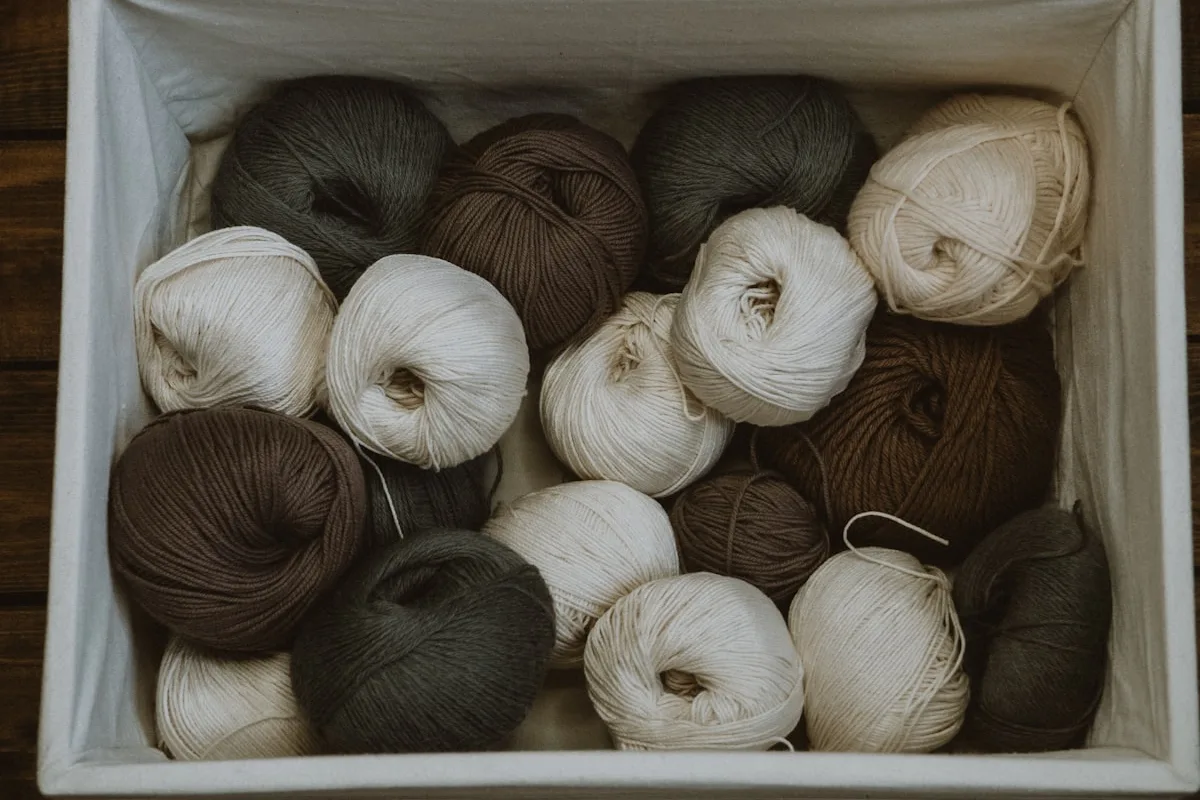
The closet smells faintly of wool and cedar. There are three clear bins, two gallon zip bags wedged behind them, and a tote that has not been fully unpacked since a fiber festival you are pretty sure was two summers ago. Somewhere in there is a single skein of hand-dyed fingering you have been saving for the right shawl, a colorway you will not be able to buy again. You just cannot remember which bag it is in.
If you sell what you make, this stash is not a mess. It is inventory — money you already spent, sitting in bins, waiting to become something you can sell. The trouble is that you cannot price a finished piece honestly if you do not know what the yarn in it cost you, and a stash easily drifts so far from its receipts that the cost becomes a fog. This is the post that lifts the fog: how to turn a years-deep stash into a costed inventory you can actually run a project through. You do not need a spreadsheet degree or a free Saturday. You need a few rules and one honest pass through the bins.
We will not relitigate whether your hours count — they do, and the labor-first pricing math for fiber artists covers that fight in full. This post is about the part that comes before pricing the labor: putting a real number on the yarn.
The short version: To cost a project from your stash, give every yarn a per-gram (or per-yard) rate — either what you paid or its current replacement cost — and record the colorway, dye lot, and quantity on hand in a stash log. Then cost each project by the grams it actually uses, not by whole skeins. The four rules below, and the worked teardown, show exactly how.
Problem: the mystery skein with no ball band
Every stash has them. A skein wound into a cake a year ago, a center-pull with the band long gone, a gift from a friend who "had extra." You know it is a worsted wool-ish something, and that is where the knowledge ends. When that yarn ends up in a project, it lands in your costs as a guess — and a guess you will quietly round down, because nobody likes admitting they do not know.
The fix is a rule, not a memory. Give every yarn one row in a stash log the moment it enters the bins, and assign its cost with a single consistent method. The cleanest rule for a stash that has already drifted is replacement cost: what would it cost you to buy this yarn, or the nearest current equivalent, today? Look it up once, write it down, and that number follows the yarn into every project it touches. If you happen to have the receipt, use what you actually paid instead — just do not mix the two methods skein by skein, or your per-project costs stop being comparable. And when the yarn is genuinely gone — a discontinued line, a hand-dyer who has closed up shop, the festival skein you will never see again — do not let it stall you: price it at the closest current equivalent in the same weight and fiber. Any defensible comparable beats leaving the cost blank.
Rule of thumb: Pick one costing method — what you paid, or replacement cost — and apply it to the whole stash. A consistent imperfect number beats a precise number you only have for half your yarn.
A row per yarn does one more quiet favor: it lets you shop your stash first. Before you buy yarn for the next make, you scan the log and discover you already own three skeins that would work. That is the rare inventory habit that pays you back in the first week.
Problem: the dye lot you can never get back
Here is the one that hurts, because it does not feel like a cost until it is one. You are a row from binding off a blanket, you run out of the main color, you order "the same yarn, same shade" — and the new skein is a hair lighter, because it came from a different dye lot. Yarn is dyed in batches, and across batches the same named color can shift just enough to show. Now you are choosing between a visible stripe, frogging hours of work, or re-buying enough to redo a whole section.
The fix costs you one column and one spare skein. Record the dye lot in the stash log next to the colorway, and when you buy yarn for a specific project, buy a safety skein in the same lot. Log that safety skein as on-hand inventory in the same row; if a later project uses it, it draws down at the same per-gram rate as the rest. The yarn's cost does not change — a $12 skein is still $12 — but tracking the lot prevents the rework that turns a $12 gap into an afternoon of unpaid labor. For a maker selling their time, the dye lot is the cheapest insurance in the bin.
Problem: "it was on sale, so it was basically free"
This may be the most expensive habit in the stash. You found the yarn at 60% off, or it was a destash bundle, or it was a gift — so when it goes into a project, you charge it nothing. The shawl feels almost free to make, which feels like a win, right up until you try to reorder that yarn at full price and the math you have been running collapses.
The fix is to separate what you paid from what the yarn is worth in a sale. If you have the record, cost the yarn at what you actually spent — that is your real outlay, and it is fair to count it as low. What you must not do is count it as zero, or quietly price the finished piece as if the material were free, because the moment you sell that pattern again in yarn you bought at full price, you can be losing money you trained yourself not to see. If you cannot find what you paid, fall back to replacement cost. Sale yarn is a discount on your costs; it is not a license to skip costing.
The honest framing: Cheap yarn lowers your cost. It does not lower your price. Your customer is buying the finished piece and your hours — neither of which got cheaper because you caught a sale.
Problem: partial skeins, leftovers, and the project that uses 1.4 balls
Almost no project uses a whole number of skeins. A hat eats most of a skein and leaves a tail; a shawl runs 1.4 balls; the scrap blanket is built entirely from leftovers. If you cost every project in whole skeins, you overcharge some pieces, undercharge others, and never get a clean number for any of them.
The fix is to cost by the amount used. Turn each skein into a per-unit cost once, then multiply by what the project actually consumes:
- A 100g / 200-yard skein that cost $18 is $0.18 per gram or $0.09 per yard.
- Weigh the finished piece on a kitchen scale, or count the yards your pattern calls for.
- A shawl that weighs 140g of that yarn cost 140 × $0.18 = $25.20 in material — not "two skeins, call it $36."
Weighing finished pieces also catches the leftovers you can fold back into the stash log as partial skeins, so the scraps stop disappearing into the bin and start showing up as yarn you can still make something from.
The teardown: one shawl, from bin to costed piece
Rules are easier to trust when you watch them run once. Picture Nadia — a composite of the fiber sellers this post is written for, who crochets shawls and sells them at two summer markets and on Etsy. Here is her newest piece — a fingering-weight triangle shawl — costed straight out of her stash, starting with the slice of her stash log the shawl draws from:
| Yarn | Weight | Colorway / dye lot | On hand | $/skein | g/skein | $/g |
|---|---|---|---|---|---|---|
| Hand-dyed merino-silk | Fingering | "Tidewater" / lot 0421 | 3 skeins | $26.00 | 100g | $0.26 |
| Speckled sock yarn (sale) | Fingering | "Confetti" / lot 1187 | 2 skeins | $11.00 | 100g | $0.11 |
The last column is the one that does the work: divide the per-skein price by grams per skein ($26.00 ÷ 100 = $0.26/g), and any project can be costed by the grams it actually uses. Always record the per-skein unit price in the $/skein column — not a bundle total — or the per-gram math breaks.
And here is the project cost worksheet she fills in when the shawl comes off the hook, with the numbers called out:
| Line item | Entry | Amount |
|---|---|---|
| (1) Main yarn used | 130g "Tidewater" @ $0.26/g | $33.80 |
| (2) Contrast yarn used | 35g "Confetti" @ $0.11/g | $3.85 |
| (3) Notions | Blocking wires (amortized), tag | $1.20 |
| (4) Materials subtotal | (1) + (2) + (3) | $38.85 |
| (5) Labor | 11 hours × $22/hr | $242.00 |
| (6) Overhead | Hook wear, electricity, fixed studio costs | $9.00 |
| (7) True cost | (4) + (5) + (6) | $289.85 |
What each line means
Reading the worksheet line by line:
- Main yarn used (130g, not "two skeins"). Costed at the per-gram rate from the stash log, so the half-skein left over is not charged to this shawl — it goes back into the log as 70g on hand.
- Contrast yarn — and notice the sale yarn still has a cost. The "Confetti" was a destash steal at $11 a skein, so its per-gram rate is genuinely low. Low is not zero. The 35g of edging still adds $3.85, and if Nadia reorders at full price, that line will rise on its own.
- Notions, amortized. A $12 set of blocking wires used across dozens of shawls is pennies per piece — but counting it keeps the small stuff from vanishing.
- Materials subtotal: $38.85. This is the number this whole post exists to produce: a real, defensible material cost for this piece, built from yarn she can no longer find a receipt for.
- Labor, the part that dwarfs the rest. Eleven honest hours at a rate she would accept anywhere else. This is where the labor-first pricing post takes over — the stash work just makes sure line 4 underneath it is true.
- Overhead. The quiet drips: hook replacement, the lamp that is on for eleven hours, a fixed slice of studio costs. Keep percentage marketplace fees — Etsy's cut of the sale price — out of this line. Those come off the selling price at the pricing stage, so counting them as a cost here too would charge them twice.
- True cost: $289.85. Now Nadia can make a decision on purpose. If the market will bear $250, she knows she is subsidizing the piece and can choose to — a loss leader for the booth, a gift, a learning project — instead of finding out at tax time. If she lists at $310, she knows the margin is real.
The grab-it-and-go version of exactly these two pages — a stash log and a project cost worksheet — is the free Yarn Stash Log & Project Cost Worksheet, if you would rather print it than build it from scratch.
When the printout starts to creak
A printed stash log is a wonderful place to start and an awkward place to scale. The day you are flipping between the stash sheet, last month's worksheet, and a calculator to answer "do I have enough Tidewater for one more shawl," the paper is telling you something.
That is the seam Ardent Seller was built for. Your stash becomes tracked inventory by weight, colorway, and dye lot, and it draws down as you make — crochet the shawl, and 130g of Tidewater leaves your on-hand count automatically. Each pattern becomes a reusable procedure with its own bill of materials, so "this shawl takes 11 hours and 165g across two yarns" — the 130g plus 35g from the worksheet — is logged once and costs itself out every time you make another. The per-piece true cost — yarn, notions, labor, overhead — is computed for you instead of reassembled by hand. The printout taught you the method; the software just stops you from re-keying it. You can start free and have your most-made piece costed in about ten minutes.
You already paid for the stash. Now make it tell you something.
The yarn in those bins is sunk cost either way. The only question is whether it sits there as a mystery or works for you as inventory — telling you what you can make today, what to reorder, and what each finished piece actually costs before you set a price. None of that takes a perfect system. It takes one honest pass through the bins, a row per yarn, and a worksheet you run the same way every time.
If you only do one thing this week, start with the five yarns you reach for most and give each a row and a per-gram cost. That single step changes what your next project costs. When you have another ten minutes, run your best-selling piece through the worksheet — and the number at the bottom is the one you have been guessing at for years. Write it down, and start pricing on purpose.
Related reading
- Fiber Arts Pricing Math: Labor-First Formula — Once your stash hands you an honest material cost, this is how to price the hours stacked on top of it — and why "materials × 3" quietly bankrupts knitters and crocheters.
- Reorder Points & Par Levels for Makers — The next thing a costed stash log makes possible: knowing the exact skein count that should trigger a reorder before a project stalls a row from the bind-off.
- Inventory Management for Craft Sellers — The five-pillar system your stash log grows into once a printed sheet stops keeping up with the bins.
Free resources
Free companion downloads if you want to put any of this into practice:
- Yarn Stash Log & Project Cost Worksheet — The print-and-use version of the two pages in this post, plus a yarn-weight quick reference (lace to jumbo) and the skein math for buying enough yarn for any project.
- Monthly Inventory Count Sheet — A printable count sheet for yarn, finished pieces, and notions — the habit that keeps your stash log honest once the bins start refilling.
- Product Pricing Calculator — Where the true cost from the worksheet becomes a defensible price: drop in materials, hours, and your marketplace fee, and the suggested retail comes back with fees netted out.
This article is provided for educational purposes only and does not constitute financial, tax, or business advice. Cost figures, per-gram rates, and pricing examples are illustrative and will vary with your yarn, your hours, and your market. Always swatch and follow your yarn's ball band for real gauge and yardage. Consult a qualified accountant or small-business advisor before making financial decisions based on this content.