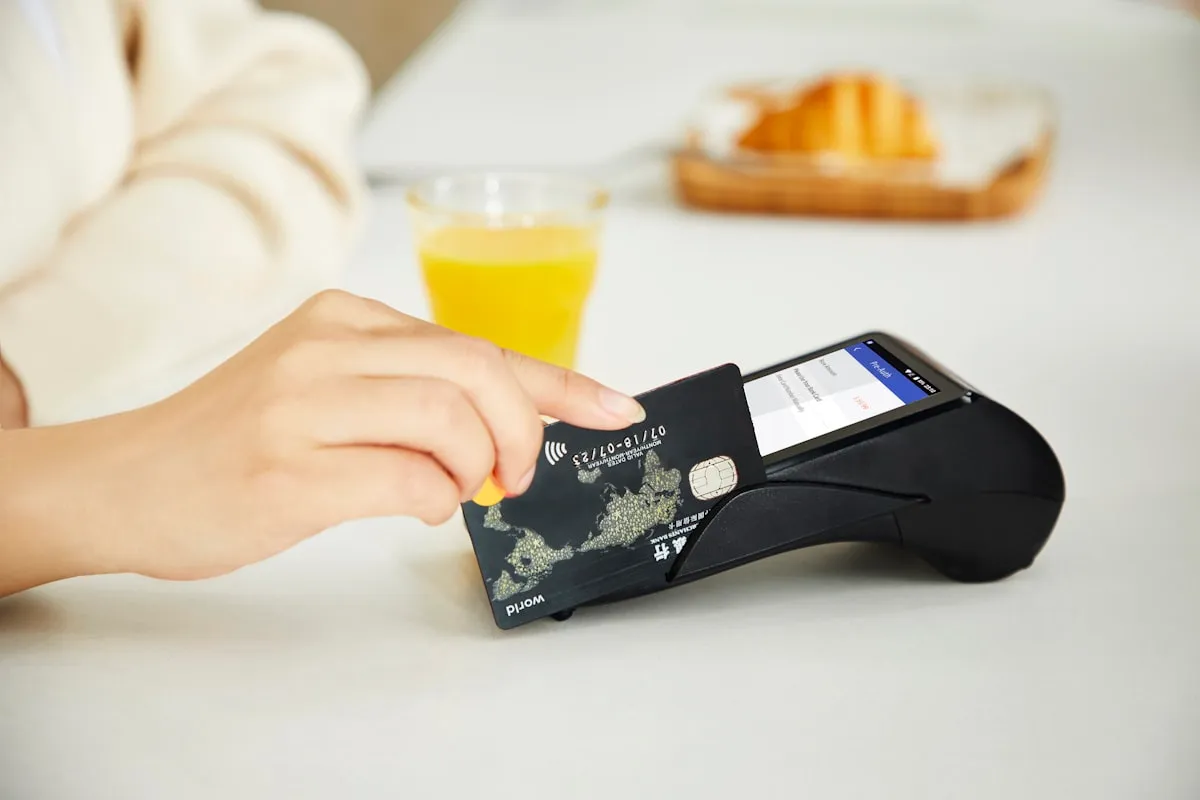
Quick question, and answer it before you read on: what did your last $100 sale deposit?
If the number that came to mind was $97.40, or "about three percent," or a shrug — that is the normal answer, and it is also why this post exists. The rate on the sign-up page is a real number. It is just not the number your bank account experiences.
The short version: a $100 card sale nets somewhere between $96.02 and $98.00 in 2026, depending on which processor took it and how. That roughly two-dollar spread is the small part. The large part is that hardly anyone pays their advertised rate — a real month mixes tapped cards, keyed cards, invoices, and online orders at four different prices, and using the instant-transfer button even once can push a market day's cost up by more than half.
The rate you quote is never the rate you pay
Every card processor prices the same way: a percentage of the sale, plus a flat fee per transaction. That second half is the part that gets forgotten, and it is the part that does the most damage to the makers who sell inexpensive things.
But the deeper problem is that no processor has one rate. Square publishes three on a single page — 2.6% + 15¢ for a tapped, dipped, or swiped card, 3.3% + 30¢ for online sales and invoices, and 3.5% + 15¢ for a manually keyed card or a card on file (Square, What are Square's fees? (opens in new tab)). Which one applies is decided in the moment by whether a chip reads on the first try.
So the question "what does Square cost" has no answer. The answerable question is: what did last Saturday cost?
One market Saturday, torn down line by line
Here is a composite market batch — the shape of a good but unremarkable Saturday for a maker selling in the $15–$45 range. Call her Delia; she sells small-batch jams and takes cards on a Square reader.
Twenty-three card sales, $612.00 gross. This is what the settlement actually looks like — six line items worth stopping on, each one explained below the block.
ILLUSTRATIVE COMPOSITE —
NOT A REAL STATEMENT

SATURDAY MARKET — CARD BATCH

(1) Tap/dip/swipe  19 ....... $498.00
      2.6% ................... $12.95
      15¢ × 19 ................ $2.85
      subtotal ............... $15.80

(2) Manually keyed  3 ........ $79.00
      3.5% .................... $2.77
      15¢ × 3 ................. $0.45
      subtotal ................ $3.22

(3) Invoice  1 ............... $35.00
      3.3% .................... $1.16
      30¢ ..................... $0.30
      subtotal ................ $1.46

(4) GROSS ................... $612.00
(5) TOTAL FEES .............. -$20.48
(6) DEPOSIT ................. $591.52
(1) The rate Delia thinks she pays — $498.00 of volume, $15.80 of fees. Nineteen tapped or dipped cards at the advertised in-person rate: $12.95 from the 2.6%, plus $2.85 from nineteen separate 15¢ charges. That is 81% of the day's volume, and it alone clears 3.17% rather than 2.6% — because a flat 15¢ riding on a $26 average ticket adds another 0.57 of a percentage point all by itself.
(2) The chip-reader tax — $79.00 of volume, $3.22 of fees. Three cards would not read. Two had worn chips; one belonged to a customer whose phone battery died mid-tap. Keying them in moved those sales from 2.6% to 3.5% — nine-tenths of a percentage point on $79, or $0.71 extra, for the crime of owning a card reader in a windy parking lot. The percentage alone came to $2.77, with another $0.45 in flat fees on top — three 15¢ charges.
(3) The invoice nobody counts — $35.00 of volume, $1.46 of fees. A customer wanted six jars for a bridal shower and asked to be invoiced Sunday. That sale left the in-person rate entirely and landed on 3.3% + 30¢ — $1.16 plus $0.30 — the highest percentage of the day.
(4) Gross was $612.00 — and gross is what the 1099-K will say. Not the deposit. More on that below, because it catches people every January.
(5) The real cost of the day: $20.48.
(6) The number that matters: $591.52 deposited — an effective rate of 3.35%, not 2.6%. Against the 2.6% Delia believes she pays, which would have cost $15.91, the day's gap is $4.57. Over fifty market days that is about $228, which is a booth fee and a tank of gas.
The blended rate is the only rate. Take total fees for a month, divide by gross sales, and use that number for every pricing decision you make. Nothing else describes your business.
The same $100 sale, six processors
Now strip away entry methods and compare the processors head to head on a clean $100 card sale. All rates are US, 2026, standard plans.
| Processor and channel | Rate | Fee | You keep |
|---|---|---|---|
| Venmo (business profile) | 1.9% + $0.10 | $2.00 | $98.00 |
| PayPal Zettle / QR | 2.29% + $0.09 | $2.38 | $97.62 |
| Venmo (Tap to Pay) | 2.29% + $0.10 | $2.39 | $97.61 |
| Shopify (in person, Basic) | 2.6% + 10¢ | $2.70 | $97.30 |
| Square (tap/dip/swipe) | 2.6% + 15¢ | $2.75 | $97.25 |
| Stripe Terminal (in person) | 2.7% + 5¢ | $2.75 | $97.25 |
| Stripe (online) | 2.9% + 30¢ | $3.20 | $96.80 |
| Shopify (online, Basic) | 2.9% + 30¢ | $3.20 | $96.80 |
| Square (online or invoice) | 3.3% + 30¢ | $3.60 | $96.40 |
| Square (manually keyed) | 3.5% + 15¢ | $3.65 | $96.35 |
| PayPal Checkout | 3.49% + $0.49 | $3.98 | $96.02 |
Sources: Square (opens in new tab), Stripe (opens in new tab), PayPal (opens in new tab), Shopify (opens in new tab), Venmo (opens in new tab).
The full spread is $1.98 on a hundred dollars — cheapest to dearest, a two-point swing. That is not nothing, but it is also not where the money is. Notice instead the two rows sitting on identical $2.75 totals:
The crossover is exactly $100. Stripe Terminal (2.7% + 5¢) and Square in-person (2.6% + 15¢) cost the same on a $100 sale. Below $100, Stripe's smaller fixed fee wins. Above it, Square's lower percentage does. Delia's average ticket is $26.61, which puts her on the Stripe side of that line every single Saturday.
Etsy deliberately is not in that table, because Etsy is not selling you processing. A $100 Etsy order in the US carries a 6.5% transaction fee on the full buyer total — item price plus shipping, plus gift wrap and personalization where they apply — which is $6.50, then payment processing of 3% + $0.25 ($3.25), then a $0.20 listing fee (Etsy fees and payments policy (opens in new tab)). About $9.95 all in. Only $3.25 of that is processing. The rest is rent. Comparing "Etsy's fees" against "Square's fees" as though they measure the same thing is the single most common version of this mistake: set $9.95 next to Square's $2.75 and the marketplace looks roughly 3.6 times more expensive than the thing it is being compared against, when only one of those two numbers is measuring the same service. The Etsy fee calculator breaks all five charges out separately.
Small tickets are where the fixed fee eats you
Run the same processors across Delia's actual product range and the ranking stops being academic. Three rates, taken from the table above: Venmo business at 1.9% + $0.10, Square in person at 2.6% + 15¢, PayPal Checkout at 3.49% + $0.49.
| Sale | Venmo business | Square in person | PayPal Checkout |
|---|---|---|---|
| $6 sticker | $0.21 — 3.6% | $0.31 — 5.1% | $0.70 — 11.7% |
| $26 jam jar | $0.59 — 2.3% | $0.83 — 3.2% | $1.40 — 5.4% |
| $480 custom order | $9.22 — 1.9% | $12.63 — 2.6% | $17.24 — 3.6% |
The $6 row is the one to sit with. A maker who prices small impulse items at $5 and $6 and takes PayPal Checkout for them is running an 11.7% payment channel — worse than Etsy's all-in rate, on a product with the thinnest margin in the shop. Nobody decided this. It is just what happens when a 49¢ fixed fee meets a $6 price tag.
Two responses are available, and only one of them is pricing. The first is a minimum-order or bundle threshold that keeps three-dollar transactions from happening at all: sell stickers in packs of four rather than singly, and the fixed fee amortizes across the whole pack. The second is choosing your cheapest channel deliberately for small sales rather than defaulting to whatever is open on the phone.
Five ways processing fees get worse than the rate card
Refunds keep the fee. Square: "When you refund a payment, the processing fees for the payment aren't refunded back to you" (Square refunds FAQ (opens in new tab)). Stripe: "Stripe's processing fees from the original transaction aren't returned" (Stripe refunds documentation (opens in new tab)). A refunded $80 sale taken in person on Square costs you the original $2.23 in fees and leaves you holding the inventory. There is one genuine escape hatch: Stripe notes that refunds issued shortly after the original charge may process as a reversal instead, and "Stripe doesn't withhold any fees for payment reversals." Speed is worth money here. If a customer emails within the hour, refund within the hour.
Instant transfer is the most expensive button on the phone. Square charges 1.95% per instant transfer, with a $25 minimum balance, against a standard transfer that is free and lands the next business day (Square, transfer options (opens in new tab)). Run Delia's Saturday through it: 1.95% of her $591.52 deposit is $11.53, taking the day's total cost from $20.48 to $32.01. Her effective rate goes from 3.35% to 5.23% — she has raised her cost of accepting cards by more than half, in exchange for having the money on Saturday night instead of Tuesday.
Not using the platform's own processor carries a surcharge. Shopify adds a transaction fee on top of whatever your third-party gateway charges: 2% on Basic, 1% on Grow, 0.6% on Advanced (Shopify pricing (opens in new tab)). On a Basic plan, a 2.9% external gateway is really a 4.9% gateway.
International cards cost more. Stripe adds 1.5% for international cards and another 1% for currency conversion (Stripe pricing (opens in new tab)); PayPal adds 1.50% on international transactions (PayPal merchant fees (opens in new tab)). A $60 order from Canada is not a $60 order: on Stripe it carries $1.50 of extra fees over the domestic rate, turning a $2.04 cost into $3.54. On PayPal the international surcharge alone adds $0.90.
Micropayments and QR codes have their own rate cards. PayPal prices QR-code transactions at 2.29% + $0.09 rather than the 3.49% + $0.49 of standard checkout (PayPal merchant fees (opens in new tab)) — a difference of $1.60 on that $100 sale, for the same money from the same customer, decided entirely by how they scanned. Reading your own processor's fee schedule once a year is a genuinely well-paid hour.
Where the number belongs once you have it
There is a January version of this problem that costs more than the fees themselves.
The IRS instructions for Form 1099-K define the gross amount in box 1a as "the total dollar amount of total reportable payment transactions for each participating payee without regard to any adjustments for credits, cash equivalents, discount amounts, fees, refunded amounts, shipping amounts, or any other amounts" (Instructions for Form 1099-K (opens in new tab)). Read that list again: fees and refunded amounts are explicitly not subtracted. Delia's 1099-K will report $612.00 for that Saturday. Her bank saw $591.52. The $20.48 gap is a deductible business expense — but only if she has a record of it, and the form will not provide one.
This is the practical case for treating processing fees as a per-channel cost rather than a lump-sum line item you reconcile once a year and forget. When the fee is recorded against the sale that generated it, two useful things become true at once: the deduction is documented without a January archaeology project, and channel profitability stops being a guess. Ardent Seller records the fees alongside each sale so that when you compare what your market days actually net against your online orders, the comparison reflects the money that landed rather than the money that was rung up.
That is the whole argument for measuring this. Not that 3.35% is outrageous — it is a fair price for taking a stranger's card in a parking lot. It is that a maker who believes she pays 2.6% and actually pays 3.35% has priced an entire product line against a number that does not exist.
Start with one month of statements
Pull one month of settlement statements, add up the fee column, and divide by gross sales. That single number — your blended rate — is the one no rate card will ever tell you, and it is the one every price in your shop should be built against.
Start a free Ardent Seller account if you would rather have the fee recorded against the sale as it happens than reconstruct it in April.
Sources and methodology
Every rate in this post was taken from the processor's own published fee schedule in August 2026. Rates change, sometimes with little notice, and plan tier changes them further — check the source before pricing against any figure here.
- Square — What are Square's fees? (opens in new tab) — in-person 2.6% + 15¢, online and invoices 3.3% + 30¢, manually keyed and card-on-file 3.5% + 15¢ (free plan; Plus and Premium plans lower the in-person rate to 2.5% and 2.4%).
- Square — Refunds FAQ (opens in new tab) — processing fees are not returned on refunds.
- Square — Transfer options (opens in new tab) — instant and same-day transfers at 1.95%, $25 minimum; standard transfers free.
- Stripe — Pricing (opens in new tab) — online 2.9% + 30¢, Terminal 2.7% + 5¢, international cards +1.5%, currency conversion +1%.
- Stripe — Refund and cancel payments (opens in new tab) — processing fees are not returned; reversals withhold no fees.
- PayPal — Merchant fees (opens in new tab) — Checkout 3.49% + $0.49, QR code and Zettle card-present 2.29% + $0.09, international +1.50%.
- Venmo — Business profile transaction fees (opens in new tab) — 1.9% + $0.10 standard, 2.29% + $0.10 for Tap to Pay.
- Shopify — Pricing (opens in new tab) — Basic plan 2.9% + 30¢ online and 2.6% + 10¢ in person; third-party gateway surcharge 2% (Basic), 1% (Grow), 0.6% (Advanced).
- IRS — Instructions for Form 1099-K (opens in new tab) — box 1a gross amount definition.
- Etsy — Fees and payments policy (opens in new tab) — the US structure used here: 6.5% transaction on the buyer total, 3% + $0.25 payment processing, $0.20 listing. The same figures drive the Etsy fee calculator on this site.
The market-batch teardown is a composite constructed to show a realistic entry-method mix, not a specific seller's records; every figure in it is reproducible from the published rates above.
Related reading
- The Best Card Reader for Craft Fairs and Farmers Markets — the hardware half of this decision: five readers compared on offline mode, battery and price, once you know what each rate actually costs you.
- Etsy Sellers FAQ: Fees, Inventory, and Bookkeeping — the marketplace side of this question, where the 6.5% transaction fee and the $0.20 listing fee live alongside processing.
- Best Platform to Sell Handmade Products: Etsy vs. Shopify vs. Square vs. Faire — the layer above these rates: what each storefront adds on top of processing, and the monthly sales figure where the cheaper platform changes.
- Margin vs. Markup: The Pricing Math Mistake — once you know your blended processing rate, this is how to build it into a price without eating it twice.
- Why Is My Craft Fair Booth Not Profitable? — the full cost stack of a market day, of which the card fees in this post are one line.
Free resources
Free companion downloads if you want to put any of this into practice:
- Etsy Fee and True Profit Calculator — separates Etsy's processing fee from its transaction, listing, and ads fees so you can compare the marketplace against your own card reader honestly.
- Multi-Channel Sales Reconciliation Worksheet — the practical way to get gross, fees, and net lined up per channel so a blended rate falls out of the math.
- 1099-K Threshold Tracker — tracks the gross figure your processors will report, which is the number this post's fees are subtracted from.
This article is provided for educational purposes only and does not constitute financial, tax, or business advice. Processing rates, plan tiers, and fee schedules change frequently and vary by processor, plan, and country; the cost examples and effective-rate figures here are illustrative and will vary by your specific circumstances. Verify current rates with your processor and consult a qualified accountant or small-business advisor before making pricing or channel decisions based on this content.