
Search for the best place to sell handmade products and you will get roughly two hundred articles, most of them written by somebody who gets paid when you click through and sign up. That is not a conspiracy, it is just how affiliate programs work. But it means the genuinely useful part — the arithmetic — is usually the part that gets skipped, replaced by a feature grid where every platform has a green check next to everything.
So here is the arithmetic. The same $1,000 of sales, pushed through six different checkouts, with every rate taken from the platform's own published pricing in early September 2026.
Then here is the part that matters more: why that table, once you have it, turns out to be close to the least important input in the decision.
What each platform actually takes
Six places a handmade seller realistically sells: Etsy, Shopify, Square, Big Cartel, Amazon Handmade, and Faire. They charge in three different shapes, and mixing the shapes up is where most comparisons go wrong.
Marketplaces — Etsy, Amazon Handmade, Faire — charge a percentage of what you sell and nothing when you do not sell. Store builders — Shopify, Big Cartel, Square — charge a monthly subscription plus card processing, and the subscription arrives whether you sold anything that month or not. Faire sits somewhere else entirely, which is why it gets its own section.
| Platform | Monthly | Per listing | Commission | Card processing |
|---|---|---|---|---|
| Etsy | $0 | $0.20 | 6.5% of order total | 3% + $0.25 |
| Shopify Basic | $39 ($29 paid yearly) | $0 | 0% | 2.9% + $0.30 |
| Square Free | $0 | $0 | 0% | 3.3% + $0.30 |
| Big Cartel Platinum | $15 | $0 | 0% | Your own processor |
| Amazon Handmade | Waived after the first month | $0 | 15% (min $0.30/unit) | Included |
| Faire | $0 | $0 | 15% + $10 new customer | 1.9%–3.5% + $0.30 |
Sources: Etsy Fee Basics (opens in new tab) and Etsy payment processing (opens in new tab); Shopify pricing (opens in new tab); Square Online plans (opens in new tab); Big Cartel pricing (opens in new tab), which states plainly that Big Cartel never takes a cut; the Amazon Handmade program page (opens in new tab); Faire's North America pricing (opens in new tab).
Two lines in that table deserve a second look before we run any numbers.
Etsy's 6.5% is charged on the order total, including shipping and gift wrap if you charge for them (Etsy Fee Basics (opens in new tab)). Sellers routinely price as though the fee lands on the item only. It does not, and switching to free shipping does not dodge it — that just relocates the postage into the item price, where the identical 6.5% is waiting.
And Big Cartel's blank commission column is real. Big Cartel takes no cut of sales at all; you connect Stripe or PayPal and pay them directly. That means your effective rate depends on which processor you pick, and the two are not close. Stripe's standard US online rate is 2.9% + $0.30 (opens in new tab). PayPal charges 3.49% plus a fixed fee (opens in new tab) for PayPal Checkout, Venmo and guest checkout, dropping to 2.99% for standard card payments. On $1,000 of sales that difference is real money for a decision most people make in four seconds during setup.
The same $1,000, run through six checkouts
Assume the shape of an ordinary handmade month: $1,000 in sales across 25 orders averaging $40 each, order totals inclusive of what the buyer paid for shipping. Auto-renew is on, as it is by default, so each Etsy sale triggers a fresh $0.20 listing fee. No advertising, no add-ons, no discount codes.
| Platform | Subscription | Per-order and commission | Total | Effective rate |
|---|---|---|---|---|
| Square Free | $0 | $40.50 | $40.50 | 4.1% |
| Big Cartel + Stripe | $15.00 | $36.50 | $51.50 | 5.2% |
| Shopify Basic (yearly) | $29.00 | $36.50 | $65.50 | 6.6% |
| Shopify Basic (monthly) | $39.00 | $36.50 | $75.50 | 7.6% |
| Etsy | $0 | $106.25 | $106.25 | 10.6% |
| Amazon Handmade | $0 | $150.00 | $150.00 | 15.0% |
Read that ranking with the rest of this article in mind: the cheapest row is not the recommendation, for reasons set out under Square is the cheapest, and it does not matter below.
Etsy's $106.25 breaks down as $65.00 transaction fee, $36.25 payment processing (3% of $1,000 plus $0.25 × 25), and $5.00 in listing fees. If your shop is in one of the nine countries where Etsy charges a regulatory operating fee — Canada, France, Hungary, India, Italy, Spain, Türkiye, the UK and Vietnam, at rates from 0.05% to 1.97%, and notably not the US (opens in new tab) — add that on top.
If you want to run your own numbers rather than the model above, the Etsy Fee Calculator does this arithmetic with your actual item price and shipping charge, including the shipping-is-taxable-by-Etsy trap above.
The fees that never appear on a pricing page
Everything above is what you are quoted. There is a second layer nobody advertises, because every line of it is conditional on you doing well.
Etsy Offsite Ads. When a buyer reaches your shop through an ad Etsy placed somewhere else and then buys, Etsy charges an advertising fee on that order: 15% if your shop has never made $10,000 in any consecutive 365-day period, 12% once it has, capped at $100 per order. The part that surprises people is the opt-out. You can decline Offsite Ads only while you are under the $10,000 threshold; past it, participation is permanent and mandatory (Etsy Help (opens in new tab)).
Put that back into the model. If a fifth of your $1,000 month comes through attributed Offsite Ads orders at the 15% rate, that is $200 of sales carrying an extra $30 — pushing Etsy's effective take from 10.6% to 13.6% of everything you sold. This is the single biggest reason sellers' own fee arithmetic comes out lower than their actual Etsy statement.
Shopify's third-party gateway fee. Shopify's headline 2.9% + $0.30 assumes you use Shopify Payments. Route payments through anything else and Basic adds a 2% third-party transaction fee on top of whatever that processor charges you (Shopify pricing (opens in new tab)). On Grow it is 1%. So the choice of processor is not a free one on Shopify the way it is on Big Cartel, and in countries where Shopify Payments is not offered, that 2% is not avoidable at all.
Faire's payout spread is a price on cash. Next-day payout costs 3.5% + $0.30; waiting sixty days costs 1.9% + $0.30 (Faire (opens in new tab)). That 1.6-point spread is not a fee difference so much as an interest rate — $16 on every $1,000, to be paid two months sooner. Whether that is expensive depends entirely on whether you needed the money to buy materials for the next order.
One line runs the other way. On Etsy, refunding a sale made through Etsy Payments credits your payment processing fee back proportionally against the refunded amount (Etsy Help (opens in new tab)) — so at least the processing slice of a refunded order is not money you simply lose. Etsy's help pages do not set out the transaction-fee and listing-fee treatment on a refund as clearly, so check your own payment account after the next one rather than assuming the whole stack comes back.
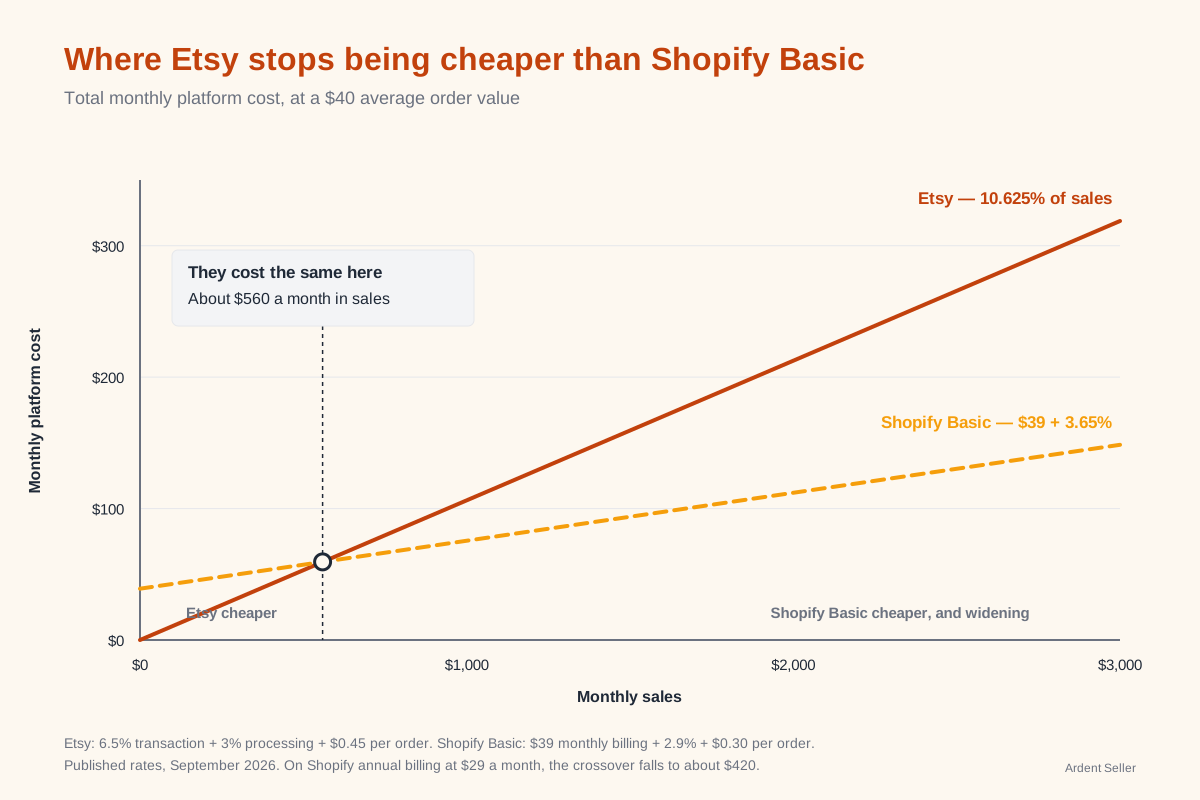
Where Etsy stops being cheaper than Shopify
Look at those two shapes rather than the two totals, because the totals only hold at exactly $1,000.
Etsy costs you 6.5% + 3% of sales, plus $0.45 per order in listing and fixed processing fees. At a $40 average order that fixed part works out to another 1.125%, so Etsy is essentially a flat 10.625% of everything, forever, at every volume — the 10.6% in the table above, carried to one more decimal place. Shopify Basic is $39 of fixed cost plus 2.9% and $0.30 per order — call it $39 plus 3.65%.
Set them equal and solve, and you get the number that actually decides it:
The crossover is about $560 a month. Below roughly $560 in monthly sales, Etsy costs less. Above it, Shopify Basic costs less, and the gap grows with every order. On Shopify's annual billing at $29 a month, the crossover falls to about $420.
That is a lower bar than most people assume. Six hundred dollars a month is about $7,000 a year — a moderately busy side business, not a full-time one. By $3,000 a month, Etsy is taking $319 and Shopify Basic is taking $149, a difference of $2,040 a year.
Which is a tidy, satisfying, completely misleading conclusion, and if you stop reading here you will make the wrong decision.
Square is the cheapest, and it does not matter
Go back and look at the top row of that cost table. Square Free costs $40.50 on the same $1,000 of sales, and it costs that from your first sale — no subscription, no commission, no listing fees. That is a little under two-fifths of what Etsy takes and a little over half of what Shopify Basic takes, and it stays cheaper than both across every volume this article deals with. (Square Free only loses to Shopify Basic somewhere north of $9,000 a month, where Shopify's lower 3.65% finally outruns the $39 subscription.)
So why does essentially no handmade business run on Square Online?
Because fees are not what you are buying, and every seller who has tried the cheap route already knows it. You are buying traffic, and traffic is the only thing on this page that is genuinely scarce.
Etsy's 10.6% is not a fee in any meaningful sense. It is a customer acquisition cost, bundled with hosting and a checkout, charged only on success. Somebody typed "ceramic mug handmade" into a search box and Etsy put your listing in front of them. If you are paying Shopify $39 a month plus 3.65%, nobody is doing that for you, and the marketing you do instead is not free. It costs money, or it costs hours, and for most makers it costs both.
That reframing changes the whole comparison. The honest question is not "which platform charges least" — Square wins that and it does not matter. It is: where do your buyers come from today, and would they still find you if the storefront moved?
If the answer is "Etsy search," your fees are buying something. If the answer is "my Instagram, a market stall, and word of mouth," you have been paying Etsy 10.6% for a service you are not using — and that is the real signal to leave, at any volume, crossover or no crossover.
Faire is not on the same axis
Faire keeps turning up in these comparisons and it does not belong in the same column, because it does not sell to your customers. It sells to shops.
The mechanics, from Faire's help center pricing article (opens in new tab): 15% commission on marketplace orders, a one-time $10 new customer fee on a retailer's first order with you, and reorders back at the plain 15%. Orders from retailers you brought to Faire yourself, through your Faire Direct link, are 0% commission. Separately there is a payment processing fee tied to how fast you want to be paid — 3.5% + $0.30 for next-day, 2.4% + $0.30 at thirty days, 1.9% + $0.30 at sixty.
Run $1,000 of wholesale orders through it — four orders of $250, two of them from retailers new to you, thirty-day payout — and you pay $150 commission, $20 in new customer fees and $25.20 in processing. That is $195.20, or 19.5%.
Nineteen and a half percent looks brutal beside Etsy's 10.6% until you remember what wholesale revenue is. Those goods were priced at wholesale, typically half of retail, so the same stock would have carried a $2,000 retail tag. Against that, Faire's take is closer to 9.8% — and it moved four boxes instead of twenty-five, with no customer service, no packing 25 individual orders, and a buyer who may reorder every quarter without you spending anything to reach them again.
Faire is not a cheaper Etsy. It is a different business model with a different cost structure, and the only comparison worth making is against pricing your own wholesale accounts directly.
Five sellers, five different right answers
Fee tables answer a question nobody actually has. Here is the question people actually have, in five shapes.
You have forty listings and no audience. Etsy, without hesitation, and stop reading comparison articles. You cannot buy your way to search traffic on a store nobody knows exists. Giving up 10.6% on an order somebody actually places is better than keeping 100% of an order that never comes. Revisit this in a year.
You have six thousand Instagram followers and one hero product. You are already generating your own traffic and paying Etsy for the privilege. Big Cartel Platinum at $15 a month plus Stripe puts you at 5.2%, and takes about an afternoon to set up. Shopify is the more capable tool but you do not yet need what the extra $24 a month buys.
You sell mostly at markets and want somewhere to send people afterwards. Square, because your online store and your booth reader are then the same system, one inventory, one set of sales reports. The free plan genuinely costs nothing per month. This is the one case where the cheapest option on the table is also the right one — with the caveat that connecting your own domain is a paid-plan feature on Square, so the free tier leaves you handing out a Square-hosted address on your market signage (Square Online plans (opens in new tab)).
You are doing $4,000 a month on Etsy and it stings. Open a Shopify store, and keep the Etsy shop open. You would save roughly $2,900 a year in fees on that volume by moving it all — but only if the buyers follow, and a meaningful share of them will not, because they were Etsy's shoppers rather than yours. Run both, watch which channel actually produces repeat customers, and shift weight toward the one that does.
Your product looks like it belongs in shops. Faire, alongside whatever direct channel you already have. Four wholesale invoices a quarter is a completely different workload from four hundred retail orders, and the Faire Direct link means the accounts you win yourself cost you nothing in commission.
Notice that four of those five answers involve more than one channel eventually. That is not a hedge. It is what happens to almost every handmade business that survives its second year — and it brings a cost that no platform's pricing page mentions.
What it actually costs to leave a marketplace
The crossover math earlier assumed that if you move, your sales move with you. They mostly do not, and the reasons are worth naming individually, because some of them are permanent and some are merely expensive.
Your reviews do not travel. A shop with four hundred reviews and a 4.9 average has an asset that took years to build and cannot be exported, imported, or recreated anywhere. On a new store your product pages start at zero social proof, against the same competitors, with the same photos. For an established Etsy shop this is frequently the strongest single argument for keeping the shop open indefinitely, whatever the fee arithmetic says.
Your ranking does not travel either. Whatever Etsy search position you hold is Etsy's, and a new domain begins with none of it. Expect months, not weeks, before your own store ranks for anything competitive — and in the meantime the traffic has to come from somewhere you pay for.
You very likely do not have a customer list. This is the one that catches people. Etsy does give you the buyer's email address on an order, but its Seller Policy is explicit about what you may do with it: the information may only be used for Etsy-related communications or Etsy-facilitated transactions, and without the buyer's consent you may not add any Etsy member to your email or physical mailing list, or use that buyer's identity for marketing (Etsy Seller Policy (opens in new tab), effective July 9, 2026). So four years of Etsy sales does not leave you with four years of marketing list. You cannot email those buyers to tell them you have moved.
Sales tax stops being somebody else's job. This one is not permanent, but it is genuinely expensive in the first year. Under state marketplace facilitator laws, Etsy calculates, collects and remits US sales tax on your behalf, with no extra administration charge and nothing required from you (Etsy Help (opens in new tab)). Amazon and the other large marketplaces operate under the same regime. Move those sales to your own Shopify or Big Cartel store and that obligation lands back on you — registration where you have nexus, correct rates, filing calendars. Whether that is a shrug or a real cost depends on where you sell and how much, which is its own subject: see sales tax nexus for handmade sellers before you assume it is a shrug.
That customer-list point is not really an argument about leaving. It is an argument about starting a second channel earlier than the fee math says you need to — because the customer relationships you can keep are only the ones you built somewhere you own, and you cannot retroactively acquire them on the way out.
The migration that works is additive rather than a switch: open the second store while the first is still healthy, put your own domain on everything you print and post, and let the mix shift over two to four quarters. Which lands you, whether you planned it or not, running two channels at once.
The tax nobody prices in: selling on two platforms at once
Every fee in this article is a number you can look up. The expensive part of multi-channel selling is not on any pricing page.
It is this: two storefronts are drawing down one physical shelf of stock. Etsy thinks it has eight mugs. Your Shopify store thinks it has eight mugs. You have eight mugs. The first weekend both platforms sell four and you are fine; the weekend one of them sells six, you are refunding somebody and eating the review.
Then it is the reconciliation. Etsy's payout is net of a fee stack that is deducted before the money reaches you. Shopify's is net of a different one. Faire's arrives thirty days late, minus commission and a new customer fee. At the end of the quarter you have three deposit figures that do not match any of your sales figures, and working out which channel is actually profitable means unpicking every one of them by hand. It is the kind of job that gets done in a spreadsheet for a quarter or two and then quietly stops getting done at all, which is how a channel can lose money for a year without anyone noticing.
This is the specific problem Ardent Seller exists to solve: one stock ledger behind every channel, so a sale anywhere draws down the same count, and per-channel fee tracking so the margin you see is the margin after Etsy, Shopify or Faire took theirs. The Etsy, Shopify, and Square connections sync orders directly; anything else records against the same inventory with its own transaction method and fee profile. The point is not the syncing — it is that "which channel is worth keeping" becomes a number you can read instead of an argument you have with yourself in January.
Before you open a second storefront, decide where that reconciliation is going to live. It is a much cheaper decision to make in advance than to retrofit.
Frequently asked questions
Do I need an LLC or business license before I open a shop on any of these?
Platform signup does not require one; your state and city may, independently of which platform you use. That question is unrelated to this comparison — see do I need an LLC for my handmade business.
Is Etsy Plus worth the $10 a month?
At $10 USD per month (opens in new tab) it does not change any fee in the table above — it is a bundle of credits and shop customization. Judge it on whether you would buy those things separately, not as a fee reduction, because it is not one.
What about TikTok Shop, Instagram Shopping, or selling through DMs?
These are traffic sources rather than platforms; they all check out through something else. The relevant question is which of the six above sits behind them, and the answer is usually whichever store you already have.
Can I move my Etsy reviews to a new store?
No. Reviews are the single least portable asset you own, and on a shop with hundreds of them that is a genuine argument for keeping Etsy open even after your own store outgrows it.
Related reading
- Payment Processing Fees for Handmade Sellers — the layer underneath this one: what per-sale payment processing fees cost across processors, and why the fixed cents matter more than the percentage on small baskets.
- Are Etsy Ads Worth It? — if you land on Etsy after reading this, the ad spend question is the next one, and it has a break-even you can calculate before spending anything.
- Shopify Inventory Limitations for Makers — if Shopify wins the fee math, this is what its inventory will and won't count for you once you make what you sell: no materials, no production record, a cost field that doesn't move, no lots.
- Best Inventory App for Etsy Sellers — the buyer's guide for the layer above the storefront, once one shelf of stock is feeding more than one channel.
- Best Place to Buy Shipping Labels — the other per-order deduction, and the one you control directly: where to buy postage once the platform question is settled, priced across five options on the same parcel.
- Handmade Selling Platform Trends — where these platforms have been moving, and which of the fee structures above are likely to shift next.
Free resources
Two free downloads from the Ardent Workshop library that pick up where the table above stops:
- Multi-Channel Sales Reconciliation Worksheet — the exact quarter-end job described in the last section: reconciling three payout figures back to one set of sales numbers, per channel.
- Etsy Fee Calculator (2026) — run your own item price and shipping charge through Etsy's stack rather than trusting the $40 average order used here.
This article is provided for educational purposes only and does not constitute financial, tax, or business advice. Platform fees change without notice and every figure above was taken from the platform's own published pricing in September 2026 — verify current rates before making a decision. Cost structures, pricing examples, and margin figures are illustrative and will vary by your specific circumstances. Consult a qualified accountant or small-business advisor before making financial decisions based on this content.