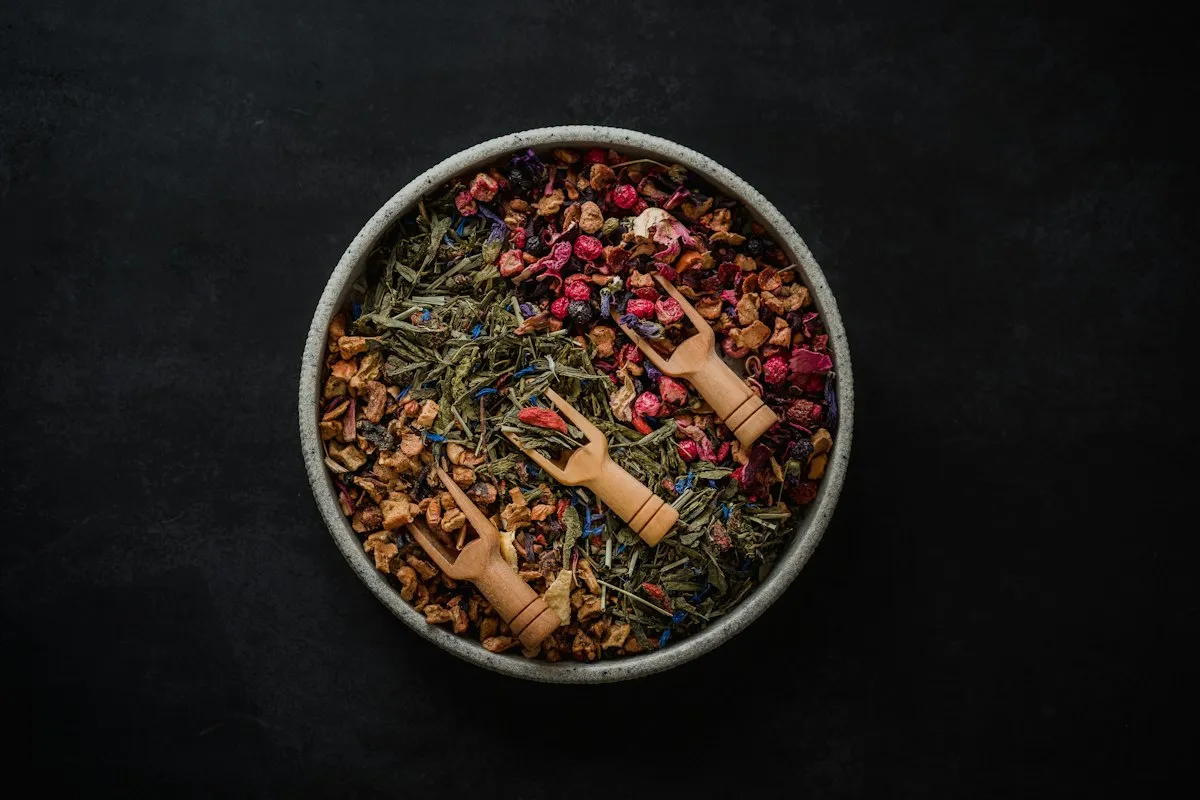
The kitchen smells of chamomile dust and dried lemon peel. Four paper sacks sit open on the counter, and the fine green powder that always escapes the lemon balm has settled on everything, including the calculator. Wren has blended the same evening tisane for a year. She sells it at two farmers markets, in 2 oz and 4 oz kraft pouches. Tonight she wants to know what one ounce of it actually costs her.
(Wren is a composite, and every price in this post is illustrative. Swap in your own invoices as you read.)
For her blend, the short answer is $1.41 an ounce for the botanicals and $1.93 an ounce once losses and labor are counted. By the time the tea is in a sealed, labeled 2 oz pouch, that pouch costs $5.06. The rest of this post shows where each of those numbers comes from, in the order she worked them out.
Step one: from price per pound to cost per gram
Wren's blend, which she calls Evening Garden, is four botanicals mixed by weight. She buys each one by the pound, and her invoices already include shipping. Her recipe is written in grams, because her scale reads in grams and because a 1,000-gram batch makes the percentages easy to read.
The bridge between the two is fixed. NIST's conversion tables (opens in new tab) put one avoirdupois pound at 453.59 grams and one ounce at 28.35 grams. So an ingredient's cost per gram is its price per pound divided by 453.59.
| Botanical | Price per lb | Cost per gram | Grams in batch | Line cost |
|---|---|---|---|---|
| Chamomile flowers | $22.00 | 4.85¢ | 450 g (45%) | $21.83 |
| Lemon balm | $16.00 | 3.53¢ | 300 g (30%) | $10.58 |
| Lavender buds | $28.00 | 6.17¢ | 100 g (10%) | $6.17 |
| Rose petals | $34.00 | 7.50¢ | 150 g (15%) | $11.24 |
| Batch | — | — | 1,000 g | $49.82 |
That gives $49.82 for 1,000 grams, or 4.98¢ a gram. Multiply by 28.35 and the botanicals cost $1.41 per ounce. (The cost-per-gram column is rounded for display, while each line cost uses the unrounded rate, so multiplying the rounded column by hand can land a cent off.)
There is a shortcut worth knowing, because it doubles as a check on the long way. If the whole recipe stays in U.S. units, the weighted price per pound is 0.45 × $22 + 0.30 × $16 + 0.10 × $28 + 0.15 × $34 = $22.60. Divide by 16 ounces and you get the same $1.41. When the two methods disagree, a percentage is usually wrong somewhere, often a recipe that quietly adds up to 102%.
Weight share is not cost share
Look at the rose petals again. They make up 15% of the blend's weight and 22.6% of its cost. Chamomile goes the other way, at 45% of the weight and 43.8% of the cost. The expensive-but-light botanicals punch above their weight in the budget, and they are the ones to watch when a supplier changes a price.
This is also why the recipe has to be written in grams. Rose petals are bulky and chamomile is dense, so a scoop of one weighs nothing like a scoop of the other. A blender who measures by the cup is making a slightly different recipe, at a slightly different cost, every time the botanicals settle differently in the sack.
Step two: the ounces you can't sell
$1.41 is the cost of an ounce that goes into the bowl. It is not the cost of an ounce that goes into a pouch, because some of the bowl never reaches one.
Wren sifts every batch to remove the powder that collects at the bottom. It clouds the cup and looks like dust through a pouch window. She weighed her sift-outs across her last several batches, and they came to about 40 grams per 1,000. She also sets aside 10 grams per batch for tasting cups at the market. That leaves 950 grams she can actually sell.
The botanicals still cost $49.82, but now that cost is spread across 950 grams instead of 1,000:
- $49.82 ÷ 950 g = 5.24¢ per sellable gram
- 5.24¢ × 28.35 = $1.49 per sellable ounce
That is 8¢ an ounce more than step one. It is not a dramatic number, but it is real, and it compounds with everything that follows. Your own loss will not be 5%. It depends on how brittle your botanicals are and how hard you sift. The way to find out is to weigh what goes into the bin for a few batches rather than guessing.
Step three: the labor inside every ounce
Weighing, mixing, sifting, and cleaning up a 1,000-gram batch takes Wren about 45 minutes. She pays herself $20 an hour on paper, which she treats as the rate she would have to pay someone else to do the job. So each batch carries $15.00 of blending labor.
Add that to the botanicals and the batch costs $64.82. Spread across the 950 sellable grams:
- $64.82 ÷ 950 g = 6.82¢ per gram
- 6.82¢ × 28.35 = $1.93 per ounce, loaded
"Loaded" here means the cost with the sift loss and the blending labor both built in. This is the number to put on the blend itself: $1.93 for an ounce of finished, sifted, sellable Evening Garden, before it touches a pouch. Filling labor comes next, because it is charged per pouch rather than per ounce.
It is also the point where a spreadsheet starts to strain. Every figure so far depends on every figure before it, and one new invoice changes all of them. In Ardent Seller, the blend is a recipe written in grams, built from ingredients bought by the pound, with the batch labor as a timed step. The cost per gram and per ounce update on their own when a price or a ratio changes, and the sift loss has a place to go as recorded waste instead of living in your head.
Step four: why 2 ounces is not half of 4
Here Wren's numbers start to diverge from the tidy per-ounce figure, for two reasons.
The first is the net-weight line on the label. Federal food labeling rules require the declared net quantity to be "an accurate statement of the quantity of contents of the package," and although reasonable variations are recognized, they "shall not be unreasonably large" (21 CFR 101.105(q) (opens in new tab), as of September 2026). Your state's cottage food rules may add their own label requirements, so check your state's page as well. Wren's scale reads in whole grams, and a 2 oz pouch has to hold 56.70 grams, so she fills to 58 to stay safely over. A 4 oz pouch holds 113.40 grams, and she fills to 115. Those extra grams are tea she gives away. On a 2 oz pouch, the 1.3 gram overfill is worth about 9¢.
To size your own buffer, re-weigh a handful of filled pouches a second time. Your fill target has to clear the declared weight by more than your scale's smallest step, plus any difference you see between the two weighings.
The second is that packaging and filling are charged per pouch, not per ounce. A 4 oz pouch costs a little more than a 2 oz one, but nowhere near double, and the label is the same label. Filling and sealing takes about 1.5 minutes for the small pouch and 1.75 for the large one.
| Line | 2 oz pouch | 4 oz pouch |
|---|---|---|
| Blend (58 g / 115 g at 6.82¢, loaded) | $3.96 | $7.85 |
| Filling and sealing labor at $20/hr | $0.50 | $0.58 |
| Kraft pouch with zipper | $0.38 | $0.52 |
| Printed label | $0.22 | $0.22 |
| Cost per pouch | $5.06 | $9.17 |
| Cost per ounce, as sold | $2.53 | $2.29 |
The per-ounce cost of the tea itself is the same in both pouches. The finished product is not. (As in the first table, each line uses the unrounded cost per gram, so the 115 g blend line shows $7.85, where multiplying 115 g by the displayed 6.82¢ by hand gives $7.84.) The small pouch costs 24¢ an ounce more to make, and a price list that charges strictly per ounce either overprices the large pouch or underprices the small one.
Compare it with step one. Two ounces of botanicals at $1.41 would suggest the 2 oz pouch costs $2.82. It actually costs $5.06, about 79% more. Most of that gap is labor, sift loss, and packaging, and none of it shows up on a supplier invoice.
From cost to shelf price
With a real per-pouch cost, pricing is one division. Wren wants a 60% gross margin, meaning 60¢ of every sales dollar left after the cost of making the product. The price is cost ÷ (1 − 0.60):
- 2 oz: $5.06 ÷ 0.40 = $12.65, which she rounds up to $12.75
- 4 oz: $9.17 ÷ 0.40 = $22.93, which she rounds up to $23.00
Those last moves are pricing choices, not arithmetic. Wren always rounds up, never down, to a price that is easy to say at a market table, so both pouches land at or just above a 60% margin. If margin versus markup is where this usually goes sideways for you, the difference between margin and markup is worth five minutes before you set a single price. The free Product Pricing Calculator runs the same division for a whole product list at once.
One more number helps at the market table. If Wren's brewing instructions call for 2.5 grams per cup, a 58-gram pouch makes about 23 cups, so the $12.75 pouch works out to roughly 55¢ a cup. That is a much easier number to say out loud than "$6.38 an ounce."
When the chamomile goes up
Botanicals are crops, and crop prices move with the harvest. Suppose Wren's chamomile supplier raises the price from $22 to $26 a pound.
- Batch: 450 g × ($4 ÷ 453.59) = $3.97 more per batch
- Loaded cost per gram: ($64.82 + $3.97) ÷ 950 = 7.24¢
- 2 oz pouch: 58 g × 7.24¢ = $4.20 of blend, up from $3.96, which takes the pouch from $5.06 to $5.30
- Margin at $12.75: down from just over 60% to about 58%
Twenty-four cents a pouch does not feel like news at the market table. Across a season of pouches, it is the difference between the margin Wren planned and the one she actually earns, and she would only notice it if she re-ran the whole chain. That re-run is the job worth handing to software. When the new chamomile invoice is recorded in Ardent Seller, the blend's cost per ounce and each pouch's cost recalculate from it, so the price question comes up the day the invoice arrives rather than at year-end.
The number she'd been missing
By the time the sacks are rolled shut, Wren has four numbers where she used to have one: $1.41 an ounce on the invoices, $1.49 once she counts what she can't sell, $1.93 once she counts her hands, and $2.53 an ounce in a finished 2 oz pouch. Her old price of $10 for the small pouch had looked comfortable against $1.41. Against $5.06, it was a 49% margin, and every pouch sold at the market was paying her for tea she thought she was selling at a better number.
Your blend will have different botanicals, a different sift loss, and a different pouch. The chain is the same five lines:
- Botanicals cost = the sum, across every botanical, of (price per pound ÷ 453.59) × grams in the batch
- Sellable grams = batch grams − sifted-out fines − samples
- Loaded cost per gram = (botanicals + blending labor) ÷ sellable grams
- Cost per pouch = loaded cost per gram × fill grams + filling labor + pouch + label
- Shelf price = cost per pouch ÷ (1 − target margin), rounded up
Multiply any per-gram figure by 28.35 to read it per ounce. If you want every link of it to update itself when an invoice changes, start a free Ardent Seller account and build your first blend as a recipe in grams, with the four prices from your last invoices.
Related reading
- Track Inventory by Weight or by Unit? — Why the blend's botanicals belong in grams even though the invoices arrive in pounds, and what to do when a supplier sells by the bag.
- Recipe Costing 101 — How to cost a recipe across all five cost categories, for when the tea line is ready to sit next to everything else you make.
- Herbal Product Shelf Life — The batch dates that decide how long a blend like Evening Garden can sit on the shelf before its cost becomes waste.
- Spice Blend Cost Per Jar: A Case Study — The same exercise for rubs and seasonings, where packaging and labor, rather than the spices, turn out to be the largest lines.
Free resources
If you'd like to run these numbers against your own blends, two free downloads pair well:
- Product Pricing Calculator — Takes the per-pouch cost you built above and turns it into a retail and wholesale price at the margin you choose.
- Recipe Scaling & Batch Calculator — Scales a gram-based blend from a 1,000 g test batch to whatever your market weekend actually needs, without redoing the percentages by hand.
This article is provided for educational purposes only and does not constitute legal, regulatory, financial, or tax advice. Costs, pricing examples, and net-quantity labeling and cottage food rules vary by jurisdiction and change frequently. Consult a qualified accountant, a food-labeling compliance consultant, or an attorney before making financial or compliance decisions based on this content.