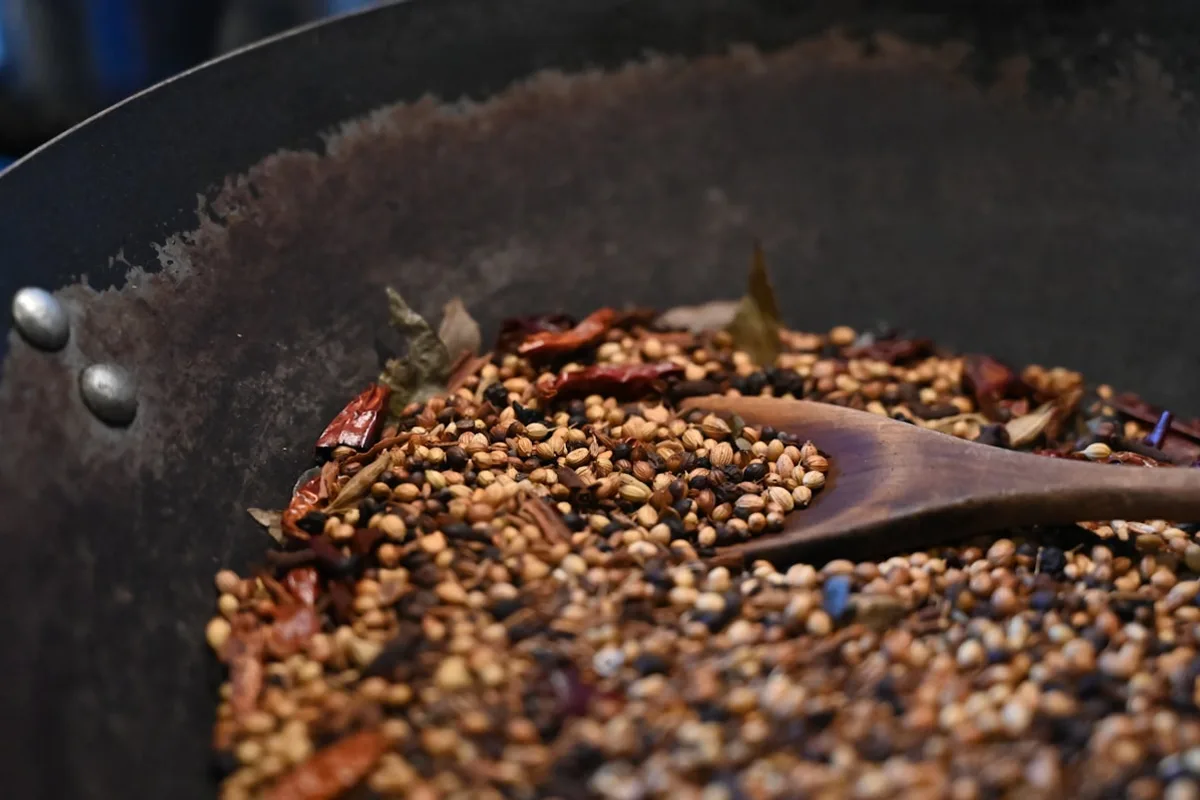
The buyer from the regional grocery co-op wanted twelve cases to start, reordering monthly, and she wanted Marisol's barbecue rub on the shelf by the fall grilling season. The price she offered was $4.50 a jar — exactly half of the $9 Marisol charged at the farmers market. "Standard wholesale," the buyer said, like it was weather.
(Marisol and the co-op buyer are composites — stand-ins for the kind of early-stage spice blender and wholesale buyer this post is written for. Every figure here is illustrative; the point is the method, not the exact dollars.)
Marisol almost said yes on the spot. Half price stung a little, but the rub cost her — what, two and a half dollars to make? Maybe less? Twelve cases a month was real money, the kind that turns a side table at the market into an actual business. She asked for a week to "check her capacity," which was the polite version of I have no idea if this is a good deal.
She was right to stall. When she finally sat down and built the number from the bottom up, her best-selling rub didn't cost $2.50 a jar — it cost $4.20. Six things go into a spice-blend jar: the blend itself, the jar and cap, the label, the hands-on minutes, a spoilage reserve, and the slice of market overhead each jar has to carry — and Marisol had only ever counted the first one. At $4.50 wholesale, that left her pouring her Saturdays into the co-op's shelves for thirty cents a jar.
The number she'd never actually built
Here's the thing about spice blends: the spices feel like the whole cost, because they're the part you fuss over. You drive to the restaurant-supply place, you buy the good smoked paprika by the five-pound bag, you toast your own cumin. The romance of the business lives in the blend. So when someone asks what a jar costs you, the spices are the number that comes to mind.
Often, the spices are one of the smaller lines on the page.
Marisol's mistake wasn't laziness. She'd been "tracking costs" the way that's easy to fall into — a guess anchored to the one line item she could picture. What she'd never done was lay all the lines side by side for a single jar and add them up. When she did, the jar she'd been treating as a $2.50 product split into six pieces, and only one of them was spice.
| Cost line | Barbecue rub, per 4 oz jar |
|---|---|
| Spice blend (bulk cost) | $0.92 |
| Jar, shaker fitment, cap | $0.95 |
| Label + shrink band | $0.43 |
| Hands-on labor (blend, fill, cap, label) | $0.75 |
| Best-by / unsold shrinkage reserve | $0.15 |
| Booth fee + card fees (per jar) | $1.00 |
| True cost per jar | $4.20 |
The spice blend — the part she thought was the cost — was ninety-two cents. The packaging that held it cost more than the contents. And the two lines she'd never counted at all, labor and her market overhead, together came to nearly two dollars.
Rule of thumb: If you can picture the cost of your product without thinking, you're probably picturing the cheapest line. Build the jar from the bottom up at least once a year, every line, or the invisible ones will quietly set your real margin.
She wasn't broke. At $9 retail, a $4.20 cost is still a healthy 53% gross margin — not the 72% she'd assumed, but not a crisis. The danger wasn't the market table. It was the co-op offer, where the same jar at $4.50 would have left her thirty cents to cover the hours she hadn't been counting.
Three jars, three different leaks
What made Marisol's week useful wasn't the barbecue rub alone. It was what she found when she ran the same exercise on her other two signature blends. Each one was bleeding margin in a completely different place — which is the part nobody warns you about. There isn't a spice-blend mistake. There are several, and you usually have a different one on each shelf.
Case study: the barbecue rub — packaging ate the product
The rub was Marisol's volume seller, and its leak was the most ordinary one in the catalog: the container cost more than what's inside it. Ninety-two cents of paprika, brown sugar, salt, garlic, and pepper went into a jar-and-cap-and-label-and-band stack that cost $1.38. She'd been buying the jars with the built-in shaker fitment forty at a time from a craft store because it was easy, paying nearly a dollar each.
The fix wasn't dramatic. She moved to a 144-count case of the same jars from a packaging wholesaler and the per-jar cost dropped from $0.95 to $0.61. Her labels, printed in runs of fifty on a home printer with a per-sheet cost she'd never divided out, came down when she ordered 250 at a time from a label printer. Two boring sourcing changes pulled roughly fifty cents out of every jar — more than half of the spice cost itself.
The outcome: A $4.20 jar became a $3.65 jar without touching the recipe. That fifty cents is the difference between a wholesale account that pays her and one that doesn't.
Case study: the curry blend — the expensive-spice trap
The curry blend was the opposite problem. Marisol had priced it at the same $9 as the rub, because in her head a jar was a jar. But the curry leaned on green cardamom, whole spices she toasted and ground herself, and a pinch of saffron — and those don't cost ninety-two cents. The spice line on the curry was $2.40 a jar, nearly triple the rub.
Worse, toasting whole spices meant the occasional scorched batch. About one batch in eight got pushed too far and went in the compost, and she'd never reserved a cent for it. Once she added the spice cost, the wasted-batch reserve, and the same packaging and labor as every other jar, the curry's true cost came to $5.10 — and she'd been selling it for the same price as a product that cost two dollars less to make.
She raised the curry to $12 and stopped apologizing for it. Nobody blinked. The people reaching for a hand-toasted saffron curry tend not to be the ones counting quarters.
The outcome: Same shelf, same jar size, $3 difference in price — because they were never the same product. Flat per-jar pricing across blends with wildly different spice costs is a silent subsidy from your cheap blends to your expensive ones.
Case study: the taco seasoning — death by generosity
The taco seasoning had the cleanest cost of the three. Cheap, shelf-stable spices, no toasting, about $0.70 of blend per jar. On paper it was her highest-margin product. On the bank statement it was a mystery, because the per-jar cost was never the taco seasoning's problem.
The leak was everything that happened around the jar. Taco seasoning was her sampler — she gave away a small bowl of it at every market so people could taste before they bought, and she never counted the giveaway spice. She ran a "3 for $24" deal most weekends, which quietly knocked her $9 jar down to $8, and she ran a steeper holiday markdown she'd never modeled. And because it was popular, she handed out a lot of "just take one" jars to friends, vendors, and the woman who ran the booth next door.
None of that is on a cost table. All of it spends margin. When Marisol tallied a month of samples, deal pricing, and giveaways, the taco seasoning's effective selling price was closer to $6.80 than $9 — and on a product she made plenty of, that gap was the biggest single leak of the three.
The outcome: She kept the samples (they sell jars) but capped the giveaway spice as a known monthly number, set the deal to "3 for $25.50" so it held a real margin, and started logging comped jars as the marketing expense they actually were. The cost per jar never changed. The money she kept did.
What the exercise actually was
Strip away the spices and Marisol did one thing three times: she made the invisible lines visible. The packaging she bought on autopilot. The hours she never billed. The batches she lost. The jars she gave away. None of it shows up when you "know" your cost — it only shows up when you build the jar from nothing, line by line, and refuse to leave anything out because it feels small.
The other half of the work was the bulk-to-jar conversion underneath it all. A spice blender buys cumin by the kilo and sells it by the four-ounce jar, and the cost has to travel cleanly across that gap — from the price on the bulk bag, through the blend ratio, into the filled-jar cost, with the jar and label and shaker insert riding along. Do that math by hand for one blend and it's a fussy afternoon. Do it for nine blends across jars, tins, and pouches and it's the kind of spreadsheet that develops a tab nobody opens.
That conversion — bulk bag to filled jar, with the packaging and labor riding along — is exactly the kind of math a costing tool like Ardent Seller is built to carry across every blend, jar, tin, and pouch at once.
The week was worth more than the deal
Marisol went back to the co-op. She'd done the math the buyer assumed she couldn't, and it changed the conversation. The rub, now a $3.65 jar after her sourcing fixes, could carry a wholesale price — but at $5.25, not $4.50, with a case-size minimum that made her fill-and-label time worth doing. The curry went on the sheet at its real tier. The taco seasoning stayed market-only, where its margin was already quietly fine once she stopped giving it away.
She got the account. More importantly, she got it on terms she chose, because for the first time she knew the floor she couldn't go below. The spices were never the thing standing between her market table and a real business. The jar she'd never bothered to add up was.
If your blends are priced on a number you've never actually built — the one that comes to mind when someone asks "what's it cost you?" — spend the afternoon Marisol spent. Build one jar from nothing, every line. The leak usually isn't where you think it is, and it often isn't the spice.
If you'd rather not rebuild that math by hand every time your spice costs move, Ardent Seller for spice blenders stores each blend as a scalable recipe and rolls the bulk cost, packaging, and labor into a live cost for every jar, tin, and pouch — so the next wholesale number lands against a floor you already know.
Start free and cost your best-selling blend first.
Related reading
- Recipe Costing 101 — the five cost categories every blend has to carry, laid out from scratch; the foundation under Marisol's whole exercise.
- Loose-Leaf Tea Blend Cost Per Ounce — the same exercise for a dry blend sold by weight, where the botanicals rather than the packaging turn out to be the biggest line, and a bigger pouch costs less per ounce.
- Batch Tracking for Food Sellers — how to put lot codes and best-by dates on spices that lose potency, so the shrinkage reserve in your cost table is grounded in real numbers.
- Margin vs. Markup: The Pricing Math Mistake That Costs You Money — why a "50% off" wholesale offer is not the same as a 50% margin, and how the two get confused at exactly the wrong moment.
Free resources
Three free downloads from the Ardent Workshop library that pair well with this post:
- Product Pricing Calculator — turn the true per-jar cost you just built into a retail and wholesale price that actually holds a margin.
- Recipe Scaling & Batch Calculator — work the bulk-to-jar conversion for a single blend, from kilo bag to filled four-ounce jar.
- Cottage Food Revenue Cap Tracker — if you sell direct under cottage food rules, track your annual sales against your state's revenue cap before a big wholesale order tips you over the limit.
This article is provided for educational purposes only and does not constitute financial, tax, or business advice. Cost structures, pricing examples, and margin figures are illustrative and will vary by your specific circumstances. Consult a qualified accountant or small-business advisor before making financial decisions based on this content.