If you have ever opened an inventory item, looked at the on-hand number, and thought that cannot be right, I know there is half a bottle sitting on the shelf — this post is for you. You are not bad at this. You just made a four-second decision months ago that has been quietly compounding ever since.
Here is the decision. When you created that item, something asked you what unit to track it in. There was a dropdown. The dropdown was standing between you and the thing you actually wanted to do, which was get the item saved so you could get back to work. So you picked whatever matched the box on your shelf. Bottle. Roll. Bag. Kit.
That is one of the most consequential setup choices in your inventory, and it is easy to make without ever registering it as a choice. The good news is that it is fixable, mostly. The better news is that once you see the rule, you will never get it wrong again.
The short answer: track in the unit you consume the material in, not the unit you buy it in. If your build sheet says nine grams, track grams. If it says eight rivets, track rivets. The four questions further down tell you which one applies to a given material.
What the tracking unit actually is
There are three different units in play here, and it is easy to carry all three around at once without ever separating them. The confusion between them is where the trouble starts.
The purchase unit is how the material arrives. A 50-yard roll. A case of 12. A 1 kilogram kit. This is what the supplier invoice says, and it needs to stay exactly as it is, because it is the record that has to reconcile against what you were charged.
The usage unit is how the material leaves. Nine grams of resin per pendant. Eight rivets per bag. Twenty-seven inches of webbing per strap. This is what your recipe or build sheet says.
The tracking unit is how the on-hand balance is expressed, and it is the one that does the actual work. It is the denominator. Every per-item cost you calculate is total cost divided by tracking units, and every "do I have enough for Saturday" question gets answered in tracking units. Pick it badly and you are not just inconvenienced. Your costs are wrong, in a direction you cannot see.
A decent inventory system keeps the purchase unit and the tracking unit separate, so you can buy in cases and count in grams without doing conversion arithmetic at the keyboard. If your current setup makes you choose between those two, that is the actual problem, and it is worth fixing before anything else.
Four makers, four different right answers
There is no universal answer here, which is exactly why the dropdown is so easy to get wrong. Watch four people reach four different conclusions from the same rule. Dana, Marcus, Priya, and Theo are not real customers, by the way. They are composites, built to show how the arithmetic plays out rather than pulled from anyone's books.
Dana pours by the gram, so she tracks by the gram
Dana makes resin pendants. She buys casting resin in 1 kilogram kits at $58, and each pendant takes about 9 grams.
She originally tracked resin by the kit, because that is what shows up on the invoice. Which meant that every time she logged a production run, she had to enter what fraction of a kit it consumed. Nine grams out of a thousand is 0.009 kits. Nobody types 0.009. She typed 0.01, because it is close enough and she had forty pendants to demold.
Close enough, forty pendants at a time, for a year.
At 0.01 kits per pendant, 400 pendants consume 4 kits on paper. In reality they consume 3,600 grams, which is 3.6 kits. Her resin line was overstated by 11%, and her cost per pendant read $0.58 against a true $0.52. Six cents. On a pendant she sells for $34, six cents is noise, and if that were the whole story it would not be worth a blog post.
It was not the whole story. The part that actually hurt was that her on-hand balance drained faster than her shelf did. Her low-stock alert fired while there was most of a kit left, so she reordered early, twice, and tied up cash she needed for a booth fee. Then the alert cried wolf often enough that she started ignoring it, which is how she eventually ran out of clear resin four days before a market.
Tracked in grams, all of that disappears. One kit is 1,000 grams at $58, so resin costs $0.058 per gram. A 9-gram pendant costs $0.522, exactly, with no rounding and nothing to type. The balance goes down by 9 when she makes one, and it hits zero when the shelf does.
Marcus counts rivets, and weighing them would be worse
Marcus makes leather bags. He buys copper rivets in boxes of 500 at $18.50, and each bag takes 8 of them.
By Dana's logic you might expect him to switch to grams too. He should not, and the reason is worth sitting with: his usage unit is already a whole item. Nothing about "8 rivets" is a fraction. Tracked by count, a rivet costs $0.037, a bag's worth of rivets costs $0.296, and the question he actually asks — how many bags can I make before I run out — is answered by dividing 500 by 8 and getting 62.
Tracked by weight, every one of those numbers becomes an estimate. A rivet weighs about 1.4 grams, but rivets vary, and now his on-hand count depends on whether he remembered to subtract the weight of the box.
Marcus did have one genuinely awkward moment, and it is the useful part of his story. A supplier once shipped him "1 kilogram of rivets" instead of a 500-count box, priced by weight, because that is how that supplier sells. For about ten minutes this looked like an argument for switching everything to grams.
It was not. He weighed a rivet, divided 1,000 by 1.4, and received the shipment as roughly 714 rivets. The conversion happened once, at the door, on the purchase record. His tracking unit never had to change. When the purchase unit and the usage unit disagree, convert at the door, and keep tracking in the unit you consume.
Priya's fragrance oil is a percentage, not a quantity
Priya pours candles. She buys fragrance oil in 16-ounce bottles at $24, and she doses at an 8% fragrance load against 8 ounces of wax, which works out to 0.64 ounces of oil per candle.
Look at what her recipe actually says. It does not say "one bottle" or "half a bottle." It says 8% of the wax weight. A percentage of a mass is a mass. There is no version of that instruction that a bottle count can satisfy.
Tracked in ounces, everything is one step. Oil costs $1.50 per ounce, so 0.64 ounces is $0.96 per candle. Saturday's 60-candle run needs 38.4 ounces, and she can look at the on-hand number and know.
Tracked by the bottle, she has to do that arithmetic in her head every single time, and then translate 38.4 ounces into "2.4 bottles" and decide whether the partly used one on the bench counts as a whole bottle or nothing. It usually got counted as a whole bottle. Which is why she twice started a run believing she had enough oil and finished it with eleven candles unpoured.
This is the case where the tracking unit is not a preference. If your formulation is expressed as a percentage, your inventory has to hold a mass, or the software cannot answer your questions and you end up doing its job for it.
Theo cuts webbing by the inch, and he only gets one shot
Theo makes canvas totes. He buys cotton webbing in 50-yard rolls at $42, and each bag takes two 27-inch straps, so 54 inches per bag.
The math is the same shape as Dana's. A roll is 1,800 inches, so webbing costs about $0.023 per inch, a bag's straps cost $1.26, and a roll yields 33 bags with a bit left over. Tracked by the roll, he is back to typing 0.03 of a roll per bag and watching the balance drift.
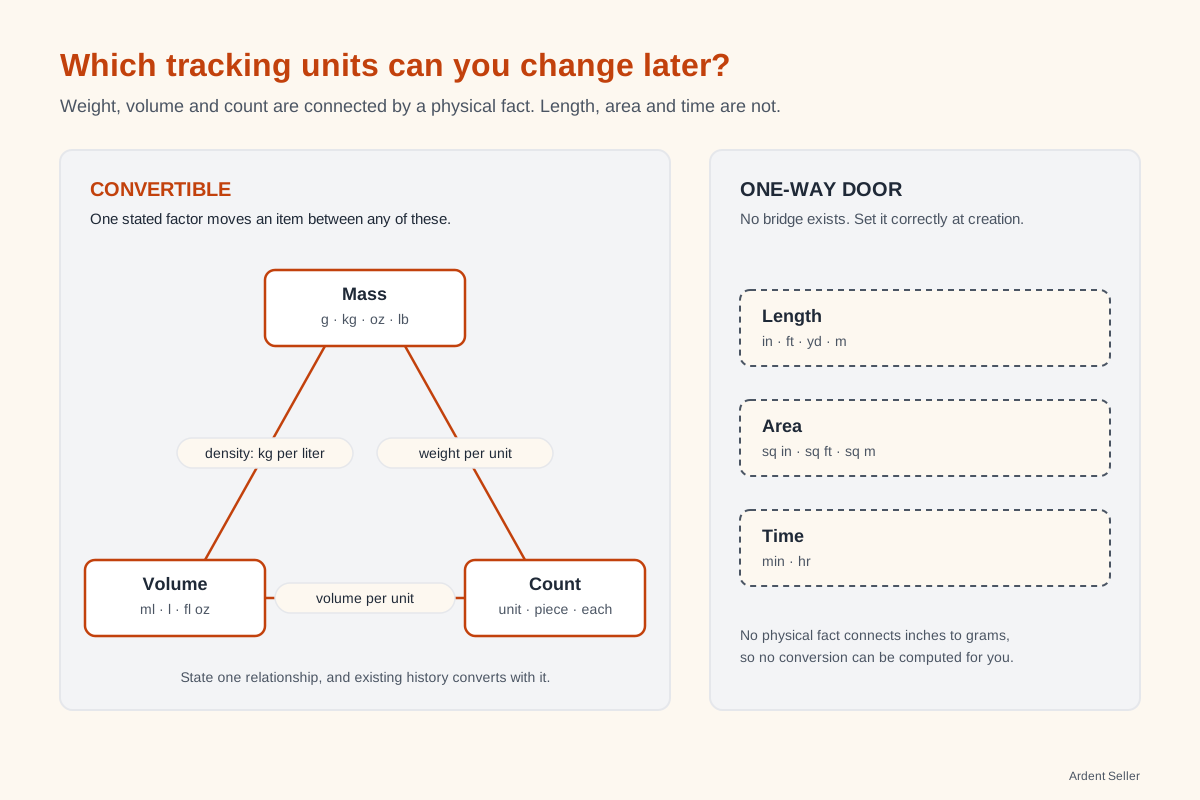
Theo's story matters for a different reason though, and it is the one genuine warning in this post. Length is a one-way door.
Weight, volume, and count are all connected to each other. If you know what one bottle weighs, a system can move an item between them and bring its history along. Length, area, and time have no such bridge. There is no fact about webbing that converts inches into grams the way density converts liters into kilograms, so no software can do that conversion for you, and none should pretend to.
If you track something by length, area, or time, get it right at setup. Theo did, mostly by luck. If he had not, his only route to per-inch costing would have been retiring the item and building a new one, which means starting the cost history over.
The pattern: four questions, in order
Dana, Marcus, Priya, and Theo all applied the same rule and got different answers, because the rule is not "use grams." It is this: track in the unit you consume, not the unit you buy. Four questions get you there. The first three usually settle it between them; the fourth can overrule all of them, so read it even when you think you are done.
Rule of thumb: if you find yourself typing a decimal fraction of a purchase unit more than once, you have your answer, and it is not the unit you are currently using.
What unit does your recipe or build sheet name? Whatever is written on the instruction is almost always your answer. Priya's recipe says a percentage of a mass, so she tracks mass. Marcus's says eight rivets, so he tracks count. If your build sheet is in your head rather than on paper, write one down first. The unit will pick itself.
Does the amount you use vary continuously, or in whole items? Continuous amounts — anything you pour, scoop, cut, or weigh — want mass, volume, or length. Whole items that get used one at a time want count. The tell is whether "half of one" is a sentence that makes sense for your material. Half a rivet is not a thing. Half a gram is.
Can you actually measure it that way at the bench? A tracking unit you cannot observe is a guess with extra steps. If you do not own a scale that reads to the gram, tracking pigment in grams will produce confident-looking numbers built on nothing. Buy the scale or pick a unit you can see. This is the question that saves you from over-engineering.
Does anything downstream already commit you to a unit? A food label, or the way your suppliers quote their prices, can settle the question on its own whatever the first three said. That is what the next section is about.
When the outside world picks for you
Sometimes the choice is not really yours, and it is worth knowing that before you fall in love with a tracking unit.
If you sell packaged food, your label already commits you. The FDA's A Food Labeling Guide explains the net quantity of contents statement this way:
It must be expressed in weight, measure or numeric count. Generally, if the food is solid, semisolid or viscous, it should be expressed in terms of weight. If the food is a liquid it should be expressed in fluid measure (e.g., fl oz).
— FDA, A Food Labeling Guide, p. 14 (opens in new tab), citing 21 CFR 101.105(a)(b)(c)
That is guidance rather than the regulation itself, and the underlying rule has its own detail and exemptions. But the practical effect for a jam maker or a spice blender is simple: the number on the front of the jar is a weight, so if your inventory holds counts, every reconciliation between what you made and what you labeled becomes a translation exercise. Hold the weight and it becomes subtraction.
Suppliers can settle it too. If most of your vendors price a material per kilogram, tracking it per kilogram means their quotes drop straight into your cost comparison without a conversion step. And if you sell the same material both ways — bulk by weight and packaged by count — track the one you make things in, and let the sales side convert.
You already picked wrong. Now what?
Probably you do, on at least one item. If you imported a catalog from a spreadsheet or another app, there is a good chance at least one item landed on the wrong unit, because importers map whatever column they were handed.
Start by finding them rather than fixing them. Open your ingredient or material list and look for two symptoms. The first is any item where you routinely enter a decimal quantity on a production run. The second is any item whose on-hand number you have stopped believing. Those two lists overlap heavily, and together they are usually a handful of items, not the whole catalog.
For each one, the fix depends on which group it is in:
Weight, volume, and count are convertible, as long as you can state one relationship between them. What does one bottle weigh? What does one liter of it weigh? How many pieces to the kilogram? You state the fact; the software does the arithmetic. In Ardent Seller that lives on the item itself as a conversion factor, and changing the tracking unit converts the existing history along with it, so on-hand and average cost come out the other side describing the same physical stock in the new unit. Your purchase records are left alone on purpose. A purchase entered as two cases of twelve bottles stays that, because that is what the invoice says and the invoice is the paper trail.
Length, area, and time are not convertible, for the reason Theo's straps illustrate. If one of these is wrong, you are choosing between living with it and retiring the item to start a clean one. Neither is free. Decide based on how much history you would be walking away from.
Then verify, because a conversion is arithmetic and arithmetic can be fed a wrong factor. Count the item physically and compare it to what the system now says. If you weighed one bottle to get your factor and that bottle happened to be the heavy one, this is where you find out. Take the Monthly Inventory Count Sheet to the shelf and check the handful of items you just changed rather than the whole room.
If you only do one thing this week, do that first list. Fifteen minutes, one pass down your materials, flagging every item where you type a decimal. You do not have to fix any of them today. You just have to know which ones are lying to you.
Related reading
- Recipe Costing 101 — once your tracking unit matches your usage unit, this is how the per-batch and per-item cost math actually comes together.
- How to Calculate Leather Cost per Item — the same unit question for hides: buy by the side, then cost each item by the fraction of a side your cutting count says it uses.
- Candle Making Cost Math: Fragrance Load and Per-Candle Pricing — the fragrance-load arithmetic worked through in full, including how it interacts with wax cost and pour weight.
- Inventory Management for Craft Sellers — the wider setup this decision sits inside, from item categories through reorder points.
Getting the tracking unit right is not a bookkeeping nicety. It is the difference between an on-hand number you act on and one you have quietly learned to distrust. Fix the handful of items where you type decimals, and the rest of your numbers stop arguing with your shelves.
Start free with Ardent Seller and set your materials up in the units you actually consume them in.
Free resources
Free companion downloads if you want to put any of this into practice:
- Inventory Tracker Starter Kit — a place to record on-hand in whichever unit you just decided on, with the purchase unit kept separate where it belongs.
- Monthly Inventory Count Sheet — the physical recount that verifies a conversion actually landed on the right number.
This article is provided for educational purposes only and does not constitute legal, regulatory, financial, or tax advice. Costs, cost-per-unit examples, and food labeling requirements vary by jurisdiction and product and change frequently. Consult a qualified accountant, a food-labeling or regulatory consultant, or an attorney before making financial or compliance decisions based on this content.