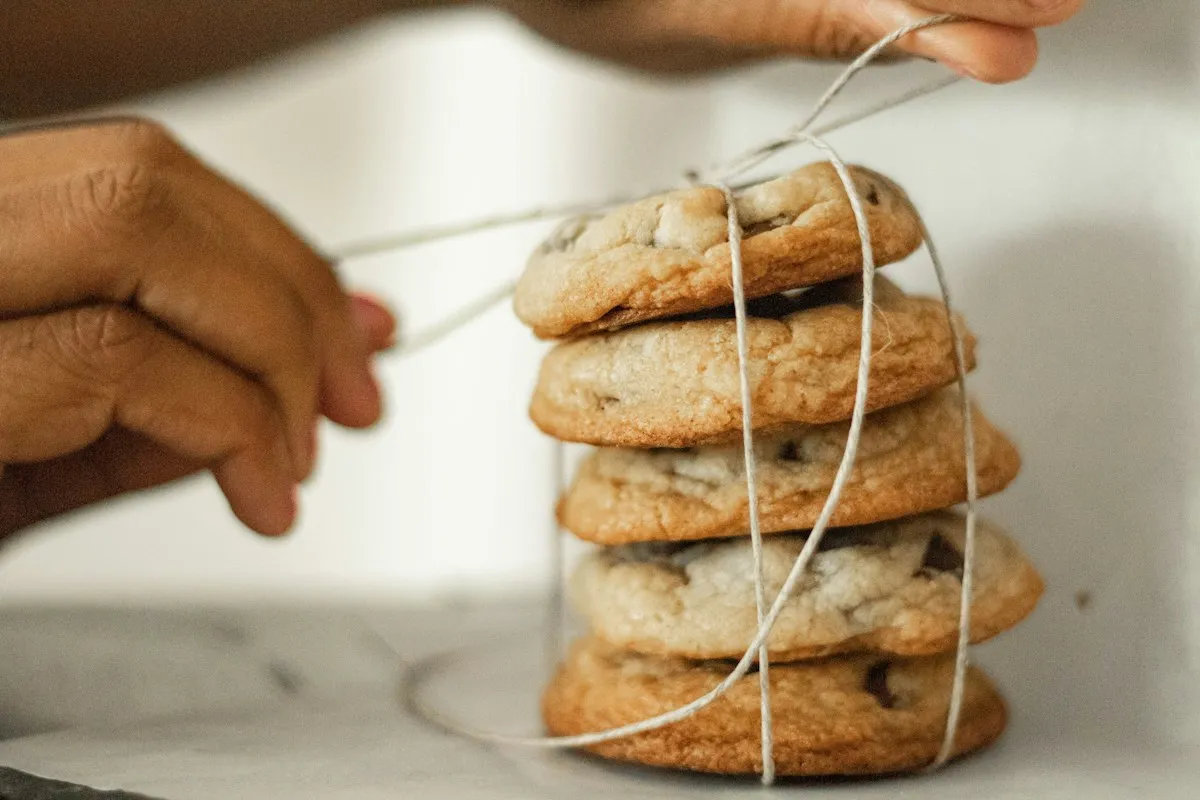
It's 5:40 on a dark December morning, and the whole house smells of molasses and slightly scorched sugar, because the fourth tray of gingersnaps stayed in a minute too long while you were piping snowflakes. Flat white boxes lean against the pantry door. Ninety-six pecan snowballs are cooling on the dining table, and the dog has taken up a position of hope underneath it.
You sold these boxes at $30, because $30 sounded like a lot of money for cookies. Somewhere around batch eleven, you start doing the division in your head. The great news is that if you're reading this before your order form goes live, none of that has happened yet, and fixing it takes one afternoon and a calculator.
The short version: to price a Christmas cookie box, cost every cookie per piece, add the packaging and the hours for a whole order run, then divide the total per box by one minus your margin. Price each box size separately, and cap orders where your batches come out even. In the worked example below, a 24-piece box of six kinds costs $33.64 to make and sells at $48.
Three composite bakers will walk the calendar with you. Marisol, Bea and Theo aren't real people, and every figure here is illustrative, so swap in your own. Another baker's price is built on her butter, her hours and her margin, which is why this post gives you a method and not a price list. The dates below are a suggested order. If you're already past them, do it all in one sitting before your form opens.
First week of November: cost every cookie in the box
Marisol's box holds 24 cookies: four each of six kinds. Each kind gets its own line, because a Christmas cookie box is really six small products sharing one lid. Count what a batch actually yields, too. The misshapen snowball you ate at the counter was a cost, delicious as it was.
| Cookie | Batch ingredient cost | Pieces per batch | Cost per piece | Four in the box |
|---|---|---|---|---|
| Shortbread | $9.60 | 48 | $0.20 | $0.80 |
| Gingersnaps | $7.20 | 48 | $0.15 | $0.60 |
| Chocolate crinkles | $11.52 | 48 | $0.24 | $0.96 |
| Jam thumbprints | $10.56 | 48 | $0.22 | $0.88 |
| Pecan snowballs | $14.40 | 48 | $0.30 | $1.20 |
| Decorated sugar cookies | $11.52 | 24 | $0.48 | $1.92 |
| Total for one box | $6.36 |
That $6.36 is the number you'll be tempted to triple. Tripling gives $19.08, and you're about to see why that price doesn't even pay for the time.
Six recipes feeding one box is where a spreadsheet starts to creak, and it's a good fit for recipes built from other recipes in Ardent Seller. Each cookie gets its own recipe, with its baking and decorating time as labor steps at your hourly rate, and the box gets a recipe made of four of each cookie plus its packaging and packing time. Enter what you paid for your ingredients and packaging, then record and complete a production run of each cookie (one batch you actually baked will do). That run gives the cookie a cost the box recipe can read. Costs follow in order, not by magic: when butter goes up, your next completed purchase moves butter's average cost, each cookie's own cost moves at its next completed production run, and the box follows from there. Your selling price stays put until you change it.
Same week: add packaging and your hours
Now for the two lines that a ball of cookie dough never mentions.
Packaging. Lay out one finished box on the counter and price everything that leaves the house with it:
- Box with a window: $1.60
- Glassine liner: $0.30
- 24 mini paper cups at $0.03: $0.72
- Ribbon: $0.35
- Ingredient label and a seal: $0.25
That's $3.22 per box, more than half the cost of the cookies. The little paper cups alone cost more than the gingersnaps.
Hours. Don't estimate one box, because nobody bakes one box. Estimate a whole run at the number of boxes you realistically expect to sell, using your own minutes per batch and per decorated cookie from a recent bake. Marisol expects to sell 24, so she needs 96 of each cookie, which means two batches each of the five 48-count cookies and four batches of the sugar cookies:
- 14 batches at an hour each, from mixing through cooling: 14 hours
- Decorating 96 sugar cookies at 2 minutes each: 3.2 hours
- Planning and shopping: 1.5 hours
- Packing 24 boxes at 6 minutes each: 2.4 hours
- Order messages and pickups: 2 hours
That's 23.1 hours. At $25 an hour, it comes to $577.50, or $24.06 per box. If you're unsure what rate to use, pick the one you'd actually accept for a December of early mornings, not the one that makes the price feel polite.
Second week: set the price per box
Here's where it all comes together, and it's the satisfying part.
| Cost | Per box | Share of cost |
|---|---|---|
| Ingredients | $6.36 | 18.9% |
| Packaging | $3.22 | 9.6% |
| Labor (23.1 hours at $25, across 24 boxes) | $24.06 | 71.5% |
| Total cost | $33.64 | 100% |
Marisol wants a 30% margin, meaning 30% of the price is left after costs. That's different from a 30% markup, and margin vs markup clears up the difference quickly. The price is cost ÷ (1 − 0.30):
- $33.64 ÷ 0.70 = $48.06
- She rounds to $48 a box, a margin of just under 30%
Case study: Marisol's $30 box
Before. Marisol charged $30 last December. Across 24 boxes that's $720. Take out $229.92 for ingredients and packaging (24 × $9.58), and $490.08 is left for 23.1 hours: $21.22 an hour, with no margin at all. It felt fine right up until she worked it out.
The change. She ran the numbers above and moved the same box to $48.
After. If she sells the same 24 boxes, revenue is $1,152. After $229.92 in ingredients and packaging and $577.50 to pay herself $25 an hour, $344.58 is left for the business. Whether every customer follows her to $48 is a fair worry. If $48 won't sell in her market, she doesn't shave the price by feel. She cuts the labor, as Bea does below, or offers a smaller size, and lets the same math set that price.
Also that week: price each box size and the decorated option
Building a menu of box sizes is the fun part. The trap is assuming that a smaller box is proportionally cheaper.
Marisol's 12-piece box holds two of each kind, so its ingredients are exactly half: $3.18. Packaging doesn't halve. A smaller box still costs $1.20, its liner $0.20, its 12 cups $0.36, and the ribbon, label and seal are unchanged, for $2.36. Labor doesn't halve either. For 24 small boxes she estimates 13.7 hours, because planning and pickups stay the same. That's seven batches, 1.6 hours of decorating, 1.5 hours of planning, 1.6 hours of packing at 4 minutes a box and 2 hours of pickups. At $25 an hour across 24 boxes, that's $14.27 per box.
| Line | 24-piece box | 12-piece box |
|---|---|---|
| Ingredients | $6.36 | $3.18 |
| Packaging | $3.22 | $2.36 |
| Labor per box | $24.06 | $14.27 |
| Total cost | $33.64 | $19.81 |
| Price | $48 | $29 |
| Margin | About 30% | About 32% |
For the 12-piece box, $19.81 ÷ 0.70 is $28.30, which Marisol rounds up to $29. At half of $48, or $24, the small box's margin drops to about 17.5%.
Case study: Bea's decorated-cookie question
Before. Bea bakes the same box as Marisol and couldn't decide whether the sugar cookies were worth it. They were the part customers photographed, and also the part that kept her up past midnight.
The change. She costed a second version, swapping the decorated cookies for a sixth plain cookie at $0.20 a piece. Ingredients fall to $5.24. Two fewer batches and no decorating take the run down to 17.9 hours, or $18.65 per box. With the same $3.22 of packaging, the box costs $27.11, and $27.11 ÷ 0.70 prices it at $39.
After. Now she knows the decorated cookies add about $9 to the box's price, or roughly $2.25 each over a plain cookie, and most of the extra cost is time rather than ingredients. So she stopped agonizing and sold both: the Classic Box at $39 and the Decorated Box at $48. A customer who wants the snowflakes pays for the snowflakes.
If your boxes overlap with gift sets you already sell, how to price gift sets and bundles covers when a bundle discount makes sense. On a seasonal box built to order, there's usually no set of singles to discount against, so don't feel you owe one.
Mid-November: cap orders where your batches come out even
It's easy to set an order cap by gut feeling. Yours can come from arithmetic, and this one tends to feel like finding money in a coat pocket.
Divide each batch yield by the pieces of that cookie in a box. With four of each in a box, a batch of 48 fills 12 boxes, and a sugar cookie batch of 24 fills 6 boxes. Your clean stopping points are the numbers all of those results divide into evenly: 12, 24, 36. If your recipes don't line up that neatly, or the next stopping point is past what your calendar allows, take the nearest cap your calendar does allow and accept some extras of whichever cookies don't come out even. Selling two sizes? Count two 12-piece boxes as one 24-piece box when you check the batches.
Case study: Theo's cap at 30
Before. Theo bakes the same box, and capped orders at 30 because it sounded manageable. Thirty boxes need 120 of each cookie. That's three full batches of each 48-count cookie, or 144 pieces, leaving 24 extras of all five kinds.
The change. He checked what six more boxes would take. The five 48-count cookies were already baked in the 30-box plan. The only new work was one more sugar cookie batch (1 hour), decorating 24 more cookies (0.8 hours) and packing six more boxes (0.6 hours).
After. Those last six boxes add $11.52 in sugar cookie ingredients, $19.32 in packaging and $60 of labor, or $90.84 in new costs against $288 in sales. If they all sell, that's $197.16 more, before a few extra pickups, from raising the cap from 30 to 36.
There's one more limit, and it outranks the arithmetic: your calendar. Marisol's 24 boxes take 23.1 hours. Count the evenings you really have, subtract the school concert you'll pretend you forgot about, and cap at the stopping point that fits. A waitlist for anyone past your cap costs you nothing. If your cap lands far from the run you priced, redo the hours: at 12 boxes, with planning and pickups held at 3.5 hours, Marisol's run takes 13.3 hours and $48 earns about 22%, not 30%. If you take money before baking, how to take preorders covers what you owe a customer if a date slips.
Before the order form opens: check the label and the sales cap
Two checks take a few minutes now and are very hard to fix mid-December. Start with your state's page in the cottage food law hub, since states set their own rules on what you can sell, where and how.
The label. Plan for a label that covers every recipe inside, and check how your state wants an assortment listed. Allergens need particular care: FDA names nine major food allergens (opens in new tab), and says the specific type of tree nut must be declared. So Marisol's snowballs mean naming pecans on the box, and one nutty cookie among six means the whole box needs that declaration. If you swap a cookie mid-season, the label changes with it.
The sales cap. Each state sets its own rules on cottage food revenue, and where a cap applies, a good December can use up a lot of what's left in a single month. Before you raise your order limit, check where the year stands with the free Cottage Food Revenue Cap Tracker. While you're on your state's page, confirm its rules on shipping and venues too, especially before you promise a box to an aunt two states away.
After the last pickup: compare your numbers with what happened
Here's the small habit that makes next year so much easier. While December is still fresh, write down what really happened: how many hours the run took, how many cookies never made it into a box, and which size sold out first. Marisol's 23.1 hours was an estimate in November. After pickup day, it's a fact, and her next price starts from it.
Then ask the only pricing question that matters: did the boxes pay you what you decided they should? If 23.1 hours became 30, your margin went with them, and next year's price or next year's menu needs to change.
All of this took a calculator and one afternoon, and you only want to do it once. Set up each cookie as a recipe and the box as a recipe built from them, and next November you start from the costs your own production runs recorded rather than a blank page. Create a free Ardent Seller account and cost your first cookie box before the order form goes live.
Related reading
- How to Price a Dessert Table Per Guest — when the inquiry is for 60 guests rather than 24 boxes, the unit changes to the guest, with an overage and a display to pay for.
- How to Price Gift Sets and Bundles — the discount math for sets built from products you also sell individually.
- How to Take Preorders for Handmade Products — what taking December's money in November commits you to.
- Holiday Production Calendar: A Q4 Plan for Makers — how to back-schedule the season once your order cap is set.
- Recipe Costing 101 — how to get each cookie's per-piece cost right, including yield loss.
Free resources
A few free tools for putting real numbers on your own box:
- Maker Hourly-Rate Pricing Calculator — labor was about 72% of the cost in the worked example, so the rate you choose moves the price more than any ingredient.
- Recipe Scaling & Batch Calculator — turn 96 of each cookie into whole batches, ingredient quantities and a batch cost for your shopping list.
- Home Baker's Order & Delivery Tracker — keep every box order, pickup time and payment in one place once the form goes live.
This article is provided for educational purposes only and does not constitute legal, regulatory, financial, or tax advice. Costs, pricing examples, cottage food laws, and allergen labeling requirements vary by jurisdiction and change frequently. Consult a qualified accountant, your state agriculture or health department, or an attorney before making financial or compliance decisions based on this content.