
You have almost certainly sold something that did not exist yet.
A holiday batch opened for orders in October because you needed the cash to buy October's supplies. A restock that went better than expected, so you took eleven orders for a thing you had six of. A custom piece you said yes to, took a deposit on, and only afterward did the arithmetic on how many Saturdays that actually was. That is not a failure of character — it is what happens when demand and capacity refuse to arrive on the same day.
The problem is that the three ways of handling it — preorder, waitlist, backorder — look interchangeable and are not. One of them starts a federal shipping clock the moment money changes hands, one of them starts nothing at all, and one of them is the first one wearing a disguise. Pick the wrong one and you have not made a marketing mistake; you have made a promise with a deadline and a refund attached to it.
Here is how to tell them apart, what you owe once the clock is running, and how to set your shop up so you can see at a glance what you have actually committed to.
Preorder, waitlist, or backorder: the difference is who is holding the money
Start with the distinction that decides everything downstream. It is not whether the item exists. It is whether you have taken payment.
| Method | What the buyer gives you | What exists | What you owe |
|---|---|---|---|
| Waitlist | A name and an email | An interest list | Nothing. No order has been placed. |
| Preorder | Payment for a specific item | An order with a ship-by date | Shipment by the stated date, or a delay notice and possibly a refund |
| Backorder | Payment for something you listed as available | An order you cannot currently fill | The same as a preorder — the obligation started when they paid |
A backorder is not a fourth category. It is a preorder you did not intend to take. The customer bought a candle they had every reason to believe was on your shelf; the fact that you have discovered otherwise changes your inventory, not your obligation.
The federal rule that governs all of this is the FTC's Mail, Internet, or Telephone Order Merchandise Rule — 16 CFR Part 435 (opens in new tab), which direct marketers call the 30-day rule. The FTC's own business guide describes its scope in one sentence: it "applies to most goods a customer orders from the seller by mail, telephone, fax, or on the Internet," and "it does not matter how the merchandise is advertised, how the customer pays, or who initiates the contact" (FTC business guide to the rule (opens in new tab)).
Two shapes fall outside it, and both are what a waitlist can safely become. A sale on approval — the customer receives the goods and pays only after deciding to keep them — is not covered, because the order was never prepaid and so was never a "properly completed order." Neither is a plain bill-me arrangement where you ship with an invoice payable on receipt. The FTC guide notes you can still be liable under the FTC Act's general prohibition on unfair or deceptive practices if you are unreasonably slow (FTC business guide (opens in new tab)), but the clock and notice machinery of Part 435 never starts.
The clock you start the moment the money lands
Most makers who get caught out by this rule are not being cavalier. They simply have the wrong mental model of when the countdown begins.
"A properly completed order" is a payment, not a shipment
The rule's clock starts at "receipt of a properly completed order," which 16 CFR 435.1(c) (opens in new tab) defines as the time you receive both the payment and "all of the information needed by the seller to process and ship the order." The FTC business guide (opens in new tab) adds the part that surprises people: "It is irrelevant when you post or deposit payment, when checks clear, or when your bank credits your account."
So the clock does not start when the payout hits your bank. It starts when the buyer checks out. On a Sunday-night restock, that is Sunday night — not Tuesday, when the platform settles.
One useful corollary: if a customer's check bounces or they are refused credit, the clock stops and resets to day one when the payment is finally honored. And if you are still missing something you genuinely need to fill the order — a monogram spelling, a color choice — the order is not yet properly completed. That is not a loophole to lean on. It is a reason to ask the question at checkout rather than three days later in a DM.
The disclosure that buys you more than 30 days
Here is the good news, and it is the single most useful sentence in the rule for anyone doing made-to-order work.
The 30 days is a fallback, not a ceiling. The rule says a seller must have a reasonable basis to expect shipment "within that time clearly and conspicuously stated in any such solicitation," and only "if no time is clearly and conspicuously stated, within thirty (30) days after receipt of a properly completed order" (16 CFR 435.2(a)(1) (opens in new tab)).
A fourteen-week lead time on a bespoke saddle is entirely compliant if you say fourteen weeks, up front, where the buyer will see it before paying. What is not compliant is saying nothing and hoping, or stating a time you have no reasonable basis to believe you can hit. And note that the FTC treats updated information given during checkout as superseding whatever your advertising said (FTC business guide (opens in new tab)) — so a listing that promises two weeks and a checkout note that says eight is measured against the eight.
Two things sharpen the "reasonable basis" test in practice:
- Speed claims are held to their own words. The FTC business guide (opens in new tab) addresses a merchant who says "we ship in 48 hours most of the time" and answers that reasonable consumers will infer their order ships in 48 hours. Hedged language does not create a hedge. The same is true of "usually ships within a week."
- You bear the burden of proof. Under 16 CFR 435.2(a)(4) (opens in new tab), a seller who cannot produce records showing systems and procedures that assure shipment within the applicable time faces a rebuttable presumption that it never had a reasonable basis. There is no recordkeeping requirement in the rule — but there is a presumption against you if you have no records.
Sidebar — the 50-day version is not about credit cards. The rule allows 50 days rather than 30 when the buyer applies to you for credit to pay for the merchandise (16 CFR 435.2(a)(1)(ii) (opens in new tab)). That means an in-house account you extend, not a Visa. Paying by card is a third-party credit sale, and the ordinary 30-day fallback applies.
There is no handmade exemption
This is where a lot of maker-facing advice quietly goes wrong, usually by implying that custom work sits outside consumer-protection rules written for catalog retailers. Read the exemption list yourself; it is four items long. 16 CFR 435.3(a) (opens in new tab) excludes serial subscriptions after the initial shipment, orders of seeds and growing plants, C.O.D. orders, and transactions governed by the FTC's prenotification negative option rule.
Nothing about handmade. Nothing about made-to-order. Nothing about business size.
The rule also sets a floor rather than a ceiling: it does not preempt state or local law that gives buyers rights "equal to or greater than" the federal ones (16 CFR 435.3(b)(1) (opens in new tab)). Some states regulate deposits and layaway-style arrangements independently, so a compliant federal posture is the start of the analysis in your state, not the end of it.
Violations carry civil penalties of up to $53,088 each (FTC business guide (opens in new tab)). That is the figure the codified penalty table sets for breaking a trade regulation rule like this one (16 CFR 1.98(d) (opens in new tab)); it reflects the January 2025 inflation adjustment and is restated annually, so check it before relying on it. Note the "up to" — it is a ceiling per violation, not a typical outcome for a shop with nine open preorders. But the number explains why every large retailer's backorder email reads the way it does, and those emails are a free template.
What you owe the day you know you will be late
The obligation is not "ship on time or else." It is a specific, sequenced set of notices, and the sequence has a shape worth learning once.
The moment you realize you cannot make the date, you owe the buyer a choice: consent to the delay, or cancel and get a prompt refund. The offer has to be made "clearly and conspicuously and without prior demand" — meaning you send it unprompted, not after the customer chases you — within a reasonable time of discovering the problem and in no event later than the original shipping deadline (16 CFR 435.2(b)(1) (opens in new tab)).
The first delay notice, and what silence means
Every first delay notice needs three things: a definite revised shipping date (or a statement that you cannot provide one, plus the reason for the delay), a plain statement that the buyer can cancel for a full and prompt refund, and a means of canceling at your expense. Email is explicitly acceptable. Posting it on an order-status page the buyer has to go and find is not — the FTC business guide (opens in new tab) is direct that a notice the customer may never see does not satisfy the requirement.
Then the branch that decides everything:
- Revised date 30 days or less past the original. You may tell the buyer that if you do not hear from them, you will assume consent. Silence works in your favor.
- Revised date more than 30 days out, or no date at all. Silence works against you. The order is canceled automatically unless you have shipped within 30 days of the original date, or received the buyer's express consent within that window.
A notice in the second shape reads roughly like this:
Your order has not shipped. The kiln element failed during the second firing and the replacement part is on back order from the supplier, so we cannot give you a firm ship date yet.
If you would rather not wait, reply to this email or use the cancel link below and we will refund you in full, including shipping, within seven working days.
If we have not shipped and we have not heard from you by 14 October, your order will be canceled automatically and refunded. If you would like us to keep the order and fill it later, tell us — and you can still cancel at any time before we ship.
That is not a customer-service flourish. Every clause in it is doing regulatory work, and the explanation of why you are late is required specifically when you cannot give a definite date, in enough detail that the buyer can judge how long the wait might be (FTC business guide (opens in new tab)).
If you want a set of these written out and ready to adapt rather than composing one at 11pm on the day the deadline lands, the Customer Service Response Starter is worth keeping open in another tab.
The second notice, where silence stops helping
If you miss the revised date too, you owe a renewed delay notice — and this one changes the default. Under 16 CFR 435.2(b)(2) (opens in new tab), the renewed notice must tell the buyer that unless you receive their affirmative consent to the further delay, the order is treated as canceled. A customer who ignores your second email has, in law, said no.
That asymmetry is deliberate, and it is the practical reason to be conservative with the first revised date. A date you can actually hit converts silence into consent. An optimistic one converts it into a cancellation.
Refunds have a clock of their own
When a refund is owed, 16 CFR 435.1(b) (opens in new tab) sets the timing: seven working days for payment by cash, check, money order, or third-party credit, and one billing cycle where you yourself are the creditor. For the overwhelming majority of makers taking card payments through a marketplace or a checkout, seven working days is the number.
Three details catch people out:
- The refund includes everything tendered — shipping, handling, insurance, the lot. Not just the item price.
- Store credit does not count. The FTC business guide (opens in new tab) states you cannot substitute credit toward future purchases, credit vouchers, or scrip for a rule-required refund.
- You cannot swap in something similar. For a backordered item, the rule offers exactly two paths — consent to delay, or refund — and substituting materially different merchandise requires the buyer's express agreement beforehand. Design, style, color, fabric, and promoted end use are all named as material differences (FTC business guide (opens in new tab)). The "I sent the blue one instead, it's nicer anyway" reflex is the wrong reflex.
Three shops, three right answers
The rules are the same for everyone. The correct mechanism is not. Rosa, Theo, and Imani below are composite examples — not real Ardent Seller customers — assembled to show how one rule lands differently depending on how you produce.
Rosa runs a cottage bakery and opens holiday pie orders on 1 November. She takes payment at booking for pickup on 22 and 23 December — seven weeks out. That is unambiguously a preorder, and a compliant one: the pickup date is the shipping representation, it is stated on the order form before payment, and she has three prior seasons of records establishing she can produce that volume.
Her actual risk is not the FTC. It is that her order book lives across an Instagram thread, a notebook, and her phone's photo roll. She cannot answer "how many pumpkin have I sold" without twenty minutes of forensics — so when she oversells 22 December by nine pies, she will discover it on 20 December.
Theo makes custom leather bags with a fourteen-week backlog. He should not be taking preorders at all, and for a while he was — a deposit at inquiry, a vague "sometime in the spring." Every one of those deposits was a properly completed order with an unstated ship date, which means the federal fallback of 30 days applied to work that takes fourteen weeks. He was in breach of a rule he had never heard of, on every order, from day one.
The fix was not a better spreadsheet. It was to stop taking money at inquiry: an open waitlist collects the name, the brief, and nothing else, and he invoices only when the hide is cut and the piece is genuinely four weeks out — a date he can state and hit.
Imani sells candles and posts a restock at 8pm on a Sunday. She listed 40 jars of one scent because that is what the last pour yielded, and sold 52 in eleven minutes because two listings shared a wax base she had already committed elsewhere. The twelve unfilled orders are backorders.
She has until the ship-by date on those orders to send a delay notice with a definite revised date — and because her next pour is nine days out, she can name a date under 30 days and treat silence as consent. Handled that way it is a footnote. Handled by going quiet for three weeks, it is twelve refund obligations and a row of one-star reviews explaining why.
Notice what separates them. Rosa's problem is visibility. Theo's was structural — the wrong instrument entirely. Imani's is speed of response. Only one of the three is solved by writing a better policy page.
Choosing yours: five questions, in order
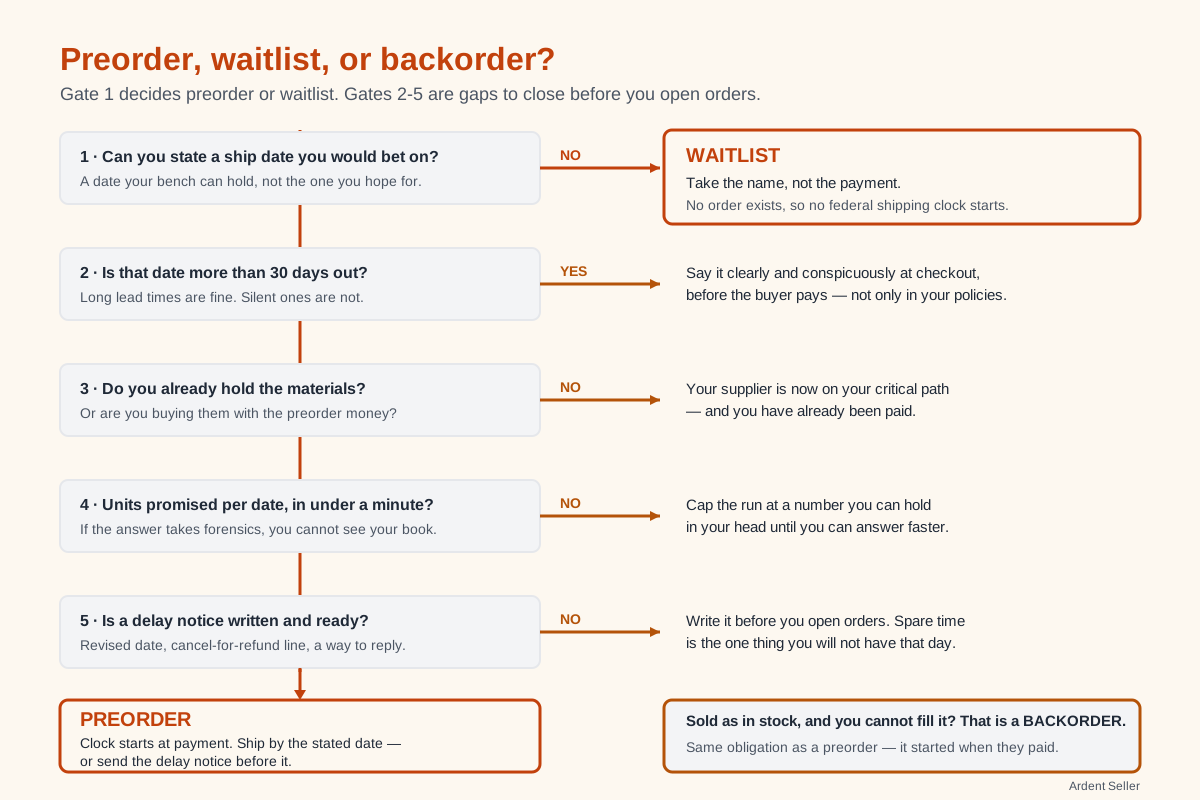
Work down the list in order. A no at question 1 means you do not have a preorder at all — stop there and run a waitlist instead. A no anywhere else is a gap to close before you open orders, not an exit. And if you have already sold something you cannot fill, you are past this list: that is a backorder, and the obligations are in what you owe the day you know you will be late.
- Can you state a date you would bet money on? If no, you do not have a preorder — you have a waitlist. Take the name, not the payment.
- Is that date more than 30 days out? If yes, that is fine, but it must appear clearly and conspicuously at the point of sale, before checkout, not only in your policies.
- Do you already hold the materials, or are you buying them with the preorder money? Preorders that fund their own supplies are a real and legitimate cash-flow tool. They are also the ones that fail, because the supplier is now on your critical path and you have already been paid. If you are buying in, quote your supplier's worst lead time rather than their usual one — their schedule is now your promise.
- Do you know today how many units you have promised, per date? If answering takes more than a minute, cap the preorder at a number you can hold in your head until you can answer it faster.
- Do you have a delay notice ready to send? If not, write it before you open orders. The one thing you will not have when you need it is spare time.
Setting your shop up so you can see what you have promised
Every failure above is, underneath, the same failure: the shop could not see its own commitments in one place. Sales channels are built to tell you what sold. They are not built to tell you what you owe, by date, against what you can actually produce.
Six fields per committed order will carry you a long way, and none of them require software to start:
- Date payment was received (the clock start, not the payout date)
- The ship-by or pickup date you stated to the buyer
- Units and variant committed
- Materials reserved versus materials still to buy
- Revised date, if a delay notice has gone out
- Consent status: awaiting response, silent-consent applies, expressly consented, or canceled
The last one is the field nobody keeps and everybody needs, because it is the difference between an order you may still ship and one that has already been canceled by operation of the rule.
A committed preorder is a different animal from stock on a shelf: a claim on materials you may not have bought, on hours you have not worked, dated to a day you promised in writing. Tracking it in the same place you track finished inventory is how nine oversold pies happen. Ardent Seller exists for this shape of problem — knowing what is on hand, what is committed, and what a run will consume before you agree to the date rather than after. If you would rather stay on paper, the Small-Batch Production Planning Playbook covers the sizing math without any of it.
Whatever you use, the test is the same one Rosa failed in December: if a customer emails asking whether their order is still on track, how long does it take you to know?
Open orders honestly, state a date you believe, and write the awkward email early. The rule, read plainly, asks for very little that a decent shop would not do anyway — it just removes the option of going quiet.
Start tracking committed orders alongside your stock — free.
Related reading
- How to Validate a Handmade Product Idea — a preorder assumes the demand is already there. This is the small-batch test that finds out first, and the point at which taking money rather than names turns the question into the rule above.
- How Much Deposit to Charge for Custom Orders — the rule above governs the date; this one governs the money, including why a "non-refundable" deposit is capped at $500 by default unless your terms liquidate the damages.
- Handmade Shop Policies Template — where your stated processing and shipping times actually need to live so a buyer sees them before checkout, not after.
- Holiday Production Calendar: A Q4 Plan for Makers — how to back-schedule a season's committed orders so the ship-by dates you promise are ones your bench can hold.
- Cash Flow for Seasonal Sellers — the slow-month problem preorders are usually being asked to solve, and the safer ways to solve it.
- Patreon for a Handmade Business — when the money that arrives up front is a membership rather than an order: what the platform takes, and why the rule above still covers the first physical item a member receives.
Free resources
Two free downloads from the Ardent Workshop library if you want to put this into practice today:
- Home Baker's Order & Delivery Tracker — an order book with deposit, balance, status and a production calendar that back-schedules from each promised date, which is most of the six-field list above already built.
- Small-Batch Production Planning Playbook — the batch-sizing math for deciding how many preorders a run can actually absorb before you open them.
This article is provided for educational purposes only and does not constitute legal, tax, or accounting advice. Consumer-protection rules, disclosure requirements, deposit and layaway restrictions, and state contract law vary by jurisdiction and change frequently. Consult a qualified attorney or small-business advisor before making decisions that affect your business.