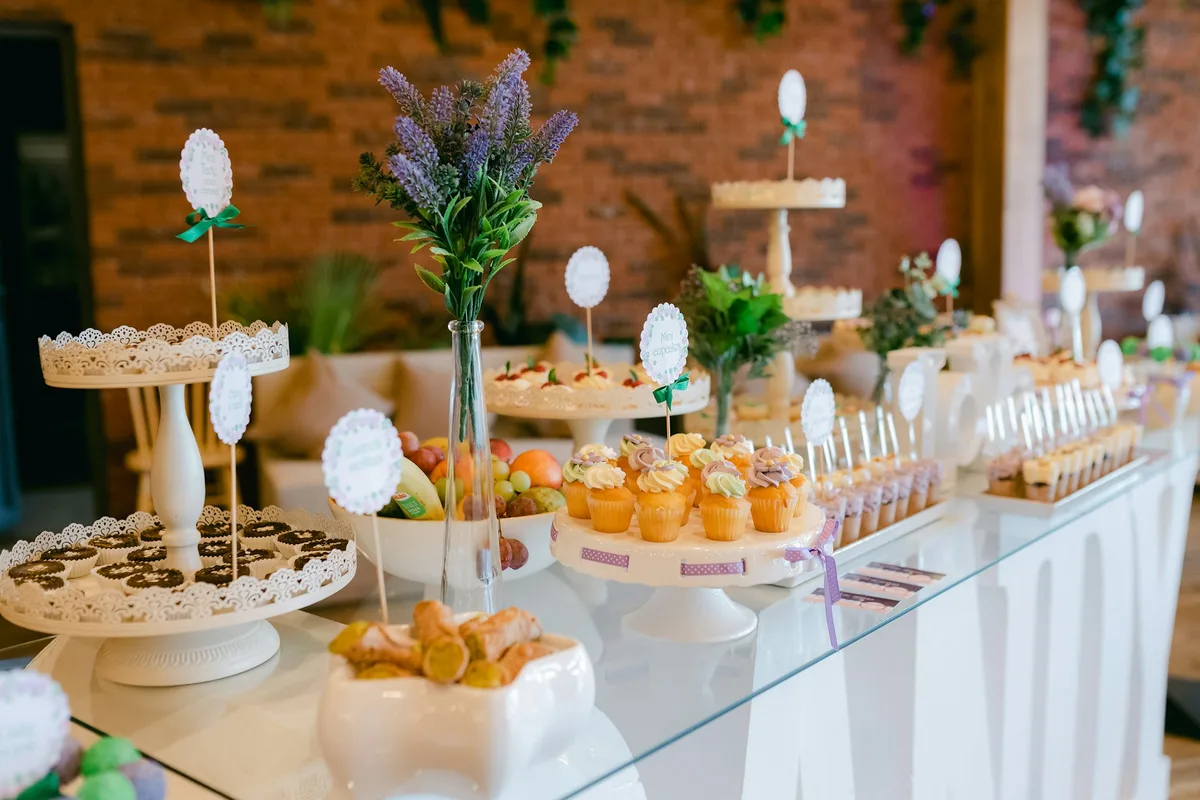
Four o'clock, and the kitchen smells like browned butter and powdered sugar. Sixty-six sugar cookies are drying in rows across every flat surface you own, each one wearing a tiny piped monogram. The brownie bites are cut. The mini cupcakes are waiting on their swirls. Your phone buzzes on the counter, and it's another inquiry: "Hi! How much for a dessert table for about 60 people?"
That question is the reason you're here, and the good news is it has a real answer. Not a guess, not "about what the other baker charges," but a per-guest number you can defend line by line. It takes five steps, and the fourth is the easiest one to skip.
The short version: decide how many pieces each guest gets, cost each treat per piece, build one guest's plate, add an overage and the cost of the display, then add your labor and set your margin. Quote it per guest, with a minimum. In the worked example below, a 60-guest table costs about $7.05 per guest to make and is quoted at $10.50.
We'll follow one baker the whole way through. Call her Jo. She's a composite, not a real person, but her kitchen will look familiar: a home bakery working under a cottage food permit, mostly cookie boxes and birthday cupcakes, with dessert tables starting to show up in her inbox.
Step 1: Decide how many dessert pieces each guest gets
Everything downstream multiplies off this number, so choose it on purpose.
There's no official pieces-per-guest figure. What matters is that you pick one, write it into your quote, and check it against what comes home after every event. Two things move it:
- Is there a cake too? If the dessert table is dessert, guests take more. If it sits next to a wedding cake, they take less.
- What kind of event is it? A dessert reception after a ceremony is different from a table at the back of a three-hour party where people graze.
Jo uses four pieces per guest when the table replaces the cake. That's her working assumption, not a law of nature, and she adjusts it after each event based on what's left over. Her inquiry says no cake, so four it is: one of each treat on her menu.
Step 2: Cost each treat per piece
This is ordinary recipe costing: total ingredient cost for a batch, divided by the pieces the batch actually yields. "Actually" is doing a lot of work there. Count the brownie bites you can sell, not the ones the recipe card promises, because the edges you trim off and eat standing at the counter are a cost, not a snack. (Fine, they're a little bit of a snack.)
Jo's four treats, with illustrative costs for her ingredients and yields:
| Treat | Batch ingredient cost | Pieces per batch | Cost per piece |
|---|---|---|---|
| Brownie bites | $10.56 | 48 | $0.22 |
| Mini chocolate chip cookies | $9.60 | 48 | $0.20 |
| Mini cupcakes with buttercream | $11.52 | 48 | $0.24 |
| Decorated sugar cookies (royal icing) | $11.52 | 24 | $0.48 |
The sugar cookie costs twice as much as anything else per piece, and as you'll see in Step 5, its real cost is in the decorating time, not the flour. If Recipe Costing 101 is new to you, start there. Everything below assumes these per-piece numbers are honest.
Step 3: Build one guest's plate
Now stack the pieces one guest gets. Jo's guests get one of each treat, so a single plate looks like this:
Worked example 1: cost of one guest's plate
- Brownie bite: $0.22
- Mini cookie: $0.20
- Mini cupcake: $0.24
- Decorated sugar cookie: $0.48
That's $1.14 in ingredients per guest. It's the number you'll be tempted to triple and quote. Resist. It leaves out the overage, the table, and every hour you spend making it.
A dessert table plate is really a bundle: one product made from several others. In Ardent Seller, you can build the plate as a recipe made from your treat recipes. Its cost rolls up from theirs, so when butter goes up and the brownie bite becomes $0.25, the plate's cost changes without you redoing the math. Scale the plate recipe to your guest count, overage included, and it tells you how many of each treat you need; divide by each recipe's yield and round up for the number of batches.
Step 4: Add the overage and the cost of the dessert table display
This is the step that gets skipped. A dessert table has two costs a cookie box doesn't.
The overage. If you bring exactly four pieces for every guest, the last people in line find a picked-over table with one lonely brownie. Jo adds 10%, rounded up to whole pieces of each treat. For 60 guests that's 60 × 4 × 1.10 = 264 pieces, or 66 of each treat. At $1.14 per set of four, ingredients come to 66 × $1.14 = $75.24, which is about $1.25 per guest, not $1.14.
Jo costs ingredients by the piece, which assumes the leftover pieces from a full batch get used elsewhere: a tasting box, the freezer, the next order. If your extras go to waste, cost the full batches you bake instead.
The table. The display is part of what the client is buying. Jo's per-event table costs:
- Stands and trays she owns: $240 worth, which she expects to last about 30 events. That's $8 per event.
- Linen laundering: $12
- Doilies, food labels and a small sign: $6
- To-go boxes for leftovers: 20 boxes at $0.45, so $9
That's $35 per event, whatever the guest count. Spread over 60 guests, it's about $0.58 each. Spread over 25, it's $1.40. Keep that in mind for later.
Rule of thumb: a cost that stays the same whatever the guest count is why small tables need a minimum. You can't spread $35 thinly over 20 people.
Step 5: Add labor, then set the price
Here's the step that changes everything. Jo times one 60-guest table honestly, from the shopping trip to the last empty tray back in the car (drive time goes on its own line, covered below):
- Shopping and prep: 1.5 hours
- Baking all four treats: 5 hours
- Decorating 66 sugar cookies: 3 hours
- Packing: 1 hour
- Setup and teardown at the venue: 2 hours
That's 12.5 hours. At $25 an hour (pick your own rate; the Maker Hourly-Rate Pricing Calculator will help you find one you can actually live on), it comes to $312.50.
Worked example 2: the 60-guest quote
| Cost | Total | Per guest | Share of cost |
|---|---|---|---|
| Ingredients (264 pieces) | $75.24 | $1.25 | 18% |
| Table and display | $35.00 | $0.58 | 8% |
| Labor (12.5 hours at $25) | $312.50 | $5.21 | 74% |
| Total cost | $422.74 | $7.05 | 100% |
Now set the price. Jo wants a 30% margin, meaning 30% of the price is left after costs. That's not the same as a 30% markup, and if the difference is fuzzy, margin vs markup is a ten-minute fix. The price that leaves a 30% margin is cost ÷ (1 − 0.30):
- $422.74 ÷ 0.70 = $603.91, or $10.07 per guest
- Jo rounds up to $10.50 per guest, $630 total, a margin of about 33%
Look at that table again. Labor is almost three-quarters of the cost. The triple-the-ingredients rule would have quoted this table at $1.14 × 3 × 60 = $205.20, about half of what it costs Jo to make. She'd have paid for the privilege of piping 66 monograms.
The same dessert table at 150 and 25 guests
The 60-guest price only holds at 60 guests. Watch what happens when the guest count moves.
Worked example 3: a 150-guest table
A month later Jo gets a 150-guest inquiry. Same menu, same four pieces, same 10% overage:
- Pieces: 150 × 4 × 1.10 = 660, or 165 of each treat
- Ingredients: 165 × $1.14 = $188.10
- Table: her $35, plus $40 to rent extra stands = $75
- Labor: 22 hours (2 shopping and prep, 9.5 baking, 7.5 decorating, 1 packing, 2 setup), so $550
- Total cost: $813.10, or $5.42 per guest
- Price at 30% margin: $813.10 ÷ 0.70 = $1,161.57, or $7.74 per guest. Jo quotes $8 per guest, $1,200 total (about 32% margin)
Per-guest cost dropped by more than $1.60. The oven runs longer but not 2.5 times as long, and even with rented stands the table cost per guest fell. This is why a single per-guest price on your website will be wrong for somebody: too high for the big wedding, too low for the backyard party.
Worked example 4: a 25-guest table, and why you need a minimum
Then a 25-guest baby shower. Same menu, on a shorter table that sets up in half the time:
- Pieces: 25 × 4 × 1.10 = 110, so Jo bakes 28 of each (112 pieces)
- Ingredients: 28 × $1.14 = $31.92
- Table: $35
- Labor: 7 hours (1 shopping, 3 baking, 1.5 decorating, 0.5 packing, 1 setup), so $175
- Total cost: $241.92, or $9.68 per guest
- Price at 30% margin: $241.92 ÷ 0.70 = $345.60. Jo sets $350 as her table minimum (about 31% margin)
A dessert table for 25 at $14 per guest can look odd on a quote. A $350 minimum reads like what it is: a professional pricing structure.
Dessert table cost per guest at 25, 60 and 150 guests
| Line | 25 guests | 60 guests | 150 guests |
|---|---|---|---|
| Ingredients | $31.92 | $75.24 | $188.10 |
| Table and display | $35.00 | $35.00 | $75.00 |
| Labor hours | 7 | 12.5 | 22 |
| Labor at $25 | $175.00 | $312.50 | $550.00 |
| Total cost | $241.92 | $422.74 | $813.10 |
| Cost per guest | $9.68 | $7.05 | $5.42 |
| Quote | $350 ($14 per guest) | $630 ($10.50 per guest) | $1,200 ($8 per guest) |
| Margin | 31% | 33% | 32% |
Turning the math into a dessert table quote
The whole method in one line: price = (ingredient cost + display costs + labor hours × hourly rate) ÷ (1 − margin). In words: add the three costs together, then divide by one minus your margin. For ingredient cost, multiply guests by each treat's pieces per guest and by one plus your overage, round up to whole pieces, multiply by that treat's cost per piece, and add the treats together. Divide the price by guests for the per-guest rate. Delivery goes on its own line.
Jo's quote sheet now has three lines that do all the work:
- A per-guest rate worked out for this event's guest count, not read off a rate card. The three-guest-count table above shows why one rate can't fit every size. Once your treats are costed, running the five steps for a new inquiry takes a few minutes.
- A table minimum of $350, the price of her 25-guest example. No table is quoted below it.
- Delivery as its own line, priced by mileage and drive time. Setup and teardown are already in Jo's labor, so she doesn't charge them twice. (The wedding-cake guide puts setup on the delivery line instead, which works just as well, as long as setup is charged in one place only.) That guide's deposit and cancellation terms for wedding cakes apply to a dessert table unchanged.
One more thing belongs in the quote: what's actually on the menu. Many state cottage food laws cover only foods that don't need refrigeration, so cheesecake bites, cream-filled pastries or curd tarts may be off the table under a home permit, along with some kinds of event delivery. Check your own state's rules in the cottage food law hub before you promise a client a lemon tart.
Notice what Jo didn't do: she didn't look up what another baker charges and knock a dollar off. She knows her number, so she can tell a client exactly why the 25-guest table costs more per head, and she can say yes to the 150-guest wedding knowing it pays.
The worked examples above took a calculator and an afternoon. The next quote shouldn't. Build your treats as recipes, build your per-guest plate from them, and the next time butter goes up, the plate's cost updates with it, so your next quote starts from the current number. Start free with Ardent Seller and cost your first dessert table per guest before the next inquiry lands.
Related reading
- Wedding Cake Pricing & Contracts — per-serving pricing, non-refundable booking fees and the cancellation terms to copy into your dessert-table quote.
- Custom Cake Pricing — the test bakes, dietary swaps and rush fees that also turn up on custom dessert-table orders.
- How to Price Gift Sets and Bundles — a guest's plate is a bundle, and this covers bundle math, including when a discount makes sense.
- Recipe Costing 101 — how to get the per-piece costs in Step 2 right, including yield loss.
Free resources
Free downloads that pick up where the worked examples leave off:
- Maker Hourly-Rate Pricing Calculator — labor was about three-quarters of the cost in the worked example, so the rate you plug into Step 5 can matter more than any ingredient price.
- Recipe Scaling & Batch Calculator — once you've rounded "165 of each treat" up to whole batches (165 ÷ 48 = 3.4, so four batches of brownie bites, with 27 to spare), enter that yield and get every ingredient quantity and the batch cost for the scaled recipe.
- Home Baker's Order & Delivery Tracker — keep the event date, guest count, deposit and delivery address for every dessert-table booking in one place.
This article is provided for educational purposes only and does not constitute financial, tax, or business advice. Cost structures, pricing examples, and margin figures are illustrative and will vary by your specific circumstances. Consult a qualified accountant or small-business advisor before making financial decisions based on this content.