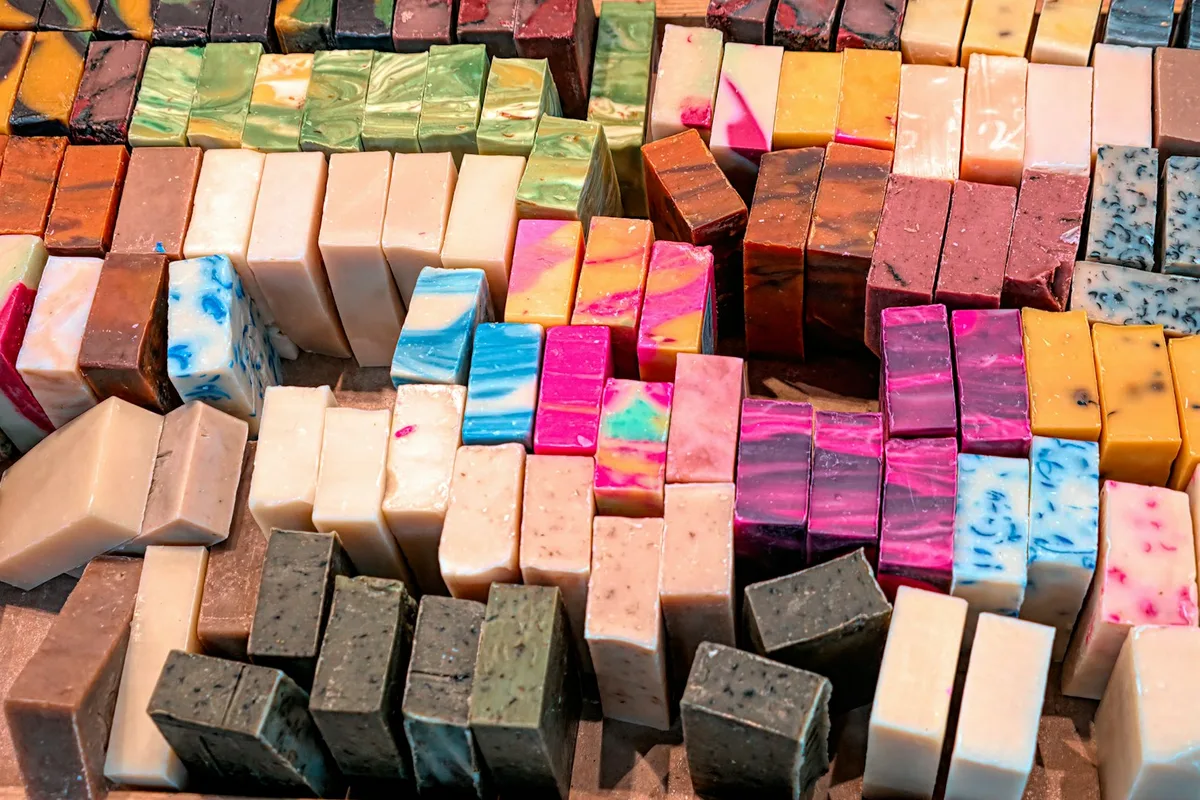
How many bars of soap does your mold make? Not how many the listing promises. How many leave your bench clean, square and close enough in weight to sell at the same price?
That number decides more of your soap business than you'd guess. It sets your batch size, your cost per bar, how often you have to make soap and whether your label weight is honest. And it depends almost entirely on the shape of the box you pour into. So let's pick the box on purpose.
Quick picks:
- Starting out, selling at markets: the Bramble Berry 10-inch silicone loaf (#1). Ten bars, no lining, no fuss.
- Your second mold: the Crafter's Choice Regular Loaf 1501 (#2), so you can pour two scents in a day.
- Making soap every week: the Nurture Handmade 7.5 lb wood mold with a silicone liner (#4). More than twice the soap per pour, in bigger bars.
- Selling custom sizes or wholesale volume: the Nurture Handmade 12 lb slab (#5) and a good cutter.
- Selling shaped or guest-size bars: the Bramble Berry 6 cavity mold (#6), with a heating pad under it.
Loaf, slab or cavity: what the shape decides
Most soap molds sold to makers come in one of three shapes, and each shape makes different choices for you before you've weighed a single oil.
| Factor | Loaf | Slab | Individual cavity |
|---|---|---|---|
| Bars per pour | 8 to 18, cut by hand | Whatever the grid allows | Fixed by the mold |
| Cutting | One cut per bar | Two directions, needs a cutter | None |
| Heat and gel | Holds heat well | Holds heat well | Loses heat fast |
| Bar weight consistency | As even as your cutting | As even as your cutting | Set by the cavity |
| Best for | Most small shops | Volume and custom sizes | Shapes, samples, guest bars |
The heat row is the one beginners skip. Soap Queen's guide to insulating soap (opens in new tab) puts it plainly: "Large slab and loaf molds hold on to heat better than small individual cavity molds." A small cavity of batter cools fast, which invites soda ash on the surface and a partial gel. A partial gel (opens in new tab) leaves the middle of the soap slightly darker than the rest, and Soap Queen notes this "only affects the look of the bars." On a bar you're photographing for a listing, though, looks are most of the job.
The material matters too. Soap Queen's guide to choosing a mold (opens in new tab) says wood molds "insulate the soap well," which "makes it easy to achieve a complete gel phase," but they need lining with freezer paper (not wax paper) and are "prone to overheating." Silicone needs no lining, but soap "does take longer to harden in silicone molds because there is no air in contact with the soap." Some wood molds are sold with a fitted silicone liner, or have one available, which gives you the wood's insulation without the freezer paper.
Six soap molds worth buying, by what you sell
Prices below are as listed on each seller's own page on October 4, 2026, and they move. One thing to watch when you compare them: sellers don't state "capacity" the same way. Nurture Handmade gives its capacity in ounces of oils. Bramble Berry's 10-inch loaf is rated at 50 ounces, which matches the "(50 oz.)" label Soap Queen gives that mold and the total batter in one of its recipes for that mold (opens in new tab) (34.1 ounces of oils plus the lye and water), and the Wholesale Supplies Plus loaf ratings read the same way. An 88-ounce oil capacity is a much bigger mold than an 88-ounce batter capacity, so the table converts every mold to oils.
| Mold | Shape and material | Inside size (inches) | Bars | Oils per batch (oz) | Price |
|---|---|---|---|---|---|
| Bramble Berry 10-inch Silicone Loaf | Loaf, silicone | 10 × 3.375 × 2.5 | 10 | About 34 (est.) | $27.99 |
| Crafter's Choice Regular Loaf 1501 | Loaf, silicone | 8 × 3.5 × 2.5 | 8 | About 28 (est.) | $20.56 on sale |
| Crafter's Choice Tall & Skinny 1505 | Tall loaf, silicone | 8 × 2.5 × 3.5 | 8 | About 28 (est.) | $16.70 on sale |
| Nurture Handmade 7.5 lb Basic | Loaf, wood with silicone liner | 18 × 3.5 × 3.5 | 18 | 88.2 | $74.70 |
| Nurture Handmade 12 lb Slab | Slab, wood with silicone liner | 12.1875 × 8.875 × 3 | Your choice | 129.8 | $85.50 |
| Bramble Berry 6 Cavity Rectangle | Six cavities, silicone | 3.25 × 1.9 × 1.1 each | 6 | About 16 (est.) | $16.99 |
The estimated oil weights use the length × width × depth × 0.40 rule from worked example 1. The Nurture figures are the seller's own.
1. Bramble Berry 10-Inch Silicone Loaf Mold: the starter that pays for itself
The 10-inch Silicone Loaf Mold (opens in new tab) measures 10 by 3.375 by 2.5 inches inside and is listed with a 50-ounce capacity, at $27.99. Slice it at an inch and you get ten bars. Soap Queen's formulating guide (opens in new tab) gives each of its recipes in a 10-inch loaf size, one totaling 34.1 ounces of oils, so those recipes fit it without any resizing.
It needs no lining. The catch is patience: silicone holds soap tight, and the product page itself recommends "1 tsp. of sodium lactate per pound of oils for easy unmolding."
Best for: your first mold, and testing new recipes in a batch small enough to throw away.
2. Crafter's Choice Regular Loaf Silicone Mold 1501: the budget loaf
Sold through Wholesale Supplies Plus, the Regular Loaf 1501 (opens in new tab) has an 8 by 3.5 by 2.5 inch cavity and a 44-ounce capacity, and it "makes eight one-inch slices of soap." It was on sale for $20.56 (regular $25.70) when checked. The page also notes the loaves fit the Crafter's Choice Mitre Box for easier slicing, which matters more than it sounds (see example 3).
Best for: a second or third mold so you can pour two fragrances on the same day.
3. Crafter's Choice Tall & Skinny Loaf Silicone Mold 1505: the boutique bar
The Tall & Skinny 1505 (opens in new tab) has the same 8-inch length but stands the cavity on end: 8 by 2.5 by 3.5 inches, making "eight one-inch bars of soap" from a 40 to 44 ounce loaf. It was $16.70 on sale (regular $20.87). Same volume as the regular loaf, different bar. A tall, narrow bar looks distinct on a market table and stands up in a display box.
Best for: a signature line that needs to look different from everyone else's rectangle.
4. Nurture Handmade 7.5 lb Basic Soap Mold with Silicone Liner: the workhorse
This is the mold for a shop that makes soap every week. The 7.5 lb Basic Soap Mold (opens in new tab) pairs a wood box with an 18 by 3.5 by 3.5 inch silicone liner, rated for 88.2 ounces of oils and "18 - Full 1" Bars." It was $74.70 with the liner included. You get the wood's insulation for an even gel and the liner's no-paper release. There's no lid; the product page suggests cling wrap laid over the top right after the pour if you gel your soap or want to limit soda ash.
One thing to know before you switch: these are not the same bars as the 10-inch loaf's. Each one has a 3.5 by 3.5 inch face against 3.375 by 2.5, so it holds about 45% more soap. If you move your best seller into this mold, its price and its label weight have to move with it.
Best for: more than doubling your output per pour without doubling your pouring days.
5. Nurture Handmade 12 lb Basic Slab Soap Mold: the volume play
The 12 lb Basic Slab Soap Mold (opens in new tab) has a 12.1875 by 8.875 by 3 inch liner rated for 129.8 ounces of oils, at $85.50 for the wood mold and liner. Its finished-soap capacity is listed simply as "Custom," because a slab is cut both ways and the bar size is yours to choose.
That freedom has a price, and it isn't on the product page. Cutting even bars from a slab by hand is hard. Soap Queen calls a multi-bar cutter (opens in new tab) "a must for business owners who need an exact weight for each bar," and also "definitely a splurge." Budget for the cutter before you buy the slab.
Best for: wholesale orders, custom bar sizes and makers who already own a cutter.
6. Bramble Berry 6 Cavity Rectangle Silicone Mold: no knife required
The 6 Cavity Rectangle Silicone Mold (opens in new tab) makes six bars of 3.25 by 1.9 by 1.1 inches each, with each cavity holding 3.74 ounces, for $16.99. Every bar comes out the same shape, and there's nothing to cut.
Here's where the heat row bites. Six small bars cool fast, so plan on a heating pad and insulation to keep the soda ash away, as Soap Queen does with its own cavity molds (opens in new tab). The good news: Soap Queen also says single-cavity silicone molds (opens in new tab) can speed up unmolding.
Best for: guest soaps, sample bars, gift sets and any bar whose shape is the selling point.
Worked example 1: size the recipe to the mold
Every one of these molds can be filled correctly with one line of arithmetic. Modern Soapmaking (opens in new tab) gives it as length × width × depth of pour, in inches, × .40 (or .38) = ounces of oils. In metric it's centimeters × .70 (or .65) = grams of oils. The source notes the factor assumes close to full water, so a heavy water discount makes it less exact.
Take the Bramble Berry 10-inch loaf:
- Inside volume: 10 × 3.375 × 2.5 = 84.375 cubic inches.
- Oils: 84.375 × 0.40 = 33.75 ounces of oils.
- Check it: One of Soap Queen's recipes for this mold totals 34.1 ounces of oils. Close enough that you'll be scraping the bowl, not overflowing the mold.
Now scale up to the Nurture 7.5 lb liner: 18 × 3.5 × 3.5 × 0.40 = 88.2 ounces of oils, exactly what Nurture publishes. To move a recipe from the 10-inch loaf to it, multiply every ingredient by 88.2 ÷ 33.75 = 2.61 (use your own recipe's actual oil weight as the divisor), then run the new amounts back through the lye calculation rather than trusting the multiplication alone.
This is the step that's worth doing once and never again. In Ardent Seller, a recipe's Recipe Scale resizes a whole batch, ingredients and yield together, so the 2.61× version of your lavender loaf is a setting, not a second spreadsheet.
Worked example 2: what trimming does to cost per bar
Here's the part nobody puts on a mold listing. Suppose (an illustrative figure, not a benchmark) the oils, lye and fragrance in one 10-inch loaf cost you $13.20.
- Ten clean bars: $13.20 ÷ 10 = $1.32 a bar.
- Trim the ends: say a domed top or a rough end costs you about one bar's worth of soap (again, illustrative). $13.20 ÷ 9 = $1.47 a bar.
- The difference: 15 cents a bar, or 11% more in ingredients, on every batch where you trim.
Trim isn't wasted if you sell it as scrap soap or rebatch it. But if you price from the number of bars the mold promises rather than the number you actually get, every bar is underpriced by that 11%, and you'll never see where it went.
Notice something else: a bigger mold does not make cheaper bars. At the same ingredient cost per ounce of oil, the 7.5 lb mold's 18 bars each cost more than the 10-inch loaf's bars, because each one is bigger (3.5 by 3.5 inches against 3.375 by 2.5). Cost per bar follows the size of the bar, not the size of the mold. What a bigger mold saves is your time.
So record what the mold actually gave you. In Ardent Seller, a production run's Qty in Batch is the number of bars the batch yields. Enter the nine bars you got, not the ten you hoped for, and the run carries the full cost of the batch's ingredients and labor into those nine bars. If you'd rather do the arithmetic on paper first, the free Soap Maker's Cost-Per-Bar Calculator handles one recipe at a time.
Worked example 3: will your bars match the label?
If your label states a net weight, the shape of your mold suddenly matters to more people than you. True soap, as the FDA defines it (opens in new tab), is regulated by the Consumer Product Safety Commission rather than the FDA. Either way, the standard for checking a declared weight is set out in NIST Handbook 133 (PDF) (opens in new tab), the handbook for checking the net contents of packaged goods. It says "the average net quantity of contents of packages in a lot must at least equal the net quantity of contents declared on the label." A package short by more than the Maximum Allowable Variation counts as an "unreasonable error," and such shortages are "not generally permitted," even when heavier packages in the same lot make up the difference.
Run the 10-inch loaf through that:
- Wet weight per bar: the mold holds about 50 ounces of batter. ÷ 10 bars = about 5 ounces per bar on cutting day.
- A crooked cut: slice one bar at 0.9 inch instead of 1 inch and it holds 10% less soap, about 4.5 ounces wet.
- The cure: bars lose water as they cure, so the weight that counts is the cured one, and it will be lower again.
The practical rule: weigh a sample of cured bars, declare a weight below the light ones, and make your cuts even enough that no single bar falls far short. A miter box or multi-bar cutter on a loaf, or a cavity mold that fixes every bar's size, is what turns that from hope into habit. For what else belongs on the label, see how to label handmade products.
Which soap mold to buy first
If you're selling at your first few markets, buy the 10-inch silicone loaf and a second budget loaf. You'll pour two scents a day, learn how your recipes behave and lose little when a batch goes wrong. When you're making soap every week and the pouring days are the bottleneck, step up to the 18-bar wood-and-liner mold, and reprice for its bigger bars. A slab mold earns its place only once you have wholesale volume or a cutter, and a cavity mold earns it when the shape itself is the product.
Whichever you buy, make the first batch count twice: once in the mold, and once in your records. Start free with Ardent Seller, set your recipe's yield to the bars your mold really cuts, and you'll know what every bar costs before it reaches the curing rack.
Related reading
- How to Calculate Lye for Soap Making — The lye math to rerun every time you resize a recipe for a new mold.
- Best Stick Blender for Soap Making — The tool that gets the batter to trace before it goes into whichever mold you choose.
- Best Scale for Soap Making — How to pick a scale that weighs a resized recipe, and your finished bars, accurately.
- How Long Does Handmade Soap Need to Cure? — What happens to the bars, and their weight, after they leave the mold.
Free resources
Two free downloads to put a new mold to work:
- Soap Maker's Cost-Per-Bar Calculator — Turns a batch sized for your mold into a cost per bar, so you can see what trimming really costs.
- Soap Batch & Cure Log — A printable log to record which mold each batch went into, how many bars it gave and when they're ready to sell.
This article is provided for educational purposes only and does not constitute legal, regulatory, or safety advice. Labeling, net-weight, and product-safety requirements vary by jurisdiction and product, and change frequently. Product prices and specifications are as listed by each seller on the date noted and may change. Consult your state weights-and-measures office, a qualified compliance consultant, or an attorney before making labeling or compliance decisions.