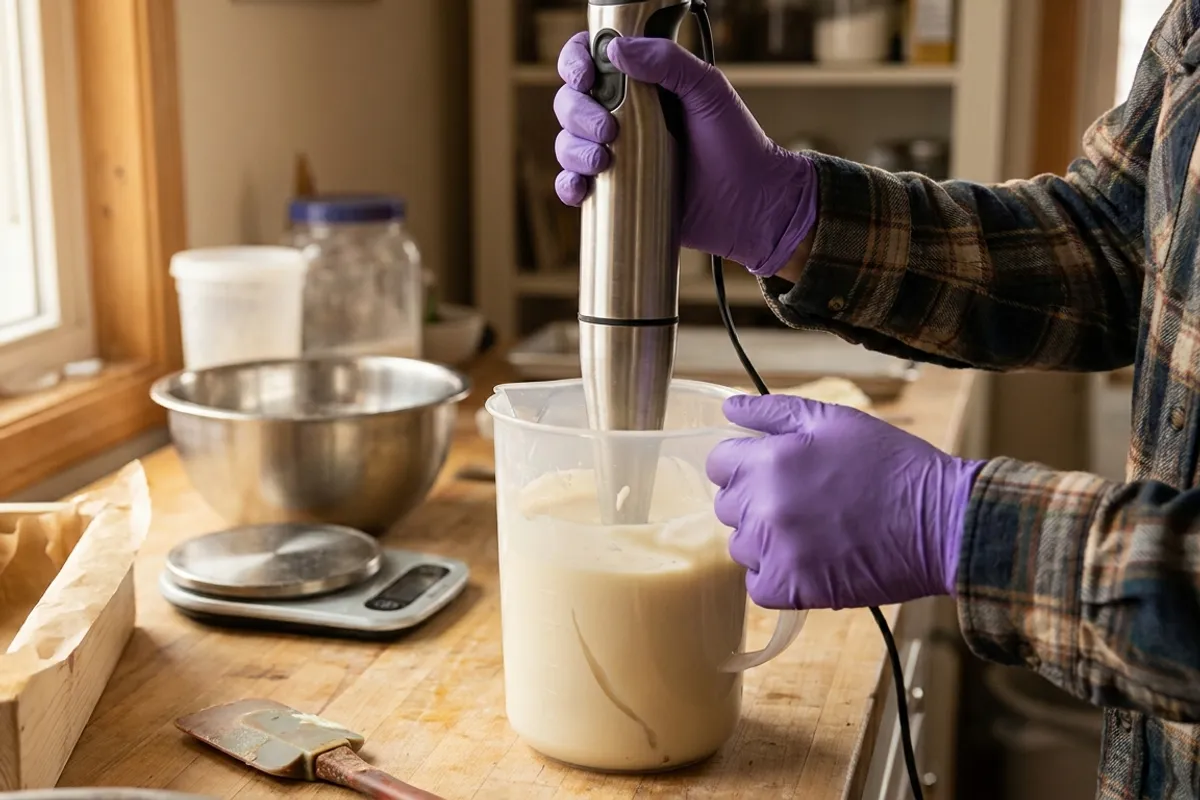
The lye water has been cooling on the back of the bench for an hour, and the oils are finally the right temperature. You pour one into the other, the batter clouds over, and you reach for the stick blender. Three seconds of a low growl, a slow stir with a spatula, another three seconds. The surface goes from greasy and streaky to something like thin custard. This is the best part of making cold-process soap, and the blender is the tool that makes it take minutes instead of an afternoon.
So which one should you buy? The spec printed biggest on the box, the wattage, barely matters for soap. What matters is printed in small type inside the manual, and it only shows up when you read the manuals side by side.
The short version:
- Our pick for most soap makers: the Cuisinart Smart Stick. It is the only blender here whose manual names a stainless blade guard, and it publishes a run limit too.
- Stainless steel where it touches the batter. Lye attacks aluminum and zinc, so check the bell and blade guard, not just the shaft.
- A shaft that comes off. You will wash it after every batch, and the motor must stay dry.
- A published run limit. Soap makers blend in short bursts, so a 60-second limit is plenty, but you want to know the number.
- Warranty fine print. Every blender here whose terms could be checked is sold for household or food use, so plan as if a soap-business blender has no warranty.
Why a stick blender, and why not your old one
Before stick blenders, soap makers stirred lye and oils by hand for a very long time. Soap Queen puts it plainly: a stick blender "emulsifies oil and lye together in seconds, rather than hours and hours" (Soap Queen on essential tools (opens in new tab)). Lovin Soap's troubleshooting guide says a two-pound batch "should definitely reach trace in less than ten minutes when using a stick blender" (Lovin Soap (opens in new tab)).
That speed is why so many soap makers rely on one. It is also why the blender you buy should never go back to the kitchen. Soap Queen's beginner's guide is direct about it: "Any equipment used for soapmaking should be exclusive – don't use it for food. Lye and fragrance can get stuck in cracks, even with thorough washing" (Soap Queen beginner's guide (opens in new tab)). The good news is that a dedicated soap blender does not need to be fancy. It needs to be the right kind of plain.
The four things that actually decide it
1. What touches the batter
Sodium hydroxide and certain metals do not get along. The NIOSH Pocket Guide lists "metals such as aluminum, tin & zinc" among its incompatibilities (NIOSH (opens in new tab)), and PubChem's reactivity profile notes that it attacks aluminum and zinc "with the evolution of flammable hydrogen gas" (PubChem (opens in new tab)).
On a blender, the part that sits in the lye is the bell: the guard around the blade at the bottom of the shaft. The Classic Bells soap guide prefers "a stainless steel mixing end, rather than the ones with a plastic bell," because plastic "can melt when doing some types of hot process soaps and is more prone to cracking." It goes further: blenders with "zinc or aluminum bells" and seals "not rated for exposure to strong alkalis like NaOH" are "not acceptable for use with soap" (Classic Bells (opens in new tab)).
Here's the catch. A product page that says "stainless steel shaft" is not always telling you what the bell is made of. Of the documents checked for this guide, only Cuisinart's manual names the guard's material in words. To check yours, look for the parts list in the manual, then the spec sheet, and if neither says, ask the maker's support what alloy the blade guard is. If nobody will tell you, treat the bell as unknown, not as stainless.
2. What comes apart
Raw soap batter is caustic, and you will wash the blending end after every batch. A shaft that detaches lets you do that without water near the motor. The Classic Bells guide calls a removable mixing end "a plus" for exactly that reason (Classic Bells (opens in new tab)).
Check the dishwasher line in the manual too. It varies more than you'd guess, even between models with similar-looking shafts.
3. How long the motor may run
This is the spec that's easiest to overlook, and it's the most interesting one. Some manuals give a hard limit on continuous blending. Others give none at all.
The good news: soap technique already keeps you well inside most limits. Soap Queen recommends that you "alternate between stirring and pulsing the stick blender in short bursts" (Soap Queen on trace (opens in new tab)). The Classic Bells guide describes "3 or 4 bursts that are 2-3 seconds per burst," with hand stirring between them, and warns against blending "until the machine overheats" (Classic Bells (opens in new tab)). That works out to roughly 6 to 12 seconds of motor time on the way to emulsion. Voyageur Soap & Candle suggests longer runs, "15-20 seconds, followed by hand mixing" (Voyageur Soap & Candle (opens in new tab)), which is still well inside a 60-second limit.
Where a limit starts to bite is the batch that will not come together. Soap Queen's answer to false trace caused by temperature (cool lye water hardening the oils) is to "keep stick blending!" until the batch is emulsified (Soap Queen on false trace (opens in new tab)). That is when you lean on the trigger, and when the manual's number is worth knowing.
4. What the warranty covers
Consumer blenders are sold for kitchens, and their warranties say so. Every model below whose terms could be checked is sold for household or food use, and none of those documents mentions soap or other non-food use as covered. So treat the warranty as a tiebreaker at most, and budget for replacement (more on that below).
Five stick blenders for soap making, compared
Every figure here comes from the maker's own product page or owner's manual, checked on October 1, 2026. Prices are the manufacturer's regular list price where one was shown. "Not stated" means the documents checked do not say; "None published" means the manual was read and gives no run limit; "Not verified" means the manual could not be retrieved. None of these is a verdict on the blender.
| Blender | Guard material | Shaft detaches | Published run limit | Warranty; use scope | List price | Watts |
|---|---|---|---|---|---|---|
| Cuisinart Smart Stick CSB-179 (our pick) | Stainless, per manual | Yes | 60 sec on, 20–30 sec rest | 3 years; ordinary household use | $79.95 | 300 |
| Hamilton Beach 59765 (two-speed) | Not stated | Yes | None published | 1 year (U.S.); void outside single-family household use | Not stated | 225 |
| Braun MultiQuick 7 MQ7035X | Not stated | Yes | Max 1 min (pictogram) | Not stated for U.S. (manual has a UK-only guarantee); household use only | $109.95 | 500 |
| KitchenAid KHBV53 | Not stated | Yes | Not verified | Not verified | Not stated | Not verified |
| bamix Classic | Not stated | No | 5 min continuous | 2 years plus lifetime motor; food preparation only | $156 | 150 |
Cuisinart Smart Stick Variable Speed (CSB-179)
The Cuisinart product page (opens in new tab) lists a 300-watt motor, an 8-inch stainless steel blending shaft, a variable speed slide and pulse action, at $79.95. Its CSB-179 manual (PDF) (opens in new tab) confirms the shaft detaches and names the guard's material: "The fixed-mount stainless blade is partially covered by a stainless guard." It also publishes a clear run limit: "Do not continuously blend for longer than 60 seconds. Release ON/OFF button for 20–30 seconds between 60-second blending cycles."
Pros:
- Stainless blade and stainless guard, stated in the manual
- Detachable shaft, so the motor stays dry at the sink
- Pulse action suits the short-burst technique soap makers already use
- Published run limit, with a rest interval
Cons:
- The manual says not to put the motor body or the blending shaft in the dishwasher, so it's a hand-wash tool
- The three-year warranty excludes damage from "other than ordinary household use," which a soap business may not count as
Best for: most soap makers. It's the one blender here where the material, the run limit and the cleaning rules are all written down.
Hamilton Beach 2-Speed Hand Blender (59765)
The Hamilton Beach product page (opens in new tab) describes a 225-watt, two-speed blender with a "stainless steel blending wand." The use and care guide (PDF) (opens in new tab) says the attachments come off the motor housing and "may also be placed in the top rack of the dishwasher." The manufacturer's page did not show a price for the blender when checked.
Pros:
- Detachable stainless wand that can go in the top rack of the dishwasher
- Simple controls: two speeds and nothing else to learn
Cons:
- Neither the page nor the manual names the bell's material
- No continuous-run limit published anywhere in the manual
- No variable speed, only high and low
- One-year U.S. warranty, which "is void if the product is used for other than single-family household use"
Best for: a first, no-frills soap blender, once you've confirmed the bell and blade guard are stainless steel, not aluminum, zinc or plastic (see the check under "What touches the batter").
Braun MultiQuick 7 (MQ7035X)
The Braun product page (opens in new tab) lists a 500-watt motor with "seamless variable speed from low to high," controlled by how hard you press the button, and a metal wand that clicks off. It listed at $109.95, on sale for $79.95, when checked. The Braun manual (PDF) (opens in new tab) linked from that page marks the blending shaft "max 1 min" in a pictogram, and Braun's safety leaflet (PDF) (opens in new tab) says the appliance is "designed for household use only."
Pros:
- The highest rated wattage of the four blenders with a confirmed figure
- Speed rises the harder you press, per Braun; a light press helps when going gentle near trace
- Detachable shaft
Cons:
- The only full manual linked from the US page is the international edition, which shows the run limit as a picture and gives no rest time for the shaft
- The bell's material is not stated separately from the "metal and plastic" description
Best for: soap makers who like fine speed control near trace, once they've confirmed the guard material with Braun.
KitchenAid Variable Speed Corded Hand Blender (KHBV53)
The KitchenAid product page (opens in new tab) lists a removable 8-inch blending arm with a four-point stainless steel blade, a variable speed trigger switch and a removable pan guard. KitchenAid's site blocked automated retrieval of the owner's manual for this guide, so its wattage, run limit and warranty terms could not be checked against the manual.
Pros:
- A trigger switch varies the speed with one hand
- Removable arm
Cons:
- The pan guard's material is not stated on the product page
- No run limit or warranty terms could be confirmed for this guide
Best for: soap makers who prefer a trigger switch, once they have checked the manual in the box (or asked KitchenAid) for the guard material, run limit and warranty terms.
bamix Classic
bamix is a Swiss-made blender sold in both household and NSF-certified commercial versions, and it has the longest published run rating here. The bamix manual (PDF) (opens in new tab) says "Do not run continuously for more than 5 minutes." On bamix.us the bamix Classic (opens in new tab) lists at $156 (on sale for $119 when checked), and the Pro-1 NSF (opens in new tab) was $229.
Then come two problems. The manual says "The appliance must only be used for the preparation of food. Any other use is deemed dangerous and might cause injury. Improper use of the appliance shall void all warranty." And the Classic Bells guide names it directly when listing blenders whose bells and seals are wrong for soap: "One example is my expensive Bamix stick blender which fails on both counts. I use it strictly for food" (Classic Bells (opens in new tab)).
Pros:
- Five-minute continuous rating, five times Cuisinart's
- A lifetime motor warranty in the manual, for food use
Cons:
- The manual restricts it to food and voids the warranty for any other use
- A soap educator who owns one says its bell and seals fail the soap test
- The shaft does not detach from the motor; only the blades come off
- Not dishwasher-safe
Best for: your kitchen, not your soap bench.
Getting the most out of whichever one you buy
Once the blender is on your bench, a few habits from soap educators make a real difference.
Burp it before you switch it on. Air trapped under the bell turns into bubbles in your bars. Soap Queen's fix is to "gently tap the stick blender on the bottom of the of your container until you see all of the air bubbles come out" before turning it on (Soap Queen on air bubbles (opens in new tab)).
Keep the head covered. Voyageur Soap & Candle says to "keep the blender on the bottom of the bowl with the jets covered to avoid splashing" (Voyageur Soap & Candle (opens in new tab)). Splashed batter is caustic. Wear the goggles: Soap Queen notes that "alkali burns are extremely dangerous for your eyes," and regular glasses are not enough (Soap Queen beginner's guide (opens in new tab)).
Put it down for the fragrance. Soap Queen warns that mixing in a fragrance oil with a stick blender "can cause even the most well behaved fragrance oil to accelerate trace" (Soap Queen on trace (opens in new tab)). Bramble Berry's advice when a batch starts moving: "stop stick blending and switch to a whisk" (Bramble Berry on misbehaving fragrances (opens in new tab)).
Know when to trade up. Bramble Berry sells its own home stick blender and still says that "for heavy daily production, we recommend upgrading to a commercial‑grade stick blender from a restaurant supply store" (Bramble Berry's stick blender page (opens in new tab)). If you're blending every day, your consumer blender is working a schedule its manual never imagined.
Budget it like the tool it is
A soap-only stick blender is a working tool with a lifespan, not a kitchen gadget. Since its warranty probably doesn't cover a soap business, plan as though it has none. Write down what you paid, when you bought it, and how many batches it has run. Then the replacement isn't a surprise, and it's already counted in what each bar costs.
That's the kind of record Ardent Seller's equipment tracking keeps for you: purchase date, maintenance, usage and depreciation for each tool, with the blender listed as required equipment on each soap recipe. The recipe itself carries every oil's current cost, so a production run turns into a cost per bar and a batch lot you can trace later. If you'd rather start with a spreadsheet, the free Soap Maker's Cost-Per-Bar Calculator does the per-bar math for one recipe at a time.
Pick one, burp it, and make soap
For most soap makers, the Cuisinart Smart Stick is the easy recommendation: stainless where it counts, a shaft that comes off, a run limit you'll never hit with short bursts, and a manual that tells you all of it. If you want a plain two-speed blender, the Hamilton Beach can work once you've confirmed the bell is stainless. Whichever you choose, keep it for soap only, keep it stainless, and keep your bursts short.
Then put the blender to work on a recipe whose cost you actually know. Start free with Ardent Seller and track your soap bench, from the oils to the blender, alongside every batch you make.
Related reading
- How to Calculate Lye for Soap Making — The lye arithmetic behind the batch you're about to blend, and why the superfat is your margin for error.
- Best Scale for Soap Making — The other tool on the soap bench, chosen by the lightest ingredient you weigh rather than the size of the batch.
- How Long Does Handmade Soap Need to Cure? — What happens to the loaf after the blender goes in the sink.
- Equipment Depreciation for Makers — How to spread the cost of a working tool like a dedicated blender across the years you use it.
Free resources
Two free downloads that pair well with a new soap blender:
- Soap Maker's Cost-Per-Bar Calculator — Turns the recipe you just blended into a cost per bar, so you can see what each batch is worth before it cures.
- Soap Batch & Cure Log — A printable log for each batch, with room to note how quickly it reached trace and which fragrances made it move.
This article is provided for educational purposes only and does not constitute legal, regulatory, or safety advice. Lye handling, equipment safety, and manufacturer warranty terms vary by product and change over time. Follow your equipment's manual and your lye supplier's safety data sheet, and consult a qualified safety professional or attorney before making safety or warranty decisions.