
The message comes in on a Saturday. Someone saw the trestle table at the spring market and wants one in walnut, eighty-four inches, for a dining room they are renovating. You quote $3,200. They say yes.
So you do what you have always done: you order the walnut and the trestle hardware. A thousand dollars of it, milled and special-ordered to the dimensions of a table that exists nowhere except in a drawing and your head. Then you clear three weeks in the shop and turn down a kitchen island because the dates collide.
Six weeks later the renovation stalls and the table is off. And the entire question of how much of that $3,200 you get to keep comes down to a text thread with no terms in it.
Here is the short answer to the question that brought you here. Size the deposit to the money you cannot recover if the order dies — not to a percentage somebody quoted in a Facebook group. For most custom work that lands between a quarter and a half of the total, but the percentage is what falls out of the arithmetic, not what goes into it. The harder and more consequential half is the part almost nobody writes down: what your terms have to say before the buyer pays, because two separate rulebooks — your state's commercial code and your card network's operating rules — both cap what you keep, and both of them decide it based on disclosures you made in advance.
Size the deposit to what you cannot get back
The percentage question is backwards. Start with a list of everything that becomes unrecoverable the moment you begin, then work out what fraction of the price that represents.
For the walnut table:
| Line | Amount | Recoverable if canceled? |
|---|---|---|
| Walnut, milled and cut to this table's dimensions | $780 | No — cut to size for this piece |
| Trestle hardware, ordered to the drawing | $220 | No — special order, non-returnable |
| Finishing oil and abrasives | $60 | Yes — usable on any other job |
| Three shop weeks reserved | — | No — the kitchen island went elsewhere |
| Unrecoverable total | $1,000 |
A deposit of $1,150 covers the unrecoverable spend with a small margin for the calendar you gave away. On a $3,200 job that is 36%. Nobody arrived at 36% by choosing it.
Run the same rule on a $600 set of cutting boards from stock lumber you would have bought anyway, and the unrecoverable spend is maybe $90. A $150 deposit — 25% — is honest. Charging 50% there is not protection, it is just holding someone's money.
Two adjustments are worth making:
- Minimum order quantities count. If the buyer's design needs a material with a long lead time, or an MOQ larger than the job itself, that overage is unrecoverable too and belongs in the deposit.
- Outsourced work counts double. Plating, digitizing, kiln time, a laser file — your supplier wants paying whether or not your buyer stays, so the deposit should cover it before you place the order.
"Non-refundable" is a claim, not a rule
This is the part that surprises people, so it is worth being precise about it.
Custom work is goods. UCC section 2-105(1) (opens in new tab) defines goods as "all things (including specially manufactured goods) which are movable at the time of identification to the contract for sale" — the parenthetical is doing real work there. A table built to a drawing is as much a sale of goods as a candle off a shelf, which means Article 2 of your state's commercial code governs what happens when the buyer walks.
And UCC section 2-718 (opens in new tab) is unambiguous about it. Subsection (2) says that where the seller justifiably withholds delivery because of the buyer's breach, the buyer is entitled to restitution of any amount by which their payments exceed either "the amount to which the seller is entitled by virtue of terms liquidating the seller's damages," or — "in the absence of such terms" — "twenty per cent of the value of the total performance for which the buyer is obligated under the contract or $500, whichever is smaller."
Read that last clause again, because the word doing the damage is smaller.
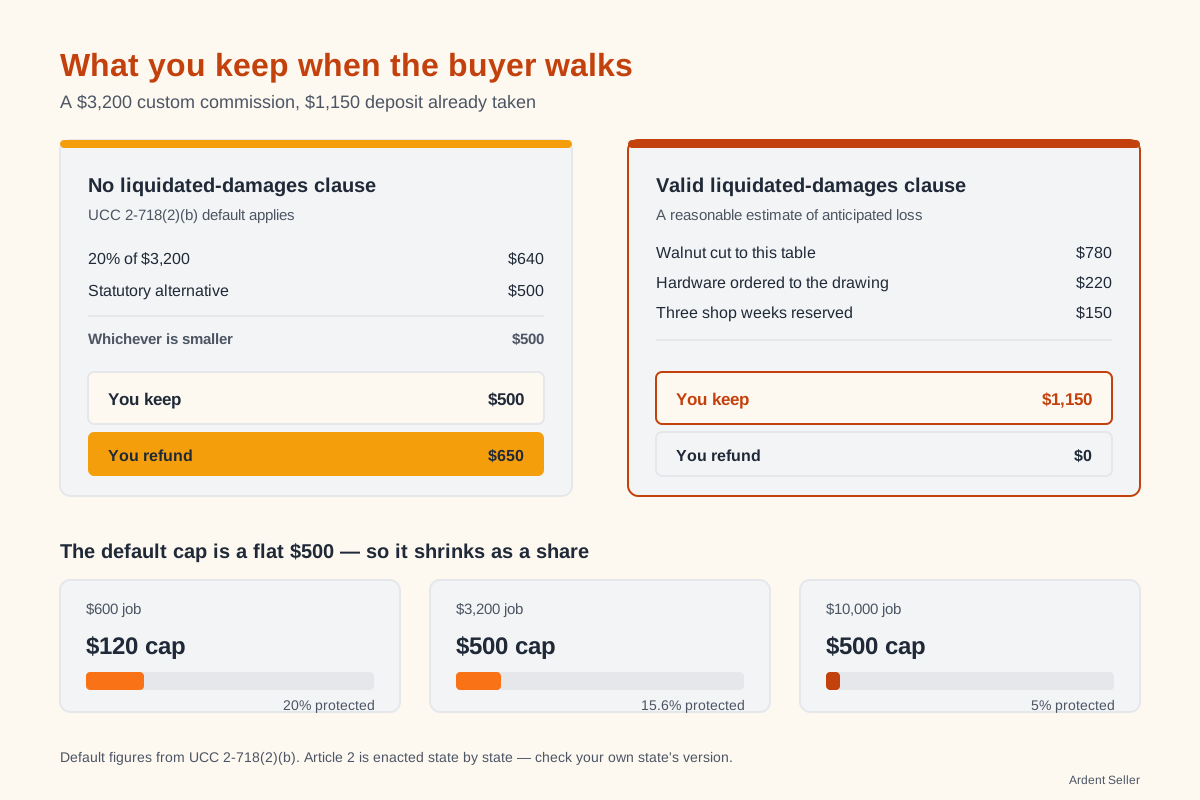
On the $3,200 table with no liquidated-damages clause: 20% of $3,200 is $640, and $500 is smaller, so the default entitlement is $500. You took $1,150. You are looking at refunding $650 of it — while sitting on $1,000 of walnut and hardware that exist in the shape of one person's dining room.
And because the figure is a flat $500 rather than a percentage, the default protection gets worse in relative terms the bigger the commission gets. On a $600 job, 20% is $120 and that is the cap — a full fifth. On a $3,200 job the cap is $500, or 15.6%. On a $10,000 architectural commission the cap is still $500. Five per cent. The jobs where the most is at risk are the jobs the default rule protects least.
Two things get you out of this.
The first is subsection (1): you can liquidate damages in the agreement, "but only at an amount which is reasonable in the light of the anticipated or actual harm caused by the breach, the difficulties of proof of loss, and the inconvenience or nonfeasibility of otherwise obtaining an adequate remedy." That is the test, and it is why a clause that just asserts a number tends to do less than a clause that shows its working. A figure that looks like a penalty gets treated like one — Cornell's Wex entry on liquidated damages (opens in new tab) puts it plainly: "Courts will not impose liquidated damages if the clause is punitive, illegal, unconscionable, or contrary to public policy."
The second is subsection (3), which preserves your right to offset against the buyer's restitution to the extent you can establish actual damages under the rest of Article 2. So the $500 is not a hard ceiling on what you can ever recover — it is what you get without proving anything. Proving a real loss on a half-built table is possible. It is also weeks of your life and probably a lawyer. The clause exists so that you never have to do it.
None of this is uniform trivia, either — states enact Article 2 individually, and California Commercial Code section 2718 (opens in new tab) carries the same "20 percent … or five hundred dollars ($500), whichever is smaller" language word for word. Check your own state's enactment.
And note that a commission that is mostly service rather than goods — a portrait sitting, a design-only engagement — falls outside Article 2 altogether, landing under your state's general liquidated-damages law instead. California's is Civil Code section 1671 (opens in new tab), which steps aside wherever a statute like 2-718 already covers the contract. Its default is friendlier than the UCC's: a clause is "valid unless the party seeking to invalidate the provision establishes that the provision was unreasonable under the circumstances existing at the time the contract was made."
It flips hard for consumer work, though. Where an individual is buying services for personal, family, or household use, that same statute makes the clause "void" — unless the parties agreed up front on a presumed-damages figure, precisely because the actual damage would be "impracticable or extremely difficult to fix." Which is one more reason to put the reasoning in the clause and not just the number.
If you want a running list of which written agreements a maker business actually needs, the Legal Documents Every Maker Should Have checklist covers the set this clause belongs to.
Stage the balance at events, not dates
A single payment at the end is how a twelve-week build turns into an interest-free loan you made to a stranger.
Split it. The default that works for most custom work is three stages:
- Deposit at agreement, sized as above, paid before you order anything or block anything.
- A mid-build payment at an approval milestone — typically 25% to 30% of the total — triggered by something the buyer can see. A photo of the glued-up top. A proof of the engraving layout. The finished-but-unfired greenware.
- The balance before the piece ships or is collected. Not on delivery. Not on the day. Before.
The mid-build payment is optional on short jobs, and close to essential once a build outlasts your own payment terms to your suppliers. For most shops that crossover lands around the six-week mark. It does two jobs at once: it moves money before your own suppliers need paying, and it gives you an early signal. A buyer who goes quiet at the approval milestone was going to go quiet at delivery.
Tie every trigger to an event, not a date. "Payment two due 15 October" fails the week your kiln element dies. "Payment two due within five days of design approval" survives it, and it keeps the buyer's obligation attached to something they participated in. The one date you do commit to is the completion date — and you commit to it in writing, because both of the rulebooks in this post care about it.
That completion date is also where federal law arrives, and it is a bigger topic than this post: taking money for something not yet made puts you under the FTC's mail, internet, or telephone order rule, which has no exemption for handmade or made-to-order work. The date you state is the date that binds. That is covered in full in how to take preorders for handmade products — read it alongside this one if your custom work runs long.
Your card network has its own deposit rules
Here is the second rulebook, and it is the one makers almost never read.
If the buyer pays the deposit by card, the transaction is what Visa's operating rules call an Advance Payment — defined in the Visa Core Rules and Visa Product and Service Rules (opens in new tab) (18 April 2026 edition) as "A Transaction for the partial or full cost of goods or services that will be provided to the Cardholder at a later time." Three things follow from that, and all three are good news if you set them up and bad news if you do not.
Custom work is explicitly allowed to take one. Table 5-21 lists only four merchant categories permitted to process an Advance Payment representing the entire purchase amount before delivery, and "Custom goods or services" is one of them, alongside travel and entertainment. The same entry adds a condition in one sentence: "The terms and conditions must specify the date of shipping of the goods or services to the Cardholder." Your completion date is not just good practice — for a card-funded deposit it is a rule.
The disclosure list is written down. Table 5-20 requires that before completing an Advance Payment, the merchant obtain the cardholder's "express informed consent to an agreement" containing the description of the goods or services, the total purchase price, and "Cancellation and refund policies, including the date that any cancellation privileges expire without Advance Payment forfeiture" — plus the merchant's location, address, email address and phone number. That is a specification for your terms block, handed to you by the network. Note what it implies: there has to be a date on which cancellation stops being free. "Non-refundable from the moment you pay" is not what the rule describes.
A buyer who never paid the balance cannot validly dispute the deposit. Section 11.10.2.3 lists what makes a "Merchandise/Services Not Received" dispute invalid, and one entry is "A partial Advance Payment Transaction when the remaining balance was not paid and the Merchant is willing and able to provide the merchandise or services." Willing and able is the operative phrase, and it is why you keep the build photos.
One thing to plan around rather than celebrate: the dispute clock. A dispute must be processed no later than 120 calendar days from the transaction processing date or 120 calendar days from the last date the cardholder expected to receive the goods. On a fourteen-week build, the second of those runs well past the first. A long lead time extends your exposure, and it does so from the date you promised.
These are Visa's rules; Mastercard, Amex and Discover each publish their own, and they differ in the details. The through-line does not: the network protects the merchant who disclosed, and it protects the cardholder against the one who did not. Table 5-20 is blunt about the other direction too — the merchant "must refund the full amount paid if the Merchant has not adhered to the terms and conditions of the sale or service."
The deposit is not your money yet — but it may be taxable anyway
Two true things that feel contradictory.
Operationally, a deposit is a liability. You are holding money against work you have not done, and the walnut still needs buying. Spending it on rent is how a shop ends up funding January's commissions out of February's deposits, which works right up until the month somebody cancels.
For tax, though, a cash-method filer generally recognizes it on receipt. IRS Publication 538 (opens in new tab) states the cash-method rule directly: "Under the cash method, you include in your gross income all items of income you actually or constructively received during the tax year." A deposit banked on 20 December for a table delivered in March is December income. Plan the estimated-tax consequence in the quarter you take the money, not the quarter you deliver. Sales tax timing is its own question and genuinely varies — some states look to when the deposit is received, others to delivery — so check your state's rule rather than assuming it follows the income treatment.
The practical fix is bookkeeping, not willpower: record the deposit against the specific order so the balance still owing is visible next to the job, rather than as a lump in the bank balance that looks like a good month. That is what customer-linked transaction records are for. In Ardent Seller the deposit is recorded against the customer and the materials against the same job reference, so both are in one place when you sit down to work out what is still owed — you are still doing that subtraction yourself, but you are not hunting for the numbers first.
The terms block, annotated
Everything above collapses into the block below. Adapt it to your own work — the callout numbers are keyed to the explanations underneath.
Custom Order Terms — [Shop Name], [PO Box, City, ST ZIP], [email], [phone] (1)
Item: one walnut dining table, 84 × 40 inches, trestle base, hand-rubbed oil finish, built to the drawing dated 5 September 2026. (2)
Total price: $3,200. Deposit to start: $1,150. Payment two: $800, due within 5 days of approval of the glued-up top. Balance: $1,250, due before shipping. (3)
Estimated completion and shipping: on or before 28 November 2026. (4)
Cancellation: cancel within 5 days of paying the deposit for a full refund — on this order, on or before 10 September 2026. After that date the deposit is retained as liquidated damages. The parties agree $1,150 is a reasonable estimate of the loss caused by cancellation — $780 of walnut milled to this table's dimensions and not returnable, $220 of trestle hardware special-ordered to the drawing, and $150 for three shop weeks reserved and not resellable at short notice — and that the actual loss would be difficult to prove. (5)
Design changes after the deposit are quoted in writing and added to the balance. (6)
To cancel, email [email] or call [phone]. (7)
What each one is doing:
- Your contact details, in the terms themselves. Visa's Table 5-20 requires the location, address, email and phone in the agreement the cardholder consents to. A PO box is fine, and is the right call if you work from home.
- A description specific enough to argue from. "Walnut dining table" is not a specification. Dimensions plus a dated drawing is. This is also your defense against the most common custom-order failure, which is not cancellation — it is the buyer who had a different picture in their head.
- The total price stated as a total, then staged. The total is required by the same Visa table, and it is the number the UCC's 20% test measures against. The three stages are the structure from the section above, with payment two hung on an approval the buyer takes part in rather than on a date.
- The completion date. Required by Visa for a custom-goods advance payment, binding under the FTC rule, and the thing that starts the 120-day dispute clock. Give yourself real margin — you are quoting a promise, not a hope.
- The liquidated-damages clause, showing its working. This is the line that changes the answer from $500 to $1,150. It states a number, itemizes the anticipated loss the number represents, and says the loss is hard to prove — which is the three-part test in UCC 2-718(1) answered in one sentence. It also names the date cancellation privileges expire, which is the Visa disclosure. If your own numbers change, change these; a clause reciting someone else's materials cost is a clause reciting a fiction.
- Changes get quoted. Scope creep on custom work is the silent margin killer, and one sentence agreed up front is worth an hour of awkwardness later.
- A cancellation route. Visa asks for a simple cancellation procedure. It also, quietly, protects you: a cancellation that arrives by a stated route is a dated record.
Have a lawyer in your state read it once. Not for every job — once, for the template. It is a two-figure expense against the four-figure question of whether $650 goes back out of your account.
The table might still fall through. Renovations stall, budgets move, people change their minds about eighty-four inches of walnut. What the terms decide is whether that is a disappointment or a bill — and unlike almost everything else on a custom job, it is settled entirely before you turn on a single machine.
If the balance owing on your open commissions currently lives in your head, start a free Ardent Seller account and put the deposits, the materials and the balances where you can see them.
Related reading
- How to Take Preorders for Handmade Products — the federal shipping-deadline rule that attaches the moment you take money for something not yet made, including what happens when your completion date slips.
- Handmade Shop Policies Template — where the public-facing version of your custom-order terms lives, torn down clause by clause.
- Wedding Cake Pricing and Contracts — the same money structure applied to a booked date rather than a build, for decorators pricing by the serving.
Free resources
Two free downloads from the Ardent Workshop library if you want to put this in place this week:
- Legal Documents Every Maker Should Have — the wider set of written agreements a maker business needs, so the custom-order terms are not the only thing in writing.
- Shop Policy Starter — the public policy page that has to say the same thing your custom-order terms say, in language a buyer reads before they message you.
This article is provided for educational purposes only and does not constitute legal, financial, or tax advice. Contract terms, deposit and cancellation provisions, commercial code enactments, card network operating rules, and tax treatment vary by jurisdiction and change over time. Consult a qualified accountant and an attorney licensed in your area before adopting contract language or setting deposit terms based on this content.