The email comes in on a Thursday, sixteen days before the wedding: "So sorry — we've decided to go with cupcakes from the venue instead. Hope you understand!"
You understand fine. What you also understand is that you blocked that Saturday four months ago, turned away two other orders for the same weekend, and already bought the specialty plates and cutters this design needed. And because the whole thing lived in a friendly text thread and a mental handshake, there was never a deposit and never a contract. So the cancellation isn't a disappointment. It's a bill — and you're the one paying it.
This is the trap of wedding cakes. They look like the birthday cakes you already make, just bigger, so decorators price and book them the same casual way. But a wedding cake is a fundamentally different product: one shot, a fixed immovable date, a delivery to a venue on someone else's timeline, and a client who has been quietly downsizing their guest count since the day they booked. Price it like a big custom cake and you'll underquote the labor, skip the protections, and eat the cancellations.
The short version: price a wedding cake by servings times a per-serving rate set by decoration complexity — not by cake size. Then protect the booking three ways: a non-refundable booking fee (commonly a quarter to half the total, though you set the number), a guest count locked about two weeks out, and a one-page signed agreement covering cancellation, changes, and delivery. Everything below unpacks each piece.
Here's how to price and book one so it pays you — and so a Thursday email two weeks out is an inconvenience instead of a loss. Work through it in order; each step fixes a specific way wedding cakes go sideways.
Step 1: Price by the serving and by tier complexity — never by "cake size"
One of the most common wedding-cake pricing errors is quoting by size ("a three-tier runs about $300") instead of by servings and decoration complexity. Cake size is a terrible proxy for cost, because a three-tier smooth-buttercream cake and a three-tier cake dripping in hand-piped lace and sugar flowers serve the same number of people and take wildly different amounts of your time. One might be eight hours of work; the other, twenty.
Build your wedding pricing on two numbers instead:
A per-serving base price, set by decoration tier. Many decorators run three complexity tiers of their own, each with its own per-serving price because each represents a different hours-per-serving reality:
- a simple/clean-finish tier;
- a semi-custom tier (textured buttercream, some fresh florals, a few details);
- a fully-custom tier (sugar flowers, hand-painting, structural or sculpted work).
As a rough starting point, decorated wedding cakes are often priced somewhere in a $6 to $15+ per-serving range, climbing with complexity — but treat that as an illustration, not a benchmark. The right number is the one you build from your own costed hours, not a figure to copy.
A serving count, from the couple's final guest number (more on locking that in Step 3).
Multiply, and you have a cake price that scales with both the crowd and the craft. A 120-serving semi-custom cake at $9/serving is a $1,080 cake — a number you'd almost never arrive at by eyeballing "a big three-tier."
The reason this matters more for weddings than for any other cake: tiered wedding cakes are where labor hides. Structural dowels, tier-by-tier crumb coats, transport-stable construction, and hours of repetitive detail work don't show up when you glance at a finished photo. Price by the serving within a complexity tier and that labor is baked into every quote automatically. This is also exactly the kind of costing that gets painful to redo by hand every time butter or fondant prices move — building each cake as a costed recipe in a tool like Ardent Seller gives you a per-serving cost that updates itself, so your tier prices stay honest as your ingredient costs drift.
Step 2: Take a non-refundable booking fee — and call it that
A wedding cake booking is you selling a specific Saturday. The moment you say yes, that date is gone: you can't sell it to another couple, and you'll turn away every other order that lands on it. That commitment is the thing a deposit protects — not the ingredients, the calendar slot.
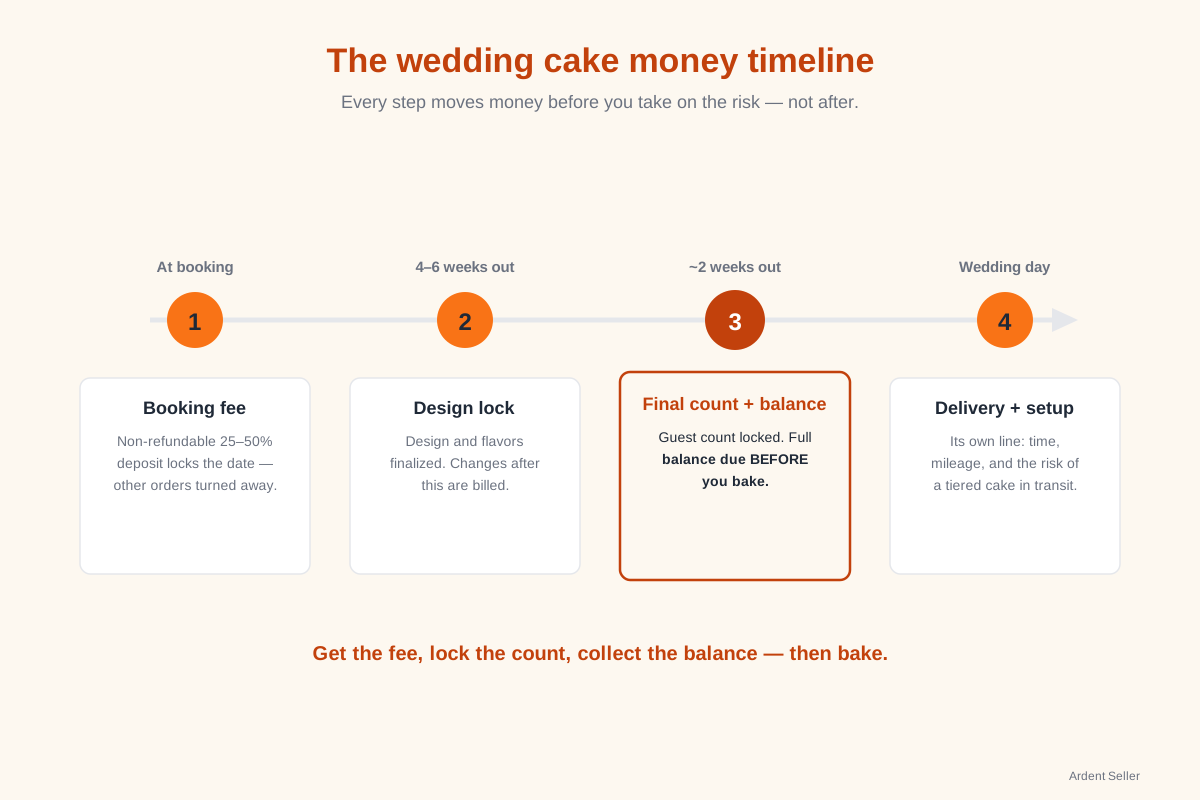
So take a non-refundable booking fee up front, and use those exact words. "Deposit" makes people think "refundable hold." "Booking fee" says what it is: the price of reserving the date. A common structure is 25% to 50% of the total to book, non-refundable, with the balance due before you bake (Step 3). The percentage is yours to set — busier decorators and peak wedding-season Saturdays justify the higher end.
The booking fee does two jobs at once. It compensates you if the couple walks, and it filters. Someone willing to put real money down to hold a date is a couple who has actually decided on you; someone who balks at any deposit was price-shopping five decorators and would have vanished the week of the wedding anyway. You are not being difficult. Other wedding vendors — venues, photographers, florists — commonly use the same non-refundable-retainer model to protect a booked date. The cake can too.
Step 3: Put the cancellation, change, and final-count terms in writing
This is the step that turns the opening email from a loss into a non-event. A wedding cake agreement doesn't need to be a lawyer-drafted monster — it needs to state, plainly, what happens in the situations that actually come up. Cover these:
- A tiered cancellation schedule. The booking fee is always kept. Beyond that, spell out what's owed as the date approaches — for example, balance becomes non-refundable inside two weeks, because at that point you've bought ingredients, blocked the weekend, and can't rebook it. The closer to the date, the more of the total is protected.
- A design lock date. Set a point — commonly four to six weeks out — after which the design and flavors are final. Changes after the lock are billed at your design rate. This stops the endless "what if we did gold instead" spiral that eats your unpaid hours in the final weeks.
- A final guest-count date. Guest counts tend to shrink between booking and the wedding, and some couples will happily tell you the smaller number the day before if you let them. Lock the serving count roughly two weeks out, and state that the price is set on the locked count — not on whoever actually shows up.
- Balance due before you bake. The full balance should clear on or before the final-count date, before you buy ingredients and start baking. You should never be carrying a wedding cake's cost into the oven on the promise of payment at the reception.
Written into a simple one-page agreement the couple signs when they pay the booking fee, none of this is confrontational. It's just how a professional cake business runs — and couples deep in wedding planning are reassured by a vendor who clearly has a system, not put off by one.
Step 4: Charge for delivery and setup as their own line — because they're the risk
A wedding cake almost never rides to the venue in the couple's car, and it definitely doesn't assemble itself on the cake table. Delivery and on-site setup are the highest-stakes thirty minutes of the entire order — a tiered cake stacked and moving, a venue on a schedule, no do-overs — and they are routinely quoted at zero because they don't feel like "cake work."
Price them as a distinct line, built from three inputs:
- Time, round-trip, at your hourly rate, including the on-site assembly minutes.
- Mileage, at a defensible per-mile figure — the IRS standard business mileage rate (opens in new tab) is the number to reach for.
- A stability/risk premium for anything tiered, stacked, or assembled at the venue, because that is the cake most likely to become a very expensive disaster on someone's most-photographed day.
Setups that require you to build tiers on-site, add fresh flowers, or wait for the venue to be ready command more than a simple drop-off. State delivery and setup as a separate charge in the quote so the couple sees it's a real service — and so it never quietly erodes the margin on the cake itself.
Step 5: Bill the tasting and the design consult
Wedding couples want a tasting before they commit — reasonable, but a tasting box is a real mini-project: several flavors baked, filled, boxed, and coordinated. Give away four tastings to land one booking and you've absorbed the cost of four small cakes before the real order starts. The same goes for an hour-long design consultation with sketches and sourcing.
Charge a tasting-and-consult fee, and credit it toward the order if they book. It recovers your cost, and — like the booking fee — it signals seriousness. A couple investing in a tasting is choosing you; a couple collecting free tastings from every decorator in town was never going to be your client.
Putting it in writing: the one-page agreement
You don't need anything elaborate — this section pulls the terms from the steps above into one place. A wedding cake agreement that a couple signs alongside their booking fee should capture:
- Names and logistics — the couple's names, the wedding date, venue, and delivery time.
- Design and count — the final design description, flavors, and locked serving count, with the design-lock and count-lock dates.
- Money — the full price, the non-refundable booking fee amount, and the balance-due date.
- Cancellation and changes — the terms from Step 3.
- Delivery and setup — the details and their fee.
- Allergen/kitchen disclosure — if your local cottage food or food-business rules require it.
That single page is the difference between the opening scenario being a shrug and being a Saturday's worth of lost income. It's the cheapest insurance in your whole business.
Wedding cakes can be the most profitable — and most rewarding — work a decorator takes on. They just carry risks that a birthday cake doesn't, and pricing them like a birthday cake leaves every one of those risks sitting on your side of the table. Price by the serving and the tier, take the booking fee, get the terms in writing, and charge for the delivery and the tasting like the real services they are. Do that, and the wedding cake stops being the order you dread and becomes the one you build your season around.
Prefer to keep your cake costs, per-serving margins, and order balances in one place instead of a stack of spreadsheets and text threads? See how Ardent Seller handles recipe costing and order tracking for makers who sell what they make.
Or start free and cost your wedding tiers before your next couple asks for a quote.
Related reading
- Custom Cake Pricing — The everyday side of the same problem: pricing non-wedding custom cakes, dietary orders, and rush jobs without underquoting the labor.
- How Much Deposit to Charge for Custom Orders — The general version of the booking fee above, and the commercial-code reason the wording matters: without a clause that itemizes the anticipated loss, the default entitlement is capped at $500 however large the order.
- Your True Hourly Wage — The number sitting under every cake price. Work out what your hours actually earn once you count all of them, not just the decorating.
- Recipe Costing 101 — Start one level down: cost a batch precisely so the per-serving price your wedding tiers are built on stands on real numbers.
Free resources
Free companion downloads if you want to take any of this off-screen:
- Maker Hourly-Rate Pricing Calculator — Run a wedding tier through the "what am I actually earning per hour" check so your per-serving tier prices clear a rate you can live on.
- Product Pricing Calculator — Build each complexity tier's per-serving price from real food cost, labor, and fees instead of guessing at the finished cake.
- Legal Documents Every Maker Should Have — A checklist covering the custom-order agreement behind Steps 2–4, so your booking fee, cancellation, and delivery terms are actually written down.
This article is provided for educational purposes only and does not constitute legal, financial, or tax advice. Pricing examples, margin figures, and contract terms — including deposit, cancellation, and delivery provisions — are illustrative and vary by jurisdiction and circumstance. Consult a qualified accountant and, for binding client agreements, a small-business attorney licensed in your area before setting prices or contract terms based on this content.