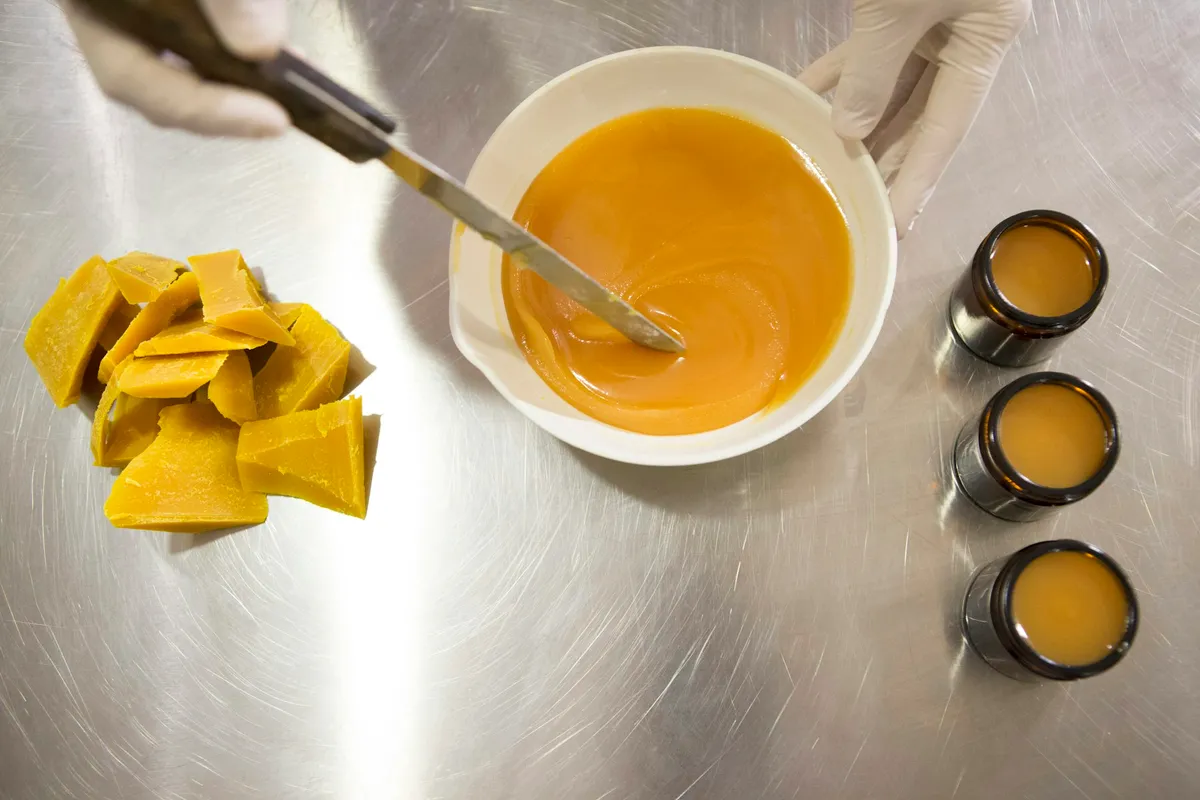
A pound of beeswax makes about 400 standard lip balm tubes in a 20% beeswax formula. Beeswax is often a small share of a lip balm: a fifth of the Wholesale Supplies Plus base, about a sixth of one Bramble Berry recipe. So one pound goes much further than its size on the shelf suggests.
The 400 comes from a supplier's own numbers. The Wholesale Supplies Plus basic lip balm base (opens in new tab) is 20% beeswax by weight (0.40 oz in a 2 oz batch), and the same page says two ounces of base fills about 10 tubes. So a pound of beeswax, 16 ounces, makes 80 ounces of balm at that share, and 80 ounces at 10 tubes per 2 ounces is 400 tubes.
The formula behind it is one line:
Tubes per pound of beeswax = 16 ÷ beeswax share ÷ ounces of balm per tube
Write the share as a decimal, so 20% is 0.20. The share is the only number that really changes between recipes, and it changes the answer a lot.
Lip balm tubes per pound, by beeswax share
Beeswax is what makes a balm firm. Both Wholesale Supplies Plus (opens in new tab) and Bramble Berry (opens in new tab) tell you to raise it for a harder balm. So a firmer formula makes fewer tubes per pound. The first two rows below come from published supplier recipes. The last two are illustrative round-number shares, worked through the same formula so you can find the row nearest your own recipe.
| Beeswax share of the formula | Balm made from 1 lb of beeswax | Tubes at listed 0.15 oz capacity | Tubes at 0.20 oz realized fill |
|---|---|---|---|
| About 16% (Bramble Berry's lavender cocoa balm (opens in new tab): 0.6 oz in 3.8 oz) | 101 oz | 675 | 506 |
| 20% (Wholesale Supplies Plus base (opens in new tab)) | 80 oz | 533 | 400 |
| 25% | 64 oz | 426 | 320 |
| About 33% (one third: equal parts beeswax, butter and oil by weight) | 48 oz | 320 | 240 |
The 0.15 oz column is the tube's listed capacity, as printed for both the Bramble Berry white tube (opens in new tab) and the Crafter's Choice oval tube (opens in new tab). A Q&A on the Crafter's Choice listing gives that figure as a volume. Waxes and oils are a little less dense than water, so a tube measured that way holds a little under 0.15 oz by weight. The 0.20 oz column is what the Wholesale Supplies Plus yield works out to. For planning a batch or a beeswax order, use the 0.20 oz column. The 0.15 oz column is a no-waste figure on paper, not a count to plan on. Flavor oil and sweetener are left out because they are a few percent of the batch and nudge the count up only slightly. The free Recipe Scaling & Batch Calculator will scale your own formula up to the size of order you settle on.
Why lip balm recipes make fewer tubes than the math says
Wholesale Supplies Plus's "about 10 tubes" from 2 ounces works out to 0.20 oz per tube, about a third more than the tube's listed 0.15 oz. Some of that is likely real material: the top-off pour that fills the shrinkage dip, drips down the outside of a tube, and the film left in the pot and the pipette. Some may simply be the supplier rounding to a tidy number. Either way, planning at 0.20 oz instead of 0.15 oz means roughly 130 fewer tubes per pound of beeswax on a 20% formula.
Recipe yields can be looser still. Bramble Berry's lavender cocoa project gives its yield as about 10 lip balms, yet it calls for 3.8 ounces of ingredients, and ten tubes listed at 0.15 oz hold about 1.5 ounces. The 10 most likely reflects the 10-pack of tubes the project uses, not what the batch actually fills. If you plan a beeswax order from a recipe's "makes 10" line, you can end up buying roughly twice the wax you need.
The cheapest fix is the one from the candle bench: weigh a real batch. Tare the pot, weigh what you melted, pour every tube you can, and divide. That figure, your ounces of balm per finished tube, is the only number in the formula you have to measure yourself. It is also the number your costing depends on, so keep it: recipe costing in Ardent Seller takes the tubes a batch really filled as the recipe's yield and divides the whole batch cost by that count.
Beeswax cost per lip balm tube
Once the count is right, the beeswax turns out to be almost free per unit. Bramble Berry lists premium white beeswax (opens in new tab) at $19.69 a pound (November 2026), about $1.23 an ounce. At 20% beeswax and 0.20 oz poured per tube, each tube holds 0.04 oz of wax, roughly 5 cents. The empty tube costs more than that: Bramble Berry's white tubes (opens in new tab) are $9.49 for a 50-pack ($2.49 for 10) as of November 2026, about 19 cents each in the larger pack.
What one filled lip balm tube costs
Beeswax and the tube are two lines of a longer list. The table prices the rest of the Wholesale Supplies Plus base (opens in new tab), at 0.20 oz poured per tube, using Bramble Berry's 1 lb listings for coconut oil (opens in new tab), shea butter (opens in new tab), deodorized cocoa butter wafers (opens in new tab) and sweet almond oil (opens in new tab) as of November 2026. One supplier's formula is priced from another supplier's catalog here, so treat it as a worked example and swap in what you actually paid.
| Line | Share of the base | Amount per tube | Listed price | Cost per tube |
|---|---|---|---|---|
| Beeswax | 20% | 0.04 oz | $19.69 per lb | 4.9¢ |
| Coconut oil | 15% | 0.03 oz | $5.99 per lb | 1.1¢ |
| Shea butter | 10% | 0.02 oz | $7.99 per lb | 1.0¢ |
| Cocoa butter | 15% | 0.03 oz | $37.99 per lb | 7.1¢ |
| Sweet almond oil | 40% | 0.08 oz | $8.99 per lb | 4.5¢ |
| All the balm | 100% | 0.20 oz | n/a | 18.6¢ |
| Empty tube | n/a | 1 tube | $9.49 per 50 | 19.0¢ |
| Filled tube, before flavor and label | n/a | n/a | n/a | 37.6¢ |
Two things stand out. Cocoa butter, at 15% of the recipe, costs more per tube than beeswax at 20%. And at these prices the empty tube costs about the same as all the balm inside it. Bramble Berry's larger sizes of all five ingredients cost less per pound (cocoa butter drops to about $33 a pound in the 5 lb size (opens in new tab) as of November 2026), so the balm line falls as you scale.
The realized fill moves the total too. Poured at the listed 0.15 oz, the same balm would cost about 14 cents instead of 18.6. So when a lip balm's cost looks high, the beeswax is rarely the reason. Look at the tube, the label and the fill first.
To run this on your own recipe, save the balm as a recipe in Ardent Seller for skincare makers, add the tube and label as lines alongside the ingredients, and enter the tube count from your weighed batch as its yield. Beeswax bought by the pound and used by the ounce converts by itself. Each line is priced at your weighted average cost, so a purchase at a new price moves the cost per tube by however much it shifts that average. Create a free account and enter your next batch's weights while the pot is still warm.
Related reading
- Pricing Handmade Skincare — once you know what each tube costs, this is how to price handmade skincare so the wholesale and retail numbers both hold up.
- Candles per Pound of Wax — the same yield question for container candles, where the size on the jar is just as misleading as a recipe's tube count.
- Recipe Costing 101 — the full method for turning bulk ingredient prices into a cost per finished unit, of which this post is one small case.
- What a Jar of Honey Costs to Produce — for beekeepers rendering their own wax, the honey cost per jar is the other half of the hive's numbers.
Free resources
One free tool pairs with the batch math above:
- Recipe Scaling & Batch Calculator — a spreadsheet that scales your tested lip balm formula to a full pound of beeswax and converts every ingredient between ounces and grams for the bigger batch.
This article is provided for educational purposes only and does not constitute financial, tax, or business advice. Cost structures, pricing examples, and margin figures are illustrative and will vary by your specific circumstances. Consult a qualified accountant or small-business advisor before making financial decisions based on this content.