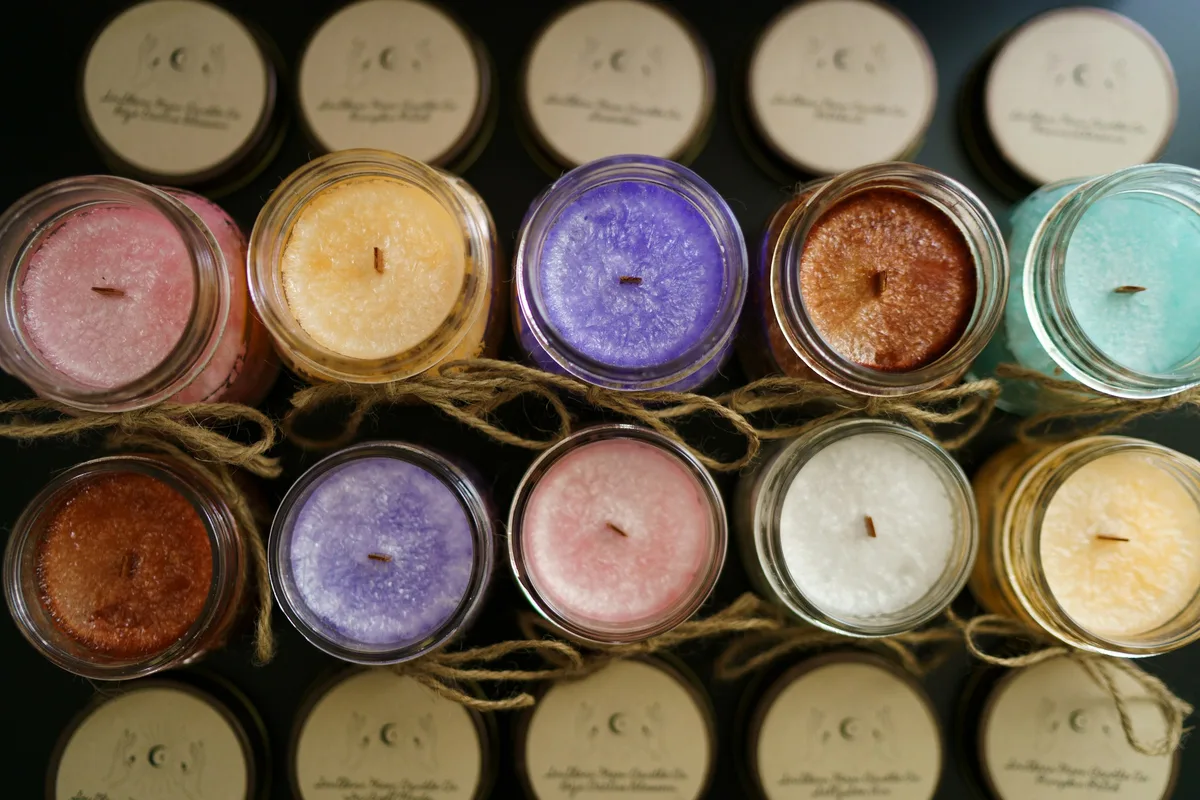
Cargill's handling sheet for its NatureWax container waxes says a candle "should be allowed to cool and cure for at least 12 hours before the candle is burned" (Cargill NatureWax C-3 and C-6 handling sheet, 2016, copy hosted by a supplier (opens in new tab)). That is Cargill's floor for lighting a candle made with those waxes. It is not the point at which a candle is ready to sell.
The short answer: let soy and coconut candles cure for about two weeks before you sell them, paraffin for about five days, paraffin-soy blends for about a week, and beeswax for about ten days. Those figures sit at the cautious end of what wax and fragrance suppliers publish, which is the conservative side to sell against. The suppliers disagree by more than you might expect, and one of them says three to four days is enough for any wax, both for testing and for the customer. The number that matters most is the one you measure on your own candle, in your own room.
How long does each wax need?
The cure times below come from wax and fragrance suppliers and candle-supply shops. Many give ranges rather than a single number, and several frame them as the wait before you test or use a candle rather than before you sell it. Read side by side, they look like this:
Published cure times, by wax
- Soy: one to two weeks. Nature's Garden says 7 to 14 days (Nature's Garden (opens in new tab)); Aromatic Fragrances International says two weeks (AFI (opens in new tab)); a retail listing for Golden Brands 464 says to "allow candles to cure for two weeks for optimal fragrance throw" (Village Craft & Candle (opens in new tab)).
- Coconut: AFI says two weeks. For coconut and coconut blends, Nature's Garden says it varies and tells you to check with your wax supplier.
- Paraffin-soy blends: one week (AFI).
- Beeswax: 7 to 10 days (AFI).
- Paraffin: three to five days according to AFI and Nature's Garden, and fully cured once it has cooled according to Makesy (opens in new tab).
- Any wax: three to four days, which Bramble Berry (opens in new tab) recommends for every wax type and says is enough for consistent test results and a reliable end-user experience.
The paraffin row has the widest gap: one supplier says no cure at all, and two say up to five days. The longer figure is the more cautious one to sell against, because holding stock for five days costs you very little.
Candle Shack (opens in new tab), which supplies UK and European makers, is the one source here that gives a separate figure for selling. It gives a 48-hour minimum before a soy candle is burn-tested, then says that "for selling, allow 7 to 14 days wherever possible." In other words, a candle can be ready to test days before it is ready to sell.
What is the candle doing while it cures?
A candle hardens fast, and that is what misleads people. Bramble Berry (opens in new tab) says wax hardens enough to handle in roughly one to five hours, "but a hard candle is not a ready candle." Curing is a separate, slower process: the fragrance oil binding into the wax and spreading through it, which "continues for several days after the candle is poured."
You can see the effect in two places:
- Scent throw. A fresh soy candle usually smells weaker than it will a week later. Candle Shack (opens in new tab) notes that many makers find their soy candles "smell noticeably stronger at 10 days than at 2." A customer who lights a three-day-old soy candle is smelling your weakest version of it.
- Your wick test. Bramble Berry warns that a fresh soy candle is softer than a cured one, "so a wick that looks right at 24 hours may actually be undersized" once the wax reaches its final density. If you burn-test too early, you may approve a wick that turns out to be too small for the cured candle. Why candles tunnel usually comes back to wick size.
Paraffin is where the sources split. Makesy's (opens in new tab) view is that paraffin is fully cured once it has cooled, while soy and other plant waxes keep changing for days. AFI and Nature's Garden still give paraffin three to five days.
How do you know when a candle batch is ready to sell?
The supplier ranges are a starting point. Your wax, your fragrance oil, your fragrance load and the temperature of the room where the candles sit all move the real number. Bramble Berry's (opens in new tab) advice is to wait out the full cure window for your wax type "before drawing any conclusions," and the simplest way to find your own window is to compare candles from the same batch.
Pull two candles from a new batch. Burn one at the earliest point your supplier allows and the other at the end of the cure window, in the same room, and note the scent throw and the melt pool each time. If the later candle smells clearly stronger, your cure window is real and you should sell against it. If it does not, you have evidence for a shorter one. Run this once for each new wax or fragrance combination, not for every batch.
The harder part is keeping track of which batch is which. A curing shelf can hold three pours at different ages, and they look identical. Write a lot code and pour date on each batch before it goes on the shelf, then work out the date it is ready (the pour date plus your cure days). The free printable log at the end of this post has a column for exactly that.
Once you are selling regularly, that log can live in Ardent Seller. Record each pour as a production run with its own lot. The run is dated, the wax, fragrance and jars it used come out of stock, and every finished candle traces back to the batch it came from. When you put candles on sale, you can see which lot was poured more than two weeks ago instead of trusting your memory of the shelf.
Related reading
- How many candles does a pound of wax make? — Size a batch before you pour it, so you know how many jars a cure window holds back.
- Why is my candle tunneling? — The wick-size problem that an early burn test can hide.
- Candle cost per unit — The fragrance-load math behind every jar on your curing shelf.
- How long does handmade soap need to cure? — The soap answer, where the cure is about water leaving the bar rather than fragrance binding into it.
Free resources
- Candle Wick-Test & Fragrance Log — A printable batch and cure log with a column for each batch's ready date, plus the wick-test log for the side-by-side burns described above.