
Picture your bench the morning after a test pour. The workshop smells like cooling soy and burnt cotton. Four jars sit there, each with a neat cylinder of black-rimmed wax carved down the middle and a quarter-inch collar of untouched wax welded to the glass. They looked perfect at pour. They looked perfect at cure. They tunneled anyway.
If you sell candles, you have already heard the explanation that circulates in every maker group: the customer didn't do the first burn right. Sometimes that's true. Often it isn't, and reaching for it first is an expensive habit — because it means you'll pour the same under-wicked SKU for another year and blame every buyer who complains.
The short version:
- In a candle you made, tunneling is a wick-size problem far more often than a burn-behavior problem.
- The test that settles it: burn undisturbed for one hour per inch of container diameter. Wax still on the wall at the end means the wick is too small.
- Target a full edge-to-edge melt pool roughly half an inch deep (CandleScience (opens in new tab)). Size up one wick in the same series and re-test.
- Fragrance load, dye, wax family, and vessel each shift the answer — so a wick is certified for a combination, not for a jar size.
- Sizing up too far trades tunneling for soot, mushrooming, and an overheated jar. There is a window, and you find it by burning, not by guessing.
- Log every test burn. An untracked wick decision gets re-litigated every time you reorder.
First, separate the two tunnels
Two completely different failures produce the same photograph, and telling them apart is the whole diagnostic.
Tunnel one: the candle never reaches the wall
Light a fresh jar, leave it alone for a long, uninterrupted burn, come back, and there is still wax on the glass. Nothing the customer did caused this. The wick is not producing enough heat to melt the wax across the full radius of the vessel you chose. This is an under-wicked candle, and it will do this in every house, every time, forever.
Tunnel two: the candle can reach the wall but wasn't given the chance
A buyer lights it for forty minutes on a work call, blows it out, and the melt pool freezes as a narrow disc. Relight it and the soft wax in the middle takes the heat first while the harder, never-melted ring resists. This is the failure the burn instructions on your warning label exist to prevent, and the National Candle Association's burn guidance is explicit about the target: candles "should burn one hour for every 1 inch in diameter of the actual candle size," long enough for "the wax to liquefy or to melt from edge to edge of the container" (National Candle Association (opens in new tab)).
Here is the part that matters commercially. A candle that only performs when the customer executes perfectly is not a well-made candle — it's a candle with a homework assignment attached. Real buyers light candles for twenty minutes while the pasta water boils. Your wick has to have margin for that. So when tunnel two shows up in your inbox, the honest question isn't "did they burn it right?" It's "is this jar so marginal that ordinary use breaks it?"
Diagnose it this way: do the test yourself, correctly, and see if the tunnel survives. If it does, you own the problem. If a properly executed burn produces a clean edge-to-edge pool and only customer reports say otherwise, you have a wick with no margin — which is still your problem, just a smaller one.
Holding a tunneled jar right now? A single candle can usually be rescued — wrap foil around the rim to reflect heat inward and burn it until the pool levels, or carefully trim away the raised wax ring. That saves the jar in your hand. It does not fix the SKU, which is what the rest of this post is about.
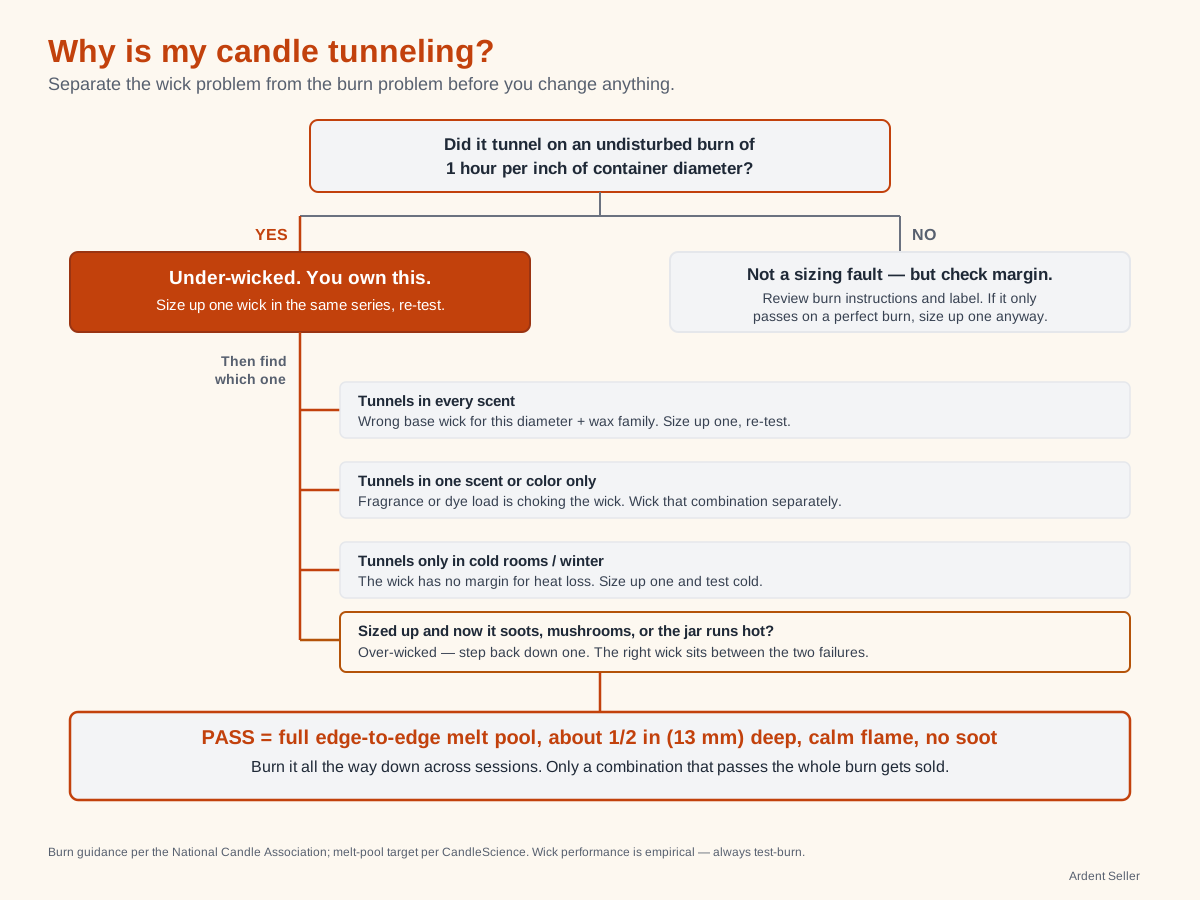
Symptom: wax on the wall after a full, undisturbed burn
This is the base case, and the fix is mechanical.
An under-wicked candle "will not burn out to the edge of the container but will instead burn down the middle," because a wick that's too small "cannot efficiently burn off all of the fuel (wax + fragrance) and generate enough heat to form a good melt pool." The target you are aiming at is specific: by the same guidance, a properly wicked candle has "an appropriately sized flame that does not flicker, with a melt pool that has extended to the edge of the container and is about 1/2 inch (13 mm) deep" (CandleScience (opens in new tab)).
The fix: size up one wick within the same series and burn it again. Not two sizes — one. Wick series are built as ladders for exactly this reason, and jumping two rungs is how a tunneling problem becomes a sooting problem in a single afternoon.
Before you size up, rule out the cheap explanation: an over-trimmed wick can fake this symptom. Trim a wick down to a nub and it can't generate enough heat either, which looks identical to under-wicking in the jar. CandleScience's guidance is to keep the wick trimmed between ¼ and ½ inch for this exact reason (CandleScience (opens in new tab)); trimming to about a quarter inch before each burn is also the discipline the NCA's safety guidance (opens in new tab) asks of consumers ("Trim the wick to ¼ inch before each use to prevent high flames and soot").
Rule of thumb: If you're changing more than one variable between test burns, you aren't testing. You're guessing with extra steps.
Symptom: it passed your test but tunnels in customers' homes
This one stings, because the test wasn't wrong — it was too kind.
Test burns happen on a clean bench, in a room you keep at a working temperature, with a jar you're watching. Customer burns happen on a drafty windowsill in February, next to an air vent, in a 62-degree room, with the wick untrimmed since the second burn. Every one of those conditions pulls heat away from the melt pool. A wick sized to just barely pass on your bench has no margin left for any of them.
The tell is a pattern: a jar that reaches the wall at hour three in your workshop, and never quite does in the field. That's a candle sitting on the exact edge of its window.
The fix: the same as the base case — size up one wick. The reason is different, though. You're not correcting a failed test. You're buying margin.
There's a business decision buried here that has nothing to do with wax. Every size-up costs slightly more wick and burns slightly more fuel per hour, which shortens burn time. Trading a little burn time for a candle that works in a cold room is almost always the right call, but it is a call, and it should be made once, on purpose, and written down — not rediscovered every time a customer emails a photo of a tunnel.
Symptom: one scent tunnels, the others don't
Same wax. Same jar. Same wick. Four scents, and only the amber one carves a canyon.
Fragrance oil is not a passenger — it changes the fuel. Per an industry supplier's wick reference, Lone Star Candle Supply (opens in new tab), a heavy fragrance and dye load is one of the causes of mushrooming — which tells you load is something the wick has to burn through, not a neutral additive. So treat load as a variable to test rather than a constant to assume: a scent that behaves at a modest load can misbehave at a heavier one in an otherwise identical jar. This is why a wick recommendation is only ever a starting point for a combination, and why the Candle Wick Size Selector asks for your wax family and fragrance load rather than just a diameter — paraffin sizes down a step, coconut blends and beeswax size up, and a high or max fragrance load steps the recommendation up again.
The fix: stop treating "4 oz tin" as the unit of wicking. The unit is wax × vessel × fragrance × dye. If you carry six scents in one jar, you have six recipes, and at least a couple of them will want a different wick than the others. That feels like a lot until you realize the alternative is a permanent complaint rate on two of your six SKUs.
This is also a common place for record-keeping to quietly fall apart. Six scents across three jar sizes is eighteen combinations, each with its own wick decision — eighteen facts sitting in a notebook, a phone photo, and someone's memory. Add a second wax and it's thirty-six. When a wick series gets discontinued (and it will), you need to know every recipe it touched. In Ardent Seller, the wick is a real inventory item inside the recipe rather than a note: each combination carries the wick that actually passed its burn, every pour decrements wick stock and rolls the cost into the per-candle COGS, and you can see which recipes a given wick SKU is load-bearing for before you reorder.
Symptom: the tunnel only shows up in winter
Ambient temperature is a real input, and it's the one nobody logs.
A jar in a 68-degree room and the same jar on a cold windowsill are burning under different conditions. Cold glass pulls heat out of the melt pool, and a wick with no margin loses. If your complaint rate has a season, you don't have a mystery — you have a wick sized for July.
The fix: test in the worst plausible condition, not the most convenient one. Run the marginal combinations in the coldest room you have access to, and size for that. A candle that's slightly over-wicked for a warm August evening is a candle that still works in January; the reverse is a support ticket.

Symptom: you sized up and now it soots
This is the over-correction — the other wall of the window, and it arrives fast if you jump two sizes.
Over-wicking produces a specific set of tells, and they tend to show up together. Trade guidance from candle suppliers pairs each with the same root cause — per Lone Star Candle Supply (opens in new tab), an industry supplier's wick reference:
- Soot and black smoke — a flame too large for the wax, or simply an untrimmed wick.
- Mushrooming — a wick that's too large, a heavy fragrance or dye load, or a candle left burning too long.
- A tall or flickering flame — a wick that's too large, or one that wasn't trimmed to length.
The NCA describes the mushrooming mechanism from the consumer side — burn a candle too long and carbon collects on the wick, "leading it to 'mushroom.' The wick will then become unstable and produce a dangerously large flame" (National Candle Association (opens in new tab)). A jar that runs uncomfortably hot is worth adding to your own pass/fail list too, even though it isn't in the supplier symptom tables: it's the tell that the flame is putting more energy into the vessel than the vessel was chosen to take.
Some of those symptoms are cosmetic and some are safety issues, and it's worth being clear about which is which. Soot on the glass is ugly and generates refunds. A jar hot enough to be unpleasant to hold, or a flame running well past a normal height, is a different category of problem — the fire-safety standard for candles, ASTM F2417, "establishes maximum flame height, tip-over limits, secondary-ignition proscriptions, and end-of-useful life specifications," while a companion standard, F2179, "establishes scratch test and temper specifications for the proper annealing of glass containers used for candles, as well as thermal shock differential requirements" (NCA's safety-standards overview (opens in new tab)). The full standards are copyrighted and sold by ASTM rather than published free, and the NCA's own summaries note they "do not provide the actual specifications" — but the direction of travel is unambiguous. A tall flame and a hot jar are not a style choice.
The fix: step back down one size. The correct wick is very often the one between the tunneling failure and the sooting failure, which is exactly why you move one rung at a time. Find both walls and you know where the window is.
Rule of thumb: When a combination tunnels at wick N and soots at wick N+1, the answer isn't always a different size — sometimes it's a different series. Wick series are built around different core constructions, and a series change can shift the burn characteristics when the ladder itself has no rung that fits. Check the construction notes on your supplier's series guide rather than assuming two series ladder the same way.
The burn test that actually settles it
Wick performance is empirical. Every wax additive, dye load, fragrance supplier, vessel material, and room temperature moves the answer, which means the chart gives you a hypothesis and the burn gives you a fact. Test like it.
- Cure first. Judging a candle before it's cured tests the wrong candle. Soy and coconut blends commonly want one to two weeks; go by your wax's technical data sheet, not the clock in your head.
- Trim to a quarter inch. Every burn, including the first. An untrimmed wick fakes over-wicking; an over-trimmed wick fakes under-wicking.
- Burn one hour per inch of diameter, undisturbed. A 3-inch jar gets a 3-hour burn on a level, heat-safe surface, away from drafts. This is the condition the pass/fail is defined against.
- Measure the pool, don't eyeball it. Full to the wall, roughly half an inch deep. Wax on the glass is a fail; a pool much deeper than that is a warning.
- Read the flame and the glass. Calm and steady, no soot on the container, no mushroom, jar warm rather than hot.
- Burn it all the way down across sessions. Most sizing failures are hiding in the bottom third, where the flame sits deep in the glass and heat behaves differently. A candle that passes at hour three and overheats at hour twenty has not passed. Keep sessions within the four-hour ceiling the NCA recommends (opens in new tab) ("it is recommended that candles do not burn for longer than four hours") and let it cool at least two hours before relighting.
- Verdict, in writing. PASS or FAIL, with the reason. Only a combination that passed the whole burn gets sold.
If you want the starting hypothesis without digging through seven manufacturer charts, the Candle Wick Size Selector takes your diameter, wax family, and fragrance load and returns two to four candidate wicks across the CD, CDN, ECO, HTP, LX, RRD, and Zinc series, with the wax-family and fragrance-load shifts already applied. It gets you to the right rung of the right ladder. The burn still decides.
What to write down, and why it pays
The reason candle makers solve the same tunnel twice is that the first solution lived in someone's memory.
At minimum, a test burn is worth six fields: the combination (wax, vessel, fragrance, load, dye), the wick tried, the cure days, the full-melt time, what the flame and glass did, and the verdict. That's a row. Six months from now, when a jar tunnels, that row is the difference between "we tested CD-10 and CD-12, and CD-12 sooted at hour eighteen" and starting over.
The compounding version of this shows up at scale. When wick, wax, fragrance, and vessel all live in the recipe as tracked inventory items rather than in a notebook — the way production runs and batch tracking work in Ardent Seller — the wick that passed is the wick that pours, every time, and the batch lot ties any future complaint back to the exact materials that made it. A supplier discontinues CD-12 and you can see the six recipes that just became urgent instead of finding out one angry email at a time.
The reframe that fixes the most candles
The instinct when a candle tunnels is to reach for the customer-education answer, because it's cheaper: better burn instructions, a card in the box, a note in the listing. Do all of that — the instructions genuinely matter, and a buyer who blows out a fresh jar after thirty minutes really can create a ring that later burns fight.
But instructions are a seatbelt, not a steering wheel. If the jar only works for a buyer who reads the card, follows it exactly, and never gets interrupted, then the candle is wicked to the edge of its window and the field will find the edge for you. Wick for the burn people actually give a candle, and the instruction card becomes what it should be — a small improvement on an already-working product, rather than the only thing holding it together.
Pull the four worst offenders in your catalog. Burn one of each, properly, one hour per inch, all the way to a full pool. You'll know by dinner whether you've been shipping a wick problem and calling it a customer problem.
Ardent Seller keeps the answer where you can act on it — wick, wax, fragrance, and vessel tracked as real inventory inside each recipe, so the combination that passed its burn test is the one that gets poured, costed, and reordered. Start a free account and set up your first candle recipe with the wick that actually earned its place. No credit card required.
Related reading
- Candle Maker Cost Math — once the wick is settled, this is how wax yield, fragrance load, and vessel cost roll into a per-candle price you can defend.
- Best Thermometer for Candle Making — if the wick checks out and the burn is still uneven, the pour temperature is the next variable, and this is how to pick a thermometer that can actually measure a 5°F change.
- How Many Candles Does a Pound of Wax Make? — the wick you settle on fixes your fill line, and the fill line decides how many jars each pound of wax pours.
- Soap Maker's Guide to Tracking Ingredients, Batches, and Costs — the same recipe-and-batch spine applied to cold process, if you pour candles and soap out of one workshop.
- Recipe Costing 101 — the foundation underneath all of it: what actually belongs in a unit cost, and what a unit cost commonly leaves out.
- Candle Spreadsheet vs. Inventory Software — once you carry a wick size per vessel across a dozen scents, this is where a spreadsheet stops keeping up, and how to tell when to move off it.
Free resources
Free companion downloads if you want to put any of this into practice:
- Candle Wick Size Selector — enter diameter, wax family, and fragrance load and get starting wick candidates across seven series, with the test-burn protocol built in.
- Candle Wick-Test & Fragrance Log — the printable that turns each burn test into a row: combination, wick, cure days, full-melt time, verdict.
- Candle & Soap Fragrance Load Calculator — because the fragrance percentage that choked your wick is the first number to check when one scent tunnels and the others don't.
This article is provided for educational purposes only and does not constitute legal, regulatory, or product-safety advice. Wick recommendations are starting points for your own test burns, not deterministic answers — wick performance is empirical and shifts with wax additives, dye load, fragrance supplier, vessel material, and ambient conditions. Candle fire-safety standards and labeling requirements vary by jurisdiction and change over time. Consult your wax and fragrance suppliers' technical data sheets, the current ASTM candle standards, and a qualified compliance consultant before selling candles to the public.