A design patent application filed today waits an average of 12.1 months for its first office action and 21.3 months to reach final disposition. A utility application waits 20.8 and 29.3 (USPTO Patents Dashboard (opens in new tab) and Design Dashboard (opens in new tab), data through July 2026).
Read those numbers against the commercial life of a handmade product. A seasonal ornament, a colorway that sells for two summers, a design you will have iterated past by next spring — the protection arrives after the thing it protects has stopped mattering. That mismatch, not the filing fee, is the reason most makers who ask about patents should not file one.
But "most" is not "all", and the makers who should file are usually the ones who never ask, because they assume patents are for laboratories. What follows works through the question in the order that costs you the least — subject matter first, then the clock, then cost, then the cheaper alternatives. Fail any one and you can stop, and the whole sequence is recapped as a five-gate checklist at the end.
Is it patentable subject matter at all?
There are two kinds of patent a maker might plausibly want, and they protect opposite things.
A utility patent covers how something works — a mechanism, a process, a composition. A design patent covers how something looks. The statute is narrow and worth reading in full: whoever invents any "new, original and ornamental design for an article of manufacture" may obtain a patent for it (35 U.S.C. § 171 (opens in new tab)). The USPTO's own guide expands that to "the visual ornamental characteristics embodied in, or applied to, an article of manufacture" (design patent application guide (opens in new tab)).
Three words in that phrase do most of the work.
Ornamental means it cannot be there for a functional reason. If the shape exists because it is the only shape that works, it is not ornamental, and a design patent is the wrong instrument.
New and original means novel against everything already public — not merely different from what your competitors sell, but different from every prior design anywhere. Craft categories are ancient and crowded. A tapered stoneware mug with a pulled handle is not new because you designed yours independently.
Article of manufacture means the design has to be embodied in a physical thing. Surface ornamentation alone is not enough; the drawings must show it applied to an article, with the article itself graphically distinguished — typically drawn in broken lines (USPTO design patent guide (opens in new tab)).
There is one further constraint that surprises people: a design patent application may contain only a single claim — "more than one claim is neither required nor permitted" (37 CFR § 1.153 (opens in new tab)). Designs that are independent or distinct must be filed in separate applications. Two vases with different surface ornamentation creating distinct appearances are two applications, not one. If you are picturing a patent that covers "my whole product line", that is not a thing that exists.
Watch for this pitch. The USPTO warns in its own design patent guide that some invention development organizations "may recommend that you add ornamentation to your product in order to render it eligible for a design patent, but not really explain to you the purpose or effect of such a change." Because minimal differences between similar designs can each be patentable, the resulting patent may be worth very little. Adding a swirl to qualify for a patent protects the swirl.
If your product's value is the look and the look is genuinely unusual, keep going. If its value is the craftsmanship, the materials, or the brand — three things patents do not touch — skip to the cheaper protections.
The clock that may have already run out
This is the gate that closes silently, and the one that most often makes the rest of the question academic.
The patent system is filing-date driven. Under 35 U.S.C. § 102(a)(1) (opens in new tab), an invention that was "in public use, on sale, or otherwise available to the public before the effective filing date" is prior art — including when the person who made it public was you. The saving provision is § 102(b)(1): a disclosure made one year or less before the effective filing date is not prior art if it came from the inventor.
So you get twelve months. The USPTO states the consequence plainly: "A public disclosure (e.g., publication, public use, offer for sale) more than one year before the provisional application filing date would preclude patenting in the United States. Keep in mind that a publication, use, sale, or other activity only has to be made available to the public to qualify as a public disclosure" (provisional application page (opens in new tab)).
For a maker, "available to the public" arrives early and casually:
- A table at a spring craft fair.
- A listing going live, whether or not anything sold.
- A photo posted to a public account.
- A wholesale line sheet emailed to buyers.
- The first sale to anyone who is not under an NDA.
Whichever came first started the clock, and that is often not a date anyone wrote down. It is a records problem before it is a legal one — and it is the reason it is worth being able to answer "when did this design first go out the door?" from something other than memory. If your listings, first sales, and market dates live in one place with dates attached, the question takes a minute. Ardent Seller keeps that history as a side effect of ordinary inventory and transaction tracking, which is the cheap version of a lab notebook.
There is a second consequence that catches people planning to sell abroad. Many countries operate absolute novelty: no grace period at all. The USPTO flags it directly — a pre-filing disclosure, "although protected in the United States, may preclude patenting in foreign countries." If Europe or the UK matter to you, the disclosure that merely started a clock domestically has already ended the question overseas.
If your first public disclosure was more than a year ago, this gate is closed. No fee, no attorney, and no argument reopens it — go straight to the cheaper protections.
Design or utility — and what each actually costs
Assume everything up to this point has cleared. Now the shape of the question changes, because the two patent types differ on nearly every axis that matters to a small business.
| Design patent | Utility patent | |
|---|---|---|
| Protects | Ornamental appearance | How it works |
| Term | 15 years from grant (35 U.S.C. § 173 (opens in new tab)) | 20 years from filing (35 U.S.C. § 154 (opens in new tab)) |
| Claims allowed | One | Multiple |
| Maintenance fees | None (37 CFR § 1.362(b) (opens in new tab)) | Due at 3.5, 7.5 and 11.5 years |
| First office action | 12.1 months | 20.8 months |
| Total pendency | 21.3 months | 29.3 months |
The maintenance-fee row is the one that quietly decides affordability. Design patents require none — the MPEP is explicit (opens in new tab) that "maintenance fees are not required for any plant patents or for any design patents." A utility patent, by contrast, has to be fed three times or it lapses.
Here is what the USPTO actually charges, taken from the current fee schedule (opens in new tab). These are the fees required to take an application to grant: basic filing, search, examination, and issue.
| Undiscounted | Small entity | Micro entity | |
|---|---|---|---|
| Design — filing, search, examination, issue | $2,600 | $1,040 | $520 |
| Utility — filing, search, examination, issue | $3,290 | $1,246 | $658 |
| Utility — three maintenance fees over the full term | $14,470 | $5,788 | $2,894 |
| Provisional application (12 months, not examined) | $325 | $130 | $65 |
One caveat on that table: the utility small-entity total assumes electronic filing, so adding the standard rows yourself gives $1,316 rather than $1,246. The fee-code arithmetic is in Sources and methodology.
Two things jump out. First, a design patent taken to grant costs a qualifying micro entity $520 in government fees — genuinely affordable. Second, the utility maintenance schedule is four to five times the cost of getting the patent in the first place, and it runs for a decade after the product may have stopped selling.
Micro entity status is where the discount lives, and it has two independent tests. Your gross income must not exceed the maximum qualifying figure, which the USPTO reset to $251,190 as of September 9, 2025. Separately, you must not have been named as an inventor on more than four previously filed applications — so the fifth application is the last one that can use the discount, and once you hit the limit no future filing qualifies, ever. Provisional applications do not count toward that limit; design, utility, and continuation applications do (USPTO micro entity status (opens in new tab)).
The number the fee schedule does not print
Government fees are the small, knowable part. Preparing the application is the large, variable part, and there is no published schedule for it because it is professional time.
The USPTO does not pretend otherwise. Its guidance says the office "always recommends using a registered patent attorney or agent to assist in preparing your application", while acknowledging in the same breath "that the cost of legal assistance can be prohibitive, particularly for independent inventors and small businesses" (patent essentials (opens in new tab)). It runs a Pro Se Assistance Program for people who file alone, and a Patent Pro Bono Program (opens in new tab) that matches volunteer patent attorneys with inventors whose gross household income is under three times the federal poverty guidelines — though the office notes that regional programs may apply different criteria.
The pro bono program's existence is itself the honest signal here: the government built a charity channel because the real cost of a patent is not the fee schedule.
Three cheaper protections that usually fit better
For most handmade products, one of these is a better answer than a patent — cheaper, faster, and aimed at what a copycat actually takes.
Copyright attaches automatically the moment you fix the work in tangible form. No filing, no fee, no waiting. The statute covers "works of artistic craftsmanship insofar as their form but not their mechanical or utilitarian aspects are concerned" (17 U.S.C. § 101 (opens in new tab)) — which is a precise way of saying it protects the art on the object, not the object's usefulness.
Where the object is itself useful, the test is separability, and the Supreme Court settled its shape in Star Athletica, L.L.C. v. Varsity Brands, Inc. A design feature is eligible for copyright "only if the feature (1) can be perceived as a two- or three-dimensional work of art separate from the useful article and (2) would qualify as a protectable pictorial, graphic, or sculptural work — either on its own or fixed in some other tangible medium of expression — if it were imagined separately from the useful article into which it is incorporated" (slip opinion (opens in new tab), decided March 22, 2017).
Applied to craft work, that line is usually legible. An original surface pattern printed on a tote clears it — imagine the pattern on canvas instead and it is still a picture. The silhouette of a functional mug usually does not, because there is nothing left once you imagine the mug away. Registration costs $45 for a single author registering one work not made for hire, or $65 on the standard application (U.S. Copyright Office fees (opens in new tab)) — roughly a twelfth of the cheapest design patent, with no examination wait.
Trademark protects the name and branding, which is frequently the asset a copycat cannot take even when they can lawfully make a similar object. It is a different question with a different process, and we walk a real filing end to end in How to Trademark a Handmade Business Name.
Speed and secrecy. Not filing is a strategy, not a failure. A design patent published two years from now protects a product you may already have replaced; a technique you simply do not explain protects itself for as long as nobody works it out. Neither gives you a cause of action, but both cost nothing and neither has a deadline you can miss.
The decision tree, in order
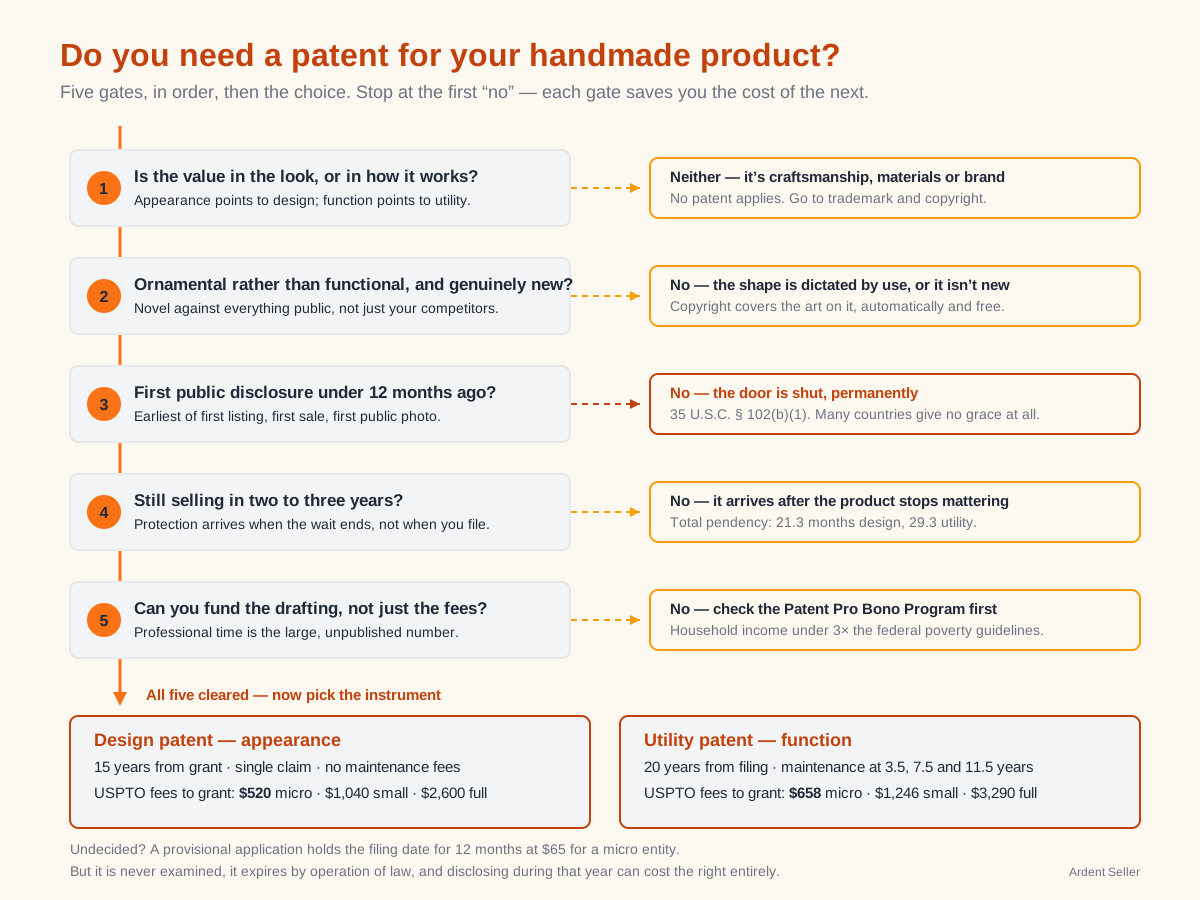
Five gates, walked in sequence. Stop at the first "no".
- Is the value in the look, or in how it works? If neither — if it is materials, craftsmanship, or brand — no patent applies. Go to trademark and copyright.
- Is that look ornamental rather than dictated by function, and genuinely new against everything already public? If not, a design patent is unavailable regardless of budget.
- Was your first public disclosure less than twelve months ago? Count from the earliest of first listing, first sale, first public photo, first market table. If it was longer, the door is shut in the US, and likely was shut abroad the day you posted.
- Will this product still be selling in two to three years? Pendency is 21.3 months for a design and 29.3 for a utility application. If the answer is no, you are buying protection that arrives after the fact.
- Can you fund the professional drafting, not just the fees? If not, check the Patent Pro Bono Program against the three-times-poverty-guidelines threshold before assuming the answer is no.
Then, and only then: design patent for appearance, utility patent for function — and if you need time to decide, a provisional application holds your filing date for twelve months at $65 for a micro entity.
That last option deserves a warning rather than a recommendation. A provisional is never examined and cannot itself become a patent; it expires by operation of law twelve months after filing. Worse, the USPTO cautions that an applicant who publicly discloses during that window "may also lose the right to ever patent the invention" if the year runs out before a nonprovisional is filed. A provisional buys a year of thinking time only if someone is watching the calendar.
When a patent is genuinely the right call
There is a shape of maker business where the answer flips, and it is worth naming so the analysis above does not read as blanket discouragement.
It looks like this: the product is a tool or a mechanism rather than a decorative object; it solves a problem the maker hit first because they work in a niche; the design is stable enough that it will still be the product in five years; and the plan involves licensing or wholesale at volume rather than one-off sales. A jig, a fixture, a clasp, a closure, a rack — things other makers buy because of what they do, not how they look. In that world a utility patent is a business asset, the maintenance schedule is affordable against the revenue, and the twenty-nine-month wait is tolerable because the product is not seasonal.
If that is your product, the cost of not asking a patent attorney is higher than the consultation. And the first thing they will ask is when you first showed it publicly — so know that date before you book the call.
For everyone else, the honest sequence is: copyright covers the art for free, trademark covers the name for a known fee, and the money a patent would have consumed buys inventory, photography, or a booth. Knowing which of your designs actually earn — and which you would even want to defend — is a bookkeeping question long before it is a legal one. Start free and put dates on your products; the record you build is the same record a patent attorney would ask you for.
Sources and methodology
All figures reflect sources retrieved on 2026-08-25. USPTO fees change periodically and pendency figures are revised monthly, so verify current values before filing.
- USPTO Fee Schedule (opens in new tab) — every filing, search, examination, issue, and maintenance fee in the two cost tables, at all three entity tiers. One cell needs its arithmetic shown: the utility small-entity total uses the schedule's separate electronic-filing basic fee for small entities (fee code 4011, $70) rather than the standard small-entity basic filing fee (2011, $140), which is why adding the standard rows gives $1,316. The $70 rate is the realistic one — it applies when you file through Patent Center, and a utility application filed on paper owes a further $200 non-electronic surcharge on top, so paper costs more either way. Every other cell in both tables uses the standard fee code for its tier.
- USPTO Patents Dashboard (opens in new tab) and Design Dashboard (opens in new tab) — pendency figures, "Patents data at a glance July 2026", fiscal-year-to-date through July 2026. Utility figures cover utility, plant and reissue applications collectively.
- 35 U.S.C. § 102 (opens in new tab) — the prior-art rule and the one-year grace period at § 102(b)(1).
- 35 U.S.C. § 171 (opens in new tab) and § 173 (opens in new tab) — design patent subject matter and the 15-year term.
- 35 U.S.C. § 154 (opens in new tab) — the 20-year utility term measured from filing.
- 37 CFR § 1.153 (opens in new tab) — the single-claim rule for design applications ("more than one claim is neither required nor permitted").
- 37 CFR § 1.362 (opens in new tab) and MPEP 2504 (opens in new tab) — no maintenance fees for design or plant patents, and the 3.5 / 7.5 / 11.5-year schedule for utility patents. Both are linked because eCFR.gov blocks automated access; the MPEP page reproduces the regulation verbatim.
- USPTO design patent application guide (opens in new tab) — the ornamental-characteristics definition, the single-claim rule, and the invention-development-organization warning.
- USPTO provisional application page (opens in new tab) — 12-month pendency, the public-disclosure warning, and the foreign-filing consequence.
- USPTO micro entity status (opens in new tab) — the $251,190 gross income limit effective September 9, 2025, and the application filing limit.
- USPTO Patent Pro Bono Program (opens in new tab) and patent essentials (opens in new tab) — eligibility threshold and the office's guidance on representation.
- 17 U.S.C. § 101 (opens in new tab) — definitions of "useful article" and pictorial, graphic and sculptural works.
- Star Athletica, L.L.C. v. Varsity Brands, Inc. (opens in new tab) — the two-part separability test, decided March 22, 2017.
- U.S. Copyright Office fees (opens in new tab) — $45 single-author electronic registration, $65 standard application.
Related reading
- Someone Copied Your Handmade Product — the other half of this question: what your options actually are once a copycat listing is already live, and why the cease-and-desist everyone recommends rarely does what they think.
- How to Trademark a Handmade Business Name — a real USPTO filing walked end to end, including the five situations where registering is money you will not get back.
- Can I Sell Fan Art Legally? — the reverse problem: what happens when the intellectual property in question is somebody else's.
Free resources
Free companion downloads if you want to put any of this into practice:
- Legal Documents Checklist for Craft Sellers — the paperwork inventory to run before you spend anything on IP, so you find out what you already have.
- Craft Seller Startup Checklist — where protection decisions sit relative to everything else a new maker business has to get right first.
This article is provided for educational purposes only and does not constitute legal, tax, or accounting advice. Patent, copyright, and trademark requirements vary by jurisdiction and change frequently, and the application of these rules to any specific product is fact-dependent. Consult a qualified intellectual property attorney before filing an application, making a public disclosure you intend to rely on, or making protection decisions that affect your business.