The US Copyright Office runs a public FAQ about fair use. Buried in it, with no ceremony at all, is the sentence that should end roughly half the arguments in every maker group on the internet:
"There are no legal rules permitting the use of a specific number of words, a certain number of musical notes, or percentage of a work." — US Copyright Office, Fair Use FAQ (opens in new tab)
No percentage. Not 30%, not 20%, not "as long as you change three things." The rule everybody quotes to everybody else does not exist and never has.
The actual answer: selling fan art, character crafts, or anything else that reproduces someone else's protected expression or brand is infringement by default. The exits are narrower and more specific than the folklore suggests — the work is in the public domain, you hold a license, you are only naming a brand to describe what your product fits, or the use qualifies as fair use. Which of the sections below applies to you depends on which of those you are relying on. What does not work is a percentage.
Throughout, there is a composite maker — call her Nadia. She is invented for illustration, not a real customer. Nadia sews tote bags, has 40 of them cut and ready, and the fabric she bought at full retail has small cartoon foxes on it that she is fairly sure belong to somebody.
Is the "30% rule" real?
The common belief: If you change a character or design by some threshold — 30% is the number that circulates most — it becomes your own work and you can sell it.
What the law actually says: There is no threshold. The Copyright Office says so in the sentence quoted above, and the statute never contained one to begin with.
What the statute does contain is a definition. A derivative work is "a work based upon one or more preexisting works … or any other form in which a work may be recast, transformed, or adapted" (17 U.S.C. § 101 (opens in new tab)). Preparing one is an exclusive right reserved to the copyright owner under 17 U.S.C. § 106(2) (opens in new tab). Notice that "transformed" appears in the definition of the thing you are not allowed to make. Under § 101, changing a work is not by itself permission — it is part of what makes the result a derivative work. (Keep that statutory "transformed" separate from the "transformative use" idea courts weigh under fair use below. They share a root word and pull in opposite directions, which is one reason this subject generates so much confident nonsense.)
The actual defense is fair use, and it is a four-factor balancing test rather than a rule you can satisfy with a percentage (17 U.S.C. § 107 (opens in new tab)):
- The purpose and character of the use, "including whether such use is of a commercial nature or is for nonprofit educational purposes"
- The nature of the copyrighted work
- "The amount and substantiality of the portion used in relation to the copyrighted work as a whole"
- "The effect of the use upon the potential market for or value of the copyrighted work"
Read factor one again and then look at your shop. Selling is commercial by definition. That does not automatically lose you the case — a commercial parody can be fair use, which is what the Supreme Court held in Campbell v. Acuff-Rose Music, Inc. (opens in new tab), 510 U.S. 569 (1994), when it threw out a lower court's rule that commercial use was presumptively unfair — but it does mean you start the analysis on the back foot, and no amount of redrawing moves you off it. Factor three is where people think the 30% rule lives. It is a weighing consideration, not a safe harbor, and courts weigh it against a work's most recognizable elements rather than its surface area.
The practical version: if a stranger can look at your product and name the character, you have taken the part that matters.
Does "handmade" change anything for character crafts?
The common belief: Mass production is what gets you sued. Something made by hand, one at a time, in a spare bedroom, is a different category.
What the law actually says: There is no handmade exception in the Copyright Act. There is no handmade exception in the Lanham Act. Nobody has ever written one.
This myth survives because it feels like it should be true. It maps onto a real moral intuition — a person hand-painting a character onto a tumbler is doing something different from a factory stamping out 50,000 of them. The law does not share the intuition. Hand-painting is reproduction. The two hours it took you is legally invisible.
Effort is not permission. It is worth saying plainly because the belief is load-bearing for a lot of shops: makers who would never dream of buying bootleg merchandise wholesale feel entirely comfortable producing the same thing themselves, on the theory that the labor launders it.
Can I sell things made from fabric I lawfully bought?
Here is the one that is genuinely unsettled — and any answer delivered with total confidence, in either direction, should make you suspicious.
First sale only covers reselling the fabric itself
Start with the doctrine everyone reaches for, and note carefully where it stops. The first sale doctrine says that "the owner of a particular copy or phonorecord lawfully made under this title … is entitled, without the authority of the copyright owner, to sell or otherwise dispose of the possession of that copy" (17 U.S.C. § 109(a) (opens in new tab)). Buy a book, resell the book. Buy three yards of licensed cotton, resell the three yards of licensed cotton. Nobody disputes that part.
But read the first six words of the statute: notwithstanding the provisions of section 106(3). Section 106(3) is the distribution right. First sale limits that right and no other — it says nothing about § 106(2), the right to prepare derivative works. So the moment you cut the fabric up and sew it into something, first sale stops answering the question. This is the single most common mistake in maker-forum legal advice, and it is the one that will lose you an argument with a lawyer in about ten seconds.
The split: is the finished item a derivative work?
The real question is narrower and stranger: is the thing you sewed a "derivative work" at all? On that, the courts genuinely disagree.
- In Mirage Editions, Inc. v. Albuquerque A.R.T. Co. (opens in new tab), 856 F.2d 1341 (9th Cir. 1988), a company bought art books, cut out the plates, and mounted them on ceramic tiles. The Ninth Circuit held that this created an infringing derivative work — and rejected the first sale argument for exactly the reason above.
- In Lee v. A.R.T. Co. (opens in new tab), 125 F.3d 580 (7th Cir. 1997), the same defendant did essentially the same thing with a different artist's notecards. The Seventh Circuit held it was not a derivative work — mounting added no originality, making it closer to framing a painting than to adapting it — and said outright that the ruling created a conflict among the circuits.
- In Precious Moments, Inc. v. La Infantil, Inc. (opens in new tab), 971 F. Supp. 66 (D.P.R. 1997), a retailer had baby bedding made from lawfully purchased Precious Moments fabric. The court refused the preliminary injunction on the copyright claim — not because first sale licensed the sewing, but because it followed the same originality reasoning the Seventh Circuit later adopted and found the finished bedding was not a derivative work in the first place.
Note what that lineup actually is. Two of the three cases are about mounting a purchased print, not sewing. The one that is genuinely about fabric is a single district court decision, and it landed on the Lee side of a split the Supreme Court has left standing — it denied review in Mirage back in 1989 (Albuquerque A.R.T. Co. v. Mirage Editions, Inc., 489 U.S. 1018) and, as of this writing, has not taken the question up since.
So the honest answer to "can I sew and sell this?" is not "yes, first sale covers me." The question is whether your finished item is original enough to count as a derivative work. One district court said sewn bedding was not. The Ninth Circuit takes a broader view of what counts. Nobody has settled which is right. No craft blog telling you otherwise has read the cases.
What this means for your shop
Two practical notes that matter more than the doctrine:
The "for personal use only" printed on the selvage is a claim, not a statute. A fabric mill printing that phrase is asserting a position about what its license permits downstream. It is not a law, you did not sign a contract at the cutting counter, and courts have not uniformly agreed with the assertion. It is also not nothing — it tells you exactly who will file the complaint.
You will almost never get to make the legal argument. Nadia's real exposure is not a federal courtroom. It is a listing removal, which arrives by email, requires no judge, and costs the rights holder almost nothing to send. More on that below.
The practical version: the more your finished item's appeal rests on the printed characters rather than on what you made of them, the more exposed you are. That exposure grows again if you sell somewhere a takedown notice can reach. Nobody can tell you exactly where the line falls, because the courts have not drawn it.
Nadia's call, for what it is worth: she finishes the 40 bags and sells them at markets and direct, where a takedown mechanism does not exist, and does not list them on a marketplace where one does. That is a risk decision, not a legal conclusion. It is the kind of decision you can only make deliberately if you know the ground is contested.
Copyright or trademark — which one is actually stopping me?
The common belief: It is all "copyright," one body of rules, one expiry date.
What the law actually says: Two separate regimes are usually in play, and they fail differently.
Copyright protects creative expression and it expires. Trademark protects "any word, phrase, symbol, design, or a combination of these things that identifies your goods or services" and "identifies the source" of them (USPTO, What is a trademark? (opens in new tab)). It is about consumer confusion over origin, not about creativity — and as long as the owner keeps using and defending it, it does not expire at all.
This is why "but it's public domain now" can be both true and useless. On January 1, 2026, US works published in 1930 entered the public domain, including Betty Boop's first appearances and the character then known as Rover, later Pluto (Duke Center for the Study of the Public Domain (opens in new tab)). The 1930 cartoons are free to use. The brands those characters anchor are live trademarks, later versions of the characters carry their own copyrights, and a tote bag that makes a shopper think a studio authorized it is a trademark problem regardless of what the copyright clock says.
Sports and collegiate logos sit almost entirely on the trademark side. So do brand names, wordmarks, and slogans. If your design's appeal is "people will recognize the team," you are in trademark territory, and there is no expiry to wait out.
Does selling "only a few" keep me under the radar?
The common belief: Enforcement is for volume sellers. A dozen items is beneath anyone's notice.
What the law actually says: There is no de minimis exemption, and the damages are not measured in the units you think.
Copyright statutory damages run "not less than $750 or more than $30,000" per work infringed, and up to $150,000 where infringement is willful (17 U.S.C. § 504(c) (opens in new tab)). Counterfeit-mark damages under the Lanham Act run from $1,000 to $200,000 per counterfeit mark per type of goods, and up to $2,000,000 for willful use (15 U.S.C. § 1117(c) (opens in new tab)). Those figures attach per work and per mark — selling three items or three hundred does not change the multiplier.
That said, the lawsuit is not the realistic threat for a shop Nadia's size. The realistic threat is quieter and much faster.
Online marketplaces take listings down first and evaluate later, and they do it for reasons that have nothing to do with your case. Safe-harbor protection under 17 U.S.C. § 512(c) (opens in new tab) requires a service provider to respond "expeditiously to remove, or disable access to," material once it receives a compliant notice. And § 512(i)(1)(A) (opens in new tab) makes that protection conditional on the provider having "adopted and reasonably implemented … a policy that provides for the termination in appropriate circumstances of subscribers and account holders … who are repeat infringers."
Read that second clause as a seller. The platform's own legal shield depends on it terminating repeat infringers. Marketplaces including Etsy publish intellectual property policies built on exactly this structure (Etsy, Intellectual Property Policy (opens in new tab)). You are not arguing with a rights holder. You are arguing with a company whose safe harbor costs nothing to preserve by removing your listing and quite a lot to risk by keeping it.
The number that should worry you is not $150,000. It is the number of notices your shop can absorb before the account goes.
So what can you actually sell?
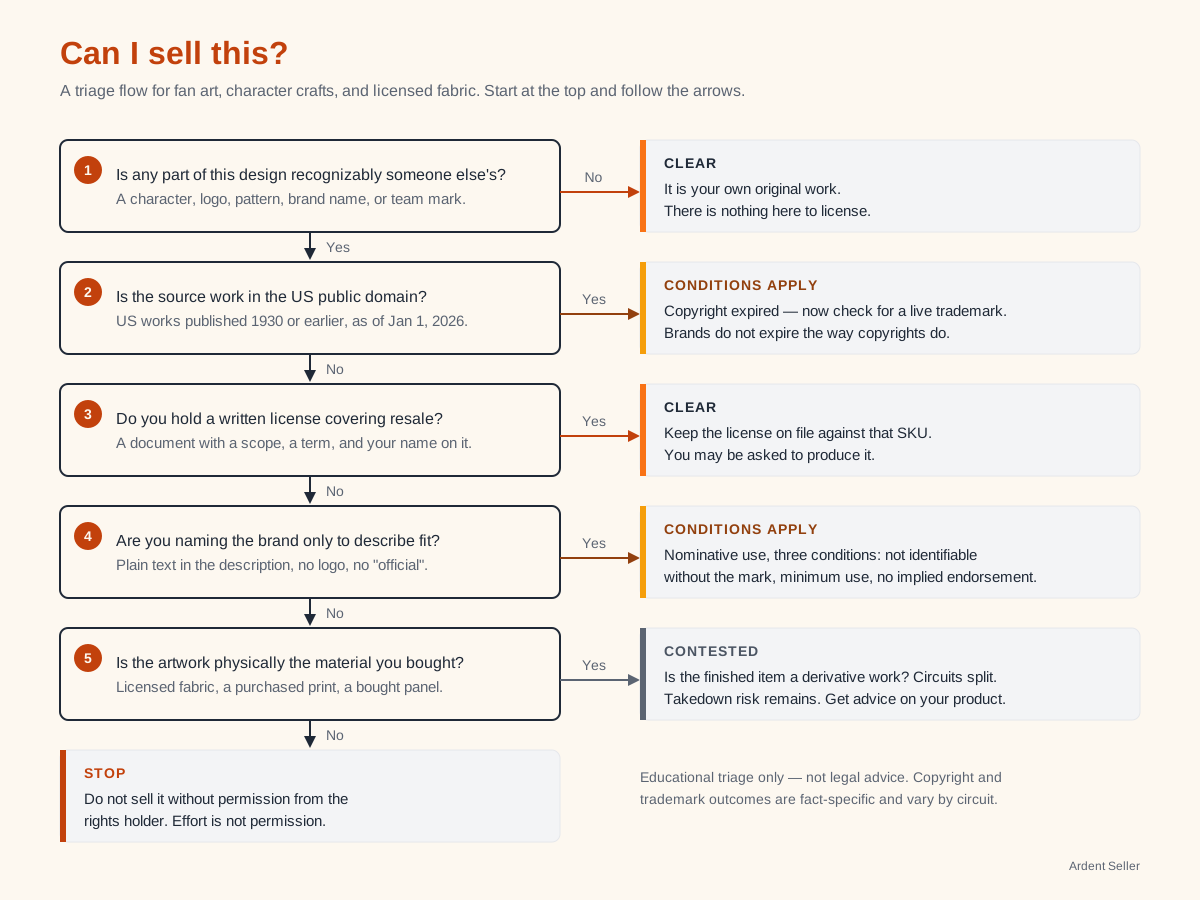
Four lanes, in descending order of comfort.
Your own original work. Unhelpful as advice, but worth stating: it is the only lane with no ceiling and no counterparty.
Genuine public domain material. As of January 1, 2026 that means US works published in 1930 or earlier, under the 95-year term for pre-1978 works (Duke CSPD (opens in new tab)). Verify the specific work and the specific version, and check separately for a live trademark on anything that functions as a brand.
Properly licensed material. A license is a document you can produce on request, with a scope, a term, and your name on it. A forum post saying a company "allows small businesses" is not a license. If you cannot produce it, you do not have it — and if you are not sure which of your paperwork exists and which you have only meant to sort out, the Legal Documents Checklist for Handmade Businesses is a short way to find out.
Descriptive compatibility, carefully. Saying your sleeve fits a particular brand of tumbler is different from printing that brand's logo on it. The nominative fair use test asks whether the product is identifiable without using the mark, whether you used only as much of the mark as necessary, and whether you did anything to suggest sponsorship or endorsement (New Kids on the Block v. News America Publishing, Inc. (opens in new tab), 971 F.2d 302 (9th Cir. 1992)). Plain text in a description, sized like the rest of your copy, no logo, no "official." The moment the brand name becomes the design, you have left the lane.
Same four lanes, as a one-look reference:
What records make any of this defensible?
Every lane above is a claim you may one day have to substantiate, and the awkward part is that you will have to substantiate it about a specific product long after you made it.
A takedown notice names a listing. A cease-and-desist names a product. Neither one asks "generally, what do you do about licensing?" They ask what went into that tote bag, and you have days rather than weeks to answer. Nadia knows the foxes came from a particular bolt bought at a particular shop in March. She knows it because she remembers, which works fine at 40 bags and stops working entirely at four hundred across nine designs and three fabric suppliers.
What makes an answer possible is provenance recorded at the product level, at the time you made it:
- Which material lot went into which finished item, and which vendor and invoice that lot came from
- Where the design element originated — original, public domain (with the source and publication year), or licensed (with the license on file)
- The date, so you can show what you knew when you made the decision
This is ordinary inventory discipline pointed at a legal question. If you already track materials through to finished goods, you already have most of it. Ardent Seller links purchases to material lots and material lots to the products you build from them, so "which fabric is in this bag, and where did I buy it" is a lookup rather than an archaeology project — and a custom field on each product is enough to record whether its design is original, public domain, or licensed, with a link to the paperwork.
The point is not that records make an infringing product legal. They do not. The point is that when the question arrives, the makers who can answer it in an afternoon are the ones who wrote it down in March.
Sources
- US Copyright Office — Fair Use FAQ (opens in new tab) — the "no specific number or percentage" statement quoted at the top.
- 17 U.S.C. § 101 (opens in new tab) — statutory definition of "derivative work."
- 17 U.S.C. § 106 (opens in new tab) — exclusive rights, including the right to prepare derivative works.
- 17 U.S.C. § 107 (opens in new tab) — the four fair use factors.
- 17 U.S.C. § 109 (opens in new tab) — first sale doctrine.
- 17 U.S.C. § 504 (opens in new tab) — copyright statutory damages ($750–$30,000; $150,000 willful; $200 innocent-infringer floor).
- 17 U.S.C. § 512 (opens in new tab) — DMCA safe harbor, notice-and-takedown, and the repeat-infringer termination condition.
- 15 U.S.C. § 1117 (opens in new tab) — Lanham Act statutory damages for counterfeit marks.
- USPTO — What is a trademark? (opens in new tab) — trademark definition and source-identifying function.
- Duke Center for the Study of the Public Domain — Public Domain Day 2026 (opens in new tab) — 1930 works entering the US public domain, and the 95-year term for pre-1978 works.
- Mirage Editions, Inc. v. Albuquerque A.R.T. Co., 856 F.2d 1341 (9th Cir. 1988) (opens in new tab) and Lee v. A.R.T. Co., 125 F.3d 580 (7th Cir. 1997) (opens in new tab) — the unresolved circuit split on whether mounting a lawfully purchased copy creates a derivative work. Lee also confirms first sale does not reach the derivative-work right.
- Precious Moments, Inc. v. La Infantil, Inc., 971 F. Supp. 66 (D.P.R. 1997) (opens in new tab) — preliminary injunction refused on the copyright claim against bedding sewn from lawfully purchased licensed fabric, on the ground that the finished bedding lacked the originality required to be a derivative work.
- Campbell v. Acuff-Rose Music, Inc., 510 U.S. 569 (1994) (opens in new tab) — commercial parody can qualify as fair use; the source of the "transformative use" analysis under factor one.
- New Kids on the Block v. News America Publishing, Inc., 971 F.2d 302 (9th Cir. 1992) (opens in new tab) — the three-part nominative fair use test.
Statutes and cases reflect US federal law as published at the time of writing. Case law in this area is circuit-dependent and the fabric question in particular remains unresolved nationally; nothing here is a substitute for advice about your own products.
The part nobody wants to hear
Most makers asking "is this legal?" are hoping for a threshold — a percentage, a quantity, a magic word in the listing that makes the problem go away. There isn't one. What there is instead is a set of questions with real answers: whose expression is this, whose brand is this, what did I actually buy, and can I prove where it came from.
Nadia's foxes are still a risk. She just knows which kind, and she made the decision with her eyes open instead of repeating a rule she heard in a Facebook group. That is the achievable version of compliance for a small shop — not certainty, but an accurate map of where you are standing.
The records are the part you can start today. The same material trail that tells you what a product cost also tells you what went into it.
Start tracking your inventory and material lots free with Ardent Seller.
Related reading
- How to Label Handmade Products — the other compliance surface every physical product carries, covering what federal and state rules require on the label itself.
- Product Liability Insurance for Handmade Sellers — the coverage question that sits next to this one, and what it does and does not pay for when a claim arrives.
- How to Stop Digital Download Piracy — the same rules pointed the other way, for anyone selling their own work as a downloadable file: how it gets copied, and what a takedown actually does.
- Do You Need a Patent for Your Handmade Product? — the same question turned toward your own original work: five gates that decide whether a patent is worth anything to you, and why copyright usually is the better instrument.
- Batch Tracking for Food Sellers — the lot-tracking mechanics behind "which material went into which product," written for the recall case rather than the takedown case.
Free resources
Free companion downloads if you want to put any of this into practice:
- Legal Documents Checklist for Handmade Businesses — the paperwork inventory to work through once you know which of your products depend on a license you should be able to produce.
- Craft Seller Startup Checklist — covers the registration, insurance, and recordkeeping decisions that sit alongside the IP questions in this post.
This article is provided for educational purposes only and does not constitute legal advice. Copyright, trademark, and licensing rules are fact-specific, vary by federal circuit, and change over time — the fabric question discussed above is genuinely unsettled in US courts. Consult a qualified intellectual property attorney before making decisions about what to sell.