The email arrives on a Tuesday. It is polite, it is from a law firm you have never heard of, and it is about your shop name. Somebody else has been using something close to it — earlier than you, in more states than you, and with a registration certificate to prove it. They would like you to stop. They have attached a list of the places you will need to change the name: your website, your labels, your packaging, your Etsy shop, the 400 jars currently sitting in your garage with the old name printed on the front.
That is the version of this story where you never looked. The version where you did look takes about four hours of work up front and, depending on how many product lines you sell, somewhere between $350 and a couple of thousand dollars.
The short version: trademarking a handmade business name means four things — running a clearance search to confirm the name is both free and legally registrable, picking the international classes that cover what you actually sell, filing through the USPTO's Trademark Center at a base fee of $350 per class (USPTO fee schedule (opens in new tab)), and then keeping the registration alive with renewal filings for as long as you want it. Average time from filing to a first examiner response is 4.7 months, as of July 31, 2026 (USPTO trademark processing wait times (opens in new tab)). And it is not always the right move: five situations where filing is money you will not get back are in When not to bother.
Throughout, there is a composite maker named Tessa. She is invented to make the steps concrete, not a real customer. Tessa pours soy candles under a name she loves, has just added a small soap line, and is starting to get wholesale interest from boutiques two states over.
First: you probably already own something
Before spending anything, understand what you have. In the United States, trademark rights start with use. The USPTO puts it plainly — ownership begins "as soon as you start using your trademark with your goods or services" (USPTO, What is a trademark (opens in new tab)).
Those are common law rights, and they are real. They are also stuck where you are. The USPTO's own framing is that you may "only be able to enforce those rights in the specific areas in the United States where you use the trademark if the use covers less than the entire country" (USPTO, Why register your trademark (opens in new tab)). If Tessa has sold candles at three markets in one county for two years, she has a claim in that county. She does not have one in Oregon.
This is also where the two little symbols come from. The ™ symbol can be used with any unregistered mark you are claiming — no permission required, no filing, no fee. The ® is reserved for federally registered marks only. Using ® before your registration issues is not a shortcut; it is a misrepresentation that can be raised against you later.
Two more things that feel like trademarks and are not:
- Registering an LLC or a DBA with your state. That is entity formation. It tells the state who is doing business; it does not give you the exclusive right to a name in the marketplace, and it will not stop another maker in another state from using it.
- Owning the domain. A domain registration is a lease on an address, nothing more. Plenty of people own a domain for a name they have no right to use commercially.
Step 1: Do the clearance search before you spend anything
This is the step people skip, and it is the one that determines whether the other $350 is an investment or a donation. Fees are generally non-refundable — the USPTO says so in as many words: "Generally, we don't refund fees. Filing an application doesn't automatically guarantee your trademark will be registered" (USPTO, Trademark fee information (opens in new tab)).
Start at the federal database. The USPTO's Trademark Search system (opens in new tab) covers registered and pending federal marks. Search your exact name, then search the way an examining attorney will: for things that sound like it, look like it, or mean the same thing.
That last part is where most self-searches fail. Likelihood of confusion is the most common ground for refusal, and marks "don't have to be identical to be confusingly similar" — they can simply be similar in sound, appearance, or meaning, or create a similar commercial impression, applied to goods that are related enough that buyers would assume a shared source (USPTO, Likelihood of confusion (opens in new tab)). A candle brand and a soap brand are not the same goods, but they are sold to the same buyers in the same aisles by the same makers, which is exactly the kind of relatedness the analysis looks for.
So Tessa searches her name, then variant spellings, then homophone spellings, then the singular and plural, then the same word with a different second word. She also searches outside the USPTO entirely — Google, Etsy, Instagram, and her state's trademark register — because the federal database contains no common law marks at all, and an unregistered senior user can still make her life difficult.
While you are searching, run the second test: is your name even registrable? An examining attorney will refuse a mark as merely descriptive if it immediately describes an ingredient, quality, characteristic, function, feature, purpose, or use of the goods. The USPTO's own examples are CREAMY for yogurt and WORLD'S BEST BAGELS for bagels (USPTO, Possible grounds for refusal (opens in new tab)). Handmade naming conventions walk straight into this. "Pure Soy Candle Co." describes soy candles. "Vermont Beeswax" describes beeswax from Vermont. The names that survive examination most easily are the ones that mean nothing in particular about the product: invented words, arbitrary words, or words used in a way that has nothing to do with what is in the jar.
Rule of thumb: if your name tells a stranger what you sell before they see the product, you have a marketing advantage and a trademark problem. The two pull in opposite directions, and only one of them is fixable later.
Step 2: Pick your classes — and understand what each one costs
Trademark protection is not granted over a name in the abstract. It is granted over a name for particular goods or services, sorted into international classes. Almost every fee is charged per class (USPTO, Trademark fee information (opens in new tab)).
A handful of the classes handmade sellers land in most, using the Nice Agreement headings the USPTO applies (USPTO, Nice Agreement, Twelfth Edition (opens in new tab)):
- Class 3 — soaps, perfumery, essential oils, cosmetics
- Class 4 — candles and wicks for lighting
- Class 14 — jewelry, precious metals, clocks and watches
- Class 25 — clothing, footwear, headwear
- Class 30 — staple foods, including baked goods, coffee, and confectionery
- Class 35 — retail store services (selling other people's goods, which is a service, not a product)
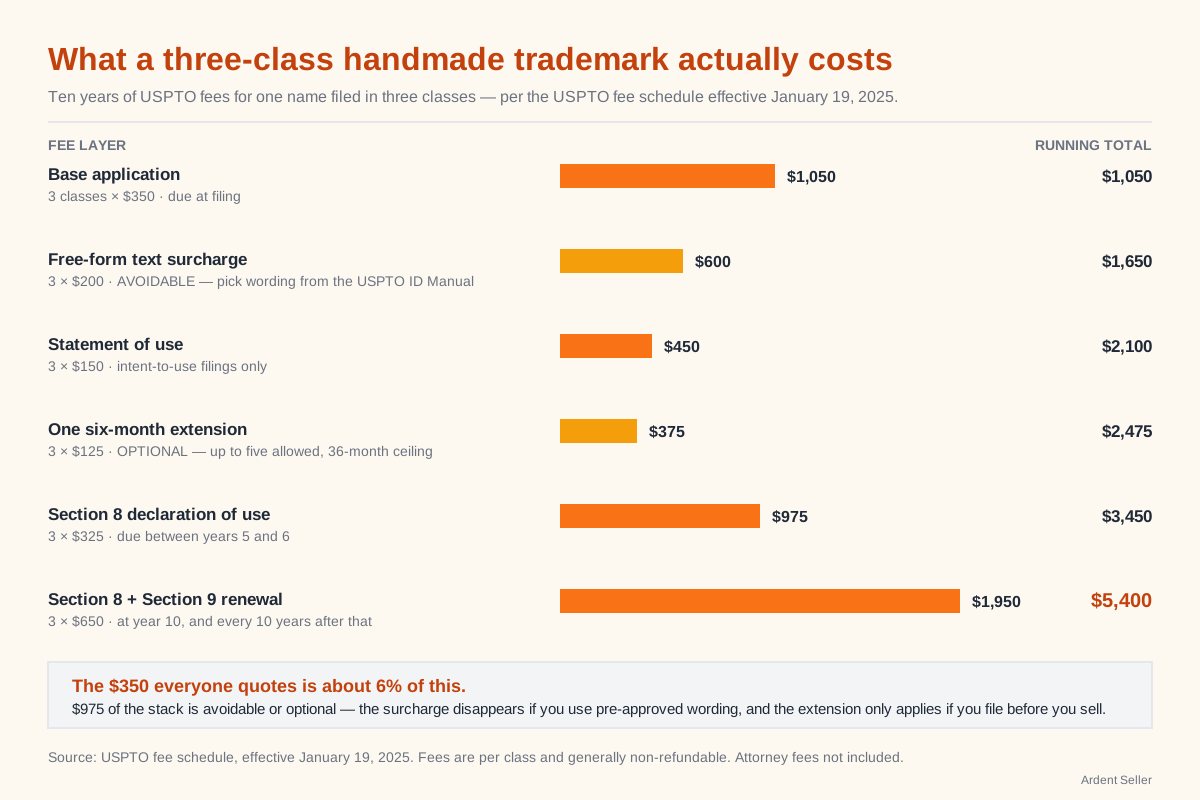
Tessa sells candles and soap. Separately from the wholesale interest, she has been weighing a small retail space of her own — stocking other makers' work alongside hers, which is a service rather than a product. So: potentially three classes, 4, 3, and 35. At $350 per class (USPTO fee schedule (opens in new tab)), her application goes from $350 to $1,050 before anything else happens.
Then comes the surcharge nobody sees coming. When you describe your goods, you can either select pre-approved wording from the USPTO's ID Manual (opens in new tab) or type your own into a free-form text box. Typing your own costs $200 more per class (USPTO fee schedule (opens in new tab)), and if your free-form text runs past 1,000 characters, each additional 1,000 characters costs another $200 for every class it affects. A separate $100 surcharge applies when required application information is missing — your citizenship, an English translation of a non-English term, a description of the mark, a verified statement.
Do the arithmetic on Tessa's three classes: writing her own descriptions instead of picking from the manual would add $600 to a $1,050 filing. That is a 57% premium for the privilege of phrasing it herself. Search the ID Manual first. Nearly every ordinary handmade product already has approved wording sitting in it.
Step 3: Choose your filing basis — are you using the name, or planning to?
There are two doors, and picking the wrong one is the most common way a maker's application falls apart.
Section 1(a) — use in commerce. You are already selling under the name, across state lines or in a way that affects interstate commerce. You file, you attach proof, and if all goes well you register. This is the cheaper, faster, simpler path.
Section 1(b) — intent to use. You have a bona fide intention to use the name but have not started yet. This lets you stake a filing date before your first sale, which matters if you are launching in six months and want the name held. It also costs more and takes longer.
Here is the 1(b) machinery, because the cost is not obvious from the front page. After your mark clears examination and survives a 30-day opposition period, the USPTO issues a notice of allowance — which is not a registration. From the date of that notice (USPTO, Section 1(b) timeline (opens in new tab)):
- Six months to file either a statement of use ($150 per class) or a request for a six-month extension ($125 per class) — both amounts per the USPTO fee schedule (opens in new tab).
- Up to five extensions, each buying another six months.
- A 36-month ceiling from the notice of allowance. Miss it and the application dies.
- Good cause required from the second extension onward — evidence of ongoing effort such as market research, manufacturing activity, or steps to acquire distributors. That requirement lives in the extension regulation itself, 37 CFR § 2.89 (opens in new tab), rather than in the USPTO's plain-language timeline.
For Tessa's three classes, going the intent-to-use route adds $450 at the statement of use, and $375 for every six months she needs to buy. Worth it if the name is for a product line launching next spring. Not worth it if she is already selling and could simply file under 1(a) today.
Step 4: Get the specimen right — proof, not a mockup
If you file under 1(a), or when you eventually file your statement of use under 1(b), you have to submit a specimen: evidence of the mark actually being used in commerce.
The rule that trips people up is that the specimen must be real. Not a mockup, not a printer's proof, not a digitally altered image, not a rendering of packaging you intend to produce, not a draft of a website. The USPTO's examination guidance is explicit that artist renderings, computer illustrations, digitally created images, and similar mock-ups are refused because they do not show actual use of the mark in commerce (USPTO, Specimens (opens in new tab)).
For goods, that means a photograph of the mark on the actual product, on its actual label, on its actual packaging, or on tags attached to it. A photo of Tessa's candle on a shelf, label applied, is a specimen. The beautiful Canva file she used to design that label is not — even though it looks better.
For services, advertising works, because there is no physical product to label. A screenshot of a webpage offering the service is acceptable, but a webpage specimen must include the URL and the access or print date. Take the screenshot in a way that captures the address bar, or record both separately.
There is a related detail that catches makers with imprecise records: your application asks for your date of first use anywhere and your date of first use in commerce, and those dates are sworn statements. Guessing is not a good habit to develop in a document you sign under penalty of perjury. If your sales history lives in a shoebox and three marketplace dashboards, reconstructing "the first time this name went on a product that crossed a state line" is genuinely hard. If it lives in one system that timestamps every transaction — which is one of the quieter arguments for tracking sales in something built for it rather than a spreadsheet you rebuild each January — it is a two-minute lookup.
Step 5: File, then wait, then respond
Applications are filed in Trademark Center. USPTO announced that it would become the only way to apply for a trademark registration as of January 18, 2025 (USPTO, Trademark Center (opens in new tab)) — so if you remember filing something in TEAS years ago, that is no longer a route for a new application.
Then the waiting. As of July 31, 2026, the USPTO reports an average of 4.7 months from filing to first office action against a 5.0-month target, and 8.3 months from filing to registration or abandonment against an 11-month target (USPTO, Trademark processing wait times (opens in new tab)). Those are averages, and they move; check the dashboard rather than trusting a number in any blog post, including this one.
A first office action is not a rejection. It is the examining attorney telling you what stands between your application and publication — sometimes a wording problem in your goods description, sometimes a disclaimer requirement, sometimes a substantive refusal on confusion or descriptiveness. You respond, they reconsider. This is the stage where an attorney earns their fee, because a substantive refusal is a legal argument and you are now writing one.
Worth knowing: an attorney is not required if you are domiciled in the US. The USPTO says exactly that, and then says it "strongly encourage[s] you to hire a U.S.-licensed attorney who specializes in trademark law," in part because USPTO employees cannot give you legal advice (USPTO, Why hire a private trademark attorney (opens in new tab)). A reasonable middle path for a small maker: do the clearance search yourself, get an attorney's read before filing, and file yourself if the read comes back clean.
One more thing, and it will happen. Within weeks of your application publishing, official-looking invoices will start arriving. They use words like "United States," "Trademark," "Office," and "Agency," sometimes with a gold-foil seal and the names of real USPTO forms, and they ask for fees higher than the real ones (USPTO, Recognizing common scams (opens in new tab)). Every legitimate USPTO email comes from an @uspto.gov address, and every legitimate USPTO web address ends in .gov. When something looks official and you are not sure, the Trademark Assistance Center answers at 1-800-786-9199.
Step 6: Keep it alive
Registration is not the end of the spending. Between the fifth and sixth years after registration you must file a Section 8 declaration of continued use — $325 per class (USPTO, How much does it cost (opens in new tab)). Every ten years thereafter, you file a Section 8 declaration plus a Section 9 renewal, which the USPTO totals at $650 per class.
For Tessa's three classes, that is $975 at year five and $1,950 every decade. Across the whole first ten years:
- Every layer stacked — base fee, the free-form surcharge, an intent-to-use statement of use, one extension, and both maintenance filings: about $5,400.
- Surcharge avoided, extension skipped — the two layers she controls outright: about $4,425.
- Filed under 1(a), no surcharge — the realistic floor for a maker who is already selling: about $3,975.
Most of that spread is the free-form text surcharge, which disappears the moment you pick your wording out of the ID Manual. The last step down is the statement of use: notices of allowance, and the statements of use that follow them, are issued only for 1(b) filings (USPTO, Trademark process (opens in new tab)), so a maker who is already selling never pays that $450 at all. The $350 headline figure is a small fraction of any of these numbers, which is precisely why the next section exists.
When not to bother
Five situations where filing is the wrong call. Some of them are temporary.
1. Your name is descriptive and you are not ready to change it. If the name says what the product is, you are paying $350 per class for a likely refusal. Fix the name or accept common law protection for what it is. Spending the money and then discovering this is the worst of both outcomes, because it is non-refundable.
2. You have not settled on the name. Makers rebrand. If there is a real chance you will be selling under a different name in eighteen months — because the current one is hard to spell, or boxes you into one product, or you have never fully liked it — file after the rebrand, not before.
3. You sell in one place and intend to keep selling in one place. A vendor at one weekly market, with no wholesale ambitions and no online sales outside their region, already has enforceable common law rights in the area where they actually trade. Federal registration buys nationwide scope, and nationwide scope is worth what your nationwide plans are worth.
4. Your clearance search found a live, similar mark in a related class. This is the hardest one to accept, because you have already printed labels. But likelihood of confusion is the most common ground for refusal, and a search that surfaces a genuine conflict is the search doing its job. The filing fee will not argue the conflict away.
5. The $350 is your last $350. If registering the name means not buying the inventory, buy the inventory. A trademark protects a business. It does not create one.
Two cheaper intermediate steps exist for cases 2, 3, and 5. State trademark registration costs a fraction of federal — California, for example, charges $70 per classification (California Secretary of State, Trademark forms and fees (opens in new tab)) — and gives you a dated public record within your state while you decide. And simply using ™ consistently and documenting your first-use dates costs nothing and preserves the common law rights you already have.
What a trademark does not do
Worth saying plainly, because expectations get set high:
- It does not protect the products. Registering a candle brand does not stop anyone from making the same candle; it stops them from selling theirs under a confusingly similar name.
- It does not cover your logo unless you file the logo as its own design mark. A word mark covers the words.
- It does not police itself. The USPTO does not monitor the market on your behalf — enforcement is yours, and enforcement is the expensive part.
- It does not reach outside the classes you filed in. Tessa's Class 4 candle registration says nothing about someone selling jewelry under the same name.
Where this leaves you
The decision is smaller than it looks once it is broken up. Search first, which is free. Test whether the name is even registrable, which is also free. Count your classes honestly and find your wording in the ID Manual, which turns a $1,650 filing into a $1,050 one. Pick 1(a) if you are already selling and 1(b) only if you genuinely are not. Photograph a real product, not a design file. Then decide whether nationwide scope is worth the ten-year number rather than the headline one.
Tessa files, for what it is worth. The boutiques two states over are the entire reason nationwide scope is worth anything to her — without them she would be paying $1,050 to protect a name inside one county she already has a claim to. A maker with the same candles, the same soap, and no plans past their own farmers market would be right to wait.
And if the answer today is no, that is a legitimate answer. The rights you have from use do not expire while you think about it — they just stay local.
Registration also assumes you can prove when the name first went on a product that actually sold. If your first-use dates currently live in memory, marketplace exports, and a spreadsheet tab named sales_FINAL_v3, that is the part to fix before anything else. Start free with Ardent Seller and every sale, product, and label change lands in one timestamped record you can actually cite.
Related reading
- Do You Need a Patent for Your Handmade Product? — The neighboring registration question, answered as five gates: what a design patent covers that a trademark cannot, and the one-year disclosure clock that has usually already started by the time anyone asks.
- Can You Legally Sell Fan Art? — The other side of the intellectual property question: what happens when the name or artwork you are using belongs to someone else, and where the genuinely unresolved lines are.
- How to Label Handmade Products — Once the name is settled, the label has legal requirements of its own — identity statements, net weight, and responsible-party details that vary by product type.
- Product Liability Insurance for Handmade Sellers — The other unglamorous protection question makers hit early, with real 2026 premiums by product category.
Free resources
Free companion downloads if you want to put any of this into practice:
- Legal Documents Every Maker Should Have — Puts trademark registration in context with the other paperwork a handmade business accumulates, so you can see what is actually urgent and what can wait.
- Craft Seller Startup Checklist — Sequences naming, entity formation, and registration alongside the rest of setup, which matters because filing before the name is settled is the expensive mistake.
- Shop Policy Starter — Your business name appears in every policy you publish; this gives you the wording to update once the name is final.
This article is general information about the US federal trademark process, not legal advice. Trademark law is fact-specific, and whether a particular name is registrable, whether a conflict exists, and how to respond to a refusal all depend on circumstances this post cannot see. All fees, processing times, and procedures cited are from USPTO sources as of August 2026 and change — verify current figures at uspto.gov (opens in new tab) before filing. Consult a US-licensed trademark attorney before making decisions about your own mark.