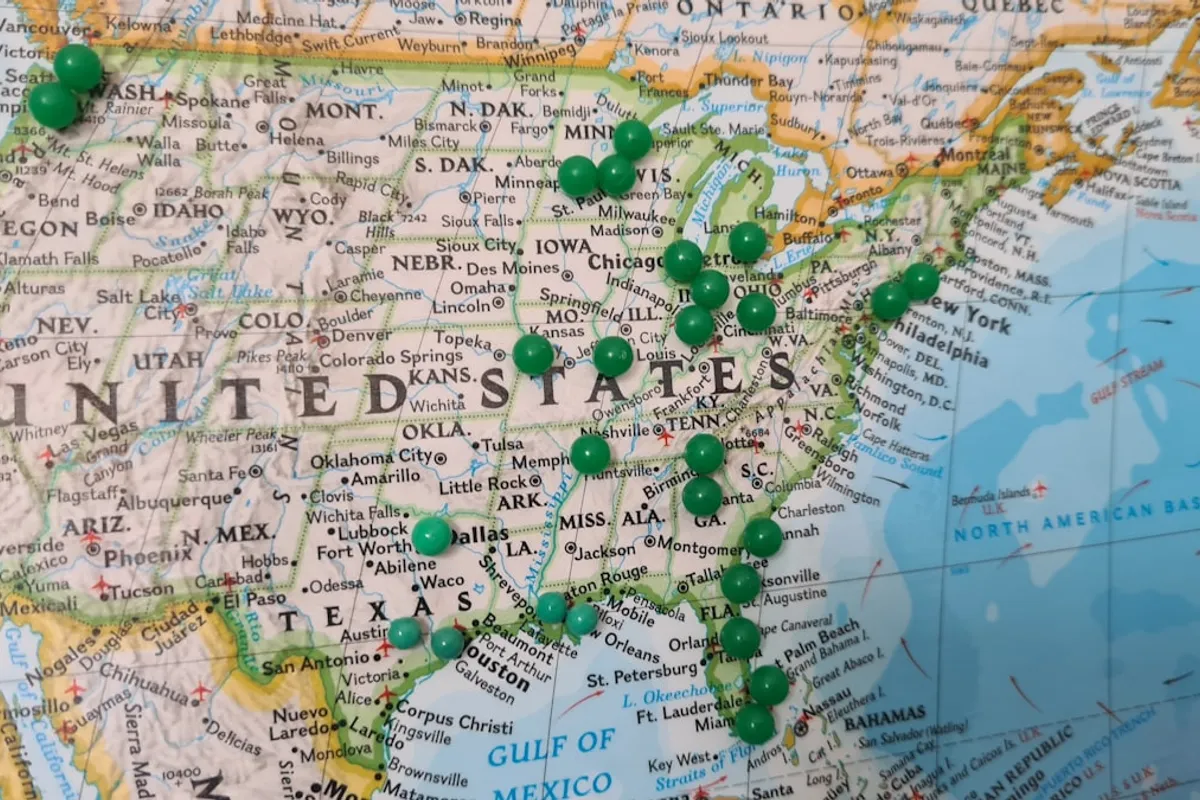
There are roughly 13,000 sales tax jurisdictions in the United States (Tax Foundation state and local sales tax data (opens in new tab)). A candle maker in Vermont who ships to customers in 30 states could, in principle, owe filings in every one of them. Most do not. A smaller fraction know why.
The reason is a word most sellers have heard and almost none can define: nexus. It is the single concept that decides whether you owe sales tax in a given state, and the rules around it were rewritten in 2018 by a Supreme Court decision almost no small seller paid attention to at the time (South Dakota v. Wayfair, 585 U.S. ___ (2018) (opens in new tab)). The result is a compliance landscape where an at-home soap maker can, technically, trigger filing obligations in a state she has never visited — and where the biggest risk to her business comes from not knowing she just did.
This guide is not tax advice. It is a plain-language map of the terrain, the terms, and the myths, so that you can have an informed conversation with a CPA or a state revenue department rather than a confused one.
Important: Sales tax rules change frequently and vary by state. Consider this article a starting point for understanding the landscape, not a substitute for professional advice from a tax preparer or state revenue department.
Why this topic suddenly matters to small sellers
Before 2018, sales tax was a physical-world problem. If you did not have a store, a warehouse, or an employee in a state, that state had no real claim on your sales tax collections. A Vermont candle maker who shipped a candle to Arizona owed exactly nothing to Arizona.
Then came South Dakota v. Wayfair, a Supreme Court ruling that allowed states to require sales tax collection from out-of-state sellers based purely on the volume of their sales into that state — no physical presence required. Within two years, 45 states and the District of Columbia had passed economic nexus laws (Sales Tax Institute economic nexus state guide (opens in new tab)). The thresholds vary, but most landed somewhere around 200 transactions or $100,000 in sales into the state per year (Sales Tax Institute economic nexus state guide (opens in new tab)).
For a Fortune 500 retailer, this was an accounting headache. For a home-based jewelry maker doing $40,000 a year across Etsy, Shopify, and craft fairs, it quietly became a compliance problem no one warned her about.
The story of sales tax nexus for small sellers is mostly the story of what happens when a law written with giant e-commerce companies in mind gets applied — in practice, if not always in enforcement — to a woman making earrings in her kitchen.
Key terms: the glossary every seller should know
Before any of the myths make sense, the vocabulary has to. These are the words that appear in every state's tax guidance, and misreading any one of them is how sellers end up confused.
Nexus
A legal connection between your business and a state that is strong enough to give the state the authority to require you to collect and remit sales tax on sales delivered into that state. Nexus is the gate. If you have it, you are in. If you do not, you are out. Everything else in this article is a variation on how nexus gets established.
Physical nexus
The traditional form of nexus. You have physical nexus in a state if you have a tangible presence there — a home, a warehouse, an employee, a contractor who works on your behalf, a booth at a farmers market held in that state, inventory stored at a fulfillment warehouse located there. If you ship product from a Fulfillment by Amazon (FBA) warehouse in Texas, congratulations: you likely have physical nexus in Texas, even if you live in Oregon.
Economic nexus
The post-2018 form. You have economic nexus in a state if your sales into that state exceed a specified threshold — a dollar amount, a transaction count, or (in some states) both. The most common threshold is $100,000 or 200 transactions in a calendar year, but the specifics vary. Some states only use a dollar threshold. A handful still cling to 200 transactions with no dollar minimum, which is the one that catches small sellers with low-priced products.
Threshold
The number that triggers economic nexus. Cross it, and you have nexus. Stay under, and you do not. Thresholds are usually measured over the prior calendar year, the current calendar year, or both (the strictest formulation). A single stickers shop selling $3 stickers on Etsy could theoretically hit 200 transactions in a state without ever crossing $100,000 in revenue there.
Remote seller
You. Specifically, a seller who does not have a physical presence in a state but is required to collect sales tax in that state because of economic nexus. The term exists because every state's compliance guidance has a "remote seller" section and you need to know which section to read.
Marketplace facilitator
A platform that lists third-party products and handles the sale for them — Etsy, Amazon, eBay, Walmart Marketplace, TikTok Shop. Under marketplace facilitator laws, these platforms are required to collect and remit sales tax on behalf of the sellers who list on them. If Etsy collects tax on your behalf for a sale to California, that sale counts against Etsy's nexus, not necessarily yours — though, and here is where it gets murky, many states still require you to include those sales when calculating whether you have crossed your own economic nexus threshold.
Marketplace facilitator laws
The state-level laws that require marketplace facilitators to collect and remit sales tax. Every state with a sales tax has one. The practical result is that if you only sell through Etsy, Etsy handles most of your sales tax for you. Add a Shopify store and you are now personally responsible for the sales tax on every Shopify order, because Shopify is not a marketplace facilitator — it is a platform you use to run your own store.
Origin-based vs. destination-based sourcing
A state-level rule about which tax rate applies when you sell something. In origin-based sourcing states (there are a handful, including Texas and Pennsylvania for intrastate sales), the tax rate is based on where you are located. In destination-based sourcing states (most of them), the tax rate is based on where the customer is located. For a Texas seller shipping to a Texas customer, you generally charge your origin rate. For that same Texas seller shipping to California, you charge the California destination rate.
Permit / license / registration
What you file with a state to legally collect sales tax there. You cannot collect sales tax in a state you are not registered in — that is itself illegal. The flip side is that you cannot legally ignore a state where you have nexus — registration is required. Every state calls this something slightly different: "seller's permit," "sales tax license," "sales tax registration." They are functionally the same thing.
Use tax
The quiet cousin of sales tax. If you purchase something tax-free (say, supplies bought wholesale or from an out-of-state vendor who did not charge tax), and you use or consume it in your state rather than reselling it, you owe use tax at the same rate you would have paid in sales tax. Small businesses routinely overlook this. Auditors do not.
Home rule jurisdictions
A wrinkle specific to a few states — Alabama, Colorado, Louisiana, and a few others — where individual cities or counties can administer their own sales tax separately from the state (Sales Tax Institute home-rule states overview (opens in new tab)). This means that registering at the state level may not be enough; you may also owe filings to specific cities. Colorado is the most notorious example for e-commerce sellers.
Now the myths.
The seven myths that cost small sellers real money
Every myth in this section is something a working seller has said to me, usually while describing a compliance letter they had received from a state revenue department. Each is wrong in a specific way.
Myth 1: "Etsy handles all my sales tax. I do not have to think about it."
Reality: Etsy collects and remits sales tax for sales made through Etsy, to customers in states where marketplace facilitator laws apply — which is most states. That part is true. The myth is in the word "all."
If you also sell on Shopify, at a craft fair, through a wholesale order to a boutique, or via an Instagram DM that ended with a Venmo payment, those sales are not covered by Etsy. They are yours. The tax obligation for those transactions depends on your own nexus status in each state — and those sales may also count toward your own nexus thresholds, even though Etsy handled the tax for the Etsy portion.
A seller doing $60,000 a year on Etsy and $20,000 a year on Shopify can easily believe her sales tax is "taken care of" while quietly accumulating a multi-state compliance problem on the Shopify side.
Myth 2: "I only owe sales tax in my home state."
Reality: This was true before 2018. It is no longer true. If you have crossed the economic nexus threshold in a state where you do not live, you owe tax there — physical presence is no longer the only path to nexus.
The uncomfortable corollary is that small sellers often find out about nexus not through proactive research but through a letter. A Pennsylvania revenue agent runs a data-matching exercise against Etsy order records for the last three years, notices that Maria's Stoneware LLC shipped $100,400 worth of mugs into Pennsylvania over 14 months, cross-references that against Pennsylvania's nexus threshold ($100,000, not coincidentally), and mails Maria a notice of tax liability. Marketplace facilitator laws may shield Maria on the Etsy portion. Her Shopify sales may not be shielded.
Notice that "I did not know" is not a defense in tax law. It is a plea for mercy. Sometimes it works. Often it does not.
Myth 3: "I am too small to worry about this."
Reality: Size matters less than sales distribution. A seller with $50,000 a year concentrated in five states can trigger nexus in all five. A seller with $50,000 a year spread evenly across 50 states will trigger nexus in none. The economic nexus framework is about crossing a threshold, not about being a big company.
The 200-transaction threshold is where small sellers get caught. If you sell $5 digital downloads or $3 stickers, hitting 200 transactions in a single state over a year is not hard. It does not require you to be a big business. It requires you to be a popular small business with a concentrated fan base.
That said, enforcement is not uniform. States do not, as a rule, chase small sellers aggressively — the return on audit dollars is higher when chasing larger targets. But "low enforcement risk" is not the same as "no obligation." And revenue departments have, in recent years, become noticeably more sophisticated at pulling marketplace data.
Myth 4: "I do not have a storefront, so I do not have nexus anywhere."
Reality: A storefront is one form of physical nexus. It is not the only one. Here is an incomplete list of things that can create physical nexus in a state where you do not live:
- Keeping inventory in an FBA warehouse located there
- Attending a single craft fair in that state (in some states — it varies)
- Hiring a contractor or photographer who performs services for your business in that state
- Having an affiliate or referral partner located there (in states with affiliate nexus laws)
- Shipping through a third-party fulfillment service located in that state
- Traveling to a state for a pop-up event where you sell product directly
A seller who sold at one craft fair in New York last summer may have had physical nexus in New York for that tax period, even if she lives in Ohio. Some states treat this as a "trailing" nexus that persists for months after the event; others treat it as triggered only during the event itself.
Myth 5: "If I do not charge sales tax, I do not owe it."
Reality: This is the most expensive myth on the list. Whether you owe sales tax is determined by the state — not by whether you collected it from your customer.
If you have nexus in a state and failed to collect tax on a $5,000 sale, the state will not come to your customer for the tax. They will come to you. You will owe the tax (at the state's rate), plus penalties, plus interest, with no ability to collect it after the fact from the customer who has long since received her product.
This is why sellers who discover they have unknowingly triggered nexus often face a three-part problem: back taxes they owe out of pocket, penalties that compound, and the need to register going forward. Many states offer voluntary disclosure agreements (VDAs) that waive some penalties for sellers who come forward proactively rather than waiting to be found. VDAs are almost always a better deal than waiting for a notice.
Myth 6: "Digital products are not taxable."
Reality: Most states now tax digital goods — downloads, e-books, PDFs, pattern files, digital art, software — at the same rate as physical goods. There is not a federal rule; each state decides. As of 2026, roughly 30 states tax digital goods, a handful are ambiguous, and the rest exempt them (Tax Foundation digital goods taxability (opens in new tab)).
For a digital-only seller, the nexus math is identical to a physical seller. You can trigger economic nexus in a state by selling $5 pattern files to enough customers there. The fact that nothing shipped does not change the calculation — it is sales volume, not shipping, that the threshold measures.
Myth 7: "Sales tax only applies if the customer is a consumer. Wholesale is always exempt."
Reality: Wholesale sales to a customer who will resell the product are exempt from sales tax — if the wholesale buyer provides you with a valid resale certificate. No certificate, no exemption. You are expected to collect the certificate before the sale, keep it on file, and produce it during an audit.
A boutique owner who buys $500 of your candles for their shop is a wholesale customer. If they hand you a resale certificate from their state, that sale is exempt. If they do not, the legal default is that the sale is not exempt — and if you did not collect tax, you may owe it. "But she told me she was buying them for her shop" is not a substitute for the form.
That is the receiving end of the mechanism. For the other end — issuing your own certificate to your suppliers so you stop paying sales tax on materials, which purchases actually qualify, and the use tax you owe when exempt stock never gets sold — see Do You Need a Resale Certificate to Buy Craft Supplies Tax-Free?.
How nexus actually gets determined: the mental model
The confusion around nexus comes from treating it as one question. It is really three.
Question one: Do you have physical nexus in the state? If yes, you are done — you have nexus, register and collect. If no, move to question two.
Question two: Have you crossed the economic nexus threshold in the state? This requires knowing (a) the state's threshold, (b) your sales into that state for the relevant measurement period, and (c) whether that state measures the threshold using gross sales, taxable sales, or both. If you have crossed it, you have nexus. Register and collect. If not, move to question three.
Question three: Does the state have any other form of nexus that applies to you? Affiliate nexus, click-through nexus, cookie nexus (yes, this exists), trailing nexus from a past event. These are the edge cases. Most small sellers do not need to worry about them, but they exist.
For a typical handmade seller selling on Etsy, through a Shopify store, and at occasional craft fairs, the practical answer usually looks like this:
- Home state: physical nexus. Register and collect.
- Etsy sales: covered by marketplace facilitator laws in most states. Etsy collects and remits. Confirm Etsy is doing so (they are, but verify).
- Shopify sales: your responsibility. Track sales by state. Register in any state where you cross the threshold.
- Craft fairs: physical nexus for at least the event window, possibly longer. Register where applicable, file zero returns where needed.
- FBA inventory: physical nexus wherever your inventory is stored. If you use FBA, pull your inventory location report; you may have nexus in states you have never thought about.
What to actually do: a practical starting plan
Here is the sequence that works for most small sellers. It is not exhaustive. It is a starting point.
Step 1: Make a list of every sales channel you use. Etsy, Shopify, Faire, Amazon Handmade, in-person events, wholesale orders to boutiques, Instagram DM sales, everything.
Step 2: For each channel, determine whether it is a marketplace facilitator. Etsy, Amazon, Walmart Marketplace, eBay, Faire (for some sales) — yes. Shopify, Square, your own website, in-person events — no. The ones that are facilitators are handling most of your sales tax automatically. The ones that are not are your responsibility.
Step 3: Pull a sales-by-state report from each non-facilitator channel for the last 12 months. Most e-commerce platforms can generate this. If you cannot pull one cleanly, that is a sign you need better transaction records — which is exactly the kind of problem a structured transaction system is built to solve.
Step 4: Cross-reference your state sales totals against each state's economic nexus threshold. There are free tools that publish an up-to-date table of thresholds; your accountant should have one, and several state-by-state guides exist online. Any state where you are close to or over the threshold is a priority.
Step 5: In any state where you have triggered nexus, register. Most states offer online registration portals. Some charge a small fee. The registration gives you a permit that authorizes you to collect sales tax on future sales into that state.
Step 6: For states where you triggered nexus in the past and never registered, consider a voluntary disclosure agreement. This is where a CPA or a sales tax consultant earns their fee. Going in through a VDA is usually cheaper than waiting for a notice, and the professional handles the back-and-forth.
Step 7: Configure your non-marketplace platforms to collect tax at the correct rate. Shopify, Squarespace, WooCommerce, and similar platforms have sales tax engines — some built-in, some requiring a paid integration (TaxJar, Avalara, Anrok). Set them up for every state where you have registered.
Step 8: File returns, even zero returns. Once registered, you are expected to file returns on the state's schedule (monthly, quarterly, or annually depending on volume), even if you had no sales into the state that period. Missing returns is how small problems become audit flags.
The role of good transaction records
Every step above depends on knowing where your customers are, how much you sold, and on what date — with enough accuracy to answer a revenue agent's questions without guesswork.
The sellers who struggle most with sales tax are not the ones with the most complicated businesses. They are the ones whose transaction records live in three places at once — a notebook of craft fair sales, Etsy's dashboard, a Shopify export, a drawer full of paper receipts from wholesale orders. When nexus questions come up, reconstructing the answer takes days. For some sellers, it takes a forensic accountant.
Ardent Seller is built to consolidate transaction records across all of your channels into a single, auditable system — with customer location data, tax category classification, and filters that let you pull sales by state, by channel, or by date range in seconds rather than hours. That is not a sales tax engine (and it is not a substitute for one), but it is the foundation underneath a sales tax engine: the reliable, structured record of every sale that your CPA, your TaxJar integration, or your future self will need when the question comes up.
The platforms that collect tax for you (Etsy, Amazon) will give you reports for their slice of your business. Nobody else is going to consolidate the rest. That is on you.
A final word on enforcement and proportionality
It is worth saying plainly: the likelihood that a state revenue department audits a home-based candle maker making $40,000 a year is low. Enforcement resources are finite and are spent where the recovery is largest. This is not a reason to ignore the rules, but it is context worth having.
The sellers who get into serious trouble tend to fit a pattern: either they grew faster than their compliance awareness, or they received a notice and did not respond. The first group is the one most at risk of a painful surprise. The second group turned a solvable problem into an expensive one.
Between those two groups sits the much larger population of small sellers who are technically out of compliance in at least one state they do not know about, and who will almost certainly never hear about it. The goal is not to panic. The goal is to know enough to recognize the line, to operate on the right side of it when the cost of doing so is reasonable, and to have clean enough records that if a question ever arrives, the answer is a query, not a rescue operation.
Sales tax is not the most exciting part of running a handmade business. It is, however, one of the parts where a small amount of structure early saves a disproportionate amount of pain later. The sellers who build their compliance awareness gradually — one channel, one state, one threshold at a time — are the ones who never have to scramble when the business starts growing faster than the spreadsheet can keep up with.
Start with your home state. Pull your out-of-state sales data. See where you stand. That is the first hour's work. The rest follows.
Start tracking your sales with Ardent Seller and give your future CPA — and your future self — the record they will thank you for.
Related reading
- Hobby vs. Business Taxes — Sales tax presumes you have already crossed the hobby-to-business line — start here if you have not.
- Business License for a Craft Fair? — Selling in person instead of shipping: do you need a business license to sell at a craft fair, and why the event's state wants its own sales tax permit.
- Wholesale Pricing for Handmade Products — Resale certificates and wholesale exemption rules connect directly to the nexus framework.
- Scaling Your Handmade Business — How fast growth quietly stacks state-level compliance obligations on top of an already-stretched operation.
Free resources
A few free downloads from the Ardent Workshop library that pair well with this post:
- 1099-K Threshold Tracker (2026) — The sister-form to economic nexus: while sales tax nexus is about whether you collect from customers, the 1099-K is about whether the IRS (and your state) gets a copy of your payment-processor activity. Federal threshold is $20K / 200 transactions per platform; 9 states and DC trigger lower thresholds (RI at $100, MA/MD/VA/DC at $600, VT at $2,000). Multi-platform tracker for Etsy Payments, PayPal, Venmo, Stripe, Cash App, and Square.
- Small Business Tax Deduction Cheat Sheet — A 12-page Schedule C walkthrough that covers the income, COGS, and deduction lines that determine which gross-revenue number actually counts toward state nexus thresholds.
- Schedule C Tax Expense Tracker — Free Excel tracker organized by Schedule C category. Logging sales-tax-permit fees on Line 23 and platform commissions on Line 10 each month gives you the per-state spend numbers that matter when you renew permits.
- Quarterly Estimated Tax Worksheet — Sales tax is what you collect from customers and remit to the state. Federal estimated tax is what you owe on the net profit underneath. This Excel worksheet handles the four federal payments (Apr 15 / Jun 15 / Sep 15 / Jan 15) so the two compliance tracks stay separate in your head.
- Craft Seller Startup Checklist — Sales tax permits, business banking, and the legal essentials — the foundation under any state-by-state nexus tracking.
This article is provided for educational purposes only and does not constitute legal, tax, or accounting advice. Nexus rules, economic thresholds, marketplace facilitator laws, and state compliance requirements vary by jurisdiction and change frequently. Consult a qualified CPA, tax preparer, state revenue department, or attorney before making decisions that affect your business.