
The short answer: an Etsy Ads campaign on a listing is worth it only when it returns more profit than it costs to run — and Etsy's dashboard won't tell you whether it does. Five minutes of math turns your real margin into the three numbers that settle it: your contribution margin per sale, your break-even ROAS (the minimum return the campaign must clear), and your max sustainable CPC (the most you can afford to pay per click). Here's how to build all three from your own numbers.
Here is the number Etsy wants you to look at: sales attributed to Etsy Ads. It sits at the top of your ads dashboard, it goes up when you spend more, and it feels like proof that the ads are working.
Here is the number Etsy doesn't show you: how much of that "attributed" revenue is left after you subtract the clicks you paid for, the 6.5% transaction fee, payment processing, and the cost of actually making the thing. That number is often a lot smaller. Sometimes it's negative. And you can run an Etsy Ads campaign for months — watching "attributed sales" climb the whole time — without ever finding out.
The good news is that the math to find out is genuinely simple. You need exactly three numbers for any listing you advertise, and once you've got them, the "should I keep this campaign running?" question answers itself. Let's build them.
The problem: "attributed sales" is revenue, not profit
When Etsy reports that your ads drove $420 in sales last month, that's the gross order value of everything a shopper bought after clicking an ad. It is not your profit. It hasn't subtracted the $180 you spent on clicks to get those orders. It hasn't subtracted Etsy's fees on those orders. And it certainly hasn't subtracted the wax, the jars, the labels, and the hour you spent pouring.
Stack those up and the picture changes completely. The fix is to stop comparing ad spend against revenue and start comparing it against the only number that actually pays for ads: your contribution margin — what's left from a sale after the cost of the product and the cost of selling it on Etsy, but before the ad spend.
So that's the first number to build.
Solution part one: build your real per-sale margin
Meet Maya — a composite example, like the two sellers later in this post; the numbers are illustrative, so swap in your own. She sells 8 oz soy candles for $28 and has run Etsy Ads on her bestseller for three months because the dashboard keeps showing sales. Let's find out what each sale actually leaves her.
First, her true unit cost — everything that goes into one candle landing on a doorstep: wax, fragrance oil, wick, jar, label, box, a few minutes of labor, and the shipping label she eats on free shipping. For Maya that's $11.00.
Then the Etsy fee stack on a $28 sale (Etsy's fee schedule (opens in new tab)):
- Transaction fee, 6.5%: $1.82
- Payment processing, roughly 3% + $0.25 (US sellers; rates vary by country): $1.09
- Listing fee, $0.20 per listing: $0.20
- Total fees: $3.11
Now her contribution margin per sale:
Contribution margin = Price − True unit cost − Etsy fee stack $28.00 − $11.00 − $3.11 = $13.89 per sale
That $13.89 is the entire pot of money available to pay for advertising and still leave Maya a profit. Not the $28. Not the "attributed sales" number. $13.89. Every dollar of ad spend per sale comes out of that pot.
This is the number to build before turning on ads — and it's the one everything else depends on.
The fix: two formulas that price a click
Maya knows Etsy charged her some amount per click last month, but "is $0.30 a click too much?" has never had an answer she could compute. It does now, and it comes from two formulas built directly on her margin.
Break-even ROAS — the floor your campaign must clear
ROAS (return on ad spend) is revenue divided by ad spend. Your break-even ROAS is the point where the ad spend exactly equals your contribution margin — spend a dollar more per sale than that, and you're paying customers to take your candles.
Break-even ROAS = Price ÷ Contribution margin per sale $28.00 ÷ $13.89 = 2.02
Maya needs at least $2.00 in revenue for every $1.00 of ad spend just to break even. If Etsy's dashboard shows a ROAS of 5, she's making real money. If it shows 1.8, she's losing money on every ad-driven sale — even though "attributed sales" looks great.
Maximum sustainable CPC — the ceiling on what a click can cost
Here's the part that trips people up: Etsy doesn't take a per-click bid. You set a daily budget and Etsy auto-bids for you, so the lever you actually pull is the budget. But the result of all that auto-bidding is an average CPC you can see under Marketing → Etsy Ads → Performance — and that observed average is what has to stay under your ceiling.
Max sustainable CPC = Contribution margin per sale × Conversion rate (enter the conversion rate as a decimal — 2% = 0.02, not 2)
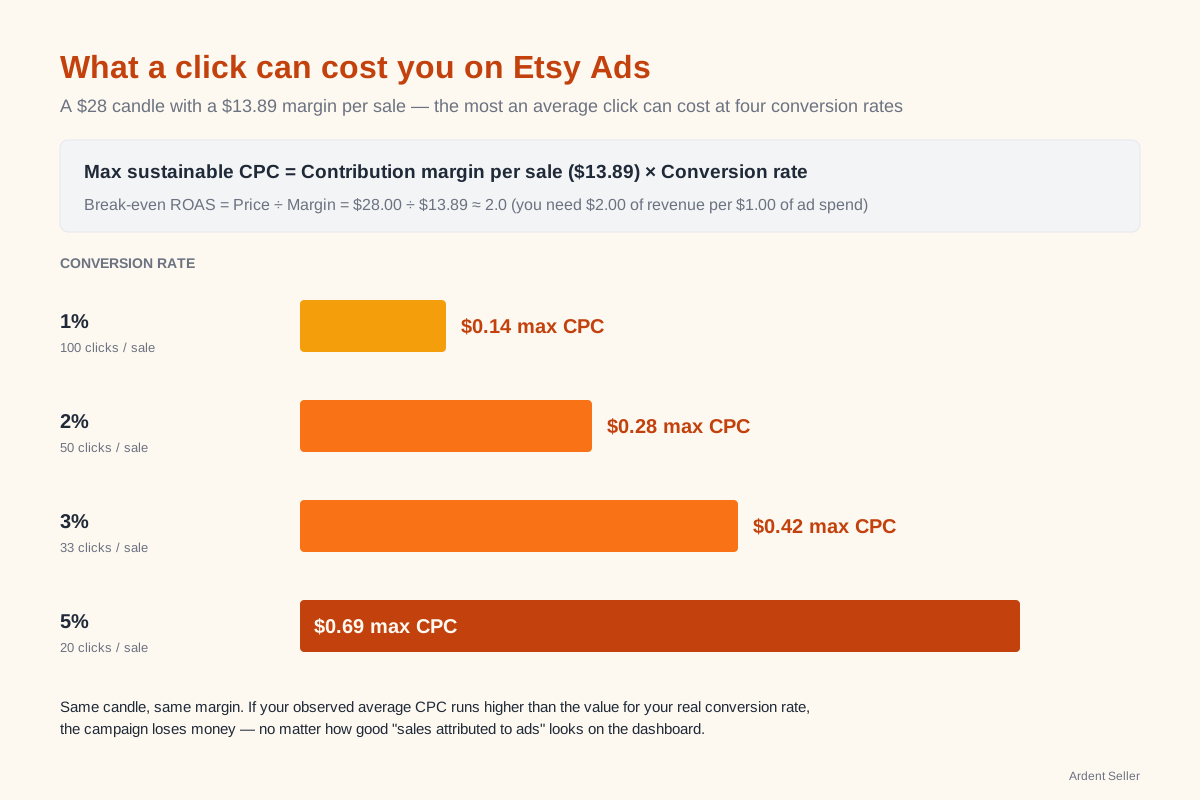
Conversion rate is the share of ad clicks that turn into sales. If 2 of every 100 people who click Maya's ad buy the candle, that's a 2% conversion rate — meaning it takes 50 clicks to make one sale. So:
- At 2% conversion (50 clicks per sale): $13.89 × 0.02 = $0.28 max CPC
- At 1% conversion (100 clicks per sale): $0.14 max CPC
- At 3% conversion: $0.42 max CPC
- At 5% conversion: $0.69 max CPC
Notice how brutal the conversion rate is on the answer. If Maya's real conversion rate is 1% — use your own actual rate here, not a guess — her clicks can't average more than fourteen cents or she's underwater. If her listing converts ad clicks at 3%, she's got real room to spend. Same candle, same margin, wildly different verdict — and the deciding factor is one number the dashboard already reports: your conversion rate.
Pull your actual conversion rate from the Etsy Ads performance page, drop it into the formula, and compare the answer to your observed average CPC. If your max sustainable CPC is $0.28 and Etsy is averaging you $0.45 a click, that campaign is bleeding money. No dashboard will tell you that. The math just did.
Solution part two: run it on the listings you actually advertise
One listing's margin doesn't predict another's. Here are two more composite makers — Priya and David, both illustrative — running the exact same math to opposite conclusions.
Worked example: Priya's sterling silver earrings ($42)
- True unit cost (silver, findings, packaging, labor, shipping): $19.00
- Etsy fees on $42: 6.5% ($2.73) + processing ($1.51) + listing ($0.20) = $4.44
- Contribution margin: $42.00 − $19.00 − $4.44 = $18.56
- Break-even ROAS: $42 ÷ $18.56 = 2.26
- Max CPC at 2% conversion: $18.56 × 0.02 = $0.37
Priya has a healthy pot and a higher price point, so her clicks can cost more before the campaign tips over. If her listing converts well, Etsy Ads are very likely worth it for her.
Worked example: David's resin keychain ($16)
- True unit cost (resin, mold wear, hardware, mailer, labor): $10.50
- Etsy fees on $16: 6.5% ($1.04) + processing ($0.73) + listing ($0.20) = $1.97
- Contribution margin: $16.00 − $10.50 − $1.97 = $3.53
- Break-even ROAS: $16 ÷ $3.53 = 4.53
- Max CPC at 2% conversion: $3.53 × 0.02 = $0.07
David's keychain needs a ROAS above 4.5 to break even, and his clicks can't average more than seven cents at a 2% conversion rate — a brutally low ceiling for a paid click. Whether his campaign clears it is something he can check in seconds against his own observed average CPC on the performance page. He's been running ads on this keychain for months, watching "attributed sales" tick up — and quietly losing money on most of them. His problem isn't the ads. It's that a 22%-margin product can't carry advertising at all until he either raises the price or cuts the cost.
That's the whole point of doing this per listing: ads aren't good or bad. They're affordable or unaffordable, and only your margin decides which.
Offsite Ads: the second fee stack that eats thin margins
There's a second ad product hiding in your fees, and it doesn't ask permission. Etsy Offsite Ads promote your listings on Google, Meta, and elsewhere, and when one drives a sale, Etsy charges a commission — 15% if your shop is under $10,000 in trailing 12-month sales and you've left them on, or a mandatory 12% once you cross $10,000 — capped at $100 per order (Etsy Offsite Ads policy (opens in new tab)). That comes out on top of the regular fee stack.
Run it through Maya's candle. An Offsite Ads sale at 15% adds $4.20 to the cost of that $28 order, dropping her contribution margin from $13.89 to $9.69. She's still comfortably profitable — a strong margin absorbs the hit.
Now run it through David's keychain. Offsite Ads at 15% on his $16 order is $2.40, dropping his $3.53 margin to $1.13 per sale. A listing the dashboard happily calls a bestseller is earning him a dollar and change — and if he's also running Etsy Ads on it, those two costs stack and the listing goes net negative. The dashboard never flags this, because to Etsy it all still counts as a sale.
The lesson isn't "turn off Offsite Ads" (under $10K you can opt out; at or above, you can't — Etsy Offsite Ads policy (opens in new tab)). It's that the same margin math has to include the ad commission to tell you which of your "winners" are real.
Doing this across a whole shop without losing your evening
Running these three numbers on one listing takes five minutes with a calculator. Running them on all forty of your listings, re-running them every time a supplier raises your costs, and catching the Offsite Ads commission attributed to the specific listing that drove each click — that's the part that doesn't fit in an evening.
That's where the math stops being a one-time exercise. Ardent Seller pulls every Etsy order with its full fee breakdown — including the Offsite Ads commission attributed to the listing that earned it — and reports each listing's true post-ad margin, so the candidates to pause sort themselves to the top instead of hiding behind a healthy-looking "attributed sales" number. The Etsy integration does the order-by-order plumbing; the per-product margin reports do the ranking. The break-even calculation you ran once on Maya's candle runs continuously across the whole shop.
The short version: what to do this week
You don't need a new ad strategy. You need to know your three numbers for every listing you're paying to promote:
- Contribution margin per sale = price − true unit cost − Etsy fee stack. This is your ad budget's source of funds.
- Break-even ROAS = price ÷ contribution margin. Compare it to the ROAS on your ads dashboard. Below it, you're losing money — pause or cut the budget on that listing.
- Max sustainable CPC = contribution margin × conversion rate. Compare it to your observed average CPC under Marketing → Etsy Ads → Performance. If your observed CPC is higher than this ceiling, pause the campaign on that listing.
Pull your real conversion rate and average CPC off the performance page, run the three numbers on your top advertised listing tonight, and you'll know — for the first time, with actual math — whether that campaign deserves your budget or whether it's been quietly spending it. Want the math done for you? Run your listing through the free Etsy Ads ROAS & break-even calculator and get your maximum sustainable CPC in about a minute.
Free resources
Free companion downloads if you want to put any of this into practice:
- Etsy Ads ROAS & Break-Even Bid Calculator — Enter one listing's price, cost, conversion rate, and fees and get its break-even ROAS and maximum sustainable CPC instantly, including the Offsite Ads math at both commission rates.
- Etsy Fee & True Profit Calculator — Build the full fee stack and true contribution margin for a listing first, so the ad math above has an accurate starting number.
Related reading
- Etsy Sellers' FAQ: Fees, Inventory & Bookkeeping — The complete anatomy of every Etsy fee, including Offsite Ads, so you know exactly what comes out of each sale before the ad spend.
- Why Are My Margins Shrinking? — Marketplace ad creep is one of six quiet margin leaks; this walks the monthly check that catches all of them.
- The Best Inventory App for Etsy Sellers in 2026 — If you're ready to track post-ad margin across every listing, here's how the tools that do it compare.
- Best Platform to Sell Handmade Products: Etsy vs. Shopify vs. Square vs. Faire — Before optimizing ad spend on Etsy, the prior question: what Etsy takes versus every other checkout, and whether your traffic would follow you off it.
This article is provided for educational purposes only and does not constitute advertising, financial, tax, or business advice. Cost structures, fee figures, conversion rates, and margin examples are illustrative and will vary by your specific circumstances. Etsy fee schedules change frequently — always confirm current rates against Etsy's published fee policy (opens in new tab) before making an ad-spend decision. Consult a qualified accountant or small-business advisor before making financial decisions based on this content.