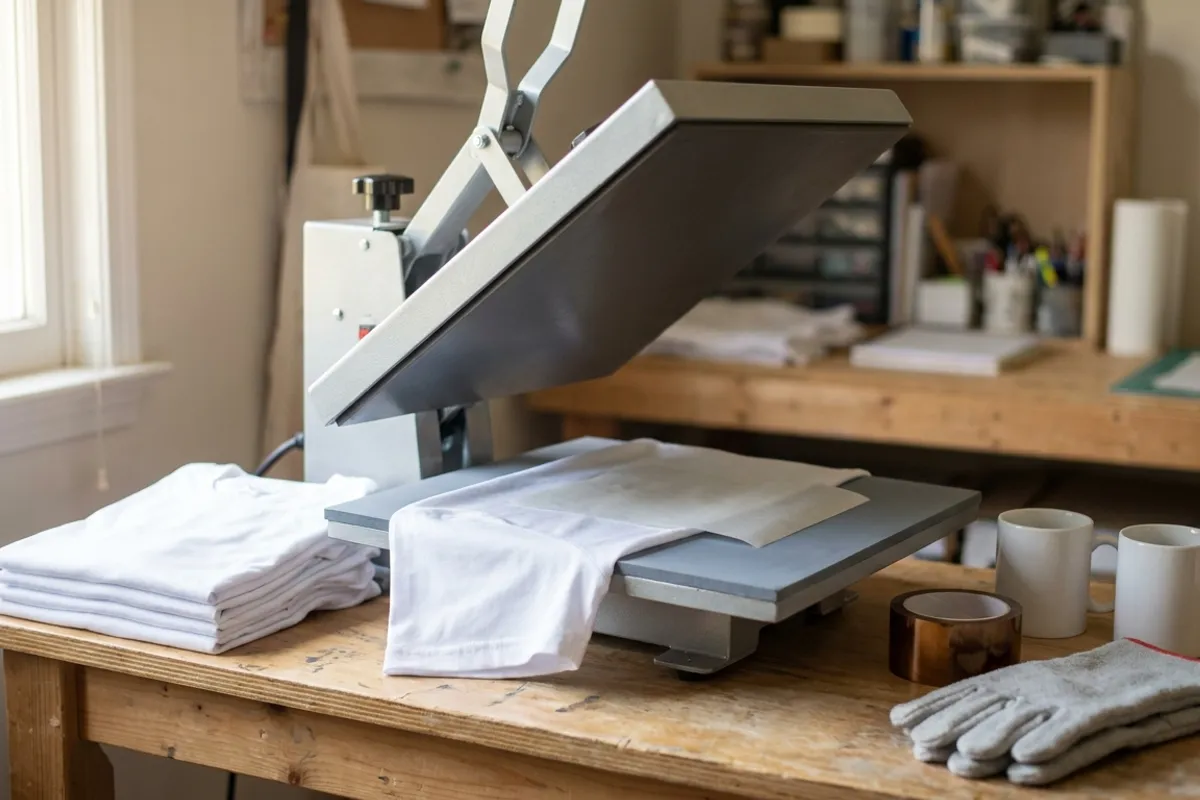
You bought the press two years ago, when sublimation was a weekend thing. It was $236, it opens on its own, and it has pressed a few hundred shirts without complaint. Then the youth soccer league orders 48 jerseys for Saturday, and somewhere around jersey nineteen you notice the number on the left shoulder is a shade paler than the one on the right. You rotate the next shirt a half-turn on the platen before pressing it. The pale patch stays on the same side of the press.
That is usually the moment a hobby press becomes a business question. Nothing broke. The press still heats, still closes, still opens. It just cannot do the same thing 48 times in a row, and every jersey it gets slightly wrong costs a blank, a sheet of paper, the ink on it and ten minutes you did not have.
The short version: the best heat press for a sublimation business is chosen by four things the box rarely leads with: a platen big enough for the largest sheet your printer makes, heat that is even across that platen, pressure that holds steady from press to press, and a warranty that says how long the maker expects the heating element to last. For most shops outgrowing a hobby press, that points to a 16 x 20 professional clamshell for apparel, or a swing-away if hardboard and tiles are a real share of the work. The real comparison is not press against press. It is the price gap against the reprints you stop making.
If you are still choosing a first press, the overview of how to start a sublimation business covers the beginner's question of which press to buy first. This post picks up later, when the press is already running most days and the question is whether to replace it.
What changes when a sublimation press runs every day
A hobby press is judged by whether a transfer comes out. A business press is judged by whether the fortieth transfer comes out the same as the first. Four things decide that.
Platen size, measured against your printer. Sawgrass lists its SG500 at up to 8.5 x 14 inches and its SG1000 at up to 11 x 17 inches (opens in new tab). A 17-inch sheet does not fit on a 15 x 15 or a 16 x 16 platen, so a shop that bought the bigger printer to print bigger designs has quietly committed to a 16 x 20 press as well. It is easy to upgrade the printer and forget the press.
Heat that is even across the platen. Sublimation runs hot and long. Sawgrass's heat press settings chart (opens in new tab) starts polyester at 400°F for 45 seconds and glass or ceramic tile at 400°F for 420 seconds, and it calls the whole chart "a starting place" that assumes "a calibrated heat press." A platen that runs cooler at one corner will print a paler corner every time, which is exactly what the soccer jerseys showed. Professional presses market against this directly: Hotronix says the Fusion IQ's cast-in element (opens in new tab) "ensures even heat distribution across entire surface and eliminates cold spots."
Pressure that holds. The Hotronix Perfect Pressure Guide (PDF) (opens in new tab) puts it plainly: "Too much or too little pressure can cause your design to fail." The same guide tells you to cut the pressure setting by 75% when you swap a 16 x 20 lower platen for an 8 x 10 quick-change platen, because the same force on a smaller area presses harder. Pressure is a setting you manage per platen and per product, and a press that drifts makes that impossible.
A warranty that names the heating element. This is the quiet tell. Hotronix covers the heating element on its Auto Open Clam for life (opens in new tab), the frame for five years, the circuit board for two and other parts for one. Geo Knight gives its DK20S a lifetime warranty on the heat platen (opens in new tab). The budget auto-lift presses in this guide carry one-year warranties on the whole press. A manufacturer that guarantees the element for life is telling you how it expects that element to age.
Sublimation heat presses compared side by side
Every figure below comes from the manufacturer's own product page or manual, read on October 10, 2026. Prices change often, and Hotronix labels its figures "retail price" and directs buyers to a distributor.
| Press | Style | Platen or capacity | Takes an 11 x 17 sheet? | Listed price | Warranty on the heating part | Power and circuit |
|---|---|---|---|---|---|---|
| Cricut EasyPress SE 12 x 10 | Handheld | 12 x 10 in | No | $99 (sale; $119 list) | Not stated on the page | Not stated |
| HTVRONT Auto Heat Press 15 x 15 | Auto-lift clamshell | 15 x 15 in | No | $236 (Standard Kit) | 1 year, whole press | 1500 W |
| Cricut AutoPress | Auto-release clamshell | 15 x 12 in | No | $299 (out of stock) | 1 year, whole press | Not stated (dual voltage) |
| Hotronix Auto Open Clam | Auto-open clamshell | 11 x 15, 16 x 16 or 16 x 20 in | 16 x 20 size only | $1,350 to $2,050 | Lifetime | 1000 W (11 x 15) or 1800 W; manual asks for a full 20-amp circuit at 120 V |
| Geo Knight DK20S | Swing-away | 16 x 20 in | Yes | $1,850 | Lifetime | 1800 W, rated 15 amps at 120 V (product page) |
| Hotronix Fusion IQ | Swing or draw | 16 x 20 in | Yes | $2,850 | Lifetime | 1800 W; manual asks for a full 20-amp circuit at 120 V |
| Geo Knight DK20SP | Air-operated swing-away | 16 x 20 in | Yes | $2,950 plus compressor | Lifetime | 1800 W, rated 15 amps at 120 V (product page) |
| Hotronix Air Fusion IQ | Air-operated swing-away | 16 x 20 in | Yes | $4,995 table top, $5,495 pedestal, plus compressor | Lifetime | 1800 W; manual asks for a full 15-amp circuit at 120 V |
| Cricut Mug Press | Mug | 11 to 16 oz straight-wall mugs | Not applicable | $99 (sale; $149.99 list) | Not stated on the page | Not stated |
| HTVRONT Auto Tumbler Heat Press | Tumbler | 10 to 30 oz tumblers | Not applicable | $139.99 (Standard Kit) | Not stated on the page | 600 W |
| Geo Knight DK3 | Mug and drinkware | 2.7 to 3.4 in diameter | Not applicable | $750 | 3 years or 3,000 mugs | 450 W, rated 4 amps at 120 V (product page) |
Handheld presses
The Cricut EasyPress SE (opens in new tab) reaches 400°F and sells for $99 on sale in the 12 x 10 size.
Good at: odd shapes a flat press cannot reach, such as tote straps, pillow edges and small fabric pieces. It costs little and stores in a drawer.
Watch for: you supply the pressure with your arm, so it changes from press to press and with how tired you are. Its platen is smaller than an SG1000 sheet. It is a good second tool and a poor main press for a shop filling orders.
Budget auto-lift clamshells
The HTVRONT Auto Heat Press (opens in new tab) lists a 15 x 15 plate, 410°F maximum, 1500 W and "dual-zone heating" for $236 in its Standard Kit. The Cricut AutoPress (opens in new tab) lists a 15 x 12 ceramic-coated plate, 400°F and an auto-release, at $299, and it was out of stock when checked.
Good at: the jump from a handheld. Both open by themselves when the timer ends, which saves a scorched blank when you are pulling the last shirt off the drying rack, and Cricut says the AutoPress adjusts itself to materials up to 2 inches thick.
Watch for: a one-year warranty on the whole press, and platens too small for an 11 x 17 sheet. Cricut's own feature list gives the original AutoPress plate as 15 x 12, not 15 x 15. These presses are fine at the volume they were built for. The question is whether that is your volume now.
Professional clamshells
The Hotronix Auto Open Clam (opens in new tab) comes in three sizes: 11 x 15 at $1,350, 16 x 16 at $1,700 and 16 x 20 at $2,050, all with cast-in tubular heating. Its operator manual (PDF) (opens in new tab) sets temperature from 176°F to 430°F.
Good at: volume shirt work on a small footprint. A clamshell is quick to load and unload, and the auto-open does what it does on the budget presses, but on a platen built for daily use.
Watch for: a clam closes at an angle, so the back of the platen meets the blank before the front. That is a non-issue on a shirt and a real one on a thick hardboard sign. You also need a full 20-amp circuit (see Before you plug in a new heat press).
Swing-away and draw presses
The Geo Knight DK20S (opens in new tab) is a 16 x 20 swing-away at $1,850, with digital control from 32°F to 600°F and a lifetime platen warranty. The Hotronix Fusion IQ (opens in new tab), at $2,850, can be used as either a swing-away or a draw press, where the lower platen slides out toward you.
Good at: thick and rigid blanks. The upper platen swings or the lower one slides clear, so you place the transfer with no hot plate over your hands, and the platen comes straight down onto the blank. Hardboard clock faces, which Unisub presses for 90 to 105 seconds (opens in new tab), and tiles are easier to keep square.
Watch for: they need more room around them than a clam, since the platen swings out to the side. Each cycle has one more motion than a clam, which adds up over a 48-jersey night.
Air-operated presses
The Geo Knight DK20SP (opens in new tab) is $2,950 and needs a compressor of at least 7 gallons, 1 cfm and 100 psi. The Hotronix Air Fusion IQ (opens in new tab) is $4,995 as a table top and $5,495 on a pedestal, and Hotronix says its "digital pressure auto-senses and adjusts to the set PSI based on product thickness."
Good at: taking pressure out of your arm. Air holds the pressure you set rather than the pressure you lean with, and on the Air Fusion IQ the press also adjusts when the product changes from a shirt to a 1/8-inch panel. For a shop running long days, that matters for the person running it too.
Watch for: a compressor is another machine, with its own noise, power draw and maintenance. Both presses need one, and neither price includes it.
Mug and tumbler presses
The Cricut Mug Press (opens in new tab) is $99 on sale ($149.99 list), takes 11 to 16 oz straight-wall mugs, and has "no manual temperature or pressure settings." The HTVRONT Auto Tumbler Heat Press (opens in new tab) is $139.99 in its Standard Kit for 10 to 30 oz tumblers, and lists a temperature range of 210 to 390°F. The Geo Knight DK3 (opens in new tab) is $750 and takes drinkware from 2.7 to 3.4 inches across, with a heat platen warranty of three years or 3,000 mugs.
Good at: drinkware, which no flat press handles well. Sawgrass's drinkware tips (opens in new tab) explain why the wrap has to be tight: when the paper is loose, the ink gas "may instead escape," leaving "streaks of blurred color across your image."
Watch for: the Cricut press's lack of settings, which is a feature for a hobbyist and a limit for a shop pressing several blank brands. The DK3's warranty is the only one in this guide written in units of work: 3,000 mugs.
When a better heat press pays for itself: the reject-rate math
The price gap between a $236 press and a $1,850 press looks enormous. Spread across the work, it is small. That is where the decision gets honest.
Take a hypothetical shop planning to press about 4,000 items a year and to keep the press three years: 12,000 presses. These figures are illustrative, so swap in your own.
| Press | Listed price | Press cost per item |
|---|---|---|
| HTVRONT Auto Heat Press 15 x 15 | $236 | $0.02 |
| Hotronix Auto Open Clam 16 x 16 | $1,700 | $0.14 |
| Geo Knight DK20S | $1,850 | $0.15 |
The professional press costs about 13 cents more per item. (The 16 x 16 clam suits an SG500 shop; the 16 x 20 size, at $2,050, works out to about 17 cents a press, about 15 cents more than the budget press.) Now price one reprint. Suppose a polyester shirt blank, the paper and the ink come to about $5, before the ten minutes of labor. A press that ruins one extra shirt in every 40 is costing you $5 ÷ 40 = 12.5 cents per item, which is about the whole difference. If your current press is spoiling one jersey in 20, the expensive press is already the cheaper one.
To run it on your own numbers, multiply the cost of one reprint by the number of items you expect to press over the press's working life, then divide by the price gap between the two presses. Call the result N. If the better press saves at least one reprint in every N items, it pays for itself. For the DK20S against the $236 press: $5 × 12,000 ÷ $1,614 ≈ 37, so one saved reprint in every 37 items.
That is why the right first step is not shopping. It is counting your reprints for a month and writing down why each one happened. Pale corners and uneven edges point at the press. Ghosting usually points at the transfer moving: Sawgrass's quick reference guide (PDF) (opens in new tab) advises tack spray and a blow-out sheet "to avoid ghosting." A new press will not fix that.
Electricity barely moves the answer. An 1800 W press drawing full power for a full hour uses 1.8 kWh. At the EIA's preliminary July 2026 U.S. average residential price (opens in new tab) of 18.31 cents per kWh, that is about 33 cents an hour. If each shirt takes about 90 seconds, Sawgrass's 45-second press plus loading and unloading, that is about 40 shirts an hour and under a cent a shirt even at full draw, and a press at temperature cycles its heater, so the real draw is lower.
What does move it is knowing your real numbers. A per-item cost that includes the blank, the paper, the ink, your time and a share of the press is the only way to see whether a reprint rate is a nuisance or a margin problem. With Ardent Seller for sublimation shops, you can add the press as a piece of equipment, log its maintenance and fold it into each product's cost, with straight-line depreciation over the years you expect to use it. The Product Pricing Calculator (Live) does the same arithmetic for one product if you want to try it on your best seller first.
Which heat press for which sublimation shop
Start from your month of reprint counts. In the example above, the break-even was about one item in 37. Run the same math with your own reprint cost, price gap and expected press count, and if your current press spoils items more often than that, skip the budget option below even at low volume.
- Mostly shirts, an SG500 printer, a few hundred presses a month, few reprints: a budget auto-lift 15 x 15 is honestly enough. Spend the difference on blanks.
- Shirts at volume, or an SG1000 printing full sheets: a 16 x 20 professional clamshell. You gain the platen size and the lifetime element at once.
- Hardboard, tiles, slates and signs alongside apparel: a swing-away or draw press, because thick blanks are where the angle of a clam starts to show.
- Long production days, or more than one person on the press: an air-operated press, budgeting for the compressor.
- Drinkware is a real product line, not an add-on: a dedicated mug or tumbler press whose temperature you can set, sized to the blanks you actually stock.
Before you plug in a new heat press
Two things catch people who upgrade.
The circuit. The Hotronix Auto Open Clam manual (PDF) (opens in new tab) and Fusion IQ manual (PDF) (opens in new tab) both say a 120-volt press "requires a full 20-amp grounded circuit," while the Air Fusion IQ manual (PDF) (opens in new tab) asks for "a full 15-amp grounded circuit." Geo Knight lists the DK20S at 15 amps. A spare-room outlet shared with a space heater or a dehumidifier may not be that circuit. Find out before the press arrives, not halfway through a tile at 400°F.
The settings sheet. A new press will not match your old settings, and two of the sources here already disagree with each other. Sawgrass's current chart (opens in new tab) (updated March 2026) gives polyester 45 seconds, where its older quick reference (PDF) (opens in new tab) gives 35 to 40 seconds. Unisub recommends 385°F (opens in new tab) for its own blanks, where that older Sawgrass guide says 400°F. Press a test piece of each product you sell on the new press, then write the winning time, temperature and pressure on a card taped to the machine.
Whichever press you buy, it is a long-lived tool, and its cost belongs in your prices for as long as you use it. Equipment depreciation for small makers explains how to spread that cost over its working life rather than eating it in one month.
If you want the blanks, the reprints and the press's share of every order counted in one place, start a free Ardent Seller account before the next big order lands.
Related reading
- What a Sublimation Tumbler Costs to Make — Seven cost layers on a 20 oz tumbler, including the machine share and the reject reserve this post argues should drive the press decision.
- Equipment Depreciation for Makers — How to spread a press's cost across the years you use it, in your prices and on your taxes.
- Laser Engraving Blank Inventory Tracking — Tracking a growing pile of blanks by size and color, which a sublimation shop needs as much as an engraving one.
Free resources
Two free tools for putting the press into your prices:
- Product Pricing Calculator (Live) — Enter the blank, paper, ink and a per-item press share for your best seller and see what the price has to be.
- Maker Hourly-Rate Pricing Calculator — Puts a number on the ten minutes each reprint costs, which is the half of the reject math most shops leave out.
This article is provided for educational purposes only and does not constitute financial, business, electrical or safety advice. Prices, specifications and warranty terms are as published by each manufacturer on the date noted and change often; cost examples are illustrative and will vary with your products and volume. Follow your press's manual, have a qualified electrician confirm your circuit, and consult a qualified accountant or small-business advisor before making purchasing decisions based on this content.