
The wind comes up around two in the afternoon, when the crowd has thinned and everybody is tired. It starts as a flap in the valance, then a lift, then the whole roof breathing like a lung. Two booths down someone is holding a leg with both hands. Somewhere behind you a display grid goes over on the grass, and a market manager is walking the row fast, telling people to drop their tops.
Nothing in that scene is decided by the color of your canopy or by the wind rating printed on the box. It is decided by four objects sitting on the ground at the corners of your booth, and by whether the frame above them was ever built to hold them.
The short version: for most craft-fair and farmers-market sellers, a straight-leg, medium-duty tent (the $290-$300 tier) plus four weight bags sized to your show's own rule — 25-pound bags cover the 24-25 lb minimums, 45-pound bags cover the 40 lb recommendation — is the right buy. Step up to a heavy-duty model near $700 when you do more than a dozen shows a year, or when a show asks for documentation naming NFPA 701 — a standard the mid-tier spec sheets do not name. Skip light-duty slant-leg tents for a booth you will use repeatedly: they cover 64 square feet of the 100 you rented, and the manufacturer's own weight plates do not fit them.
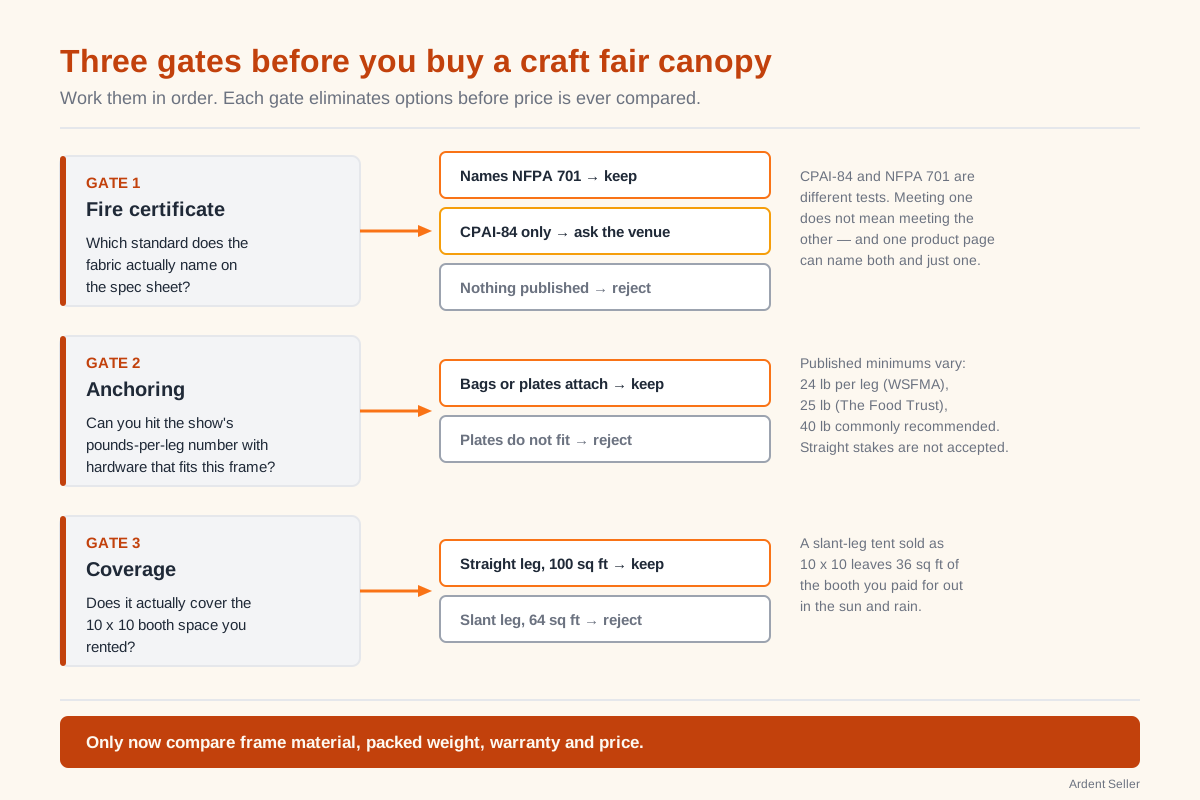
Most canopy roundups rank on price, wind rating, and how fast the thing pops up. Those are all real, and none of them is what turns a vendor away at load-in. The three variables that actually gate a booth are written in documents most buyers never read until the week of the show: the fire certificate the venue will accept, the pounds-per-leg number in the vendor packet, and the difference between a tent advertised as 10x10 and a tent that covers 10x10.
The three gates that decide your tent
Work them in this order. Each one eliminates options before you ever compare frame materials.
- Can it legally be there? Does the fabric carry a fire certification naming the standard your venue enforces?
- Can you anchor it to the show's number, with hardware that physically fits it? The required weight is set by the show. The hardware that attaches is set by the frame.
- Does it cover the booth you paid for? A slant-leg 10x10 does not.
Frame material, peak height, warranty length, and price are the fourth question, not the first. They decide how long the tent lasts and how much your back hates it. They do not decide whether you get to sell on Saturday.
Gate 1: A fire certificate the marshal will accept
This is the gate that surprises people, because it has nothing to do with wind and everything to do with a building inspector.
Old Deerfield Craft Fairs states it plainly in its exhibitor rules: "Local Building inspectors and Fire Marshals enforce the MA state law requiring tents, backdrops, table coverings, and awnings to be flame resistant." The show also tells exhibitors how to satisfy it — "a photocopy is acceptable of your tent's documentation of fire resistance. If your tent does not have a tag, the manufacturer can provide you with necessary documentation" (Old Deerfield vendor rules (opens in new tab)).
So far, so manageable. The complication is that "flame resistant" is not one test.
CPAI-84 is a voluntary industry standard whose full title is "A Specification for Flame-Resistant Materials Used in Camping Tentage" — it was written for camping fabrics, and it went unrevised between 1995 and 2021 (Advanced Textiles Association (opens in new tab)). NFPA 701 is the National Fire Protection Association's fire-test method for textiles and films (opens in new tab). A tent treated to meet CPAI-84 is not automatically NFPA 701 compliant, because they are different tests measuring different things. California adds its own layer: the State Fire Marshal registers flame-retardant fabrics under Title 19, which E-Z UP cites as "Title 19, Subchapter 1, Article 4 section 332 (a) (2)" separately from both national standards (E-Z UP fire certifications (opens in new tab)).
Which standard your venue actually enforces is a local question, and none of the three vendor packets quoted in this post names a standard at all — Old Deerfield's rule says only "flame resistant." So the useful move is not to memorize a hierarchy of tests. It is to find out which standard your venue's fire code cites, and then confirm your tent's fabric is certified to that one.
Now look at what that means across one manufacturer's actual line. E-Z UP's own specification tabs, read in September 2026:
| Model | List price | Fire certification named on the Specifications tab |
|---|---|---|
| Vista 10x10 (opens in new tab) (light duty) | $137.90 | "fire resistant treated to meet fire code CPAI-84" — but see the contradiction below |
| Vantage 10x10 (opens in new tab) (medium duty) | $292.60 | "fire resistant treated to meet fire code CPAI-84" |
| Eclipse MAX 10x10 (opens in new tab) (heavy duty) | $693.00 | "CPAI-84 and NFPA-701, CAN/ULC-S109 Fire-Resistance Requirements and California Fire Certified Flame Retardant" |
| Endeavor MAX 10x10 (opens in new tab) (heavy duty) | $1,389.00 | "Meets the CPAI-84, NFPA-701, & CAN/ULC-S109 Fire-Resistance Requirements & California Fire Certified Flame Retardant" |
The $292 Vantage names CPAI-84 and stops. The $693 Eclipse MAX names NFPA 701 as well. That is a real, published difference, and it has nothing to do with how strong either tent is.
Then the light-duty Vista demonstrates why none of this can be taken at face value. Its Specifications tab says CPAI-84 only — but a features bullet higher up the same page claims the product "Meets CPAI-84 and NFPA-701 Fire Resistant Requirements." One page, two different answers to the only question a fire marshal will ask.
That is not a reason to distrust one manufacturer. It is the reason the marketing copy is never the artifact. E-Z UP's fire certifications page (opens in new tab) says its fabrics "meet or exceed the minimum requirements of one or more of the following flame resistance standards," then lists six of them and offers three separate certificates — Professional, Commercial, and Recreational fabric. A brand-level "one or more" statement tells you nothing about the cloth over your head, and a features bullet is not a certificate either. Only the certificate for your fabric grade settles it — and E-Z UP says where to find which grade you have: "search for your product and view its details page to find the certificate located in the Specifications tab."
Do this before the show, not at the gate. Open your model's product page, find the fire certification line in the Specifications tab, then download the matching certificate for that fabric grade and put a copy in the tent bag. If the standard your venue names is not on that certificate, you have a problem you can still solve on a Tuesday and cannot solve on a Saturday morning.
One more wrinkle worth knowing before you spend: at some shows the canopy is not allowed at all. Old Deerfield's indoor spring and holiday events tell exhibitors they "MAY NOT use a canopy on their tent, and must also bring spray retardant for table drapes." If your season mixes indoor and outdoor venues, the fabric rules follow you inside — they just apply to different fabric.
Gate 2: Weight the show will actually count
"Forty pounds per leg" is a number that circulates informally among vendors. It is a good default and it is not a rule. The rule is whatever your show wrote down, and the published numbers vary more than you would expect.
The Washington State Farmers Market Association requires its member markets to put specific contract language in front of vendors. Its guidance document was last updated in October 2012, so treat it as the shape of a typical market rule rather than as today's requirement at any particular market — but the language it asks members to adopt is unusually explicit:
All vendors who wish to erect canopies (including umbrellas) on the Farmers Market site during a normal period of market operations, including the set up and break down period, are required to have their canopies sufficiently and safely anchored to the ground from the time their canopy is put up to the time it is taken down. Any vendor who fails to properly anchor his or her canopy will not be allowed to sell at the Farmers Market on that market day, unless that vendor chooses to take down and stow their canopy and sell without it. Each canopy leg must have no less than 24# (pounds) anchoring each leg, and market umbrellas, 50#.
Note what the consequence is. Not a warning. Not a fine. You sell without a canopy, in whatever weather brought the rule up in the first place.
The Food Trust's 2026 farmers market vendor handbook sets a different bar and a different enforcement point: "Tent weights must weigh at least 25 pounds for each leg and be tightly secured to each tent leg or where two legs meet," and "vendors without proper weights will not be allowed to set up a tent." It also reserves the right "to raise the minimum weight requirements at certain markets based on location and high winds," bans buckets and glass receptacles as weights outright, and states that "any damage incurred or caused by inadequately secured tents will be at the expense of that vendor" (The Food Trust 2026 Vendor Handbook (opens in new tab)).
Meanwhile WSFMA's own guidance notes that "one canopy manufacturer recommends at least 40 pounds on each corner of a 10x10 tent; double that on a 10x20 tent."
So the published range across just these sources runs 24, 25, and 40 pounds per leg — with a written right to raise it on a windy day. Buy to the top of the range you will actually face, because the difference in cost is small and the difference in outcome is your entire table.
Why the minimum is a floor and not a margin. The velocity-pressure equation in ASCE 7, the American structural-loads standard, multiplies 0.00256 by the square of wind speed in miles per hour to get pounds per square foot, then applies exposure, topographic, directionality and elevation factors on top (equation restated by Dlubal Software (opens in new tab), a secondary source). Take just the bare coefficient: at 25 mph that is about 1.6 psf, and a 10x10 roof is 100 square feet — roughly 160 pounds of force before any of those factors, or the gust and shape factors a real design calculation adds. Four legs at 24 pounds is 96 pounds of ballast. This is illustrative arithmetic, not an engineering wind load; the point is only that the show's number keeps ordinary days uneventful rather than certifying the tent against weather. WSFMA says as much itself: "in certain inclement weather conditions even properly secured canopies can be precarious."
The stakes exception, and its limits
On grass you may have a second option, but not with the stakes in the tent bag. WSFMA's contract language permits canopies to be secured on grass or unpacked soil "by steel auger anchors or spiral tent stakes of at least 1/2" thickness and 12 - 15" length, properly installed and secured," and then rules out the obvious substitute: "non-spiraled, straight tent stakes are not an acceptable canopy anchoring system." It adds that auger holding capacity "is dependent on soil conditions and density and may not be adequate in rocky soils" (WSFMA, Canopy Safety 101 (opens in new tab), updated October 2012).
On pavement, a parking lot, or a gym floor, the question does not arise. You need weights, and you need to have brought them.
The hardware has to fit the frame
Here is the part that quietly punishes the cheapest purchase.
E-Z UP sells cast-iron Weight Plates (opens in new tab) at 22 pounds each, stackable and interlocking, starting at $81.90 and sold in packs of two or four. Read the feature list to the end and you find this line: "Not Compatible with Patriot, Vista, Dome, or Vue." Those are four of the company's own light-duty models — including the $137.90 Vista. The manufacturer's best anchoring hardware does not attach to its own budget frames.
There is a second problem with plates even where they do fit. One 22-pound plate is two pounds short of the WSFMA minimum, so you need two per leg — eight plates, 176 pounds of cast iron, carried from a parking space to a booth and back, twice a day, by you.
Fabric weight bags avoid both problems. They wrap or strap around almost any leg shape, and they ship empty, so the load in your car is nylon rather than iron until you fill them on site. E-Z UP lists a four-pack of 25-pound bags at $50.40 (opens in new tab) and a four-pack of 45-pound bags at $84.70 (opens in new tab) — in both cases the stated figure is what each bag holds, and the sand or gravel is not included. The 25-pound set clears WSFMA's 24 and the Food Trust's 25. The 45-pound set clears the 40-pound recommendation with room to spare.
For a seller who loads and unloads alone, bags plus a bag of play sand from any home center is the better answer at nearly every show, and it is roughly a quarter the price of the equivalent iron.

Gate 3: Whether it covers the booth you paid for
A booth space is usually sold as ten feet by ten feet. A canopy sold as "10x10" may or may not cover it, and the difference is the leg geometry.
Slant-leg tents flare outward at the base. The footprint measures 10x10 on the ground, but the roof above it is smaller, so the coverage is smaller. E-Z UP's slant-leg Vista lists 64 square feet of coverage area. Straight-leg tents run vertical, so the roof matches the footprint: the Vantage, Eclipse MAX, and Endeavor MAX all list 100 square feet.
36 square feet is not a rounding error. It is the entire outer band of your booth — the band where your display racks, your best-selling table, and your customers all want to be — left in the sun in July and in the rain in October. Slant legs also cut diagonally through the corners at exactly the height where a grid wall or a shelf unit wants to stand.
There is one honest argument for slant legs: they are cheaper and lighter, and for a seller doing two shows a year under a pavilion roof, that can be enough. For anyone building a booth they will use repeatedly outdoors, straight legs are the default and the 64-square-foot figure is the reason.
What's left: frame, weight, and warranty
Only after the three gates does the spec sheet start to matter. Here is the same E-Z UP line read on the variables that decide longevity rather than admissibility.
| Model | List price | Frame | Legs | Top fabric | Packed weight | Warranty |
|---|---|---|---|---|---|---|
| Vista (opens in new tab) (light) | $137.90 | Steel | Slant | Denier not published | "Under 40 lb" (marketing copy — no weight in its spec tab) | 3 years |
| Vantage (opens in new tab) (medium) | $292.60 | 1015 steel, powder-coated | Straight | Duralon PLUS, 300D poly | 48 lb | 5 years |
| Eclipse MAX (opens in new tab) (heavy) | $693.00 | 1015 steel, 32 mm square | Straight | Duralon PRO, 500D poly | 67 lb | 7 years |
| Endeavor MAX (opens in new tab) (heavy) | $1,389.00 | 6061-T6 aluminum, 50 mm octagonal | Straight | Duralon PRO, 500D poly | 68 lb | Lifetime limited |
Three things are worth pulling out of that table.
Fabric denier is the difference between the mid and heavy tiers, not just the frame. The Vantage's 300D top and the Eclipse MAX's 500D top are different cloths. Denier measures yarn thickness, and a heavier top resists abrasion, UV breakdown, and the slow sag that turns a four-year-old canopy into a rain collector.
Aluminum does not buy you a lighter tent here. The all-aluminum Endeavor MAX is listed at 68 pounds against the steel Eclipse MAX's 67. What the aluminum actually buys is corrosion resistance and a much larger 50 mm octagonal leg — worth it for coastal markets and heavy year-round use, and largely wasted on twelve shows a year inland.
The warranty is the clearest signal of intended duty cycle. Three years, five years, seven years, lifetime — that ladder tracks how hard the manufacturer expects each tier to be used. A tent that lives in a car every weekend from May to December is not being used the way a three-year warranty anticipates.
On prices. Every figure above is the list price published on the manufacturer's own product page in September 2026, and E-Z UP was running a sitewide promotion at the time. Street prices move constantly, and other makers — Caravan, Impact, ABCCANOPY, Eurmax, and the art-fair specialists like TrimLine and Light Dome — occupy the same tiers at different price points. Use the tiers as the shape of the decision, and check current pricing before you buy.
What a compliant setup actually costs
Price the tent and the anchoring together, because a tent you cannot anchor is not a tent you can use.
A medium-duty kit that clears the 24-25 lb minimums most contracts set — a straight-leg Vantage at $292.60 plus a four-pack of 25-pound weight bags at $50.40 — is about $343 before sand. Check your own show's packet before settling on it: a market that asks for 40 pounds a leg, or exercises its written right to raise the minimum on a windy morning, needs the heavier bags. A heavy-duty kit whose spec sheet names NFPA 701 — an Eclipse MAX at $693.00 plus 45-pound bags at $84.70 — is about $778.
Now put that against a season. A seller doing eighteen market days a year lands near $19 per show day on the medium kit in its first year, and under $4 per show day if the tent lasts the five years its warranty anticipates. The heavy kit is about $43 in year one and roughly $6 per day across a seven-year life.
Those are small numbers next to a single booth fee, and they are very small next to the alternative. A tent that leaves the ground does not just destroy itself. It takes the inventory underneath it, and — as the Food Trust handbook spells out — "any damage incurred or caused by inadequately secured tents will be at the expense of that vendor."
Which is the argument for treating booth gear as equipment rather than as an errand. A canopy, a set of weights, tables, grid walls, and a card reader are assets with useful lives, and the show fees, mileage, and parking that surround them are costs attached to specific selling days. Recording them that way — as equipment with a purchase date on one side, and per-event costs on the other — is what turns "was that show worth it?" into a number rather than a feeling. That is the shape of the equipment and event-cost tracking in Ardent Seller: the tent is an asset you bought once, and each market day carries its share of what it cost to stand there.
Buying it once
The pattern in all three gates is the same. The variables that decide whether your booth opens are external — a fire marshal's standard, a market's contract language, the dimensions of the space you rented — and the variables that dominate the marketing are internal to the product. Wind ratings, pop-up speed, and color get the headline. A certificate, a number in a PDF, and 36 square feet decide the day.
So read your show packets first and shop second. Pull up the two or three shows you most want to do next season, find the tent paragraph in each one, and write down the highest weight number and any named fire standard. That list is your specification. Then buy the cheapest straight-leg tent that meets it, buy weight bags rather than iron, and put the fire certificate in the bag with the tent.
Done in that order, this is a purchase you make once and stop thinking about — which is the entire point of gear.
Related reading
- Best Card Reader for Craft Fairs — the other piece of booth hardware where the advertised number is not the deciding one; ranks five readers on offline behavior and battery rather than the rate.
- Why Your Craft Fair Booth Isn't Making Money — once the tent is bought, this is the booth-day diagnostic that tells you whether the show itself is worth returning to.
- Craft Fair Booth Theft Prevention — how product and cash actually leave a table, and the booth layout changes that stop it.
- 10 Farmers Market Mistakes That Are Costing You Money — the recurring operational errors that cost regular market vendors real margin across a season.
Free resources
Free companion downloads if you want to put any of this into practice:
- Craft Show Prep and Profit Tracker — a per-event sheet for booth fees, gear, mileage, and sales, so each show day resolves to a profit figure rather than a guess.
- Craft Seller Startup Checklist — the wider setup list for a first selling season, of which the canopy is one line.
This article is general information about event equipment and vendor requirements, not legal, safety, or engineering advice. Fire code, tent anchoring rules, and permit requirements are set by individual venues, municipalities, and state fire authorities, and they change — the requirements quoted here are examples of how much they vary, not a substitute for the rules of the specific show you are applying to. Always read your own show's vendor packet and follow the manufacturer's instructions for your canopy and anchoring hardware. Prices and specifications were published by the manufacturer in September 2026 and change without notice.