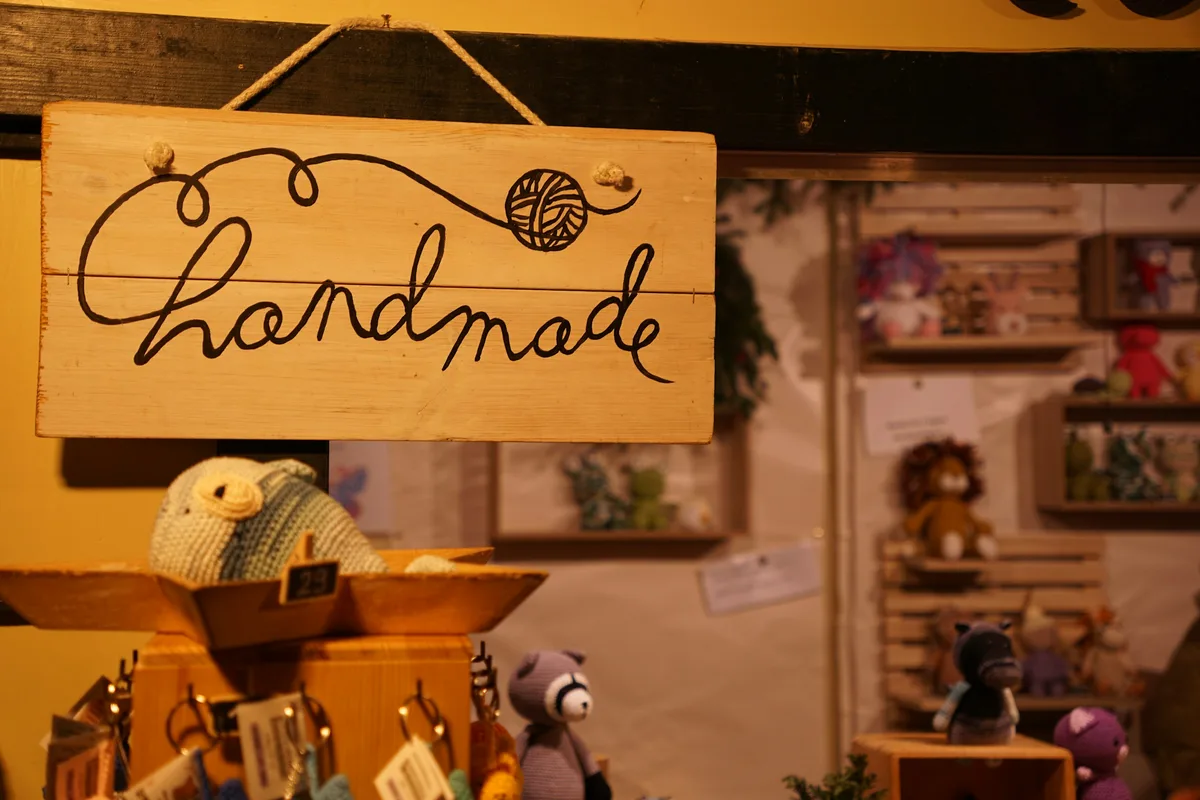
The canopy is doing nothing about the heat. It is a little after eleven, the Saturday crowd has thickened into that slow shuffle where nobody can quite get past anybody, and there are four people at your table. One is asking whether the lavender soap is the same as the lavender-and-oat. One is holding a bar in each hand doing the price math out loud. Two more are behind them, waiting, doing the thing where they pick something up and put it down again.
You are talking to the first one. Your back is half-turned. The cash apron is on the table because you took it off to reach the restock bin.
This is the two minutes. Every market vendor has them, most weeks, and they are where the losses happen.
Nobody writes about this. There is no dataset on craft fair booth theft, no annual survey, no benchmark shrinkage percentage for a ten-by-ten tent.
The short version: product and money leave a market booth four ways — off the table while a crowd has your attention, out of the cash box (including short-changing and counterfeit notes), through a payment that never actually arrives (a faked app confirmation, or a keyed card that charges back), and overnight at a multi-day show. Each has a specific setup fix. None of them is solved by watching harder, and all of them are cheaper to survive if you counted your stock before you left the house.
Here is how each one actually plays out, and then the checklist.
Nell and the crush: when product walks off the table
The four vendors below are composites, written to illustrate each pattern rather than to report a particular person's bad Saturday. The sourced figures around them are real.
Nell sells soap. Her table is a good one: bars fanned out on risers, arranged by scent, low enough to touch, which is the whole reason people buy handmade soap in person. She counted 214 bars into the van that morning because she always does.
She came home with 186 bars and receipts for 24.
Four bars, roughly $28 of product, walked off during a Saturday she remembers as a good day. She never saw it happen, and she never will, because the theft and the sale look identical from six feet away. That is the mechanic: a table designed to invite handling is a table where a hand closing around something is the expected motion.
The fix is not suspicion, and it is not putting the soap behind glass, which would cost her far more than $28 in sales. The fix is layout. Small, high-value, pocket-sized items move off the front edge and onto the part of the table you are standing behind. The impulse items that need to be touched stay at the front, but they are the ones you can afford to lose a few of. And the front edge of the table gets a little depth in front of it, so reaching the goods means leaning in where you can see it.
The other half of the fix is that Nell already had the important thing and did not know it. She counted 214 bars. A vendor who never counts has no way to separate a theft from a miscount, or from a bar handed out as a sample. Nell can.
Marcus and the cash box: short-changing and counterfeit notes
Marcus, also a composite, makes small wooden things: spoons, boards, a few boxes. He runs cash-heavy because his customers at this particular market are cash-heavy, and for three seasons he ran a cash box on the table with the lid up.
He lost the whole box once. Not dramatically, nobody grabbed it and ran. He simply turned to wrap a cutting board, and when he turned back it was not there.
Cash is the one category with no paper trail at all. A stolen product at least leaves a hole in an inventory count. Cash leaves nothing, which is why the reconstruction after the fact is always guesswork.
Two smaller versions of the same problem cost more vendors more money than the dramatic version:
The short-change routine. It works on exactly the conditions a market booth provides. Someone pays with a large bill, changes their mind mid-transaction, asks you to break something else, adds a small item, and keeps talking while you are counting. It is a rhythm designed to load your working memory until you lose track of what is in your hand. The defense is procedural and slightly rude: finish one transaction before starting the next, and keep the bill you were handed visible on the box until the change is counted back.
The counterfeit note. Here the loss is unambiguous and entirely yours. The Federal Reserve puts it plainly: "Accepting a counterfeit note could lead to a real financial loss for individuals or businesses" (Federal Reserve Financial Services, Handling Counterfeit Currency (opens in new tab)). Federal Reserve Banks do not accept deposits of counterfeit currency, so the note does not get quietly absorbed somewhere upstream. It stops with whoever took it. If you do end up with one, the route depends on whether you are reporting as a business. A business submits the note to the Secret Service on Form SSF 1604; the electronic submission site it replaced was retired on November 1, 2024, and an individual is told to contact their local Secret Service field office (U.S. Currency Education Program (opens in new tab)). The Secret Service's own counterfeit page routes individuals differently again, to their local police department (U.S. Secret Service, Counterfeit Investigations (opens in new tab)). If you are trading as a business, SSF 1604 is the line that applies to you, and either way the note is gone.
Marcus now runs a float in an apron he is wearing and moves anything above it out of reach. The rule he uses is worth stealing: the cash within arm's reach of the customer side of the table is the amount he has decided he can afford to lose, because that is the amount he is actually risking.
Tess and the payment that never arrived: screenshots and keyed cards
Tess, another composite, sells jam. Her losses have all been digital, and they are the ones vendors are least prepared for because they do not feel like theft at the time. They feel like a completed sale.
The screenshot. A customer holds up a phone showing a payment confirmation to her handle, takes four jars, and leaves. The money never arrives. A screenshot is an image; anyone can make one, and the ones in circulation are good. The rule is simple and needs no judgment call: the money is confirmed in your account, in your app, before the product leaves your hands. Not their screen. Yours.
The reason scammers like this rail at all is the same reason it is convenient for you. The FTC's guidance to consumers is that "sending money through a payment app is like sending cash — it's very hard to get it back" (FTC Consumer Advice, August 14, 2023 (opens in new tab)). That is written for the person sending, and it cuts both ways at a market table: a genuine transfer settles fast and stays settled, which is good for you, and a fake one is worth faking precisely because a real one would have been final.
The keyed card. This one is expensive and almost nobody knows it. Market signal is bad, the reader will not connect, the line is growing, and the app offers to let you type the number in. Do not, if you can avoid it. The U.S. Payments Forum states it directly: "if the merchant uses manual key entry, the merchant is liable for fraudulent transactions" (Understanding the U.S. EMV Liability Shifts (opens in new tab), U.S. Payments Forum, July 2017). That sits inside the broader October 2015 EMV liability shift, which moved liability for certain card-present fraud to whichever party had not adopted chip technology. A keyed sale that turns out to be fraudulent does not bounce back to the bank. It lands on you, weeks later, as a chargeback against a jar of jam you handed over in June.
The practical answer is a reader that works offline, a charged battery bank, and the discipline to take a phone number and invoice rather than key a card you cannot dip.
Ray and Saturday night: overnight theft at multi-day shows
Ray, the fourth and last composite, throws pottery. His worst loss was not during market hours at all.
Two-day shows create a category of their own: the overnight. Vendors leave tents standing, because striking and rebuilding a booth twice is brutal, and many shows explicitly expect it. Some have overnight security. Some have a person in a golf cart. The difference matters enormously and is rarely stated clearly in the vendor packet, which means it is a question you have to ask before you decide what to leave.
When Ray called his insurer afterward, he found the thing that makes this whole category worse than vendors expect. The Insurance Information Institute's guidance to home business owners is blunt: "Don't assume that your homeowners policy covers your home business. It may, but probably only to a maximum of $2,500 for business equipment in the home and $250 away from the premises" (Insurance Information Institute, Insuring Your Home Business (opens in new tab), accessed August 2026).
Two hundred and fifty dollars, away from the premises. A booth is away from the premises. So is the van, and so is the storage unit you stopped at on the way. For a potter carrying two thousand dollars of work to a weekend show, that ceiling is not a deductible problem, it is a coverage problem — the policy was never designed to cover this and does not pretend to.
The III describes the alternatives in the same guidance: an endorsement on the homeowners policy for an "incidental" business, individual business policies, or a businessowners package. Some of the small-business packages it describes cover business property on or off premises, with money off premises covered to a stated limit. Which of those is right depends on your volume and your state, and it is a conversation with an agent rather than a decision you make from a blog post. The part worth acting on today is narrower: find out what your actual off-premises limit is before the next show, not after one.
That call will cover more than theft, because the same conversation decides what happens if one of your products injures somebody. Product liability insurance for handmade sellers works through that side in full — what the policies cost, and which shows and marketplaces demand a certificate before you can set up. This post stays on the property side: what you are carrying, and what it is worth if it does not come home.
What the four have in common
Nell's soap off the table, Marcus's cash box, Tess's phantom payments, Ray's overnight loss: different mechanics, one underlying condition. A booth is a retail store with no back room, no camera, no second employee, and a floor plan optimized for touching the merchandise. Every fix above is a version of the same move: put a little friction between the customer side of the table and the things you cannot afford to lose, and keep a record good enough to prove what was there.
The record is the part vendors skip, and it is the part that decides whether a bad Saturday is a loss or a claim. Nell's 214 bars is a boring detail right up until the moment somebody asks her what was taken. A police report wants a number. An insurer wants a number and a value. "About a dozen candles, I think" closes both doors.
Counting in and out of every event is tedious by hand, which is why most people do it once, hate it, and stop. It is much less tedious when the count lives somewhere that already knows your product list and your costs. Ardent Seller tracks inventory by location, so a market is just another place your stock can be, and the difference between what went out, what sold, and what came home is a number you can read rather than reconstruct.
The pre-market checklist
Run this the night before, not in the parking lot.
- Count what goes in the van. Units by product. Write it down or record it somewhere you can retrieve it under stress. This is the single highest-value item on this list.
- Re-plan the table by reach. Small and valuable moves behind your standing position. Touchable impulse items stay at the front. Nothing you would grieve sits on a corner nearest the aisle.
- Split the cash. A working float you are wearing, everything else out of reach. Decide the float amount deliberately: it is your accepted loss.
- Charge everything, and pack a backup. Reader, phone, and a battery bank. A dead reader is what produces keyed transactions, and keyed transactions are the ones you are liable for.
- Test the reader on the actual site if you can. Signal at your booth number is not signal at the gate.
- Write down your payment handle correctly and check it against your own app. Scam variants rely on lookalike handles; if yours is displayed clearly and correctly, a mismatch is easier to spot.
- Ask the organizer two questions. Is there overnight security, and what does the show's vendor agreement say about liability for booth contents? Both answers change what you leave.
- Know your off-premises insurance limit. One phone call to your agent, once. Then you can make the overnight decision on facts.
- Bring a second pair of eyes if the show is big. The crush of several customers at once is unavoidable alone and largely solved with a helper. A teenager who wraps purchases is cheaper than the shrinkage at a busy show.
- Count what comes home. Same list, other end of the day. The reconciliation against sales is where you find out whether any of this is working.
The first ten minutes after
If you realize something is gone, the order matters, and the instinct to tear the booth apart looking is the wrong first move.
- Do not confront anyone. You are alone, in public, with cash. Nothing in your booth is worth what a confrontation can turn into.
- Note what you can safely observe, and tell market management immediately. Direction, description, time. They can radio, they know the layout, and they often know the pattern, because the same people work the same circuits.
- Report it to the police and get a report number, even when the value feels too small to bother. That number is the thing an insurer will ask for, and a report filed Tuesday about a Saturday is a materially weaker report.
- Do the count before you pack. Reconstructing shrinkage from a van full of unpacked bins the next day is guesswork, and guesswork is not a claim.
Then there is a fifth step that is emphatically not a ten-minute one. One theft is not a pattern. Three at the same market with the same shape is, and vendors on that circuit usually know it before you do. Ask around before you spend money on a fix for a problem you have had once.
None of this makes a booth secure, because a booth cannot be. It makes the losses small, visible, and provable, which is the realistic goal. The vendors who handle this well are not the ones who never lose anything. They are the ones who can tell you exactly what they lost, and therefore whether it is getting worse.
Bring the count sheet. Wear the apron. Confirm the money in your own app.
Related reading
- Why Your Craft Fair Booth Isn't Profitable — the post-mortem for the other kind of bad Saturday, where nothing was stolen and the day still lost money.
- Farmers Market Mistakes Costing You Money — per-event profitability, spoilage, and the costs that make a full cash box misleading.
- The Best Card Reader for Craft Fairs and Farmers Markets — taking more cards means less cash in the box, but a $299 terminal is its own target; this weighs each device on what it costs and what it survives.
- Best Canopy Tent for Craft Fairs — the other way a booth loses stock in one afternoon is the tent coming off the ground; the weight-per-leg rules and the frames that will not take weights at all.
- Product Liability Insurance for Handmade Sellers — the other half of the insurance conversation: what happens when your product injures someone, rather than when someone takes it.
- Selling at Juried Craft Shows — the higher-stakes version of a market weekend, where booth fees and overnight decisions both get bigger.
Free resources
Two free downloads that make the counting half of this workable:
- Craft Show Prep & Profit Tracker — the pre-show packing list and post-show reconciliation in one sheet, so the count in and the count out live next to what you sold.
- Monthly Inventory Count Sheet — print one for the van and one for the drive home; the variance column is where shrinkage shows up as a number instead of a feeling.
This article is provided for educational purposes only and does not constitute financial, insurance, legal, or business advice. Insurance coverage limits, policy terms, payment network rules, and show organizer liability provisions vary by carrier, jurisdiction, and event, and change over time. Consult a licensed insurance agent, a qualified accountant, or an attorney before making coverage or financial decisions based on this content.