A barcode is not a number. It is a way of saying a number out loud so that a machine can hear it. The stripes are the voice; the digits underneath are the name. GS1 US, the organization that issues those names in the United States, puts it plainly: the barcode is the "data carrier," and what it carries is a Global Trade Item Number — a GTIN (opens in new tab).
Which means the question makers tend to ask first — "how do I get a barcode?" — is really the second question. The first one is whether your product needs a registered name at all. Most of the channels handmade sellers actually use — Etsy, your own site, markets, wholesale to small shops — never ask for one. The products that do need a registered number often need fewer of them than the pricing page implies, and can cost less than a first glance at it suggests.
The number and the stripes are two different things
Three identifiers get tangled together, and untangling them resolves most of the confusion in one pass.
A SKU is a code you invent for your own records. It identifies one specific sellable variant — the 8 oz lavender candle in the black tin, not the lavender line. Nobody outside your business has to agree with it, which is exactly why it is free and why you can change it. (If you are still designing yours, that is a separate craft with its own rules, and SKU Design for Small Sellers covers it properly.)
A GTIN is a number licensed through GS1 so that it means the same thing in everyone's system. GS1 US defines it (opens in new tab) as "a GS1 identification key used to identify a trade item." Its formats differ only in length and territory: GTIN-12 is the 12-digit number used for point-of-sale scanning in North America and is the only kind encoded in a UPC-A symbol; GTIN-13 is its 13-digit international counterpart, carried by EAN-13; GTIN-14 is 14 digits and identifies a case or carton rather than a retail unit, so it never appears at a register; GTIN-8 exists for very small packages outside North America.
A barcode symbol — UPC-A, EAN-13, Code 128, ITF-14, a QR code — is just the printed pattern. It can encode a licensed GTIN. It can equally encode your internal SKU, or the word BANANA. The symbol has no opinion about what it carries.
The distinction that saves money: printing a barcode is free. Licensing the number inside it is the part that costs $30 and up, and it is only worth paying for when someone else's computer has to recognize the number.
The only question that matters: who scans it?
Everything below is really one decision, applied to different channels.
If the scanner belongs to you — your booth tablet, your packing bench, your stocktake — you do not need a licensed number. You can print a Code 128 symbol of CDL-LAV-8OZ-BLK and scan it all day. Your own system is the only system that has to recognize it.
If the scanner belongs to a stranger — a supermarket register, a distributor's receiving dock, a marketplace validating your listing against a global registry — you need a number that is globally unique and traceable back to you. That is what the GS1 license buys. Not the stripes. The uniqueness, and the record that says the prefix belongs to your business.
Almost every genuinely confusing case resolves once you ask whose machine is doing the reading.
Where you don't need a GTIN
Etsy. Etsy's SKU documentation (opens in new tab) covers only the code you assign yourself — SKU numbers are "a way for you to keep track of your inventory and quickly identify what you have in stock" — and the page never mentions a GTIN, a UPC, or any registered identifier. A handmade listing publishes without one.
Your own website. Shopify offers a barcode field on every variant, and its documentation (opens in new tab) is refreshingly direct about who it is for: "barcodes are typically used by resellers. The identifier needs to be a new or existing Global Trade Item Number (GTIN)." It also flags the real trigger — "some sales channels require a GTIN before a product can be published using the channel." The store platform is not asking. A downstream channel might.
Google Shopping, if your products are handmade. This one surprises people, because the feed does ask for a GTIN. Google's product data specification answers it directly: submit the identifier_exists attribute with a value of no for "custom goods or one-of-a-kind products, like custom T-shirts, art, or handmade goods" (opens in new tab), alongside vintage items and books published before 1970. Google's GTIN attribute page (opens in new tab) adds the corollary: supply a GTIN only when you are sure it is correct, and never guess or invent one. Handmade is an anticipated case in the spec, not a loophole.
Markets, fairs, and your own point of sale. Square lets you print labels from your item library (opens in new tab) and choose whether the symbol encodes the SKU or a GTIN, and Square Handheld (opens in new tab) "can scan 2D barcode types such as PDF417 and QR, in addition to the following 1D barcode types: UPC-A, UPC-E, EAN-8, EAN-13, and Code 39." It will happily scan a label you designed yourself.
Most wholesale to independent shops. A boutique that rings sales on a tablet scans whatever it puts into its own catalog. Ask the buyer rather than assuming — it may never come up at all.
Ardent Seller sits in this tier for most makers: every inventory item renders a scannable barcode and QR code from its SKU, with the symbol format set once under Settings → Preferences (Code 128 by default, with UPC-A, EAN-13, ITF-14, Code 39, Code 93, and EAN-8 available). Print, scan, count — no licensing involved. You can see where that fits in the rest of the system on the features page.
Where you do need one
Four situations, and they share a family resemblance: in each, your product enters a catalog that other companies also write to.
Amazon, in most categories. GS1 US quotes (opens in new tab) Amazon's Seller Central guidance directly: "We verify the authenticity of product UPCs by checking the GS1 database. UPCs that do not match the information provided by GS1 will be considered invalid. Obtain your UPCs directly from GS1." Amazon does run a GTIN exemption program — GS1 US describes it as allowing "certain products to be listed on Amazon without providing a UPC or other GTIN" — and for handmade brands selling only on Amazon it is often the right route. Apply for it before you buy anything.
Grocery, big-box, and national chain retail. This is where the question usually hardens into a requirement — but it is the retailer's requirement, not a rule you can look up. Each chain sets its own supplier criteria and publishes them in its own vendor documentation, and they differ. Ask your buyer what their systems need before you license anything; the answer decides not only whether you need a number, but how many.
Distributors and anyone receiving your product by the case. Retail units get a GTIN-12 or GTIN-13; the shipping carton gets its own GTIN-14, printed as an ITF-14 symbol. If a distributor asks for "case codes," this is what they mean, and it is a different number from the one on the unit.
Any channel that has told you so in writing. This is the whole rule. Nobody needs a barcode preemptively. They need one because a specific counterparty asked, and that counterparty can tell you which format and which registry.
What GS1 actually charges
Picture a hypothetical candlemaker — call her Nadia — with four scents in three sizes. A regional co-op tells her they would stock her line, and the buyer mentions, almost in passing, that everything on the shelf has to scan.
Here is the price list (opens in new tab) she is looking at.
| Option | Capacity | Initial fee | Annual renewal |
|---|---|---|---|
| Single GTIN | 1 number | $30 | None |
| GS1 Company Prefix | 10 numbers | $250 | $50 |
| GS1 Company Prefix | 100 numbers | $750 | $150 |
| GS1 Company Prefix | 1,000 numbers | $2,500 | $500 |
| GS1 Company Prefix | 10,000 numbers | $6,500 | $1,300 |
Two features of that table do the work. The first is that a single GTIN carries no annual renewal — it is a one-time $30. The second is that capacity is counted in numbers, not product lines, and every sellable variant needs its own. Square's own guidance (opens in new tab) is blunt about it: reusing one GTIN across item variations "is strongly discouraged, as each variation should have its own unique GTIN."
So Nadia's four scents in three sizes are not four numbers. They are twelve.
Twelve single GTINs cost $360, once. The 10-number prefix cannot hold them. The 100-number prefix can, at $750 up front plus $150 every year after — $390 more on day one, and $1,140 more once five annual renewals have been paid. What tips the arithmetic back toward a prefix is not the count today but the trajectory: if a seasonal scent and a gift set are already sketched for spring, the per-number cost of buying singles one at a time starts to matter, and the prefix also gives you room to number cases and future lines from one licensed block.
The mistake worth naming is the one that feels responsible. Faced with a tier list, buying the bigger tier looks like prudence — more headroom, less risk of running out. Here the headroom costs $150 a year forever, and twelve numbers were the whole requirement. Nadia buys twelve singles and keeps the difference. Count your variants first, then buy the smallest thing that covers them.
The cheap resold barcodes, and why they fail
Search for cheap UPCs and you will find resellers offering codes for a few dollars each. They are real GS1 numbers. They will scan.
They are also registered to somebody else. A reseller is subdividing a company prefix that GS1 issued to a business years ago, so the number's registry entry names that business, not yours. For a booth scanner, nobody looks. For any counterparty that checks the registry, the mismatch is the entire point of checking. Amazon states that it verifies UPCs against the GS1 database and treats non-matching codes as invalid, and GS1 US warns (opens in new tab) that "GTINs that are not directly issued from GS1 may be linked to another company and do not comply with GS1 Standards."
The uncomfortable part is that a resold code fails later than you would like — after the labels are printed and the pallet is built. If the reason you are buying a number is that somebody else's system has to recognize it, then a number that resolves to a stranger has not solved the problem. It has moved it downstream and added packaging costs to the eventual fix.
The decision, on one page
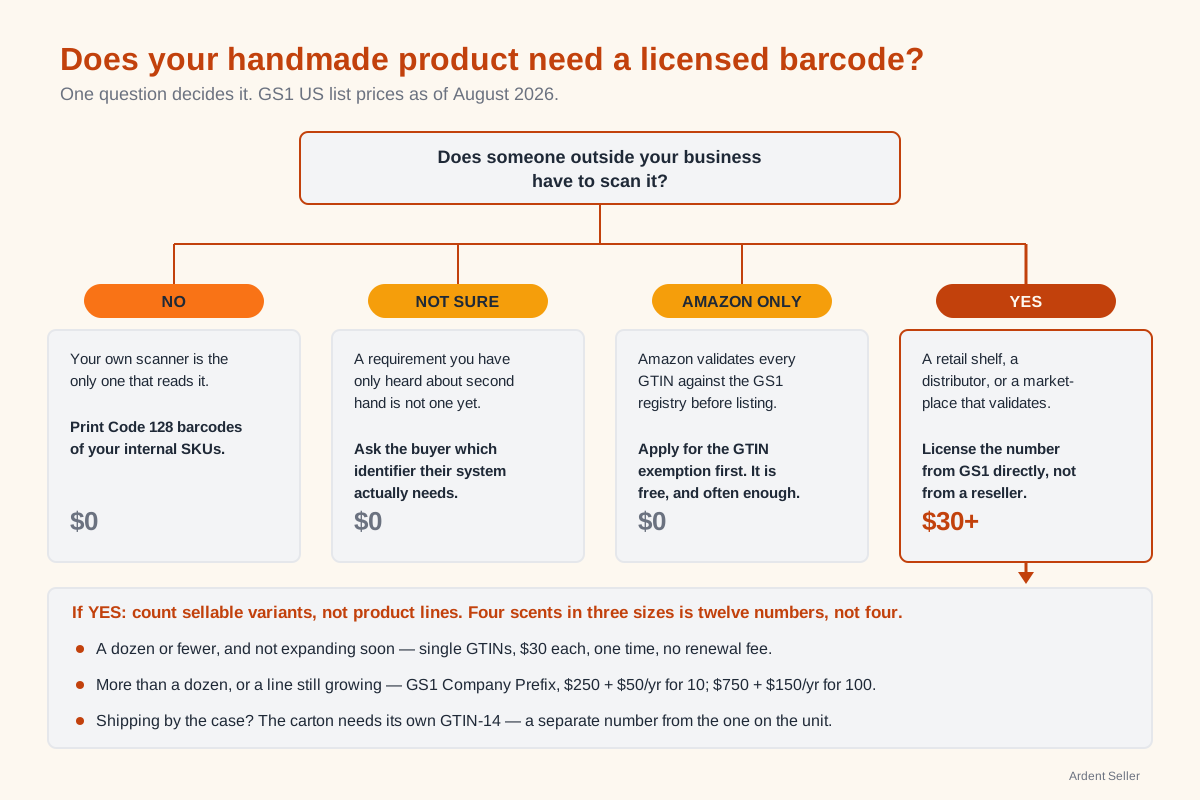
Read down until a branch describes you, then stop. If you sell through more than one channel, run the question separately for each — a yes from any single channel means you need a number, even when the others do not care.
Does a specific buyer, marketplace, or distributor require a registered identifier, in writing?
- No → You need no GTIN. Print barcode symbols of your own SKUs for picking, stocktake, and booth checkout. Revisit only when the answer changes.
- Not sure → Ask them before spending anything. "Do you need a GS1-registered GTIN, or will our own barcode scan into your system?" takes one email and settles it.
- Yes, and it is Amazon only → Apply for the GTIN exemption first. If it is granted, you are finished; if it is denied for your category, treat yourself as the next branch and license from GS1.
- Yes, and it is retail, a distributor, or a marketplace that validates → License from GS1 directly. Then count your sellable variants — every scent, size, and colorway — before you choose between single GTINs and a prefix. At around a dozen numbers or fewer, with no near-term expansion, singles are usually cheaper over any horizon longer than a year. Add a growing line or a second product category and the prefix earns its renewal. If you are shipping by the case, budget a separate GTIN-14 for the carton — it is a different number from the one on the unit.
If you want that logic on paper alongside the SKU conventions it depends on, the SKU Naming & Barcode System Starter Kit is a printable version you can tape above the packing bench.
What changes by the end of 2027
One development is worth knowing about, mostly so it does not panic you when a supplier newsletter mentions it.
GS1 is coordinating a global move to 2D barcodes at the register — QR codes built to the GS1 Digital Link standard, carrying the same GTIN plus more. GS1 US calls the initiative Sunrise 2027 (opens in new tab) and describes it as "a global transition from 1D UPC barcodes to 2D barcodes, like QR codes." The obligations it names fall on retailers — "install optical scanners that are Sunrise-capable to read 2D barcodes and extract the GTIN at POS" — and on brands, to add 2D codes to packaging and make sure any QR code already on the label carries a real GTIN in the standard's format. GS1 US is also explicit that it is "not necessary to implement all the capabilities of 2D by that date."
For a maker, the practical reading is short. Existing UPC symbols are not being switched off, and nothing about the decision above changes. What does change is that the QR code you may already be printing for a care-instructions page becomes a candidate to carry your GTIN too — one symbol doing two jobs. That is a 2027 conversation, not an August one.
The barcode question, in the end, is smaller than the internet makes it sound. Somebody either has to recognize your product in their system or they do not. If they do, buy the smallest licensed block that covers your variants, and buy it from the registry. If they do not, print your own stripes and leave Nadia's $360 in the wax budget.
Ardent Seller keeps the identifier work in one place: a SKU on every variant, a barcode and QR code generated from it, stock and cost attached to the same record, and label formats you can switch without redoing your catalog. Start free and print a sheet of labels for your next market.
Related reading
- SKU Design for Small Sellers — the codes you invent yourself, and how to structure them so they survive three years of new variants.
- Best Label Printer for Makers (2026) — once you know which symbol you are printing, this covers the hardware that prints it.
- Best Barcode Scanner for Small Business Inventory — the device on the other end of the label: which scanners read the symbol you chose, and why a 1D model will never read a QR code.
- First Wholesale Account: A Decision Tree — the conversation where "do you need our products barcoded?" usually comes up for the first time.
Free resources
Two free downloads from the Ardent Workshop library that pair with this post:
- SKU Naming & Barcode System Starter Kit — a printable cheat sheet for the SKU conventions your barcodes will encode, plus the five operational signals that mean scanning is worth the setup.
- Inventory Tracker Starter Kit — a working spreadsheet to hold the variant list you will be counting before you choose a GS1 tier.
This article is provided for educational purposes only and does not constitute legal, regulatory, or business advice. GS1 licensing fees, marketplace identifier requirements, and retailer vendor policies vary by channel and change frequently. Confirm current pricing with GS1 US and current identifier requirements with the specific marketplace, retailer, or distributor before making purchasing decisions.