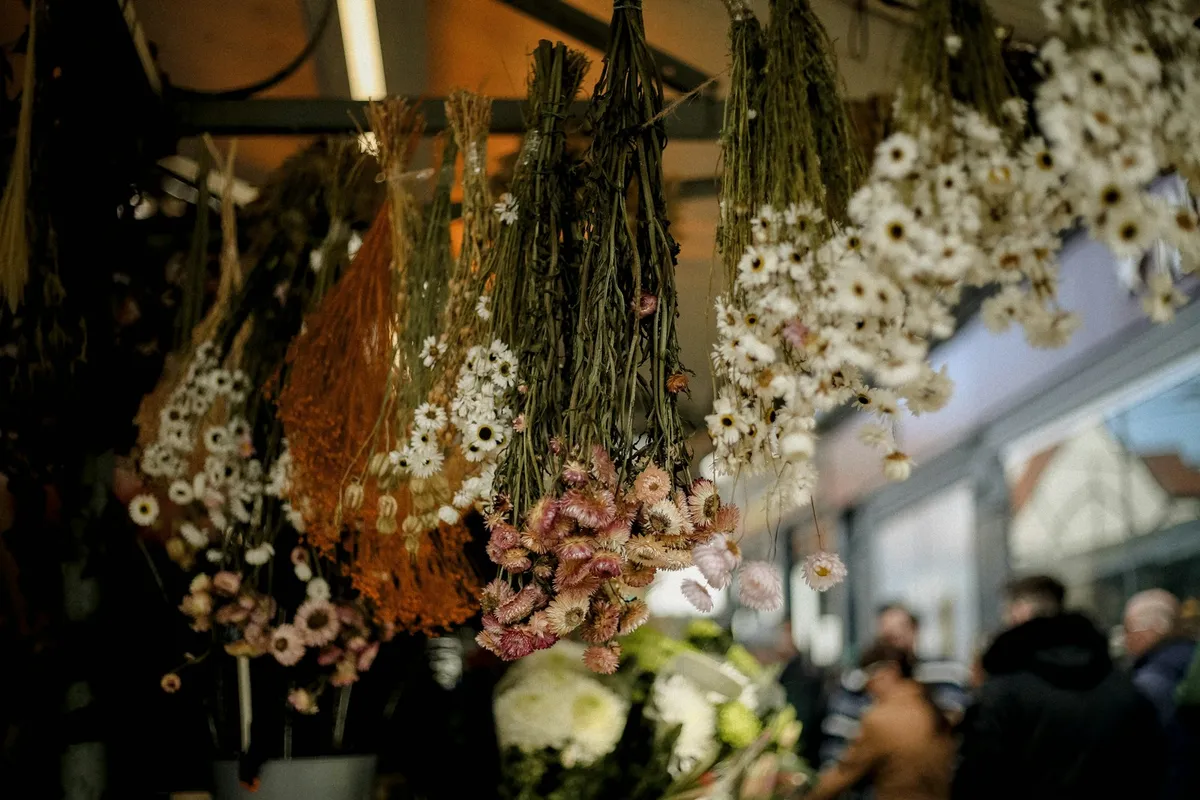
The spare room smells like a hayloft. Forty bunches of statice, strawflower, and larkspur hang head-down from a wooden rack, each one cinched with a rubber band, and when you brush past them they rustle like old paper. The dehumidifier in the corner clicks on, hums for a while, and clicks off again.
Hollis is standing in the middle of it with a clipboard, counting. She's a composite maker, built from patterns common to small dried-floral sellers rather than any one real business, and in July she bought her fresh stems from a grower down the road. In October she'll sell wreaths at a fall market for $95 each. Her cost sheet says each wreath costs $47.90 to make, which feels like a lovely, comfortable margin.
It's actually $65.78. Every dollar of that gap is traceable, and most of it is hiding on this rack. Let's go find it.
The receipt prices fresh stems. The wreath is made of dried ones.
Here's the whole idea in one line: a dried stem costs what you paid for the fresh stem, divided by the share of fresh stems that survive to become part of a wreath.
Dried floral work has a yield problem, the same way jerky loses weight in the dehydrator and coffee loses weight in the roaster. You pay for stems at one stage and sell them at another, and between those stages some of them drop out. Some get culled the day they arrive. Some fade, mold, or shatter on the rack. Some snap in your hands at the bench, because air-dried flowers are, in the words of Clemson Cooperative Extension's drying factsheet (opens in new tab), "extremely stiff once dried."
Hollis's first cost sheet priced every stem at the grower's invoice price. That treats every stem she bought as a stem that ended up in a wreath. The fix is to count at each stage, and it's much more satisfying than it sounds, because the counts tell you exactly which flower is costing you.
Stage one: the stems that never reach the rack
The cull starts before anything gets hung. The extension guidance on picking flowers for drying is blunt, and it doubles as a costing rule. University of Missouri Extension's guide to drying flowers and foliage (opens in new tab) says to "always collect more material than is needed, to allow for damage," and to use only the most perfect forms, because "poor shapes dry as poor shapes." It also warns that damage "becomes only more obvious after drying."
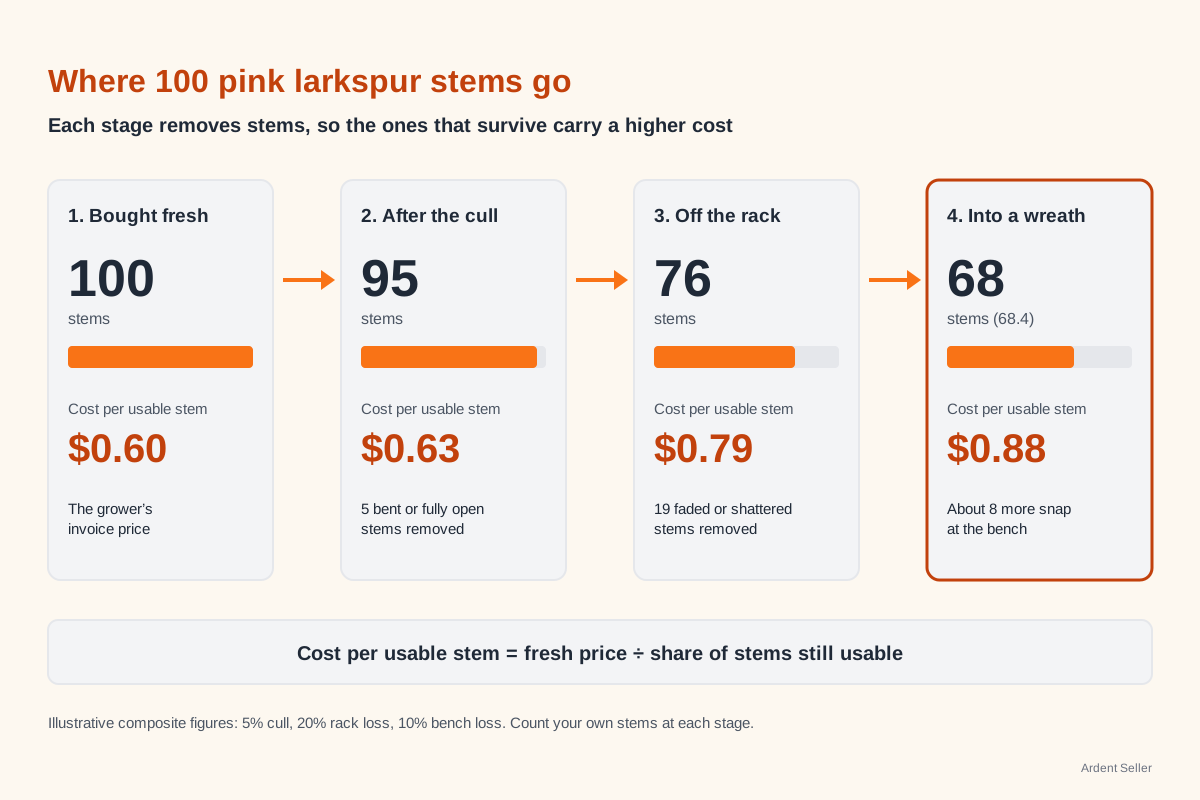
So Hollis culls hard on arrival. Bent stems, bruised heads, and anything already fully open go to the compost. That last one matters, because Missouri Extension notes that flowers continue to open as they air dry and shouldn't be fully open when picked. In her tally, about 5 of every 100 stems are gone before a single rubber band goes on.
This is also where the first hidden labor happens. Missouri Extension says strawflower "should have a wire substituted for stems before drying," so each strawflower head gets wired while it's fresh. Hollis wires about 25 heads to end up with 20 usable ones for a wreath. That means she wires the heads she'll lose later too, and the wire and the minutes still count.
Rule of thumb: any work you do on a fresh stem gets spread across the stems that survive. Wire five heads that later break, and their wire and wiring time belong on the cost of the heads that didn't.
Stage two: the rack takes its cut
Hanging day is the fun part, and it's also where your cost picture starts to come into focus. Missouri Extension says air-dried flowers hung upside down in a warm, dry, dark space normally take two to three weeks, and that the rubber-banded bunches "will pull tighter as the stems shrink during drying." Illinois Extension (opens in new tab) puts it at one to two weeks, depending on the flowers' moisture and the room's temperature. The shorter your drying time, the more loads your rack can turn.
When the bunches come down, Hollis counts again, and this is the count that surprises her. The statice and strawflower come through nicely. The pink larkspur doesn't. Clemson's factsheet explains why: "Blue and yellow flowers retain their colors when air dried, but pink flowers fade." Faded stems that no longer match the wreath design get pulled, along with anything that shattered or picked up mold. For her pink larkspur, only about 76 of every 95 stems that went up make it to the sorting table.
A notebook tally works fine for one batch. Across a whole season, with four flowers, several racks, and stems landing in the compost at three different stages, a record that follows each stage does the division for you. That's where Ardent Seller comes in: it logs culled and broken stems as waste or damage adjustments against the batch they came from.
The rack is also your capacity. Hollis's rack holds 40 bunches, and one wreath's worth of fresh stems fills about 8 bunches, so each rack load dries enough for roughly 5 wreaths. At two to three weeks per load across a 12-week summer buying window, that's 4 to 6 loads, or somewhere between 20 and 30 wreaths. Her October inventory is set by her drying space in July, not by how many people show up to the market.
Stage three: the bench snaps what the rack spared
Assembly is where stiff stems meet a grapevine base and hot glue. Some snap as they're pushed in. Some heads pop off. Grass seed heads shed onto the table. Missouri Extension's advice is to remove weak or brittle stems and wire the flowers instead, which saves the head but adds more wire and more minutes.
Hollis's bench tally is gentler than the rack's: about 5% of statice, and 10% of the strawflower, larkspur, and grass. Multiply the three stages together and you get each flower's usable yield:
- Statice: 95% × 95% × 95% = 85.7% of what she bought ends up in a wreath.
- Strawflower: 95% × 95% × 90% = 81.2%.
- Quaking grass: no cull, then 90% × 90% = 81.0%.
- Pink larkspur: 95% × 80% × 90% = 68.4%.
These percentages are illustrative. Your varieties, your grower, and your spare room's humidity will give you different ones, and that's exactly why they're worth counting. To get your own, count each flower four times: when it arrives, after the cull, when it comes off the rack, and after assembly. Divide the last count by the first, and that's the yield to price with.

The teardown: one wreath, every line annotated
Here's Hollis's wreath costed both ways: the sheet she started with, and the sheet built from her stage counts. The recipe is 12 statice stems, 20 strawflower heads, 8 pink larkspur stems, and 25 quaking grass stems on a 12-inch grapevine base. Fresh prices from the grower are $0.50 a stem for statice, $0.45 for strawflower, $0.60 for larkspur, and $0.12 for grass. Labor is valued at $20 an hour.
| Line | First sheet | Real sheet |
|---|---|---|
| (1) Statice, 12 stems | $6.00 | $7.00 |
| (2) Strawflower, 20 heads | $9.00 | $11.08 |
| (3) Pink larkspur, 8 stems | $4.80 | $7.02 |
| (4) Quaking grass, 25 stems | $3.00 | $3.70 |
| (5) Stem wire for strawflower heads | not listed | $0.98 |
| (6) Grapevine base, glue and paddle wire, ribbon, bag and care card | $5.10 | $5.10 |
| (7) Drying reserve: racks, rubber bands, dehumidifier power | not listed | $0.50 |
| (8) Labor at the bench: assembly and finishing | $20.00 | $23.33 |
| (9) Labor upstream: wiring, bunching, hanging, sorting | not listed | $7.07 |
| Total cost per wreath | $47.90 | $65.78 |
What each line means
- Statice. She buys 14 fresh stems to end up with 12 usable ones. At 85.7% yield, each usable stem costs $0.58, not $0.50.
- Strawflower. About 25 heads bought for 20 used, so each usable head costs $0.55. It's the biggest flower line because the recipe uses so many heads.
- Pink larkspur. The smallest recipe count and the worst yield. About 12 stems bought for 8 used puts each usable stem at $0.88, 46% over the invoice price. This line is the one to watch.
- Quaking grass. Cheap and shatter-prone. About 31 stems bought for 25 used.
- Stem wire. An average of 24.6 heads wired per wreath at 4 cents each, including the ones that later break.
- Base and finishing materials. The base at $3.25, glue sticks and paddle wire at $0.70, a ribbon hanger at $0.60, and a kraft bag with a care card at $0.55. No yield problem here, so both sheets agree.
- Drying reserve. A small per-wreath share of the racks, rubber bands, and dehumidifier electricity. Tiny on its own, but the rack is doing real work, so give it a line.
- Bench labor. Her first sheet counted 60 minutes of assembly. The real sheet adds the 10 minutes of ribbon, tagging, and photographing each wreath, for 70 minutes.
- Upstream labor. 8.2 minutes wiring strawflowers (20 seconds a head), 8 minutes stripping, bunching, and hanging, and 5 minutes taking bunches down and sorting them. That's 21.2 minutes of July work that the October cost sheet never saw.
Put the $95 price next to the real sheet. After a 3% card fee (a round placeholder here; use your processor's actual rate), Hollis keeps $26.37 per wreath on top of her $20 hourly wage, not the $47.10 she was expecting. The $20.73 gap breaks down like this:
- $10.40 of labor her first sheet never counted
- $6.00 of stem loss
- $2.85 of card fee
- $0.98 of stem wire
- $0.50 of drying reserve
The stem loss on its own is $6.00, or 26% more flower cost than the invoice showed. That's the headline of this post. But notice that it didn't travel alone. Once you start counting stems at each stage, the labor spent on those stems shows up too.
What Hollis changes before the market
Hollis doesn't need to feel bad about her first sheet. She has a better one now, and it points at three good moves.
She reprices from the real cost. To keep a 35% margin after the card fee, the price has to cover $65.78 of cost with 62% of the sale price: $65.78 ÷ 0.62 = $106.10. She rounds up to $108, which leaves $38.98 per wreath, or 36%. If you'd like to try your own numbers, the Product Pricing Calculator runs the same cost-plus-margin math in your browser.
She changes the recipe, not just the price. Clemson's note that blue and yellow hold their color is a design lever as much as a botany fact. If blue larkspur comes off her rack the way her statice does, with about 5% loss instead of 20%, the larkspur yield rises to 81.2% and the swap saves $1.11 per wreath. It isn't dramatic, but it's free, and across 25 wreaths it adds up to real money.
She gives the losses somewhere to go. Faded larkspur and loose grass heads get bundled into small "seconds" bunches for a basket at the front of the booth. She tracks them as their own product with their own sales, rather than subtracting them from the wreath cost. Counting that income in two places would make the wreath look cheaper than it really is.
Keeping the stage counts without a clipboard
The counting method above works on paper for one batch. It gets harder to keep up in November, when you're reordering for holiday wreaths and trying to remember whether the larkspur yield was 68% or 78%.
In Ardent Seller, the tally becomes part of the records you already keep:
- Fresh stems come in as a purchase, at the per-stem cost from the grower's invoice.
- The cull and the bench breakage get logged as waste or damage adjustments, so the losses have dates, quantities, and a reason attached.
- Drying can run as a production run that turns fresh stems into a dried-stem subassembly, so each dried stem carries the cost of the ones that didn't make it.
- The wreath gets a recipe built from dried stems, the base, finishing materials, and labor. Its cost updates automatically when the grower raises the price of statice next summer.
The payoff is the moment Hollis spent a whole afternoon working toward: seeing, per wreath, what it really costs to make, and knowing which flower is responsible.
Related reading
- Jerky Costing After the Shrink: The same yield logic applied by weight instead of by stem, for anyone who wants to see how beef jerky cost per bag is worked out once three pounds of meat become one.
- Wedding Florist Stem Math: If you also take fresh work, this is how to price wedding flowers when the recipe on the quote and the stems on the table don't match.
- The True Hourly Wage of a Maker Business: The $20 an hour in Hollis's teardown is a placeholder. This is how to find the true hourly wage for makers that your own prices are actually paying.
- Farm Crop Costs & Profit Per Bed: For growers drying their own harvest, how to work out profit per bed in a market garden so home-grown stems stop being priced at zero.
Free resources
A few free tools that pair well with this post:
- Product Pricing Calculator (Live): Put in your yield-adjusted wreath cost and a target margin, and see the price your market table needs before you print the tags.
- Maker Hourly-Rate Pricing Calculator: Replace the placeholder $20 with a labor rate built from your own hours, so the 91-odd minutes behind each wreath get valued properly.
This article is provided for educational purposes only and does not constitute financial, tax, or business advice. Cost structures, yield percentages, pricing examples, and margin figures are illustrative composites and will vary by your specific flowers, suppliers, drying conditions, and circumstances. Consult a qualified accountant or small-business advisor before making financial decisions based on this content.