The cooler smells like eucalyptus and yesterday's lisianthus. It's a quarter past five on a Saturday morning, and the buckets along the back wall are crowded — peonies in three colors, garden roses too big to ignore, ranunculus that opened farther than anyone wanted overnight. The cement floor is wet in the corner where a bucket tipped on Thursday and nobody bothered to dry it properly. The cooler light is too white and too cold. Outside the workshop door, a van is idling. The ceremony starts at four. Setup is at one. Drive time is forty minutes.
This is the moment a florist is most aware of stems. Not when the quote went out three months ago. Not when the deposit cleared. Now — when the peonies are open too far, the eucalyptus came in shorter than the supplier promised, and the bridal bouquet recipe says forty-five stems but the pile on the table already looks like more.
The math you did three months ago is the math you're stuck with. If the per-stem margin was wrong then, it's wrong now.
The single number every florist undercosts
Most floral pricing advice tells you to triple your wholesale. Some of it tells you to use a 3.5x or 4x multiplier on flowers and a 1.5x multiplier on labor. None of it tells you what to do when the wholesale price moves $0.40 between when you quoted the wedding in February and when you ordered the stems in May. None of it tells you what a stem actually means once you start counting the eucalyptus that disappears into a centerpiece and the three improv roses you added because the couple sent a Pinterest photo on Friday night.
The number florists undercost is not the flower. It's the recipe. It's the gap between "fifty stems for the bridal bouquet" on the quote and the actual count on the table the morning of. The gap is usually small — three or four stems per arrangement. Across a forty-arrangement wedding, that gap is one hundred and sixty stems. At an average wholesale of $1.80 per stem, it's almost three hundred dollars of margin that quietly walked out of the cooler and into someone else's day.
You are not bad at pricing. You are running a business where the unit of work is a recipe, and the unit of cost is a stem, and the gap between those two is where the margin lives. Most floral pricing advice skips over it. The three florists below do not.
What follows is three composite scenarios — assembled from patterns common across small-batch wedding florists, not based on any specific business. The math is real. The mistakes are real. The fix in each case is small and worth doing this week.
Vignette one: Maya, the Saturday-market florist
Maya runs a one-table farmers market booth in a county-seat town of twenty thousand people. She started the business four years ago after the local floral shop closed, and the booth now does $620 to $940 on a good Saturday and around $48,000 a year. She takes one wedding a month between April and October — small ones, usually between twelve and twenty arrangements, and she charges between $2,400 and $3,800 depending on the count.
Maya's bridal bouquet recipe says thirty-five stems. Five focal blooms (garden roses or peonies), twelve secondary blooms (spray roses, ranunculus, lisianthus), eight filler stems (waxflower or astilbe), and ten greenery stems — silver dollar eucalyptus, mostly.
The recipe is correct. The order is correct. The booking sheet is correct. The thing Maya undercounts is the eucalyptus.
Her recipe says ten stems of silver dollar eucalyptus per bouquet. The bouquet she actually makes uses fourteen — three of them buried in the bind, one trimmed almost to the floor as she shapes the back, and one she adds at the last second because the asymmetric trail looks thin. At her wholesale of $0.90 per stem, four extra stems is $3.60 per bouquet. Across a wedding with one bridal bouquet, four bridesmaid bouquets, and one toss bouquet, that's $21.60 of unpriced eucalyptus per event.
Maya does between eight and twelve weddings a year. The unpriced eucalyptus alone is between $173 and $259 annually — small enough to not notice, big enough to be the difference between covering her quarterly insurance premium and writing a personal check.
There is a second, larger leak. When Maya orders stems, she orders for the recipe. She does not order a buffer. Roughly one in fifteen stems arrives bruised, broken, or wilted past use. On a 350-stem order for a typical wedding, that's twenty-three lost stems. She backfills from the market booth's own inventory — peonies that were going to anchor Saturday's centerpieces, ranunculus from the wedding overstock she'd planned to sell at the market the following week. The cost shows up nowhere on the wedding's quote. It shows up as a slower market Saturday two weeks later when the cooler is half-empty.
What Maya should do this week. Open the last three wedding orders. Add up the per-event greenery stem count from the actual final arrangements — count what you used, not what the recipe said. Compare to the recipe. The delta is your unpriced greenery. Either tighten the recipe to match reality (likeliest case) or add the delta back to the quote — that raises the price by less than four percent on a typical wedding. And start every wholesale order with a 12% over-order buffer baked in. The buffer is not a cost; it's the price of not raiding the market booth.
If Maya only does one thing this week, it's the greenery delta. The buffer fix takes a week to integrate. The greenery delta takes thirty minutes.
Vignette two: Priya, the studio wedding florist
Priya runs a studio out of a converted carriage house in a mid-market metro. Seven years in, she books eighteen to twenty-two weddings a year, all between $5,500 and $18,000. Her summer book is full by January. She has a part-time designer who comes in Friday and Saturday during peak season, and she pays a stem-prep person $22 an hour for the day-before processing.
Priya's recipes are tight. She uses a proper recipe library — each arrangement type and size has a documented stem count by tier, and her wholesale orders go in five business days before the wedding with a 12% buffer. The recipe-to-order math is right.
Her costing problem is somewhere else. It's in how she translates "wedding flowers" into a quote.
When Priya quotes a wedding, she quotes the arrangements. Fifteen centerpieces at $185 each. Bridal bouquet at $295. Five bridesmaid bouquets at $110 each. A ceremony arch at $1,400. Boutonnieres and corsages at $35 and $55. The total comes to roughly $6,800 before delivery and setup.
What the quote does not name is the stems she pulls for the seven things wedding couples ask for between contract signing and walk-through that aren't in the contract. The flower-girl crown the couple decides they want when they see one on Instagram in April. The two extra pew markers when the venue mentions a wider aisle. The bud vase on the welcome table. The four cake-flower stems the baker sends a text about on Thursday. The corsage for the mother-in-law that wasn't on the original family list. The "could you bring a few loose stems for the photo wall" ask that lands two days out.
Each of these is small. Five to fifteen stems at most. None of them gets back-charged. Priya covers them from buffer overage and from the studio's working inventory, because saying no to a small ask three days before the wedding is not what wins her the next referral.
Across an average twenty-arrangement wedding, the unbilled additions consume between sixty and ninety stems. At her blended wholesale of $2.10 per stem, that's $126 to $189 of unpriced flowers per wedding. Twenty weddings a year, the floor is $2,520. The ceiling is $3,780. That's the cost of one good vacation, or the gap between hiring the part-time designer for an extra Saturday a month and not.
The fix is not "stop saying yes." Priya already knows she can't stop saying yes. The fix is to name the buffer in the contract.
A change-order clause — three to five sentences in the wedding agreement that says "small additions under $150 in flower cost are included in the booking; additions above that level are billed at the same per-stem rate as the original quote" — does two things. It makes the small additions feel intentional rather than free. And it gives Priya a real number to fall back on when the asks get bigger, because most of the asks land somewhere right at the threshold.
For the additions that do exceed the threshold (the chuppah upgrade, the second arch the rabbi requested, the suddenly-doubled cocktail-table count), the change order itself becomes a one-page add. Priya runs the stem-count math from her recipe library or the Wedding Floral Stem Counter & Quote Builder, applies her standard markup, sends a one-paragraph email, and adds it to the final invoice. She is not negotiating in the moment. She is naming what was always implied.
What Priya should do this week. Pull her last five wedding contracts. Count the additions on each one between deposit and event. Multiply the average count by her blended wholesale, then by her markup, then by 20 (her annual wedding count). The result is the annual cost of the silent change order she has been writing herself. Then add the three-sentence clause to her standard contract. The next twenty weddings will book it.
If she only does one thing this week, it's rewrite the contract clause. The math she can run on a slow Monday morning. The clause has to land before the next contract goes out.
Vignette three: David, the corporate florist
David runs a commercial floral operation in a metro of about three million. Twelve weekly office accounts (corporate lobbies, law-firm conference rooms, hospital atria), eight to twelve quarterly corporate event installations, and a handful of high-end private events. He has three full-time designers, a delivery driver who is on payroll, and a salesperson who handles event sales. The business does between $780,000 and $920,000 a year.
David's costing problem is the opposite of Maya's and Priya's. He is not undercosting individual stems. He has the staff and the systems for that. He is undercosting the design improvisation that happens between when the contract gets signed and when the install goes in.
A typical corporate event for David runs $18,000 to $42,000 in floral. The contract names twenty to forty arrangements by type, size, and location. The recipe library is built. The wholesale order goes in eight days out. The buffer is 15%, the working-florist standard for installations because installation stem loss is higher than arrangement stem loss.
The improvisation is what happens during the install itself. A lead designer walks into the lobby on a Friday afternoon for a Saturday-evening event, sees the actual scale of the space versus the floor plan, decides the arch needs three additional garlands to read from across the room, and adds them. Each additional garland is forty to sixty stems of mixed greenery and accent blooms. At a blended $2.40 per installation stem, each unplanned garland is $96 to $144 in unpriced flowers.
The unplanned additions on a typical event range from $150 to $400 in flower cost. The labor for adding them is also unpriced — usually two designers for ninety minutes — which David has internalized as part of "the install," but which is $150 to $220 in labor depending on the designer.
Across forty events a year (eight to twelve large plus the weekly-account event-extensions), David is absorbing between $12,000 and $24,800 a year in improvised flowers and labor. That's roughly the salary differential between hiring his next lead designer at a junior rate versus a senior rate.
The fix is structural. David doesn't need a clause in the contract — his contracts already specify installations are billed at completion. He needs a pre-priced add-list. A one-page menu of common install-day additions (extra garland yard, extra installation stem set, extra hanging mass, extra accent vessel) with stem counts, wholesale, markup, and a per-unit price. The lead designer has it on the iPad in the van. When they decide on Friday afternoon that the arch needs three more garlands, they tap three on the menu, the price flows automatically into the event ledger, and the client gets the addition on the final invoice with the same transparency as the original contract.
There is a secondary fix that's bigger but slower. David's recipe library, like Priya's, has stem counts per arrangement. It does not have stem counts per cubic foot of installation. When his sales team quotes a 300-square-foot ceremony arch, they price it from the recipe library by approximating "what would 300 square feet of arch be in arrangement-equivalents?" The approximation is consistently low because human estimation of three-dimensional volume favors the low side. A formal stem-density table — focal blooms per linear foot of installation, accent stems per cubic foot of mass — eliminates the under-quote at the source.
What David should do this week. Build the install-day add-list. Five line items, two hours to populate, one hour to train the leads on the iPad workflow. The stem-density table is a Q3 project, but the add-list pays for itself on the next install.
If David only does one thing this week, it's the add-list. The stem-density work can wait until the slower part of the calendar.
The pattern across all three
What the three florists have in common is not the size of their business or the kind of event they run. It's the shape of the leak. In every case, the gap between the recipe and the actual stem count is smaller than the florist would have guessed and bigger than the books are catching.
- For Maya, the leak is greenery — soft, cheap, easy to pull more of, easy to forget to count.
- For Priya, the leak is the post-contract small ask — the boutonniere, the cake-flower, the welcome-table bud vase that wasn't priced but couldn't be declined.
- For David, the leak is the install-day improvisation — the extra garland, the unplanned hanging mass, the seventh centerpiece that "would really make the room."
In every case, the fix is small, structural, and unsexy. Tighten the recipe. Name the change-order threshold. Build the add-list. None of these are pricing reinventions. They are recipes for catching what was already happening, naming it, and getting paid for it.
Two things almost every florist gets wrong about stem counts.
The first is treating "the recipe" as if it described the final arrangement. The recipe describes the starting point. The final arrangement is the recipe plus the room, plus the couple, plus the way the eucalyptus came in, plus the design instinct that made one more stem go in. That delta has to be priced somewhere — either in the recipe itself (tighten it) or in the contract (name it).
The second is treating the over-order buffer as if it were a cost. It isn't. The buffer is the price of not raiding next week's market booth and not pulling from the studio's working inventory. A 10-15% buffer on the wholesale order is the floral industry's standard for exactly this reason. The buffer that doesn't get pulled is not waste — it's the stems you sell to walk-in customers, use for the next arrangement, or build into the next event.
A worked example, end to end
A small intimate wedding, twenty-two pieces:
- one bridal bouquet (30 stems)
- three bridesmaid bouquets (15 stems each)
- two parent bouquets (11 stems each)
- four boutonnieres (6 stems each)
- four corsages (11 stems each)
- one head-table centerpiece (33 stems)
- three guest-table centerpieces (18 stems each)
- one cake-flower set (14 stems)
- two ceremony aisle pieces (25 stems each)
- one welcome-table arrangement (18 stems)
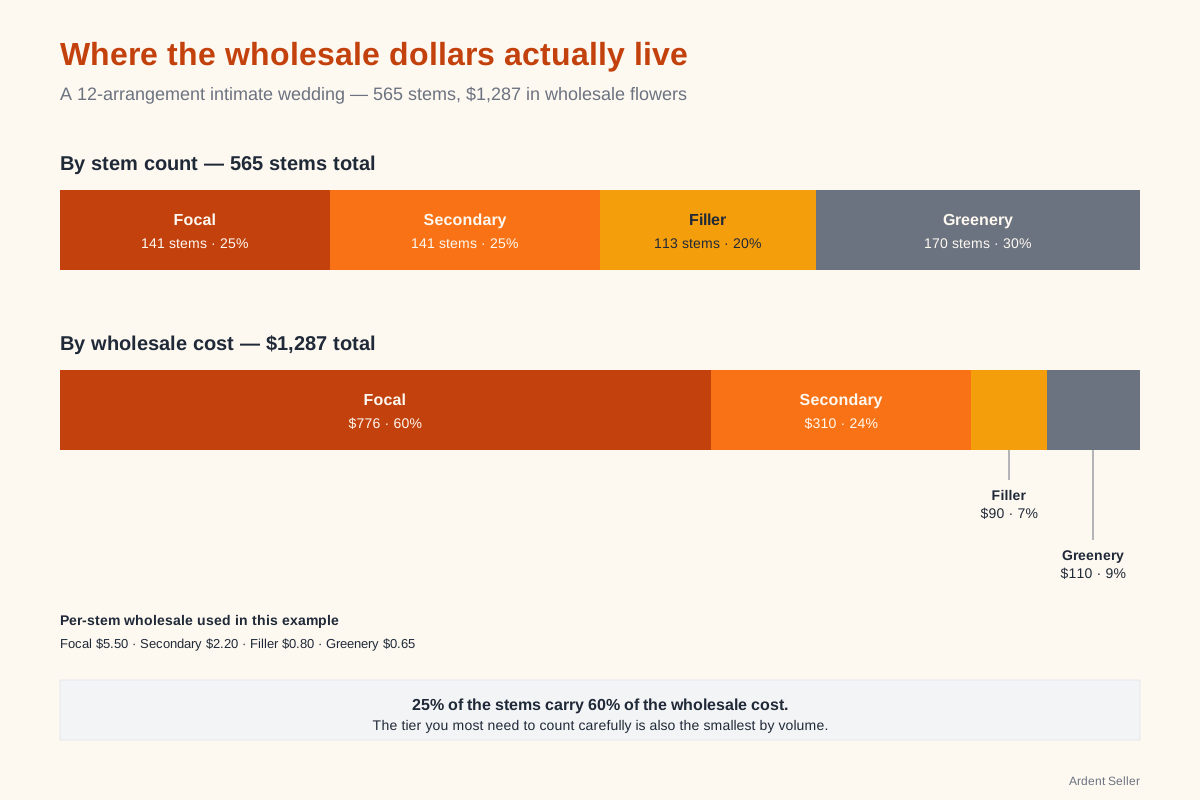
Composition tier across the whole event: roughly 28% focal, 27% secondary, 18% filler, 26% greenery.
Walked through the stem counter, the total comes to 334 stems before buffer, 367 stems with the standard 10% buffer, and 384 stems with the 15% buffer many florists use for installations and over-eager Pinterest brides.
With per-tier wholesale at $5.50 (focal), $2.20 (secondary), $0.80 (filler), and $0.65 (greenery), the wholesale cost lands at roughly $823 before buffer and $906 with the 10% buffer — call it $900 in round numbers. The interesting math is not the total. It's the tier breakdown: focal blooms are 28% of the stems but 63% of the wholesale cost, while greenery is 26% of the stems but 7% of it. The tier you most need to count carefully is also the one that moves the invoice.
At a 3.5x floral multiplier on the $1,400 wholesale, the floral-only quote is $4,900. Add design labor (15 hours at $55) and delivery and setup (5 hours at $45 plus a $120 vehicle fee), and the wedding quotes at roughly $6,070 before any of the change-order math.
If the math feels small, look at the wedding count. Twenty weddings a year at this size is roughly $121,000 in floral revenue. The change-order clause Priya wrote into her contract captures another $2,500 to $3,800 of unbilled work that was already happening — bringing the total closer to $124,000 to $125,000 for the same work. That difference is not a price hike. It's a recipe.
Closing the gap
The recipe is the unit of work in floral design. Everything downstream of it — the wholesale order, the buffer, the change-order clause, the install-day add-list — is built on whether the recipe matches the arrangement that actually leaves the cooler. When the recipe is loose, every system downstream of it is loose too. When the recipe is tight, the rest gets to be loose with you, because the math has a floor.
Most florists do not have a stem-tracking problem. They have a recipe-honesty problem. Walking through three recent weddings with a real stem counter, comparing what came out to what was quoted, then rewriting one piece of the upstream system — the recipe, the contract, the install-day menu — is enough to close the gap.
If you only do one thing this week: open the Wedding Floral Stem Counter & Quote Builder, walk through your most recent wedding, and compare the total against the contract you wrote. The delta is your homework. It's small, it's specific, and it's the cheapest pricing fix you'll make all year.
When you're ready to move beyond stem counts to per-event P&Ls — recipes that update with current wholesale, a wedding ledger that tracks deposit through final payment, design labor rolled in, and a true margin number per event — that's what Ardent Seller was built for. The stem counter gets you to a quote. Ardent Seller turns every wedding into a tracked event with a real number at the end. See the features or pick a plan.
Related reading
- Dried Flower Wreath Pricing — If you also dry stems for wreaths, the buffer stops being a wedding-day cushion and becomes a yield loss: how dried flower wreath pricing accounts for the stems culled, faded on the rack, and snapped at the bench.
- Recipe Costing 101 — The foundational five-cost framework Maya's, Priya's, and David's recipes are built on, walked through line by line.
- Margin vs. Markup: The Pricing Math Most Sellers Get Wrong — The 3.5x multiplier most florists use is a markup, not a margin; here's the math that catches the difference before it costs you a wedding's worth of profit.
- Wholesale Pricing for Handmade Products — When David's commercial accounts pay net-30 and ask for tier discounts, the math behind the wholesale price shifts; this walks through what changes and what doesn't.
Free resources
Free companion downloads if you want to put any of this into practice:
- Wedding Floral Stem Counter & Quote Builder — Walk every arrangement on your next wedding by tier and size, and get an estimated wholesale flower cost out the other side. Built specifically for the math in this post.
- Recipe Scaling & Batch Calculator — Resize your existing arrangement recipes when the wedding count moves from 12 to 40 and the math still has to work.
- Wholesale Line Sheet Template — For florists serving repeat corporate or retail accounts (David's situation), a line sheet is the document that names your tier pricing without forcing a custom quote every Friday.
This article is provided for educational purposes only and does not constitute financial, tax, or business advice. Cost structures, pricing examples, stem counts, and margin figures are illustrative composites and will vary by your specific suppliers, market, and circumstances. Consult a qualified accountant or small-business advisor before making financial decisions based on this content.